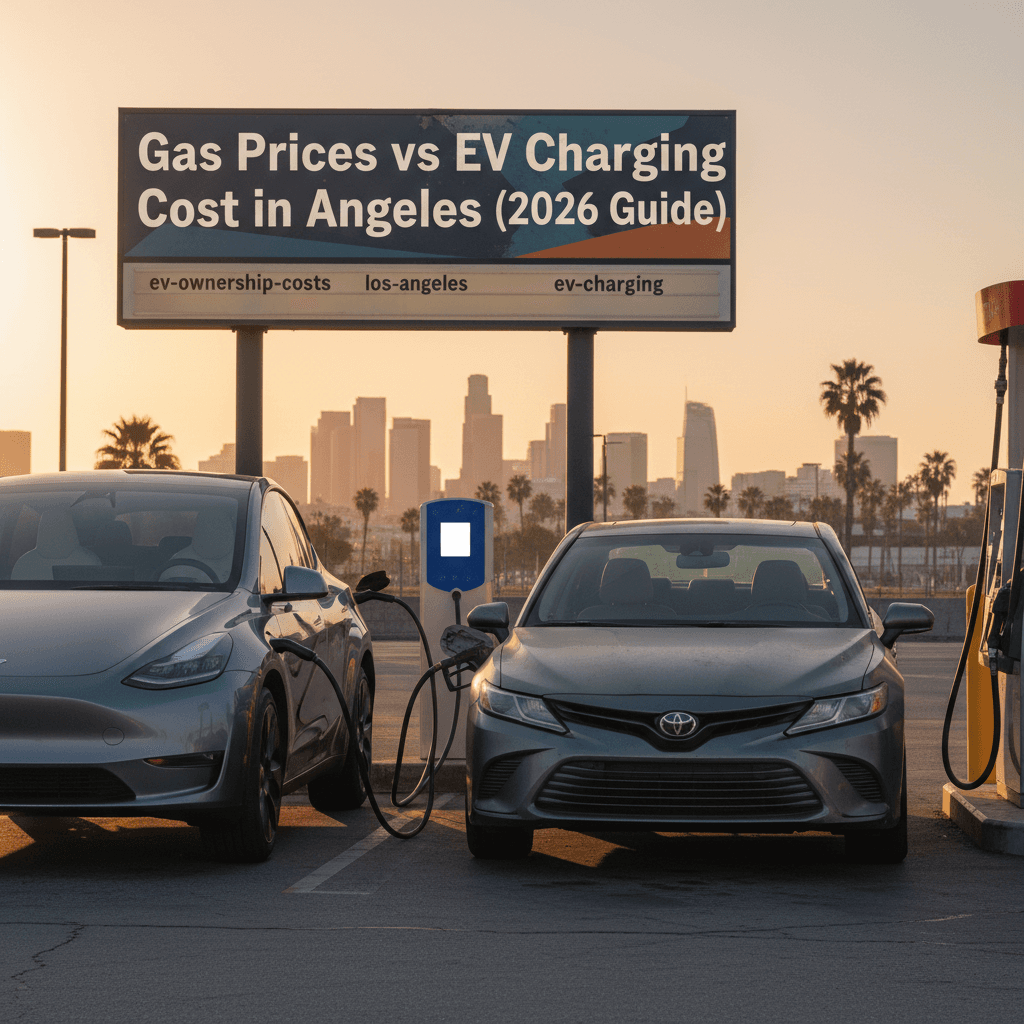
If you live in Los Angeles in 2026, you’re feeling energy prices from both sides. Regular gas is hovering well above $5 a gallon in much of LA, while electricity rates are among the highest in the country. That makes the “gas prices vs EV charging cost Los Angeles 2026” question more complicated, and more important, than it was a few years ago.
Context for April 2026
Why 2026 gas and charging costs feel so different
Two big forces are squeezing Los Angeles drivers in 2026. On the gas side, the war in Iran has pushed national pump prices back above $4, and California is once again near the top of the charts, with LA commonly above $5 per gallon. On the electricity side, California’s long‑running transition to clean energy, wildfire mitigation costs, and heavy grid investment have all driven rates well above the national average.
- Los Angeles drivers are often paying $5.40–$6.00+ per gallon for regular gas in spring 2026, depending on neighborhood and station.
- Residential electricity for LA households typically runs around $0.28–$0.32 per kWh on average, with special EV and time‑of‑use plans offering cheaper off‑peak hours.
- Public DC fast charging and some Level 2 charging in LA often cost $0.35–$0.65 per kWh, with demand‑based “surge” pricing at busy times.
A word of caution on “average” prices
Snapshot: 2026 gas and electricity prices in Los Angeles
Los Angeles 2026 energy cost snapshot (typical ranges)
Those building blocks, price per gallon, price per kWh, and how far your car goes on each, let us translate everything into cost per mile, which is what really matters when you’re choosing between gas and electric.
Cost per mile: gas vs EV in Los Angeles
To compare “gas prices vs EV charging cost Los Angeles 2026” fairly, you need a common yardstick. We’ll use cost per mile for a typical LA‑style mix of city streets and freeways. Below are reasonable assumptions for mainstream vehicles, not outliers.
Typical 2026 cost per mile in Los Angeles
Illustrative examples using realistic 2026 LA prices and efficiency for common vehicle types.
| Vehicle type | Fuel/energy price assumption | Efficiency assumption | Energy cost per mile |
|---|---|---|---|
| Gas sedan (non‑hybrid) | $5.50/gal gas | 28 mpg mixed | ≈ $0.20/mi |
| Gas crossover/SUV | $5.50/gal gas | 22 mpg mixed | ≈ $0.25/mi |
| Hybrid sedan | $5.50/gal gas | 50 mpg mixed | ≈ $0.11/mi |
| EV, home off‑peak charging | $0.23/kWh off‑peak TOU | 3.5 mi/kWh | ≈ $0.07/mi |
| EV, standard home rate | $0.29/kWh blended | 3.5 mi/kWh | ≈ $0.08–0.09/mi |
| EV, public DC fast charge | $0.50/kWh | 3.0 mi/kWh (less efficient at high speed) | ≈ $0.17/mi |
| EV, high‑priced fast charge | $0.64/kWh | 3.0 mi/kWh | ≈ $0.21/mi |
Your actual numbers will vary, but this table shows how gas and electricity prices translate into everyday driving costs.
Rule of thumb for LA in 2026
What you’ll really pay to charge at home in LA
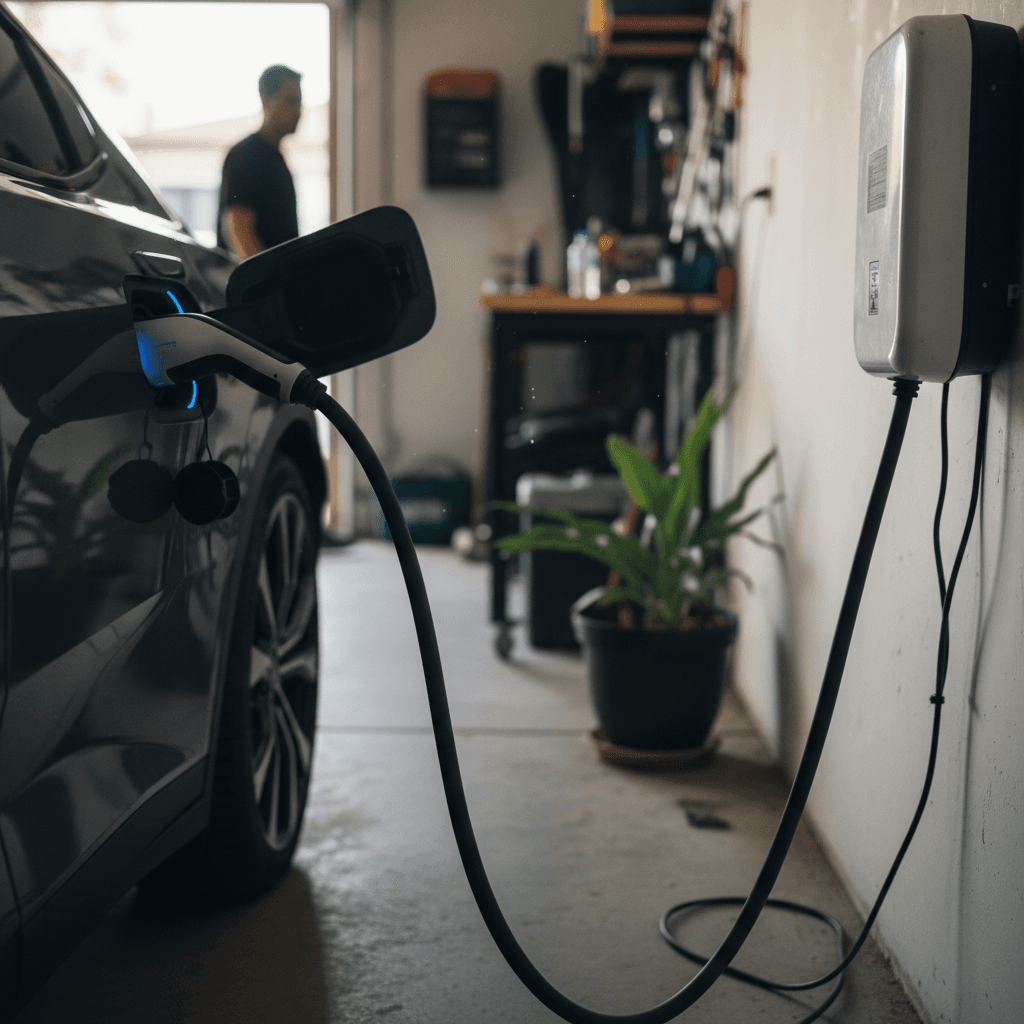
For most LA‑area EV owners, home charging is where the real savings come from. You avoid station markups, demand charges, and parking premiums, and you can take advantage of your utility’s cheapest hours.
Home charging cost building blocks in Los Angeles
Three questions determine what you’ll pay per kWh at home.
1. Who’s your utility?
If you live in the City of Los Angeles, you’re likely on LADWP. Many surrounding communities use SCE or Clean Power Alliance. Each offers different EV and time‑of‑use (TOU) plans.
2. When do you charge?
TOU plans charge more from late afternoon into the evening and less overnight. For many LA drivers, shifting charging to roughly 9 p.m. to 6 a.m. can drop the effective rate by several cents per kWh.
3. What outlet or charger?
A dedicated Level 2 charger on a 240V circuit doesn’t usually change your rate, but it lets you add 25–35 miles of range per hour. That makes it practical to concentrate charging in the lowest‑cost hours.
Typical home charging prices in LA
Example: 1,000 miles/month, mostly home charging
Let’s say your EV averages 3.5 mi/kWh and you drive 1,000 miles per month in LA.
- Energy needed ≈ 285 kWh (1,000 ÷ 3.5).
- At $0.23/kWh off‑peak: 285 × $0.23 ≈ $66/month in energy.
- At $0.29/kWh blended: ≈ $83/month.
That’s your “fuel” bill if nearly all charging happens at home.
Same miles in a gas car
Now compare a 28‑mpg gas sedan driving the same 1,000 miles at $5.50/gal:
- Gallons needed ≈ 36 gal (1,000 ÷ 28).
- 36 × $5.50 ≈ $198/month.
Even at LA’s high electricity rates, home‑charged EV fuel cost can be about one‑third of a typical gas sedan’s fuel bill.
Home charging installation isn’t free
Public EV charging cost in Los Angeles
Public charging in Los Angeles is where the math gets trickier. Station operators pay the same high wholesale power costs, plus demand charges, hardware, installation, site rent, and maintenance. The result: per‑kWh pricing that can rival, or in some situations exceed, the cost per mile of driving a high‑efficiency hybrid on gas.
Typical 2025–26 public charging prices in greater LA
Approximate ranges you’ll see when charging in public around Los Angeles.
| Charging type | Typical LA 2025–26 price | How it’s billed | Notes |
|---|---|---|---|
| Level 2 public AC | $0.30–$0.45/kWh | Per kWh, sometimes plus a session or parking fee | Good for topping up while parked for several hours. |
| DC fast charging (non‑member) | $0.45–$0.65/kWh | Per kWh, sometimes rising with demand | Common on major networks along freeways and in busy retail areas. |
| DC fast charging (member) | ~$0.40–$0.55/kWh | Per kWh with membership discount | Memberships can reduce cost modestly if you fast‑charge often. |
| Time‑based or session fees | $0.10–$0.30/min or $1–$5/session | Per minute or flat fee | Watch for idle fees if you stay plugged in after charging completes. |
Actual prices vary by network, location, time of day, and membership status.
When public charging can be “more expensive than gas”
That doesn’t mean public charging is always a bad deal. It does mean that if you can’t install home charging and you’ll depend heavily on high‑priced DC fast chargers, your cost advantage over gas shrinks dramatically. For some LA drivers in apartments, a hybrid can be cheaper to run than an EV that lives on pricey public plugs.
EV vs hybrid vs gas: three LA commuter examples
Let’s ground this in real‑world Los Angeles scenarios. We’ll use a 1,200‑mile‑per‑month driver, a blend of weekday commuting and weekend errands, which is common in the region.
Three 2026 LA driver profiles
Same miles, different drivetrains and charging habits.
1. Gas crossover in the Valley
Vehicle: 22‑mpg crossover
Miles/month: 1,200
Gas price: $5.50/gal
Monthly fuel: 1,200 ÷ 22 ≈ 55 gal
55 × $5.50 ≈ $303/mo
2. Hybrid sedan in West LA
Vehicle: 50‑mpg hybrid
Miles/month: 1,200
Gas price: $5.50/gal
Monthly fuel: 1,200 ÷ 50 = 24 gal
24 × $5.50 ≈ $132/mo
3. Used EV in the city
Vehicle: EV averaging 3.5 mi/kWh
Miles/month: 1,200
Charging mix: 80% home at $0.23/kWh off‑peak, 20% public at $0.50/kWh
Energy: 1,200 ÷ 3.5 ≈ 343 kWh
Home (274 kWh × $0.23) ≈ $63
Public (69 kWh × $0.50) ≈ $35
Total ≈ $98/mo
How the three drivers stack up
Beyond fuel: insurance, maintenance and battery health
Fuel or electricity is just one slice of ownership cost. When you compare a gas car to a used EV in LA, keep three other items in mind: insurance, maintenance/repairs, and long‑term battery health.
- Insurance: In the LA market, some EVs can cost more to insure than comparable gas cars due to higher repair costs, while others are similar. It varies widely by model, trim, and your driving record.
- Maintenance and repairs: EVs eliminate oil changes, smog checks, and many common engine‑related repairs. Over a several‑year span, that often offsets a higher purchase price, especially against complex turbocharged gas engines.
- Battery health: A degraded EV battery cuts range and can affect resale value. This is where buying from a seller that can document battery health, like a Recharged Score Report on a used EV, becomes particularly important in LA’s hot‑and‑cold stop‑and‑go climate.
How Recharged can help with the “hidden” costs
When an EV saves you money in LA, and when it doesn’t
Situations where an EV usually wins on cost
- You can install a Level 2 charger at home or have reliable workplace charging at a low kWh rate.
- You drive at least 800–1,000 miles per month, so fuel savings have time to add up.
- You’d otherwise drive a less‑efficient vehicle (compact SUV, older sedan) getting 20–28 mpg.
- You choose an EV with solid efficiency (roughly 3+ mi/kWh in LA traffic).
- You plan to keep the car long enough that lower fuel and maintenance costs offset the higher purchase price.
Situations where a hybrid or gas car may be smarter
- You rent or live in a multi‑unit building with no reliable home charging options and must rely on public fast charging.
- Your driving is light (under 600–700 miles per month) and you already own a paid‑off, efficient car.
- You do frequent long‑distance trips where you’ll be paying premium DC fast‑charge prices most of the time.
- You can buy a very efficient hybrid at a much lower purchase price than any EV you’re considering.
Think total cost of ownership, not just the pump
How to estimate your own EV charging cost in LA
You don’t need a finance degree to compare gas prices vs EV charging cost in Los Angeles. A few assumptions and a calculator will get you very close. Here’s a simple framework you can use for any EV you’re considering, new or used.
5‑step checklist: build your personal LA EV cost estimate
1. Estimate your monthly miles
Look at your odometer now and one month from now, or use a maps app’s driving history. Many LA commuters fall between 800 and 1,200 miles per month, but your use might be very different.
2. Find your EV’s real‑world efficiency
Search for owner‑reported efficiency for your target EV, look for figures in mi/kWh for city or mixed driving. For many compact crossovers and sedans in LA, 3.0–3.7 mi/kWh is realistic.
3. Check your utility and EV rate options
Visit your utility’s website and look for EV or time‑of‑use plans. Note the off‑peak and peak rates. If you can reliably charge overnight, use the off‑peak rate in your calculation; otherwise use a blended estimate.
4. Calculate home charging cost
Divide your monthly miles by mi/kWh to get monthly kWh. Multiply by your home rate per kWh. Example: 1,000 miles ÷ 3.5 mi/kWh ≈ 285 kWh; 285 × $0.23 = $65.55/month.
5. Add your expected public charging mix
If you’ll need public charging (say, 20% of energy), multiply that share of kWh by a realistic public rate (e.g., $0.50/kWh) and add it. Compare the final monthly number to your current gas spending at LA prices.
Need help running the numbers?
Ready to find your next EV?
Browse VehiclesFrequently asked questions: gas vs EV costs in LA (2026)
LA gas vs EV charging cost FAQ
Bottom line: should LA drivers go electric in 2026?
In 2026 Los Angeles, the math is more nuanced than the simple “EVs are always cheaper than gas” line you may have heard a few years ago. Gas prices are punishing, but electricity isn’t cheap either, and public fast charging can erase much of an EV’s advantage if that’s your primary energy source.
That said, if you can reliably charge at home or at work at a fair kWh rate, and you drive a typical LA mileage, an EV still tends to deliver meaningful savings per mile alongside quieter, smoother driving and lower routine maintenance. A modern hybrid remains a strong value play for apartment dwellers who can’t install chargers and would otherwise live on high‑priced public plugs.
If you’re weighing a used EV against your current gas car or hybrid, it’s worth running your own numbers, and getting independent reassurance about battery health and fair pricing. That’s exactly what Recharged was built to do: pair transparent battery diagnostics with expert, EV‑savvy guidance so that your next car doesn’t just feel good to drive in LA traffic, it also makes sense in your monthly budget.