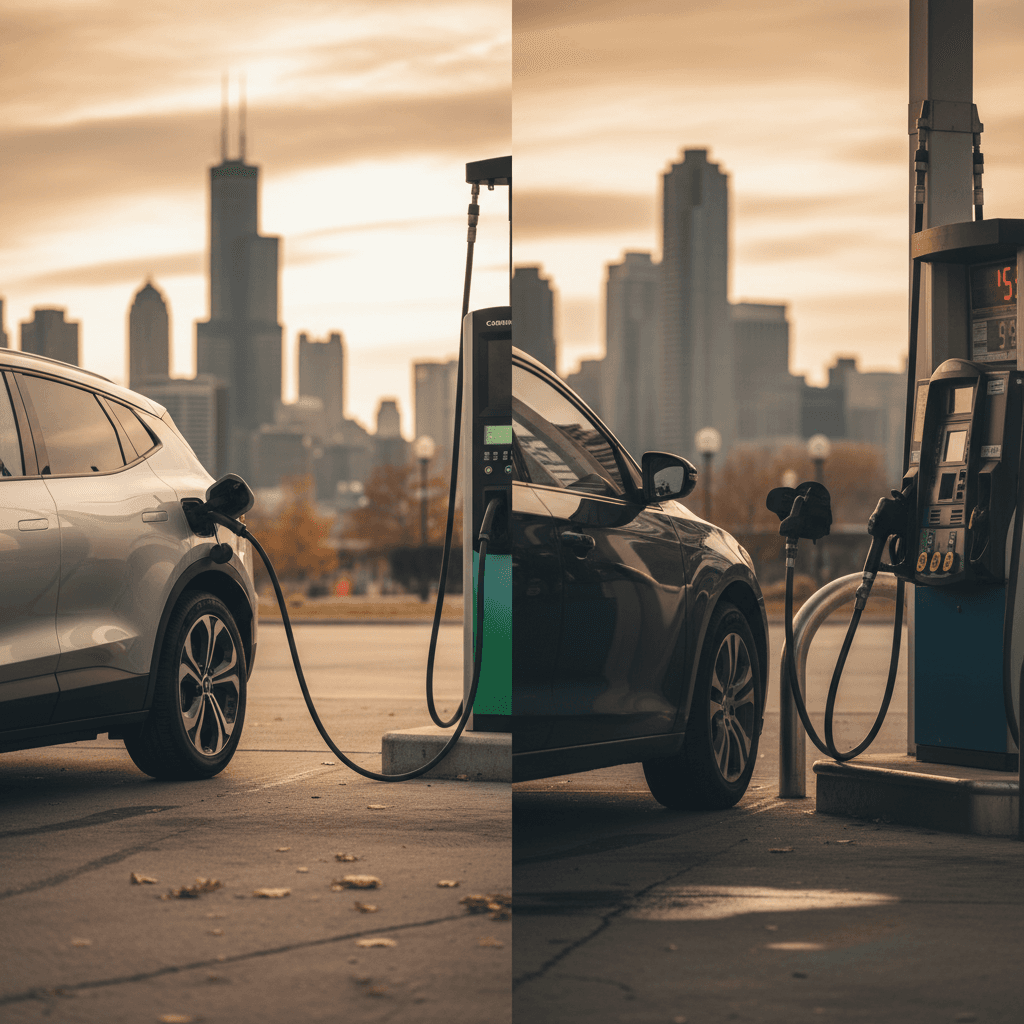
If you live in Chicagoland, you’ve probably felt that sting at the pump again. With regular gas climbing back over **$4 a gallon in early 2026**, a lot of drivers are wondering how gas prices compare with **EV charging costs in Chicago in 2026**, and whether it’s finally time to switch.
Snapshot: 2026 Chicago prices
Why 2026 is the year to run the numbers
The seesaw between fuel and electricity prices has been going on for years. But 2026 is different: global tensions have pushed **oil prices higher**, gasoline in Illinois is at its **highest levels since 2022**, and electricity costs have also crept up as the grid is modernized. The gap between gas and electrons can change month to month, so it helps to look at today’s realities in Chicago instead of old national averages.
For most drivers in the city and suburbs, the story looks like this: - **Home EV charging** is still dramatically cheaper per mile than gasoline, even with higher power rates. - **Public Level 2 charging** is usually competitive with or slightly cheaper than gas. - **DC fast charging only** can cost similar to, or occasionally more than, driving a thrifty gas car, but it still beats many big SUVs and trucks.
Think in cost per mile, not per gallon
Baseline 2026 gas and electricity prices in Chicago
Key 2026 price benchmarks for Chicago drivers
Let’s define the two price levers you actually face when you fill up or plug in: - **Gasoline in Chicago (Spring 2026):** After a run‑up linked to global conflicts, national averages passed $4 per gallon again, and Chicagoland is on the high side of that curve. Seeing **$4.25 or more** on the pump for regular isn’t unusual. - **Residential electricity in Illinois:** Statewide averages for early 2026 land around **16¢/kWh**, though your exact ComEd bill will vary a bit based on supplier, fees, taxes, and whether you’re on a special rate plan. - **Public charging in Chicago:** Level 2 stations downtown and in popular neighborhoods usually show **20–35¢/kWh**, depending on operator and parking markups. DC fast chargers, what you’d use for a quick top‑off on the road, often sit near **50¢/kWh** before parking fees.
Watch the fine print on public charging
From gallons and kWh to cost per mile
Now for the part that really matters: **How much do you pay to drive a mile** in Chicago traffic on gas vs electricity? We’ll make a couple of reasonable, real‑world assumptions to keep the math grounded:
- Typical gas car in Chicagoland traffic: **28 mpg** combined (many crossovers and sedans land here in real life, even if the window sticker says 30+).
- Typical EV efficiency: **3.0–3.5 miles per kWh** in mixed city/suburban driving.
- You’re seeing around **$4.25/gal** at the pump and **16¢/kWh** on your electricity bill at home.
Estimated 2026 cost per mile: gas vs EV in Chicago
Illustrative cost‑per‑mile calculations using common Chicago‑area prices and typical real‑world vehicle efficiency.
| Scenario | Price Assumption | Efficiency Assumption | Estimated Cost per Mile |
|---|---|---|---|
| Gas car (typical crossover) | Gas: $4.25/gal | 28 mpg | ≈ 15¢/mile |
| Efficient hybrid gas car | Gas: $4.25/gal | 45 mpg | ≈ 9¢/mile |
| EV – home charging | Power: $0.16/kWh | 3.2 mi/kWh | ≈ 5¢/mile |
| EV – public Level 2 | Power: $0.25/kWh | 3.2 mi/kWh | ≈ 8¢/mile |
| EV – DC fast charging | Power: $0.50/kWh | 3.0 mi/kWh | ≈ 17¢/mile |
These are ballpark numbers; your exact costs will depend on your specific car, driving style, and utility rate plan.
What the math is telling you
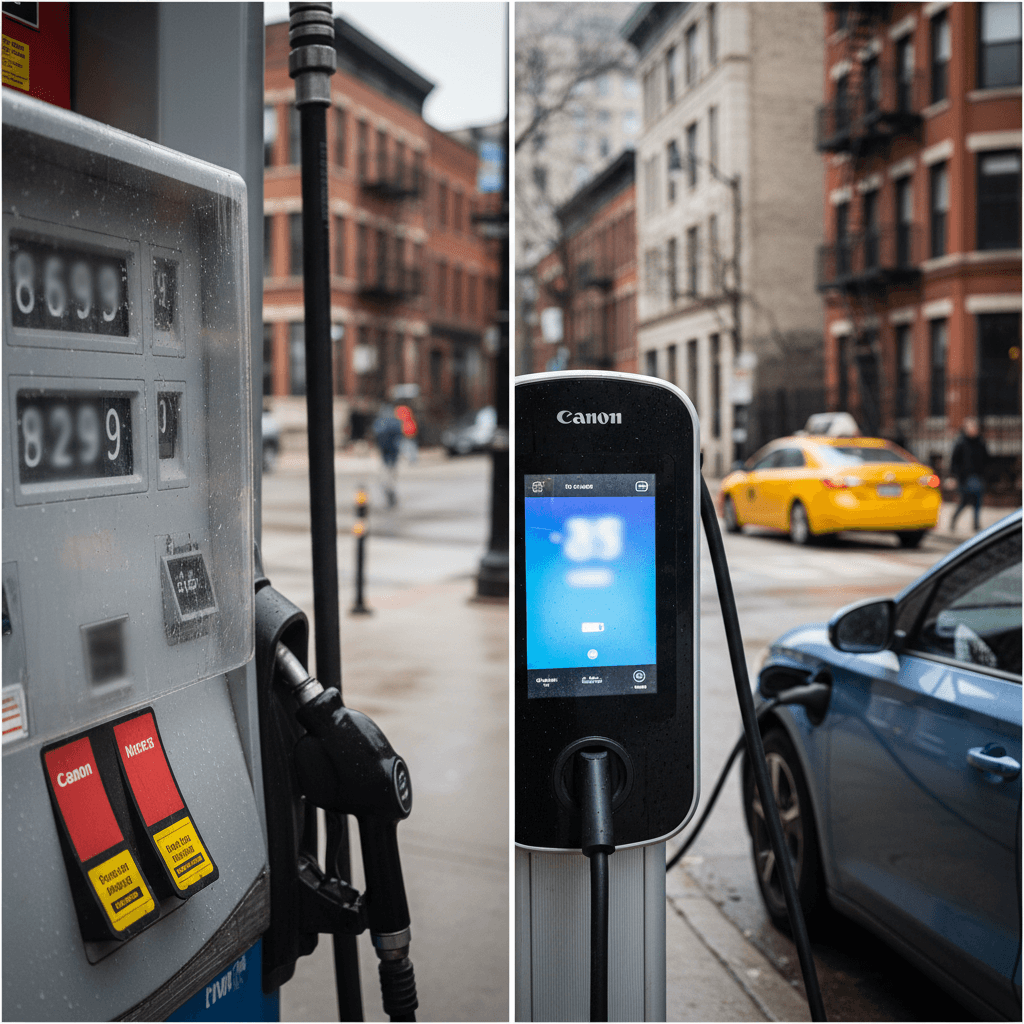
Home charging vs public charging in Chicago
How Chicago drivers actually charge
Pros, cons, and rough costs for each charging option
Home charging
Best for: Single‑family homes, some townhomes with dedicated parking.
- Lowest per‑mile cost (often around 5¢/mile).
- Charge overnight when the grid is quieter.
- Up‑front cost for Level 2 equipment and installation.
Workplace charging
Best for: Office commuters with employer‑provided stations.
- Many workplaces offer low or free rates.
- Lets apartment dwellers live “off street.”
- Availability and fairness (who gets a spot?) can be issues.
Public Level 2 & DC fast
Best for: Apartment dwellers, road‑trippers, and occasional top‑ups.
- Level 2 often 20–35¢/kWh; comparable to or cheaper than gas.
- DC fast near 50¢/kWh; great for time, not for the budget.
- Parking and session fees can add up quickly.
Charge when Chicago sleeps
Real‑world examples for typical Chicago commuters
Scenario 1: The 30‑mile round‑trip commuter
You live in Oak Park and commute downtown, roughly 30 miles round trip with a mix of Ike traffic and surface streets.
- Gas crossover (28 mpg, $4.25/gal): 30 ÷ 28 ≈ 1.07 gallons/day → about $4.55/day.
- EV on home charging (3.2 mi/kWh, 16¢/kWh): 30 ÷ 3.2 ≈ 9.4 kWh/day → about $1.50/day.
That’s roughly $3 saved every workday, or about $780 a year assuming 260 workdays.
Scenario 2: The 60‑mile suburban slog
You drive from Naperville to the Loop or from the North Shore to the southwest suburbs, about 60 miles per day.
- Gas crossover: 60 ÷ 28 ≈ 2.14 gallons/day → about $9.10/day.
- EV home charging: 60 ÷ 3.2 ≈ 18.8 kWh/day → about $3.00/day.
- EV on public Level 2 at 25¢/kWh: 18.8 × $0.25 ≈ $4.70/day.
Even if you rely mostly on public Level 2, you’re still saving around $4–5 a day versus gas at these 2026 prices.
Hybrids narrow the gap, but don’t close it
Beyond fuel: maintenance, parking, and other perks
Other cost levers that favor EVs over gas
Fuel is only part of the story, especially in an older, congested city like Chicago.
Less maintenance
EVs skip oil changes, spark plugs, exhausts, and many transmission problems. In the real world, that often means hundreds of dollars a year in savings compared with an aging gas car.
Brake wear in city traffic
Chicago’s stop‑and‑go traffic is brutal on brakes. EVs use regenerative braking, which slows the car electrically and often doubles or triples brake life compared with a similar gas car.
Parking & city perks
Some garages and workplaces offer discounted or priority parking for EVs. Chicago has experimented with green parking initiatives before; if more EV‑friendly perks arrive, they can quietly tilt the math in your favor.
Don’t ignore battery health on a used EV
How rate plans and incentives shape EV costs
Illinois and ComEd have been experimenting with **time‑of‑use and hourly pricing programs**, as well as **rebates for home EV chargers**. These can swing your per‑mile cost meaningfully if you’re willing to plug in smart.
Key questions to ask your utility or supplier
1. Can I get cheaper overnight rates?
Ask whether ComEd, or your alternative supplier, offers a time‑of‑use or hourly plan where power costs less after 10 p.m. If you can shift most EV charging to those hours, your effective cost per mile may drop well below the 5¢ estimate.
2. Are there rebates for installing a Level 2 charger?
Some Chicago‑area EV drivers have seen **multi‑thousand‑dollar rebates** to offset purchase and installation costs for a home Level 2 charger. That can turn what feels like an expensive project into a quick payback, especially if you drive a lot.
3. Will a new rate apply to my whole house or just the charger?
Make sure you understand whether a special EV rate covers **all your household usage** or only a dedicated circuit for charging. That difference can make or break the deal, particularly in older city homes with electric heat or window AC units.
4. How volatile are hourly prices in extreme weather?
Hourly pricing can be fantastic most months and brutal during heat waves or polar vortices. Ask to see <strong>historical hourly rate charts</strong> so you know how often prices spike above your comfort zone.
5. Is my building EV‑ready?
If you live in a condo or apartment, check whether your association or landlord has a policy on adding EV chargers. In some parts of Chicago, buildings are actively planning shared EV infrastructure, which can spread costs across many residents.
Apartments: cheap EV miles, tricky logistics
Is an EV actually cheaper for you? A simple checklist
Quick self‑assessment: will an EV save you money in 2026 Chicago?
You drive at least 10,000 miles per year
The more you drive, the more those 5¢‑vs‑15¢‑per‑mile differences add up. High‑mileage commuters and rideshare drivers generally see the biggest payback from switching to an EV.
You can reliably charge at home or work
If you can plug in at a house, townhouse, or dependable workplace charger, you’re likely to beat gas by a wide margin. If you’ll be living on DC fast charging, run the numbers very carefully.
Your current gas car isn’t very efficient
If you’re driving a **V6 SUV or pickup** that averages 18–22 mpg around Chicago, the fuel savings with an EV can be dramatic, even using a mix of home and public charging.
You’re facing upcoming repairs
Timing matters. If your current car needs a transmission, catalytic converter, or a laundry list of repairs, folding that money into a newer used EV can shift your total cost of ownership in your favor.
You’re comfortable planning charging on road trips
In everyday Chicago life, it’s easy to keep an EV topped off. But if you love long winter drives to Wisconsin or Michigan, make sure you’re comfortable with route planning and cold‑weather range before you commit.
Where used EVs fit in, and how Recharged helps
If the math on fuel and maintenance has you leaning electric, the next question is usually, “Do I really need a brand‑new EV?” For a lot of Chicago‑area drivers, the sweet spot is actually in the **used EV market**, especially now that early‑generation models have taken their initial depreciation hit.
That’s exactly where Recharged comes in. Every EV we list comes with a **Recharged Score Report** that covers verified battery health, market‑based pricing, and how the car stacks up against similar models. In a city where winter cold, road salt, and street parking are part of daily life, seeing an objective look at **battery health and previous use** matters more than ever.
How Recharged makes EV ownership simpler for Chicago drivers
From the first test drive to your first home‑charged commute, you don’t have to figure it all out alone.
Battery health transparency
Every vehicle on Recharged gets a Recharged Score with battery diagnostics, so you can confidently compare a city‑driven Bolt to a long‑commute Model 3 without guessing which pack is in better shape.
Financing built for EVs
Recharged offers financing and trade‑in options tailored to used EVs, plus an instant offer or consignment if you’re moving out of a gas car. That makes it easier to roll fuel savings into a monthly payment you can live with.
Digital experience, local support
Shop completely online, tap into EV‑specialist support when you have questions, and have your vehicle delivered nationwide, or visit our Experience Center in Richmond, VA if you prefer to kick the tires in person.
Ready to find your next EV?
Browse VehiclesFAQ: Gas vs EV charging costs in Chicago (2026)
Frequently asked questions about 2026 costs in Chicago
Bottom line: Gas prices vs EV charging cost in Chicago 2026
On today’s numbers, **gasoline in Chicago is expensive enough, and EV charging is efficient enough, that the math lines up in favor of electricity for most drivers**. If you can plug in at home or work, it’s realistic to cut your fuel cost per mile by half to two‑thirds compared with a typical gas crossover, and to pocket hundreds of dollars a year in maintenance savings on top of that.
The equation gets tighter if you’re relying heavily on DC fast charging or driving a super‑efficient hybrid, but even then, an EV can hold its own in a city built on short trips and stop‑and‑go traffic. The real trick is matching the **right used EV** to your **real‑world charging options and budget**, and going in with clear eyes about battery health and total ownership cost.
If you’re ready to see how that plays out with actual cars instead of rough math, take a look at used EVs on Recharged, where every listing includes a **Recharged Score Report**, financing options, and EV‑savvy support. Whether your daily drive is a Lake Shore cruise or a red‑line‑dodging crosstown slog, 2026 is a very good year to ask if your next miles should be powered by gas, or by electrons.