If you’re searching for a gas prices forecast for 2026–2027, you’re probably trying to answer a simple question with a very expensive punchline: should you keep betting on gasoline, or is it finally time to go electric? You’re not alone, millions of drivers are staring at station price boards and wondering if the roller coaster ever stops.
Forecasts, not fortune-telling
Why gas price forecasts for 2026–2027 matter now
Gas prices aren’t just dinner-table trivia; they’re one of the largest single operating costs of owning a car. Over a 5–7 year ownership period, the difference between $2.75 and $4.25 per gallon can easily add up to thousands of dollars. When you’re deciding between another gas crossover and a used electric vehicle, a credible gas prices forecast for 2026 and 2027 becomes part of the financial spreadsheet.
For gas drivers
- Fuel is often your single biggest variable cost.
- Price swings hit you immediately at the pump.
- Budgeting is guesswork when geopolitics goes sideways.
For EV drivers
- Electricity costs move slowly, often with published rate plans.
- Home charging lets you lock in predictable per‑mile costs.
- You’re less exposed to oil shocks and refinery issues.
In other words, you don’t need a crystal ball; you need to know whether the next few years look like smooth pavement or black ice, and whether a used EV might be the safer lane.
How experts actually forecast gas prices
Let’s demystify the black art. When agencies and analysts publish a gas price outlook for 2026–2027, they’re not throwing darts. They’re usually combining four pillars:
- Crude oil supply and demand: global production (OPEC+, U.S. shale, others) versus global consumption.
- Refining capacity and bottlenecks: how much crude can be turned into gasoline and diesel, and where.
- Economic growth: strong growth pushes fuel demand up; recessions drag it down.
- Policy and technology: EV adoption, fuel-efficiency standards, carbon rules and taxes that slowly eat into gasoline demand.
Ignore the headline, read the band
Baseline: where gas prices are today
Before you look ahead to the 2026–2027 gas forecast, you need a current baseline. As of early 2026, U.S. average regular gasoline prices have cooled from the wild spikes seen after the 2022 energy shock, but they haven’t gone back to the bargain-bin days of the early 2010s. Think of today’s prices as a new, higher normal with periodic storms.
Gas price context heading into 2026
Think of the market like climate versus weather. The climate, long‑term oil demand trending sideways, EVs eating market share, argues against a permanent return to ultra‑cheap gas. But the weather, wars, supply cuts, hurricanes hitting refineries, can still send you from $3 to $5 in a single ugly season.

Gas prices forecast for 2026
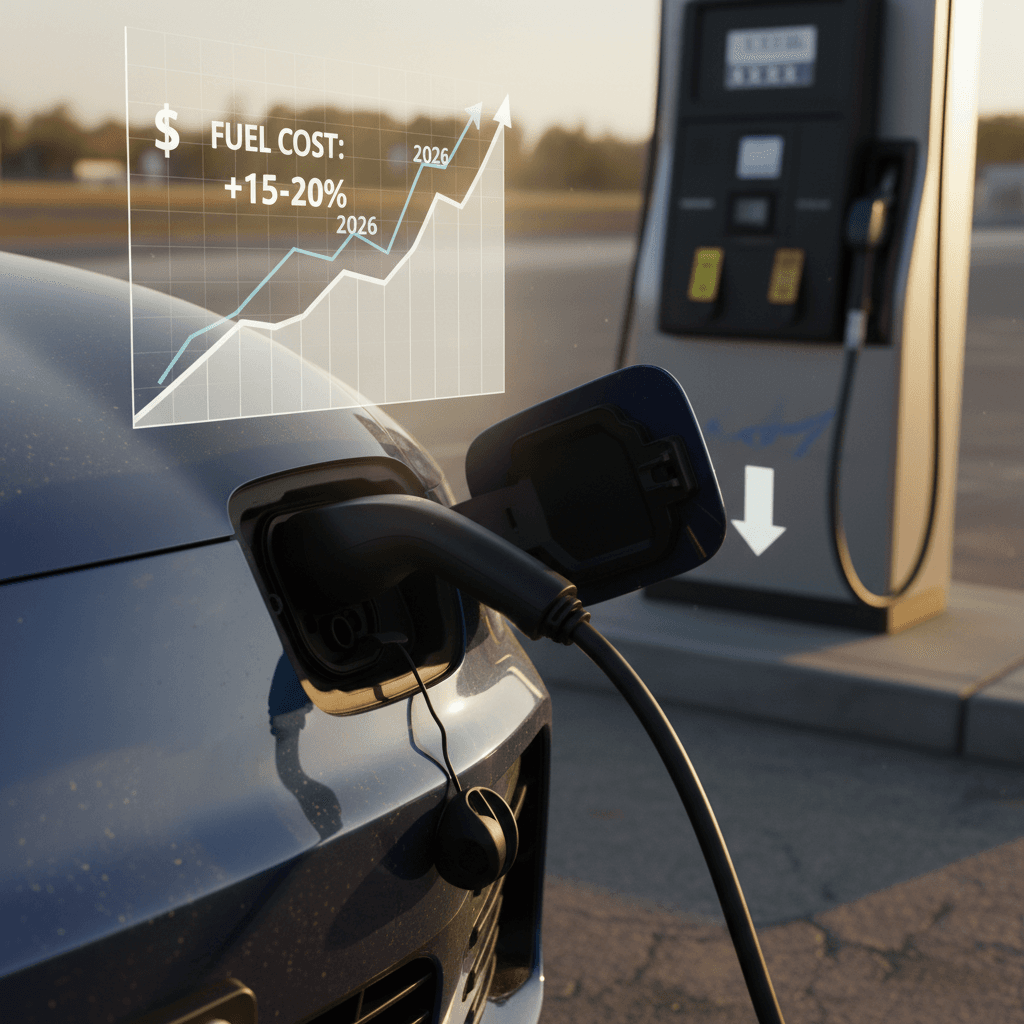
Most mainstream forecasts for 2026 point toward a world where gasoline is not in structural shortage, but also not on clearance. Think of 2026 as a year of uneasy balance: OPEC+ managing supply, U.S. shale no longer on an all‑you‑can‑pump binge, and EVs finally showing up in the data enough to slow demand growth.
2026 gas outlook: what the models are assuming
These are the levers behind most 2026 gas price forecasts, not fixed facts, but central assumptions.
Moderate oil demand
Managed supply cuts
Faster EV adoption
Translate that into plain English and you get a 2026 in which a national average in the mid‑$3s doesn’t require heroics, and mid‑to‑high $4s are within reach if something big breaks in the world. For a typical commuter, that’s the difference between fuel being annoying and fuel being a monthly crisis.
The 2026 pain point
Gas prices forecast for 2027
By 2027, forecasts lean even harder on structural trends: a bigger EV fleet, more hybrids, tougher efficiency standards, and, on the other side of the ledger, still‑growing global travel and freight demand. The big picture is a tug‑of‑war between technology and appetite.
2027 “benign” scenario
- No major new wars or embargoes throttling oil supply.
- Global growth is steady but not overheated.
- EVs and hybrids keep chipping away at gasoline demand.
Result: prices drift, but don’t explode, more nuisance than nightmare.
2027 “stormy” scenario
- Geopolitical shock squeezes crude supply.
- Extreme weather knocks refineries offline.
- Policy shifts (like new fuel taxes) add a fresh layer of cost.
Result: sudden spikes, where road‑trip budgets get rewritten overnight.
In either case, the key point is that 2027 doesn’t look like a return to the era when gasoline was reliably cheap and boring. The baseline is higher, and the volatility is stubborn. That combination is exactly why so many households are looking at EVs not as gadgets, but as insurance policies.
What could push gas prices higher than expected
When you read any gas prices forecast 2026–2027, it’s worth stress‑testing it: what has to go wrong for prices to break the top of that range? A few repeat offenders:
- Geopolitical shocks: conflicts or sanctions affecting major oil exporters.
- Coordinated supply cuts: producer groups deliberately holding back barrels to prop up prices.
- Refinery outages: hurricanes, fires, or accidents knocking big plants offline during peak demand season.
- Surprisingly strong growth: if global travel and freight roar ahead faster than expected, demand may outrun supply for a while.
- Policy shifts: higher fuel taxes or carbon pricing that filters directly into pump prices.
Your worst‑case scenario
What could push gas prices lower
There are also forces that could soften the blow, and show up as the low end of any 2026–2027 gas price prediction:
Forces that lean toward cheaper gas
None of these guarantee bargain fuel, but they all sit on the brake pedal.
Faster EV & hybrid adoption
Efficiency gains
New supply & capacity
Cheap gas is always possible in short spurts; we’ve seen it before. But betting your next six years of car ownership on best‑case fuel prices is like planning your retirement around lottery tickets. Nice if it works. Catastrophic if it doesn’t.
EV vs gas: how the 2026–2027 outlook hits your wallet
So what does the gas prices forecast for 2026–2027 actually mean for you as a driver? It boils down to cost per mile and predictability.
Gas vs EV cost dynamics into 2027
High‑level comparison of how gasoline and electricity behave as energy sources for your daily driving.
| Factor | Gasoline vehicle | Electric vehicle |
|---|---|---|
| Energy price trend | Tied to oil markets; structurally higher and volatile | Tied to local electricity; slower‑moving, often more stable |
| Short‑term shocks | High: conflicts, hurricanes, refinery outages | Low: mostly insulated from oil market spikes |
| Home fueling | Not available | Common; lets you charge at predictable residential rates |
| Per‑mile cost | Highly sensitive to global events | Mostly sensitive to local rates and usage patterns |
| Planning visibility | Hard to forecast beyond a few months | Easier to estimate multi‑year costs |
Exact numbers vary by region, but the structural differences are consistent across most of the U.S.
Where used EVs quietly win
Used EVs as your hedge against fuel-price roulette
If the 2026–2027 gas price forecast reads like a weather report with too many storm icons, a used EV is the raincoat. You’re not eliminating costs; you’re trading an unpredictable one (gasoline) for a more predictable one (electricity), plus some upfront questions about battery health.
Financial upside
- Lower energy cost per mile in most U.S. regions, especially with home charging.
- Less exposure to geopolitical drama and refinery outages.
- When gas spikes, your EV quietly keeps the same commute cost.
Risk management
- Battery health is a one‑time due‑diligence problem, not a weekly price shock.
- With the right inspection, you avoid surprise degradation.
- You can plan multi‑year ownership costs with more confidence.
This is exactly where a platform like Recharged tries to de‑risk the decision. Every vehicle on the marketplace comes with a Recharged Score Report, including verified battery health and fair‑market pricing, so you can compare a used EV against your current gas car using real numbers instead of hunches. If you decide to make the jump, you can handle everything digitally, from trade‑in or instant offer to financing and nationwide delivery.
Checklist: choosing an EV when gas is unpredictable
Key steps before you swap the pump for a plug
1. Map your actual driving
Look at a month of real‑world driving: commute, errands, road trips. Most people severely overestimate their daily miles. If you’re under ~60–80 miles a day, a wide range of used EVs will cover you comfortably.
2. Compare five‑year energy costs
Take a conservative gas price band for 2026–2027 (for example, your local average ± $0.75) and compare it to your local electricity rates. Estimate total fuel spend for both a gas car and an EV over five years.
3. Prioritize battery health verification
In a used EV, the battery is the single most important component. Look for vehicles with <strong>third‑party or platform‑verified battery diagnostics</strong>, like the Recharged Score, so you’re not guessing at remaining capacity.
4. Check home charging options
Do you have a garage or driveway with access to a 120V or 240V outlet? If not, what’s the public charging situation near you? Clarify this before you buy; it’s the difference between seamless and frustrating ownership.
5. Look at total cost of ownership, not just sticker price
Include insurance, maintenance, fuel/charging, and potential tax incentives or rebates. A slightly higher EV sticker can be cheaper over 5–7 years once you factor in the 2026–2027 gas price outlook.
6. Use EV‑savvy financing and trade‑in options
Not all lenders understand EVs well. Using a marketplace like Recharged, you can <strong>get pre‑qualified for financing</strong>, value your trade‑in, or get an instant offer, without setting foot in a traditional showroom.
FAQ: gas prices forecast 2026–2027
Frequently asked questions about the 2026–2027 gas outlook
Bottom line: gas prices, 2026–2027, and your next car
When you strip away the noise, the gas prices forecast for 2026–2027 tells a simple story: gasoline is unlikely to be cheap, and it’s almost guaranteed to be jumpy. You can’t control OPEC meetings, hurricanes or elections, but you can choose whether your household finances are at their mercy.
If you’re ready to get off the fuel‑price roller coaster, a well‑vetted used EV is one of the most practical hedges you can buy. With tools like the Recharged Score Report, EV‑savvy financing, trade‑in and instant‑offer options, and nationwide delivery, Recharged makes that transition less of a leap of faith and more of a line item in a spreadsheet.
The next time you drive past a gas station sign and wonder what those numbers will be in 2027, remember: you don’t have to care nearly as much. You just have to pick the right car now.