If you own, or are thinking about buying, a Ford Mustang Mach-E, you’ve probably heard about a handful of recalls, especially around the battery system and door latches. This Ford Mustang Mach-E recalls list walks through the biggest campaigns from 2021–2025, what they actually fix, and how they should factor into a purchase decision, especially if you’re shopping used.
Quick takeaway
Overview: How many Mustang Mach-E recalls are there?
Because the Mustang Mach-E has been on sale since the 2021 model year, there isn’t a single official “Ford Mustang Mach-E recalls list” in one place. Instead, there are multiple campaigns filed over time with the National Highway Traffic Safety Administration (NHTSA) and Ford. The big ones owners ask about fall into three buckets:
- High-voltage battery contactor / junction box recalls on many 2021–2022 extended-range and GT trims, tied to overheating during DC fast charging and hard acceleration.
- 12-volt battery / electronic door latch recall for 2021–2025 Mach-E SUVs, where a low 12-volt state of charge can leave doors locked and passengers stuck using normal electronic releases.
- A broad rearview camera software recall covering over a million Ford and Lincoln vehicles, including certain Mach-E model years, where the camera image can freeze or fail to display.
On top of those, there are smaller, more targeted campaigns and service actions. For most owners and used-vehicle shoppers, understanding these three categories, and whether a specific VIN is affected, is enough to assess risk and next steps.
Mustang Mach-E recalls at a glance
Major Ford Mustang Mach-E recall campaigns and timeline
Below is a simplified, owner-friendly Mustang Mach-E recalls list for the major campaigns most likely to affect you. Exact NHTSA campaign numbers and Ford internal codes are omitted here for readability, but your dealer can pull those up using your VIN.
Key Ford Mustang Mach-E recall campaigns (high level)
This table summarizes the highest-profile Mach-E recalls that owners and used buyers ask about most often.
| Issue | Approx. Model Years | Main Risk | Typical Fix |
|---|---|---|---|
| High-voltage battery contactor / junction box overheating | 2021–2022 (mostly extended-range & GT) | Loss of motive power while driving or failure to start | Software update and/or replacement of high-voltage battery junction box / contactor components |
| Expansion / follow-up contactor recall | Subset of 2021–2022 | Same as above, after incorrect or incomplete initial remedy | Additional software update for a small group of vehicles |
| 12-volt battery / electronic door latch behavior | 2021–2025 | Passengers may be unable to open doors normally if 12-volt battery is very low | Software update to ensure doors can be opened or clear guidance on mechanical releases |
| Rearview camera software glitch | Select 2021–2025 | Camera image may freeze, delay, or fail to display in reverse | Software update over-the-air or at dealer |
Always verify recall status using the VIN on Ford’s recall site or with a Ford dealer.
Recall list vs. service history
High-voltage battery contactor & junction box recalls
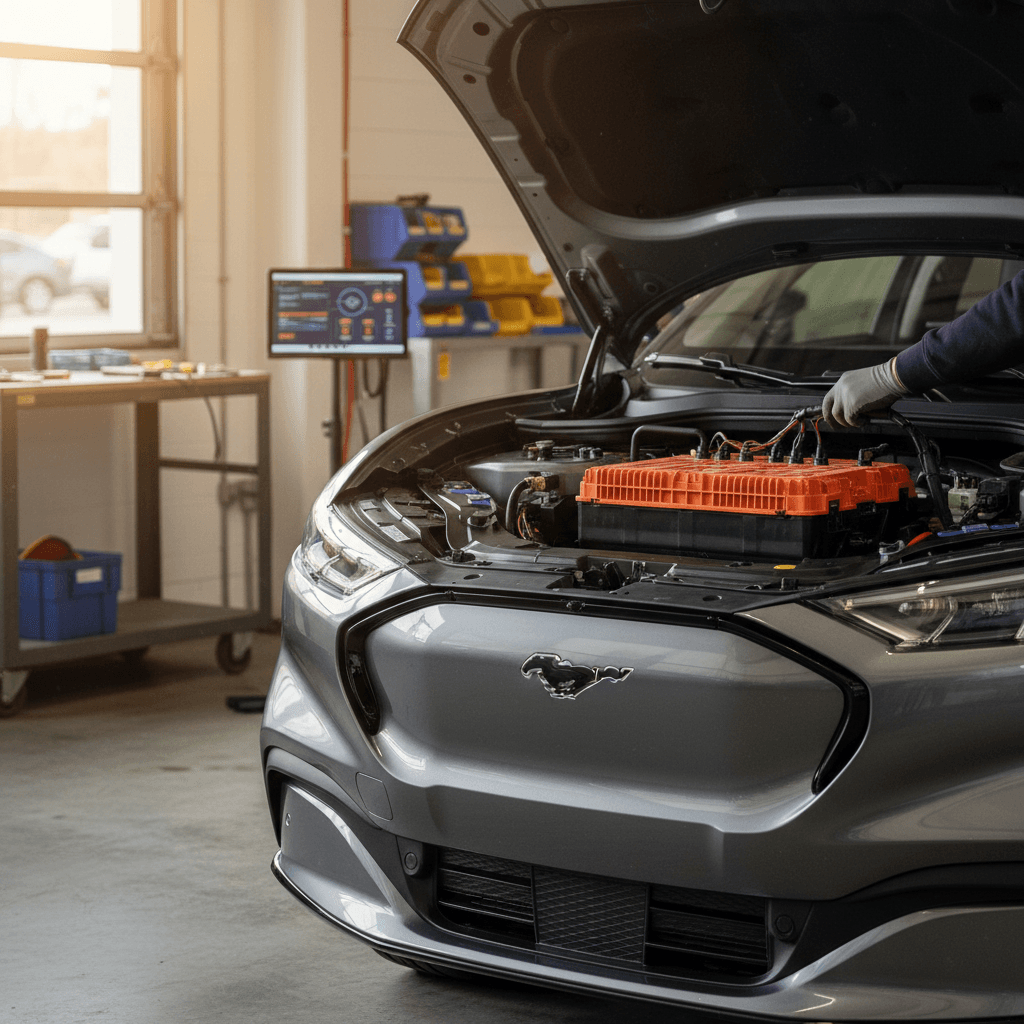
The recall most Mach-E owners have heard about involves the high-voltage battery contactors inside the high-voltage junction box. These are heavy-duty electronic switches that connect the main traction battery to the rest of the car. On certain extended-range and GT models built roughly between late May 2020 and late May 2022, repeated DC fast-charging sessions and hard acceleration events can overheat these contactors.
When that happens, contact surfaces can deform or weld, which may prevent the vehicle from starting, or cause a “Stop Safely Now” message and sudden loss of drive power while you’re on the road. Low-voltage systems like power steering and brakes remain active, but you can lose the ability to accelerate.
- Affected vehicles: Primarily 2021–2022 Mustang Mach-E extended-range and GT trims, built from May 27, 2020 through May 24, 2022.
- Symptoms: Wrench light in the cluster, “Stop Safely Now” messages, no-start condition after charging, or sudden loss of power while cruising.
- Original remedy: Ford first issued a software-only recall to monitor contactor temperature, reduce available power, and protect the hardware.
- Update to remedy: Later, Ford followed up with a campaign to physically replace the high-voltage battery junction box in many of those vehicles.
- Follow-up recall: A small group of Mach-E SUVs that were repaired incorrectly under the original contactor campaign received a second, narrower recall to ensure the proper software remedy was installed.
What owners should do about the battery recall
12-volt battery & electronic door latch recall
Another widely discussed item on any Ford Mustang Mach-E recalls list is the 12-volt battery / door latch campaign covering nearly 200,000 vehicles. In affected Mach-E SUVs from model years 2021 through 2025, a low 12-volt battery state of charge (below roughly 8.4 volts) can keep the electronic door latches from unlocking and operating normally.
In the real world, that means a front occupant could exit, close the door, and then be unable to re-enter using the normal electronic handle. A rear passenger, especially a child, might not know how to use the manual mechanical release, and could feel trapped if the electronics don’t respond.
- Affected vehicles: Approximately 197,000+ 2021–2025 Mustang Mach-E SUVs.
- Main risk: Occupants may be unable to open doors in the usual way if the 12-volt battery is too low.
- Fix: Ford is rolling out a software update to change how the latches behave in low-voltage situations and to reduce the risk of passengers becoming trapped.
- Owner guidance: Ford explains how to use the mechanical interior releases and advises owners to schedule the update once notified.
Take this one seriously
Rearview camera software recall affecting Mach-E
In 2025, Ford announced a large software-related recall covering more than a million vehicles across several nameplates, including the Mustang Mach-E, due to rearview camera image issues. In affected vehicles, the camera view may freeze, be delayed, or fail to appear when the car is shifted into Reverse.
For Mach-E owners, this is less about EV-specific hardware and more about software reliability and general safety. A delayed or missing camera feed can make backing out of tight spaces riskier, particularly in crowded urban or parking-lot environments.
- Affected range: Select 2021–2025 model-year Ford and Lincoln vehicles; check your Mach-E’s VIN to see if it’s included.
- Risk: Higher chance of a back-over crash if the driver relies on the camera and it doesn’t display correctly.
- Remedy: Software update, which may be delivered over-the-air (OTA) or via a dealer visit depending on your specific vehicle configuration and campaign details.
Good news on camera fixes
How serious are Mustang Mach-E recalls for owners?
When you scan a Ford Mustang Mach-E recalls list, it’s easy to assume the worst. In practice, the picture is more nuanced. These recalls range from software cleanups to hardware changes, and their real-world impact depends on whether the fix has already been done on your vehicle.
Putting Mach-E recalls in context
Use this as a framework to evaluate risk level for a specific vehicle.
Battery contactor / junction box recalls
Risk if unfixed: Moderate to high. Loss of motive power while driving isn’t something to ignore, even if steering and braking remain.
Once repaired: Dealers replace or protect the affected components. Afterward, most owners never encounter the issue again, even with frequent DC fast charging.
12-volt / door latch and rear camera recalls
Risk if unfixed: Important but manageable, especially if you know the manual door releases and check your surroundings when backing up.
Once repaired: These campaigns mainly improve behavior in edge cases. For many owners, they’re peace-of-mind updates rather than constant pain points.
Compare across all EVs
How to check your Mach-E’s VIN for open recalls
The only way to know for sure whether a specific Mach-E is covered by or still has open recalls is to check its Vehicle Identification Number (VIN) against Ford’s and NHTSA’s databases. Here’s a simple process you can use whether you already own the car or are shopping used.
Step-by-step: Verify Mach-E recall status by VIN
1. Locate the VIN
On the Mustang Mach-E, the VIN appears at the base of the windshield on the driver’s side, on the driver’s door jamb sticker, and on your registration or insurance documents. If you’re shopping online, ask the seller or dealer to share it.
2. Run the VIN on Ford’s recall site
Visit Ford’s official recall lookup page and enter the VIN. You’ll see whether the vehicle is affected by any open safety recalls and what the recommended remedy is.
3. Cross-check with NHTSA
Use the VIN lookup tool on NHTSA’s website for an extra layer of confirmation. It will list safety recalls that still need to be performed on that specific vehicle.
4. Ask for proof of completed work
If the recall is listed as completed, ask the seller or servicing dealer for <strong>service invoices</strong> showing the campaign code, date, and mileage when the work was done.
5. Confirm software update status
Because several Mach-E recalls involve software, confirm the vehicle is running current firmware. You can often see software version details in the infotainment system or FordPass app.
6. Road-test for symptoms
Even after the right repairs, take a careful test drive: include highway speeds, some firm acceleration, and repeated parking maneuvers to confirm there are no warning lights, power-loss events, or camera glitches.
Include recall checks in every used-EV inspection
Buying a used Mustang Mach-E? How to factor in recalls
If you’re shopping for a used Mach-E, recalls shouldn’t automatically scare you off. Instead, they’re a lens you can use to judge how well the vehicle was maintained and how seriously previous owners took safety and software updates.
Green flags when you see recalls
- All relevant campaigns completed with paperwork from a Ford dealer.
- Owner can explain what the battery and door-latch recalls were and how they were fixed.
- Vehicle shows regular service visits in its history, not just recall work.
- Road test shows no warning lights, “Stop Safely Now” messages, or power loss.
Red flags to watch for
- Seller won’t share the VIN or service records.
- Ford or NHTSA sites show open recalls with no appointment scheduled.
- Owner says the car “just needs a software update” but hasn’t bothered to get it.
- The Mach-E shows intermittent power loss, camera glitches, or door issues during your test drive.
From a used-market perspective, a Mach-E with recall work fully documented, and especially one that has had the high-voltage junction box replaced, is often a stronger bet than a low-mileage example that’s been sitting on old software and has never seen a dealer bay.
Potential leverage on price
How Recharged handles Mustang Mach-E recalls and battery health
At Recharged, the Mustang Mach-E is a core part of our used-EV lineup. Because we focus exclusively on electric vehicles, recall status and battery behavior are baked into how we evaluate and price every Mach-E we list.
What Recharged checks on every Mustang Mach-E
Beyond just ticking the recall box.
Recall & campaign verification
We verify each Mach-E’s VIN against Ford’s and NHTSA’s databases, confirm which campaigns apply, and ensure all safety recalls are completed or scheduled before delivery.
Recharged Score battery diagnostics
Every Mach-E gets a Recharged Score Report with verified high-voltage battery health, charging behavior, and real-world range estimates, not just the original EPA number.
Drive-cycle & feature testing
Our specialists road-test vehicles to check for “Stop Safely Now” messages, camera performance, and proper door-latch operation, then document results for you.
Ready to find your next EV?
Browse VehiclesBecause we also offer financing, trade-in options, instant offers, consignment, and nationwide delivery, you can handle everything, from questions about a specific Mach-E recall through signing paperwork, digitally or at our Experience Center in Richmond, VA.
Want help reading a recall report?
Ford Mustang Mach-E recalls FAQ
Frequently asked questions about Mustang Mach-E recalls
The bottom line: the Ford Mustang Mach-E has had its share of recalls, but most are straightforward to remedy and many improve long-term safety and reliability when handled correctly. Whether you already own a Mach-E or you’re eyeing one on the used market, treat recall status, battery health, and real-world test drives as three pillars of your decision. With the right checks, and transparent reporting from specialists like Recharged, you can enjoy what the Mach-E does best: quiet, quick, genuinely fun electric driving with the peace of mind that its known issues are already in the rearview mirror.