If you own or are shopping for a Ford Mustang Mach-E, the phrase “Ford Mustang Mach-E battery replacement cost 2026” can sound like a thunderclap. The high‑voltage pack is the most expensive component in the car, and horror stories about five‑figure quotes are easy to find. The reality in 2026 is more nuanced: full pack failures are rare, warranty coverage is strong, and you have more options than just paying whatever a dealer prints on an estimate.
Why this matters in 2026
Overview: 2026 Mustang Mach-E battery replacement costs
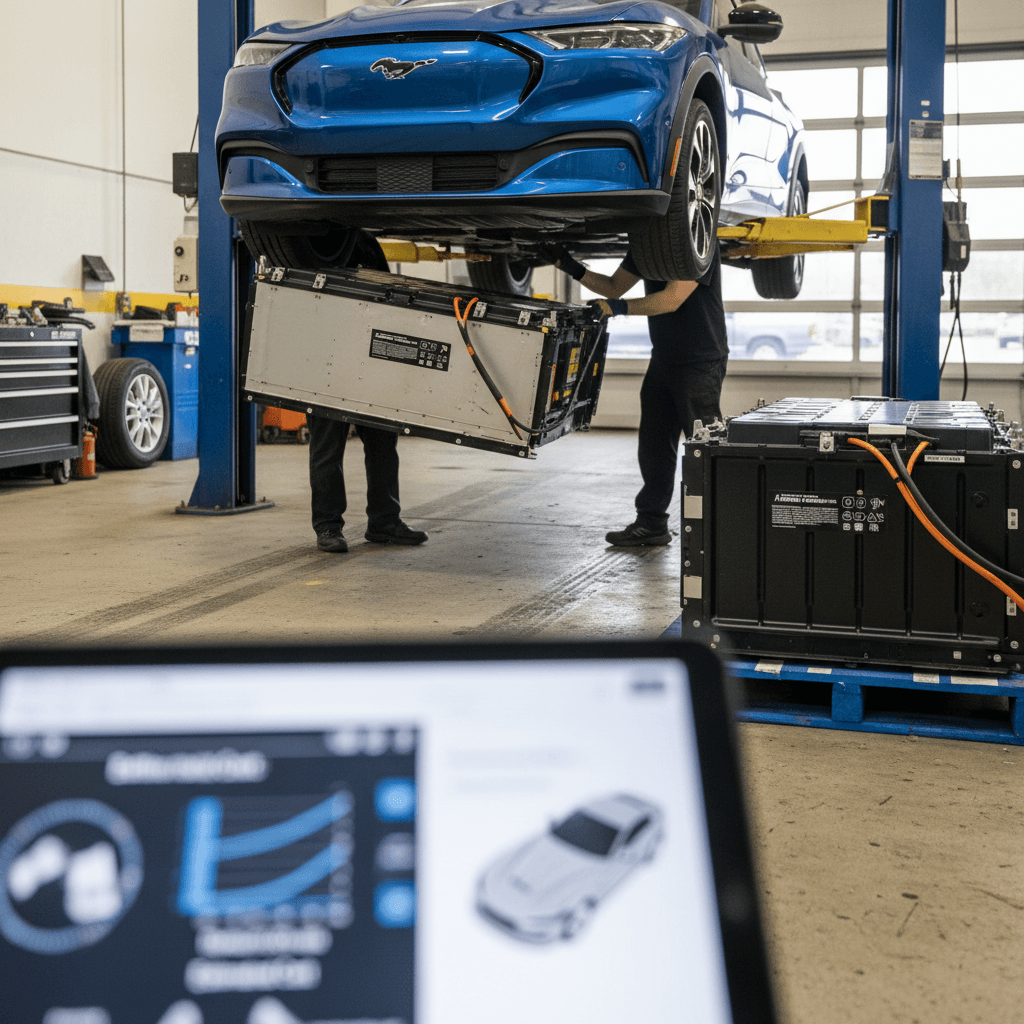
Let’s set expectations before we dive into the details. The Mach-E uses a large underfloor lithium‑ion pack, roughly 70 kWh (standard‑range) or about 88–99 kWh (extended‑range), depending on model year. Ford prices these packs more like an engine and fuel system combined than like a 12‑volt battery. That’s why you’ll see eye‑watering numbers on some dealer quotes, even though most owners will never pay them out of pocket.
Mustang Mach-E battery replacement at a glance (2026)
Quick answer: What Mach-E owners actually pay in 2026
If you’re here for the headline, here it is: in 2026, a full Ford Mustang Mach-E battery replacement at retail in the U.S. can easily land in the $22,000–$30,000+ range at a Ford dealer once you factor in parts, labor, taxes, and fees. That’s for a brand‑new OEM high‑voltage pack installed out of warranty. Many online price snapshots show similar territory, with full packs for the Mach‑E commonly listed in the mid‑five‑figure range before labor and core charges.
However, that’s the worst‑case, top‑shelf scenario. In real life, most owners in 2026 fall into one of three buckets: - The pack is still under the 8‑year/100,000‑mile battery warranty and repairs are heavily discounted or free. - The pack doesn’t actually need full replacement; module‑level or component‑level repair fixes the issue for $3,000–$7,500 instead of five figures. - The owner goes with a used or refurbished pack from a reputable dismantler in the $8,000–$20,000 installed range, depending on pack size and labor.
Think “engine replacement,” not “battery swap”
Cost breakdown: New pack, used pack, and repair options
To make sense of 2026 pricing, it helps to separate three very different jobs: full pack replacement with a brand‑new Ford unit, installing a used/salvage pack, and repairing only the failed pieces inside your current pack.
Typical 2026 Mach-E high-voltage battery costs (U.S. ballparks)
These are illustrative ranges based on 2024–2025 price data, salvage listings, and reported dealer quotes, adjusted for 2026. They’re not official Ford pricing or a guarantee of what your local dealer will charge.
| Scenario | What’s being done | Estimated parts cost (2026) | Estimated labor | Total ballpark cost |
|---|---|---|---|---|
| Full pack – standard-range (dealer, new OEM) | New OEM standard‑range high‑voltage pack installed at Ford dealer | $18,000–$24,000 | $1,000–$2,000 | $19,000–$26,000 |
| Full pack – extended-range (dealer, new OEM) | New OEM extended‑range pack installed at Ford dealer | $22,000–$28,000 | $1,000–$2,500 | $23,000–$30,000+ |
| Full pack – used/salvage standard-range | Low‑mile standard‑range pack from dismantler, installed by qualified shop | $6,000–$8,000 | $1,500–$3,000 | $7,500–$11,000 |
| Full pack – used/salvage extended-range | Low‑mile extended‑range pack (≈98.8 kWh) from dismantler or online marketplace | $8,000–$9,500 | $1,500–$3,000 | $9,500–$13,000 |
| Module‑level repair or partial rebuild | Replace 1–2 bad modules or key high‑voltage components inside existing pack | $2,000–$6,000 | $800–$1,800 | $3,000–$7,500 |
| Diagnostic and minor HV repair | Software updates, contactors, sensors or wiring, not the cells themselves | $500–$2,500 | Included above | $500–$2,500 |
Real invoices vary by dealer, region, and vehicle condition, always get written estimates before approving work.
Don’t confuse high-voltage and 12‑volt battery costs
What drives Mach-E battery pricing in 2026
5 big levers that change Mach-E battery cost
The same car can get wildly different quotes depending on these details.
Pack size & configuration
Standard‑range packs are smaller and generally cheaper than extended‑range units. AWD and performance variants may use different pack part numbers and cooling layouts that affect price.
Parts source
New OEM packs from Ford are the most expensive. Used or refurbished packs from dismantlers or specialty shops can cut the parts bill dramatically, but require careful vetting.
Repair vs. replace
Many problems can be solved with module-level repair, new contactors, or updated electronics, far cheaper than ordering a whole new pack.
Region & labor rates
Hourly labor at a coastal metro dealer can be double what you’d pay at a rural independent EV specialist. That matters when a job is 8–15 hours on the lift.
Core charges & fees
Ford and dismantlers typically apply a core charge to encourage returning the old pack. Taxes, shop fees, and hazmat handling can add hundreds of dollars.
Goodwill & insurance
Out-of-warranty failures that are close to the limit sometimes qualify for goodwill coverage or fall under comprehensive insurance after damage or collisions.
Why are new OEM packs so expensive?
Warranty coverage: When you pay $0 vs full price
For U.S. buyers, the most important line in the owner’s manual is the Electric Unique Component warranty. For the Mustang Mach‑E, Ford covers the high‑voltage battery pack for 8 years or 100,000 miles, whichever comes first. The warranty also promises that the pack will retain at least around 70% of its original capacity over that period, though the exact phrasing can vary by model year.
- If a covered defect requires pack replacement inside 8 years/100,000 miles, Ford typically covers parts and labor, minus any deductible tied to an extended service plan.
- If capacity drops below the stated threshold during that window, you may qualify for repair or replacement even if the pack still functions.
- Damage from collisions, floods, improper lifting, or unauthorized modifications generally isn’t covered, those cases can fall to your insurance instead.
- The warranty clock follows the car, not the first owner. If you buy a 2021 Mach‑E in 2026, you still benefit from the remaining years and miles.
Good news for most 2026 owners
Real-world scenarios and example estimates
Let’s translate all of this into situations you might actually face. These aren’t formal quotes, but they’re realistic sketches of what Mach‑E owners are seeing in 2024–2026.
Scenario 1: 2022 Mach-E, 60,000 miles, bad module
You’re still inside the 8‑year/100,000‑mile window. The car throws a high‑voltage fault and loses power. The dealer diagnoses one or two failed modules in the pack.
- Out-of-pocket cost: Often $0, covered as a warranty repair.
- Downtime: 1–3 weeks depending on parts availability.
- Battery health after: Essentially unchanged; the bad modules are replaced, not the entire pack.
Scenario 2: 2021 Mach-E, 120,000 miles, pack failure
You’ve driven past the 100,000‑mile limit. The pack throws repeated HV errors, and the dealer recommends a full replacement.
- Dealer quote (new OEM pack): Around $23,000–$30,000+ with labor.
- Alternative: Used extended‑range pack installed by a specialty shop for $10,000–$13,000 total.
- Decision point: Compare repair cost to the car’s current market value and your remaining ownership plans.
Scenario 3: Range feels low, but no hard failure
Your Mach-E still drives fine, but the guess‑o‑meter range has fallen noticeably. A diagnostic report shows capacity around 78% of original after six years.
- Under warranty: This might be considered normal degradation and not qualify for replacement.
- Out of warranty: Replacement is entirely elective and will almost never make financial sense.
- Better move: Optimize charging habits and consider trading into a newer EV if the range no longer fits your life.
Scenario 4: Accident or flood damage
A crash, curb strike, or flood compromises the pack enclosure. The car may be structurally sound, but the high‑voltage system is no longer safe.
- Insurance: Comprehensive coverage may treat the car as a total loss if pack replacement exceeds its value.
- Salvage route: Some owners buy back the car and pursue a cheaper used pack, but resale markets can be limited for branded‑title EVs.
- Alternative: Skip the headache and start fresh with another EV, potentially a used Mach-E with a clean Recharged Score battery report.
Should you replace the battery or sell the car?
Staring at a $20,000–$30,000 estimate on a car that might only be worth $22,000–$28,000 retail is sobering. In 2026, more Mach‑E owners are asking a hard but fair question: does a full battery replacement ever make financial sense? Often, the answer is “only under specific circumstances.”
Questions to ask before approving a Mach-E battery replacement
1. What’s the car worth today?
Look up realistic private‑party and trade‑in values. If the repair quote is close to or above your Mach-E’s market value, a pack replacement is hard to justify unless someone else (warranty or insurance) is paying.
2. How long do you plan to keep it?
If you’d happily keep the Mach-E for another 7–10 years after a new pack, there’s at least a case to be made. If you were thinking of changing cars in a year or two anyway, heavy repairs rarely pencil out.
3. Is the pack truly beyond repair?
Always ask whether module‑level repair or component replacement is possible. A second opinion from an EV‑specialist shop can sometimes cut the bill by five figures.
4. Can you source a safe used pack?
Quality used packs with verified mileage and provenance can dramatically reduce cost, but you need a shop that’s comfortable installing them and standing behind their work.
5. Are there better options on the used market?
Sometimes the most rational answer is to sell or trade your current Mach-E and step into a different EV, ideally one with a documented battery health report, like the Recharged Score you’ll see on cars listed at <a href="https://www.recharged.com">Recharged</a>.
When replacement almost never makes sense
How to avoid surprises and negotiate a fair quote
You don’t have to accept the first number someone prints on a service sheet. EV battery work is specialized, but it’s still auto repair, and you’re allowed to shop around.
Mach-E battery quote playbook for 2026
1. Ask for itemized estimates
Insist on a written quote that separates diagnostics, parts, labor hours, core charges, taxes, and fees. That’s the only way to compare options or see where the money is really going.
2. Clarify: new OEM vs. used vs. refurbished
Make the service writer spell out exactly what kind of pack they’re quoting. A brand‑new Ford pack, a Ford reman unit, or a used pack from a dismantler carry very different risk and pricing.
3. Get at least two opinions
Once you have an initial diagnosis, call a second Ford EV‑certified dealer or an independent EV specialist. Even if you stick with the first shop, you’ll know whether their quote is out of line.
4. Ask about goodwill assistance
If you’re just outside the 8‑year/100,000‑mile window, or if the failure seems abnormal, ask Ford customer care and the dealer whether any goodwill coverage is available.
5. Involve your insurer if damage is external
If the battery damage stems from a collision, debris strike, or flood, loop in your insurance company early. They may decide to total the car rather than authorize an enormous repair bill.
Leaning toward selling instead?
Battery life expectancy and early warning signs
So far, the news is good. Across the industry, high‑voltage EV packs are aging better than many early skeptics predicted, and the Mach‑E is no exception. With reasonable charging habits and thermal management, a modern lithium‑ion pack can reasonably be expected to last well past 150,000 miles and often 200,000–300,000+ miles before degradation becomes a deal‑breaker for most drivers.
- A few percent of capacity loss in the first couple of years, then a slower decline afterward, is normal and expected.
- Frequent DC fast charging, especially to 100%, and storing the car at very high or low states of charge can accelerate wear over many years.
- Ford’s software may limit power or range and throw warnings if it detects serious cell or module problems, don’t ignore those messages.
Watch for these early warning signs
Catching issues early can turn a five‑figure replacement into a smaller repair.
Sudden range drops
One day’s drive looks totally different from the next for no clear reason, even in similar weather and routes.
HV system warnings
Repeated high‑voltage or “stop safely now” alerts, especially if they appear under load or while charging, deserve immediate attention.
Charging or temperature oddities
DC fast charging speeds that plummet versus your early experience, or warnings about pack temperature, can flag cooling or module issues.
Use data, not your gut, to judge battery health
Used Mach-E buyers: Battery checks that matter
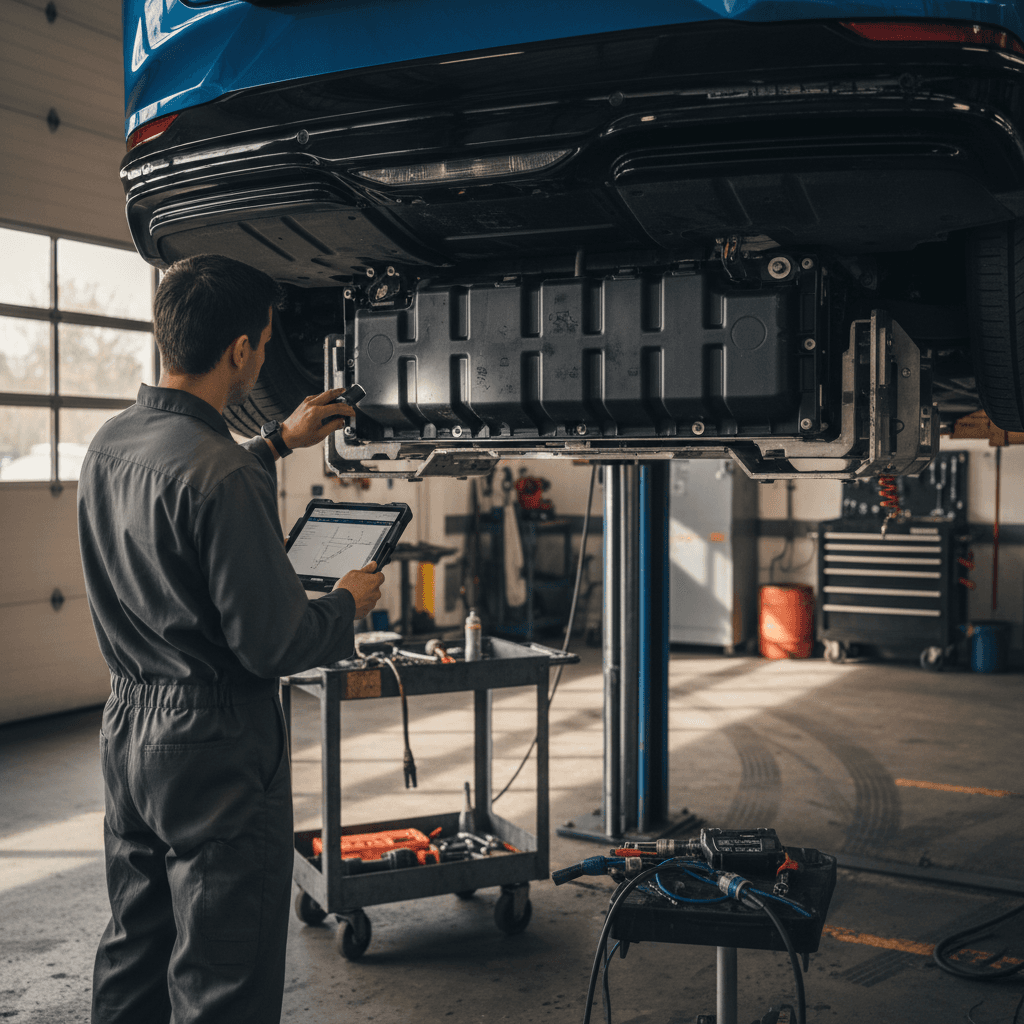
Shopping for a used Mustang Mach-E in 2026 is a little like buying a turbo car in the early 2000s: the big mechanical component is expensive, but if you know what to look for, you can sidestep the bad apples. Battery replacement cost is the downside risk; smart shopping is how you control it.
Battery questions to ask when buying a used Mach-E
1. Is the battery warranty still active?
Ask for the in‑service date and mileage. A 2022 Mach-E sold in 2026 should still have several years and many miles of battery coverage left.
2. Can I see a battery health report?
Look for a professional assessment, not just a photo of the dash range readout. On Recharged, that’s the Recharged Score; elsewhere, ask the seller to provide recent diagnostics.
3. How was the car charged?
Daily DC fast charging on road‑trip corridors is harder on the pack than mostly home Level 2 charging with occasional fast‑charge use.
4. Any high-voltage repairs so far?
Previous HV repairs aren’t necessarily bad, but you want to know who did the work, what was replaced, and whether it’s under warranty.
5. Has the car been in an accident or flood?
Damage to the battery enclosure or cooling system after a crash or flood can haunt you years later. Request full history and inspections.
How Recharged can help used Mach-E shoppers
Ready to find your next EV?
Browse VehiclesFAQ: Ford Mustang Mach-E battery replacement cost 2026
Common questions about Mach-E battery replacement in 2026
Bottom line: Mach-E battery replacement in 2026
When you see a five‑figure Ford Mustang Mach-E battery replacement cost in 2026, it’s easy to assume that owning an electric pony car is a ticking time bomb. The bigger picture is calmer: outright pack failures are still rare, most cars remain under the 8‑year/100,000‑mile battery warranty, and you have real choices, module‑level repair, used packs, or selling the car, long before you’re forced into a $25,000 decision.
The smartest move you can make is to stay informed. Know where your Mach-E sits in its warranty timeline, pay attention to early warning signs, and insist on clear, itemized estimates before authorizing any major work. If you’re shopping used, lean on verified battery health data, like the Recharged Score Report you’ll find on every car at Recharged, so you can enjoy the Mustang Mach-E’s smooth, silent shove without lying awake at night doing worst‑case math.