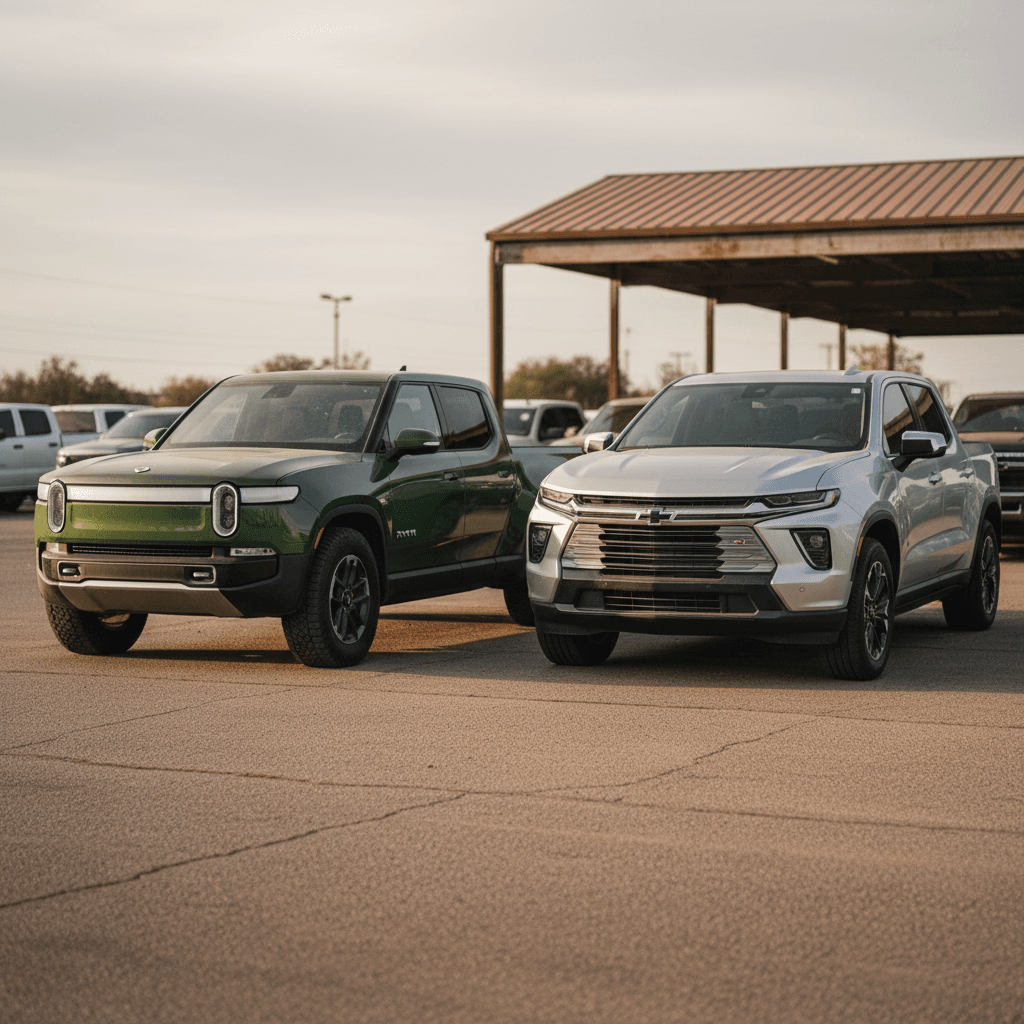
Shopping electric trucks and stuck between the GMC Hummer EV and the Rivian R1T? You’re not alone. Both are wildly capable, wildly quick electric pickups, but they solve very different problems. This guide breaks down the GMC Hummer EV vs Rivian R1T in plain language so you can decide which one actually fits your lifestyle, especially if you’re considering a used example from a marketplace like Recharged.
Two very different visions of an electric truck
GMC Hummer EV vs Rivian R1T: overview
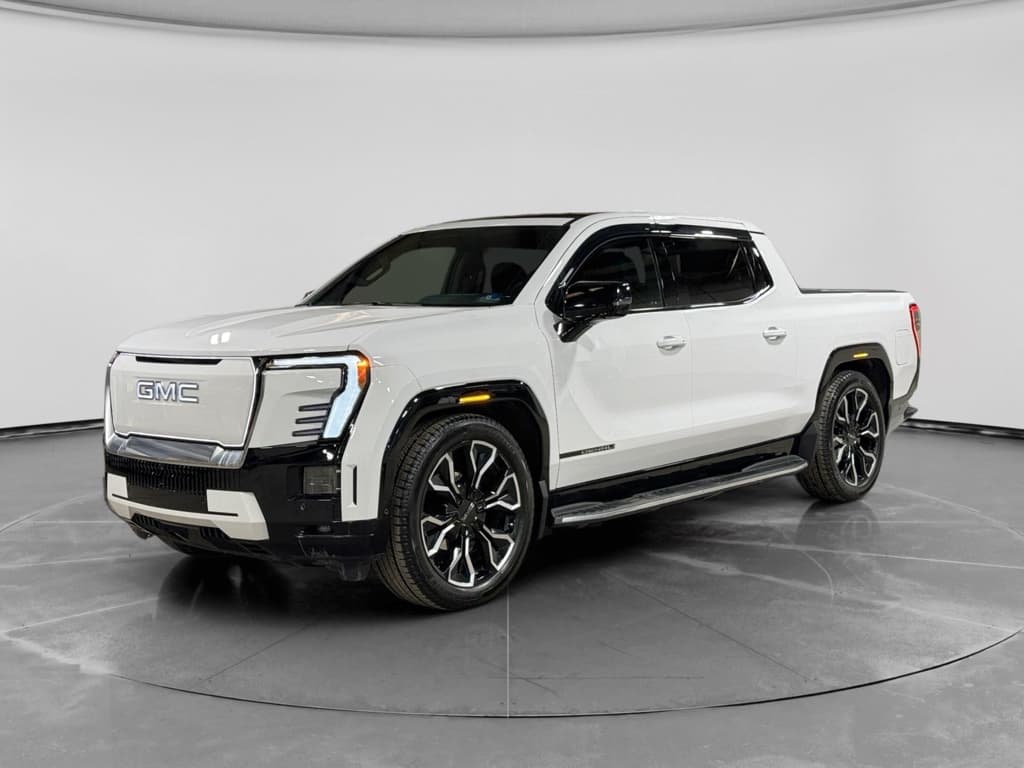
Before we get into the weeds on battery sizes and tow ratings, it helps to answer a basic question: What are these trucks really built to do? The Hummer EV pickup is enormous, heavy (over 9,000 pounds), and designed to be a rolling showcase for GM’s Ultium platform and off-road tech, crab walk, extract mode, big tires, big stance. The Rivian R1T, by contrast, is roughly the size of a full-size crew-cab pickup, but it’s tuned for on-road comfort, overlanding, and daily driving as much as for rock crawling.
Mission and character at a glance
Who each truck is really for
GMC Hummer EV pickup
- Mission: Electric supertruck, maximum wow factor
- Strengths: Extreme off-road hardware, huge battery, wild acceleration
- Tradeoffs: Size, weight, efficiency, and price
Rivian R1T
- Mission: Adventure and lifestyle truck
- Strengths: Range, efficiency, clever storage, daily drivability
- Tradeoffs: Smaller bed, less outrageous presence
Quick takeaway
If you want the most outrageous, tech-packed off-road EV on the planet and don’t mind inefficiency, the Hummer EV is your truck. If you want an EV pickup you can live with every day, the R1T is usually the smarter choice.
Key specs: GMC Hummer EV vs Rivian R1T
Core specs comparison
High-level specs for popular 2024–2025 configurations
| Spec | GMC Hummer EV Pickup (EV3X/Edition 1) | Rivian R1T (Dual Motor Large/Max Pack) |
|---|---|---|
| Horsepower | Up to ~1,000 hp (3-motor) | Approx. 533–665 hp (Dual Motor variants) |
| Torque | “1200+ lb-ft” equivalent (marketing figure) | Up to ~700+ lb-ft (Dual Motor High Output) |
| 0–60 mph | Around 3.0–3.5 seconds with Watts To Freedom | About 3.5–4.5 seconds depending on configuration |
| Battery capacity | ~205 kWh usable (largest pack) | Up to ~149 kWh (Max pack) |
| EPA range estimate | Roughly 311–381 miles depending on trim and pack | Approx. 270–410 miles depending on pack and motors |
| Max towing | 7,500–12,000 lbs (trim dependent) | Up to 11,000 lbs |
| Curb weight | >9,000 lbs | Roughly 7,000–8,000+ lbs (varies by spec) |
| Length / width | ~217" / 86–87" | ~217" / 82" |
| Seats | 5 | 5 |
Exact specs vary by trim, battery, and wheel/tire package, but this table captures the heart of the differences.
Headline numbers that matter in the real world
Spec sheet trap
Range and efficiency: how far will they really go?
Both the GMC Hummer EV and Rivian R1T can post impressive range numbers on paper. But once you factor in weight, tire choice, speed, and towing, their real-world stories are very different, especially if you’re planning cross-country adventures.
GMC Hummer EV range & efficiency
- Available packs support roughly 311–381 miles of estimated range, depending on trim and the optional larger 24‑module battery.
- The truck’s massive weight and off-road rubber mean higher energy use, so highway and winter driving can cut that number significantly.
- Under heavy towing, owners and testers have seen range fall dramatically, think double-digit percent drops compared with unloaded highway cruising.
- As a heavy-duty truck, the Hummer EV largely sidesteps formal EPA efficiency labels, so you rely more on owner/test data than window-sticker numbers.
Rivian R1T range & efficiency
- Offered with multiple packs: about 270 miles (Standard), mid‑300s (Large), and up to 410 miles (Max) in some 2024–2025 setups.
- Better aerodynamics and lower weight than the Hummer EV help the R1T deliver more miles per kWh in everyday use.
- Towing still hits range hard, pulling a 6,000‑lb trailer can drop real-world range to roughly 100–120 miles at highway speeds, but it generally does better than the Hummer EV per unit of battery energy.
- Because it’s lighter and narrower, it’s easier to keep speeds and energy use under control in daily driving.
How to think about range if you tow
Towing, hauling, and everyday utility
On paper, both the GMC Hummer EV and Rivian R1T can tow a serious trailer. In practice, the way they package storage and weight makes them feel different to live with day to day.
Utility breakdown: towing and cargo
What each truck is like as a tool, not just a toy
Tow ratings
- Hummer EV: approximate max of 7,500–12,000 lbs, depending on trim and wheels. Extreme Off-Road packages usually lower the rating.
- R1T: up to 11,000 lbs on all configurations.
- Both will see significant range loss at or near max tow.
Cargo and clever storage
- Hummer EV: Short bed plus a useful front trunk; big exterior dimensions make parking and tight trails tougher.
- R1T: Short bed but adds a gear tunnel behind the cab, plus a frunk and under‑bed storage.
- Rivian’s storage layout is more flexible for camping and overlanding.
Daily usability
- Hummer EV: Feels huge in city traffic and parking garages; weight affects braking and tire wear.
- R1T: Still a big truck, but easier to maneuver and park; more like a modern half-ton.
- If you live in a dense suburb or city, the R1T will feel more manageable most of the time.
Don’t underestimate mass
Off-road capability: desert racer vs trail tool
If you’re looking at these trucks, off-road ability is probably high on your list. Both will go astonishing places right out of the box, but they approach the task differently.
Why the Hummer EV feels like a comic-book off-roader
- Available CrabWalk rear steering lets the truck move diagonally in tight spaces.
- Extract Mode can lift the suspension several inches to clear big obstacles.
- Massive off-road tires, skid plates, and cameras give you confidence in the rocks and sand.
- Downside: That mass is always there. On steep or loose descents, you’ll feel how hard the brakes and traction systems are working.
Why the Rivian R1T is an ideal overland partner
- Adaptive air suspension and sophisticated traction management make the R1T incredibly capable on trails.
- Multiple off-road drive modes tailor power and regen to terrain.
- Because it’s narrower and lighter than the Hummer, it often feels more precise on tight forest trails.
- Rivian’s available accessories (camp kitchen on some early trucks, bed racks, etc.) skew toward camping and overlanding use.
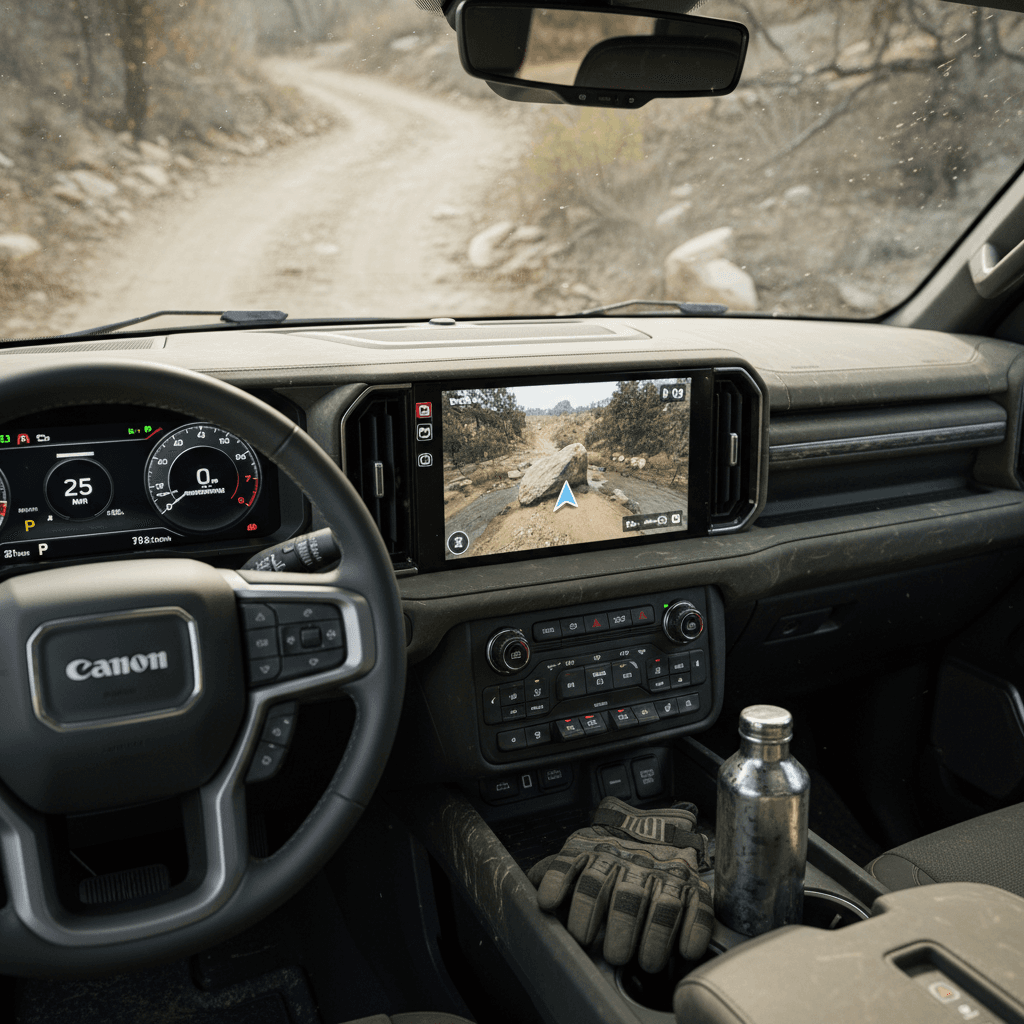
Off-road verdict
Driving experience, comfort, and tech
Beyond raw capability, you’ll live with the seats, screens, and ride quality every single day. Here the R1T and Hummer EV feel like they were designed for different personalities.
Cabin feel and technology
What it’s like behind the wheel
Ride and comfort
- Hummer EV: Surprisingly comfortable given the hardware, but the big off-road tires and weight mean you’re always aware you’re piloting something massive.
- R1T: More crossover‑like ride on pavement; quieter and more composed on long highway drives.
Screens and UI
- Both trucks use large central touchscreens and digital gauge clusters.
- Rivian’s interface leans minimalist and modern, with frequent over‑the‑air updates.
- GMC’s system feels more traditional GM with custom Hummer graphics layered on.
Noise and ambiance
- Hummer EV’s cabin experience is dominated by the view over the hood and the sense of size.
- R1T feels more intimate and upscale, with design details aimed at outdoor enthusiasts.
- Both can be very quiet at a cruise compared to gas pickups.
"If you want something that feels like a tech-forward luxury SUV that happens to be a pickup, the Rivian R1T is your answer. If you want a truck that turns every drive into an event, that’s the Hummer EV."
Charging and road-trip usability
Fast-charging performance matters more with trucks because aero drag and weight are brutal at highway speeds. Both of these EVs can charge quickly, but the experience on a cross-country trip won’t be identical.
- Both support DC fast charging that can add a meaningful chunk of range (think 100+ miles) in roughly 20–30 minutes under ideal conditions.
- The Hummer EV’s huge pack can accept very high peak charging power, but because the battery is so big, a “fast” session may still feel long if you’re trying to top way up.
- Rivian has continued refining its charging curves via software. Paired with its growing Adventure Network of DC fast chargers, the R1T is increasingly friendly for long trips in EV‑dense regions.
- Either truck will chew through range more quickly if you run 75–80 mph on big all‑terrain tires, so expect to stop often on road trips unless you drive with a light right foot.
Home charging makes or breaks EV truck ownership
Costs, value, and the used EV truck market
New, both of these trucks sit at the expensive end of the EV world. But as more early adopters trade out of their 2022–2024 models, used inventory is slowly growing, and that’s where marketplaces like Recharged can make them more accessible.
Ownership cost factors to keep in mind
Beyond the window sticker
Purchase price and depreciation
- Hummer EV: High MSRPs and limited supply kept prices lofty early on, but as more hit the used market, depreciation can be steep, especially for heavily optioned trims.
- R1T: Also expensive when new, but broader trim spread (Standard, Large, Max packs; Dual and Tri/Quad motor) creates more price points on the used side.
Energy, tires, and maintenance
- The Hummer EV’s mass and tire sizes mean higher tire and brake costs over time.
- R1T is kinder on consumables and generally more efficient, which translates to lower energy costs per mile.
- Both benefit from fewer moving parts than gas trucks, no oil changes, fewer routine items.
Battery health and truck usage
- How a previous owner used the truck, towing heavy, frequent fast‑charging, constant high‑speed runs, can affect long‑term battery health.
- A detailed battery diagnostic is crucial on either model, but especially on high‑mileage Hummer EVs that have been worked hard.
Why a battery health report matters more on big trucks
Which electric truck fits you?
Let’s boil this down to how you’ll actually use the truck. Specs are helpful, but the right answer usually comes from being honest about your daily life and your weekends.
Pick the truck that matches your reality
You want maximum theater and off-road spectacle
You love the idea of a truck that stops traffic everywhere it goes.
You’ll genuinely use CrabWalk, Extract Mode, and the Hummer’s other off‑road tricks.
You’re less concerned about efficiency and more interested in owning an electric conversation piece.
You have wide roads, a big driveway, or rural property where the Hummer’s size is an asset, not a liability.
You want an everyday adventure truck
You plan to daily‑drive your truck, park in garages, and navigate tight parking lots.
You care about range and efficiency because you’ll take longer trips several times a year.
You’re into camping, skiing, biking, or overlanding and want clever storage like the R1T’s gear tunnel.
You like the idea of frequent software updates and a cabin that feels more like a modern luxury SUV.
You tow regularly
If you’ll tow near max weight often, prioritize the truck whose <strong>package</strong> suits your trailer, bed length, hitch access, cameras, and payload all matter.
Either truck will see a big range hit towing, but a Rivian R1T with a large or Max pack usually gives you a better balance of capability and efficiency.
Regardless of brand, plan routes around DC fast chargers that can comfortably accommodate longer, heavier vehicles.
You’re shopping the used market
Focus less on the badge and more on <strong>individual vehicle history</strong>: mileage, towing use, and charging patterns.
Look for a truck sold with a recent, independent <strong>battery health report</strong> rather than just relying on dashboard range estimates.
Consider total ownership cost, insurance, tire prices, energy use, not just the monthly payment.
How Recharged helps if you’re eyeing a used Hummer EV or Rivian R1T
If you’re leaning toward a GMC Hummer EV or Rivian R1T, buying used can make these halo trucks far more attainable, but only if you can see what’s going on beneath the skin. That’s where Recharged comes in.
What you get when you shop a used EV truck through Recharged
1. Verified battery health with the Recharged Score
Every vehicle listed on Recharged includes a <strong>Recharged Score Report</strong> with battery diagnostics, so you can compare a used R1T and Hummer EV on more than just mileage and photos.
2. Transparent, fair pricing
Recharged benchmarks each truck against the broader used EV market, so you can see whether that six‑figure Hummer EV or high‑spec R1T is actually priced fairly for its age, condition, and battery health.
3. Financing tailored to EVs
You can <strong>pre‑qualify for financing online</strong> with no impact to your credit, making it easier to see what a used electric truck really costs per month before you fall in love.
4. Trade‑in and selling options
Have a gas pickup or another EV to move first? Recharged offers trade‑ins, instant offers, or consignment so you can simplify getting into your next truck.
5. Nationwide delivery and expert guidance
From its digital-first buying experience to EV‑specialist support and an Experience Center in Richmond, VA, Recharged is set up to help you shop, compare, and buy from your couch, and have your truck delivered to your driveway.
FAQ: GMC Hummer EV vs Rivian R1T
Frequently asked questions
Both the GMC Hummer EV and Rivian R1T prove that electric pickups can be shockingly quick, incredibly capable, and genuinely useful. The trick is matching the truck to your life. If you crave maximum drama and off-road spectacle and you’ve got room to park a supertruck, the Hummer EV will make you smile every time you fire it up. If you want an EV truck that can commute, road‑trip, and escape to the mountains without feeling like overkill, the Rivian R1T is usually the smarter, more livable choice, and on the used market, it can be surprisingly attainable. Either way, going in with clear priorities and solid data on battery health will make you a much happier electric‑truck owner.