If you own or are considering a Ford Mustang Mach-E, you’ve probably asked the same question every EV shopper does: how fast will the battery degrade, and what does that mean for range and resale value? This guide pulls together what Ford has promised, what early high‑mileage data shows, and what you can actually do to slow Mustang Mach-E battery degradation, especially if you’re looking at a used example.
Key takeaway up front
Overview: Mach-E battery and degradation basics
Every EV battery degrades over time. The Mustang Mach-E is no exception, but the pace and impact of that degradation are often misunderstood. You’ll see a few key ideas throughout this article:
- Capacity loss is gradual, not a sudden cliff. You’re more likely to lose a few percent over years than half your range overnight.
- Ford built in a buffer between gross and usable battery capacity, so the pack can age while your displayed range stays relatively stable for a long time.
- Charging and temperature habits have more impact than occasional hard acceleration.
- When buying used, the question is rarely “Will the battery fail tomorrow?” and more often “How much range has it realistically lost, and is that acceptable for my daily driving?”
Mach-E battery packs: chemistry, capacity & range
To understand degradation, you first need to know what’s actually under the floor. The Mustang Mach-E launched with nickel‑manganese‑cobalt (NMC) lithium‑ion packs and later added lithium iron phosphate (LFP) options on standard‑range trims.
Mach-E battery options and usable capacity (U.S. models)
Approximate usable capacity and EPA range figures for recent Mach-E model years (numbers rounded for clarity).
| Model years / pack | Chemistry | Usable capacity (approx.) | Typical EPA range (RWD) | Typical EPA range (AWD) |
|---|---|---|---|---|
| 2021–2023 Standard Range | NMC | 68 kWh | ~247–250 miles | ~224–230 miles |
| 2021–2023 Extended Range | NMC | 88 kWh | ~300 miles | ~270 miles |
| 2024+ Standard Range | LFP | ~72 kWh | 250 miles | 230 miles |
| 2024+ Extended Range | NMC | ~91 kWh | 320 miles | 300 miles |
| Performance (GT / Rally, ER) | NMC | ~91 kWh | 280 miles (GT) | 265 miles (Rally) |
Exact range depends on wheels, trim and conditions, but this gives a sense of pack size and capability.
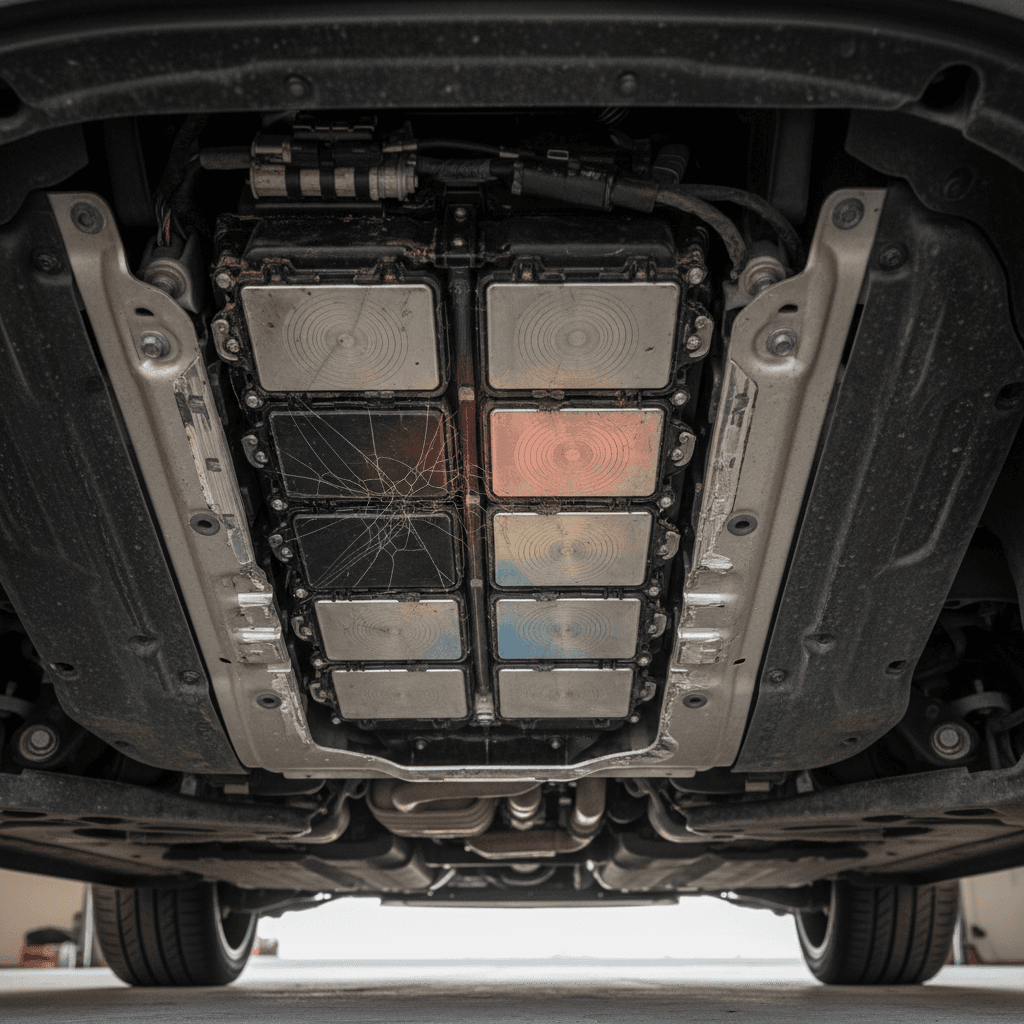
Usable vs. gross capacity
What Ford promises: warranty and capacity thresholds
Before you dig into owner anecdotes, start with what Ford itself is willing to stand behind. In North America, the Mach-E’s high‑voltage battery and related electric‑drive components are covered by an 8‑year / 100,000‑mile warranty (in Canada it’s 8 years / 160,000 km). That’s meant to cover manufacturing defects and excessive capacity loss, not normal wear.
- Ford documents and FAQs indicate the Mach-E battery is designed to retain at least 70% of its original usable capacity over the warranty period under normal use.
- If capacity drops below that threshold within the coverage window and it’s not due to abuse or damage, you may qualify for repair or pack replacement.
- The warranty is tied to time and mileage, so a high‑mileage rideshare vehicle can hit the limit well before a casual commuter.
Warranty is not a performance guarantee
Real-world Mustang Mach-E battery degradation so far
The Mach-E has only been on the road since late 2020, so we’re just now seeing meaningful high‑mileage data. Early results are encouraging.
Early Mach-E battery degradation signals
Anecdotal owner scan‑tool readings also line up with this picture. It’s common to see a roughly 3–5% drop in the first couple of years, followed by a slower, steadier decline, more like 1–2% per year, depending on climate and charging patterns. That “early hit” is typical of most lithium‑ion EV packs, not unique to the Mach-E.
Good news for used shoppers
What actually drives battery degradation in a Mach-E
Battery degradation isn’t random. The same factors that affect Tesla, Hyundai, or Volkswagen packs also matter for the Mustang Mach-E. From owner data, lab testing and Ford’s own guidance, the main drivers boil down to five buckets:
Five major drivers of Mach-E battery degradation
No single habit will make or break your pack, but patterns over years do matter.
1. High temperatures
Heat is enemy number one for lithium‑ion cells.
- Living in a hot climate, parking in direct sun, and frequent fast charging in high ambient temps all add stress.
- The Mach-E’s liquid‑cooled pack helps, but it can’t rewrite physics.
2. High state of charge
Keeping the pack near 100% for long periods accelerates wear.
- Regularly charging to full and letting it sit, especially in heat, is much worse than cycling between, say, 20–80%.
3. Deep discharges
Routinely running down to very low state of charge (single digits) can increase long‑term degradation.
- Occasional deep runs are fine; making it a habit isn’t.
4. Heavy DC fast charging
High‑power DC fast charging (DCFC) warms the pack and adds stress, especially back‑to‑back sessions.
- Ford gives the Mach-E up to about 150 kW on extended‑range models, great for road trips, but slower than some newer rivals partly to protect the pack.
5. Age and calendar time
Even if you barely drive, chemical reactions continue in the background.
- A lightly‑driven 6‑year‑old Mach-E will usually show some loss just from time, though typically less than a high‑mileage car fast‑charged daily.
6. Driving style & load
High sustained speeds, constant full‑throttle launches and heavy loads mean more heat cycles.
- They matter less than temperature and charging habits, but over 100,000 miles they still add up.
Think patterns, not one‑offs
LFP vs NMC Mach-E batteries: does chemistry change degradation?
Starting with the 2024 model year, Ford shifted the Mach-E’s standard‑range pack to LFP (lithium iron phosphate) chemistry in many markets, while extended‑range packs remain NMC. That matters for how you treat the battery and what kind of degradation to expect.
LFP packs (mostly 2024+ Standard Range)
- More tolerant of high SOC: LFP generally handles frequent 100% charges better than NMC, which is why Ford can recommend regular full charges for range estimation and balancing.
- Slower cold‑weather performance: LFP is more sensitive to low temperatures, which can temporarily reduce power and range until the pack warms up.
- Degradation pattern: Often shows a smaller initial drop, then very slow change for a long time, assuming reasonable charging habits.
NMC packs (most Extended Range & 2021–2023 cars)
- Higher energy density: More kWh in the same space, delivering the Mach-E’s 300+ mile extended‑range figures.
- Less happy at 100%: NMC chemistry prefers spending less time at full charge, especially in hot conditions.
- Degradation pattern: Typically a 3–6% hit in the first couple of years, then a gradual tapering to a slower loss rate.
How this affects daily charging
How to reduce battery degradation in your Mach-E
You can’t freeze chemistry in time, but you can meaningfully slow Mustang Mach-E battery degradation with some simple, repeatable habits. Think of it as long‑term maintenance you do from your driveway, not the service bay.
Everyday habits to protect your Mach-E battery
1. Set a sensible daily charge limit
For NMC extended‑range cars, aim for <strong>70–80%</strong> for daily charging and bump to 90–100% only before road trips. For LFP standard‑range cars, 90–100% is fine more often, but there’s still no need to sit at 100% all week if you don’t need the range.
2. Avoid living at 0% or 100%
Use the full pack when you need it, but don’t make a habit of arriving home nearly empty or parking long‑term at full. If you finish a trip at a very low state of charge, plug in soon and charge back into a more comfortable buffer (20–30%+).
3. Use DC fast charging strategically
On a cross‑country run, use DC fast charging freely. Back home, rely mainly on Level 2. If you regularly road‑trip, stopping around <strong>80–85%</strong> at DCFC instead of forcing a full 100% will save time and reduce heat stress.
4. Take advantage of battery preconditioning
When routing to a DC fast charger through the built‑in navigation or compatible Android Auto, the Mach-E can <strong>precondition the battery</strong> so it’s at an optimal temperature before you plug in. That shortens charging sessions and reduces stress compared with hammering a cold or overheated pack.
5. Manage heat where you can
In hot climates, choose shaded parking when possible and avoid leaving the car fully charged in direct sun all day. The Mach-E’s liquid‑cooling system will do its part, but small choices here add up over summers and years.
6. Keep software up to date
Ford has already used software updates to refine charging curves, thermal management and range estimates. Staying current helps the car protect its pack more intelligently in the background.
What *not* to do consistently
Battery health when buying a used Mustang Mach-E
If you’re shopping used, battery degradation isn’t an abstract worry, it’s one of the biggest factors that separates a smart purchase from a regret. Two similar‑looking Mach-Es can have very different histories and battery health even at the same mileage.
How to assess Mach-E battery health as a used buyer
You probably don’t need an engineering degree or a lab, just a structured approach.
1. Start with simple range reality checks
Ask the seller for a photo of the car at 100% charge along with the estimated range in the cluster.
- Compare it to the original EPA range for that trim and wheel size.
- A 10–15% gap on a 3–5‑year‑old car can be perfectly normal, depending on climate and use.
2. Look at charge and usage patterns
Ask how and where the Mach-E was charged most of the time.
- “Mostly home Level 2 to 80%” is ideal.
- “Daily DC fast charge to 100% for rideshare work” is still workable, but you should expect somewhat more degradation.
3. Use scan tools or reports when available
Some owners use OBD‑II dongles and apps to estimate pack health. On their own, those readings can be noisy, but they’re useful supporting evidence when interpreted alongside range and history.
At Recharged, we roll this type of analysis into our Recharged Score battery health diagnostics.
4. Confirm remaining battery warranty
Check the in‑service date and mileage to see how much of the 8‑year / 100,000‑mile high‑voltage warranty is left.
- A 2022 Mach-E with 40,000 miles likely still has years of coverage on the pack.
How Recharged approaches used Mach-E batteries
Quick checklist for shopping a used Mach-E
1. Verify pack type and trim
Identify whether the car has Standard Range (LFP or NMC depending on year) or Extended Range (NMC) and whether it’s RWD, AWD, or GT/Rally. This sets your expectations for original range and charging behavior.
2. Compare indicated range to original EPA ratings
At a full charge, compare the displayed range to the EPA number for that specific configuration. Adjust for wheel size and driving profile; a previous owner who drove mostly highway at 75 mph will skew the computer’s estimate downward.
3. Ask about charging habits and climate
Learn where the car lived (Arizona vs. Michigan) and how it was charged (mostly home Level 2 vs. heavy DCFC use). Use that to contextualize any range loss you see.
4. Inspect service history and recalls
Confirm that software updates and recalls, including powertrain and charging‑related campaigns, have been addressed. Healthy thermal management and up‑to‑date charge curves support long‑term battery health.
5. Lean on third‑party evaluation when possible
If you’re not buying through a specialist, consider an independent EV‑savvy inspection. With Recharged, that expert review and battery‑health focus is baked into the process.
Frequently asked questions about Mach-E battery degradation
Mach-E battery degradation FAQ
Bottom line: Should you worry about Mach-E battery degradation?
The Ford Mustang Mach-E is still a relatively young product, but early evidence points in the same direction: battery degradation is real, but manageable. Ford engineered in buffers, conservative fast‑charging behavior and an 8‑year high‑voltage warranty that collectively make catastrophic failures rare and gradual range loss the more realistic scenario.
If you own a Mach-E today, focusing on a few simple habits, reasonable charge limits, mostly Level 2 charging, smart use of DC fast charging and up‑to‑date software, will go a long way toward preserving range. If you’re shopping used, treat battery health as a first‑class consideration alongside price and trim, and lean on objective diagnostics wherever you can. That’s exactly why Recharged bakes battery analytics into every listing: so you can understand not just what you’re buying, but how it’s likely to perform years down the road.