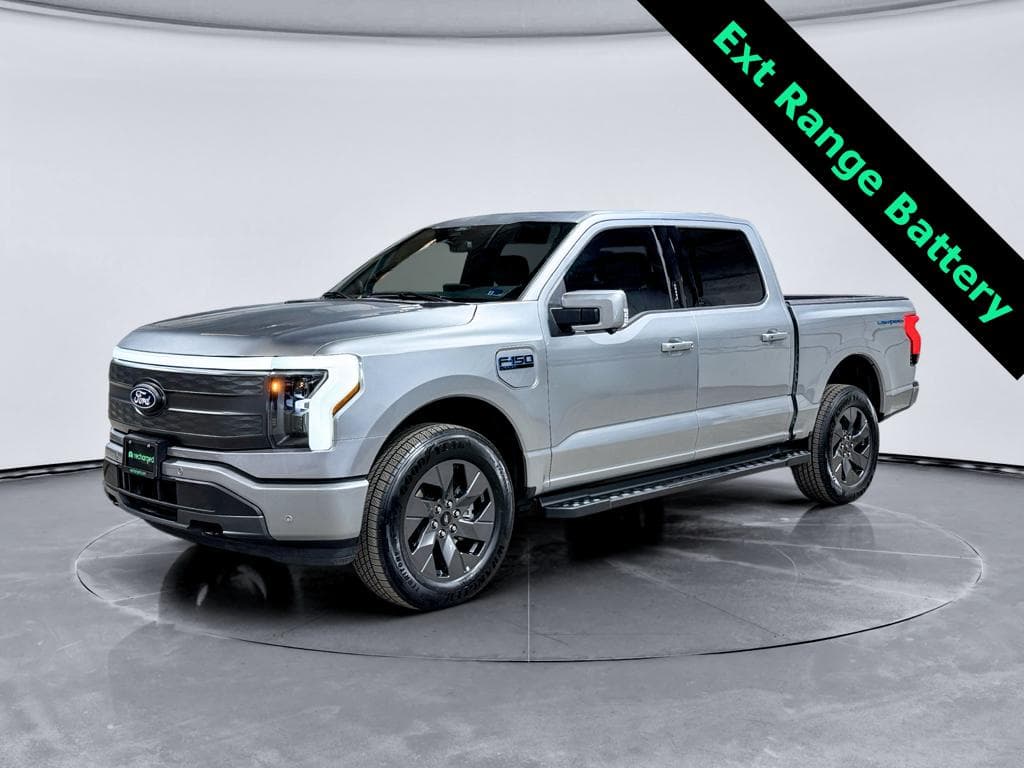
If you’re cross‑shopping a gas Ford F-150 against an all‑electric F-150 Lightning, the sticker price only tells part of the story. The real question is total cost of ownership: fuel or electricity, maintenance, insurance, depreciation, incentives and, ultimately, how much money leaves your wallet over 5–10 years.
Key idea
Why total cost of ownership matters more than sticker price
Full‑size pickups are long‑term purchases. You’re not just paying for the truck; you’re paying for every gallon of gas or kilowatt‑hour of electricity, every oil change or tire rotation, and the value you get back when you sell. When you compare a Ford F-150 vs F-150 Lightning on total cost of ownership, 5–10 years of running costs can easily outweigh a $5,000–$15,000 difference in MSRP.
Headline numbers: F-150 vs F-150 Lightning ownership costs
Quick answer: Which is cheaper to own, F-150 or Lightning?
When the Lightning can win on cost
- High annual mileage: 15,000–20,000+ miles per year, especially if most charging is done at home rates.
- Good electricity vs gas prices: You pay around $0.12–$0.18/kWh for power and $3.25+ per gallon for gas.
- Moderate towing: Mostly commuting and light hauling, with only occasional heavy towing.
- Tax credits/rebates: You qualify for federal or state EV incentives that effectively lower your purchase price.
When a gas F-150 usually wins
- Heavy, frequent towing: You’re pulling large trailers often, which hits Lightning range hard and may require DC fast charging.
- Limited home charging: You live in an apartment or can’t install a Level 2 charger, so you rely heavily on public DC fast charging.
- Low annual mileage: Under 10,000 miles per year, so you don’t exploit the Lightning’s fuel and maintenance savings.
- Rural infrastructure: Sparse DC fast charging networks make long‑distance electric towing a hassle.
Big-picture rule of thumb
What actually goes into total cost of ownership?
- Purchase price (minus any EV tax credits or rebates)
- Financing costs (interest if you finance or lease)
- Energy costs: gasoline or diesel vs electricity
- Routine maintenance and unexpected repairs
- Insurance premiums
- Registration, taxes and EV‑specific road‑use fees (varies by state)
- Depreciation: how much value the truck loses over time
- Opportunity cost: how much downtime you face for scheduled service or charging
For this Ford F-150 vs F-150 Lightning total cost of ownership comparison, we’ll focus on the big levers you can actually estimate: energy, maintenance, insurance, depreciation and incentives, using realistic U.S. assumptions a typical truck owner would recognize.
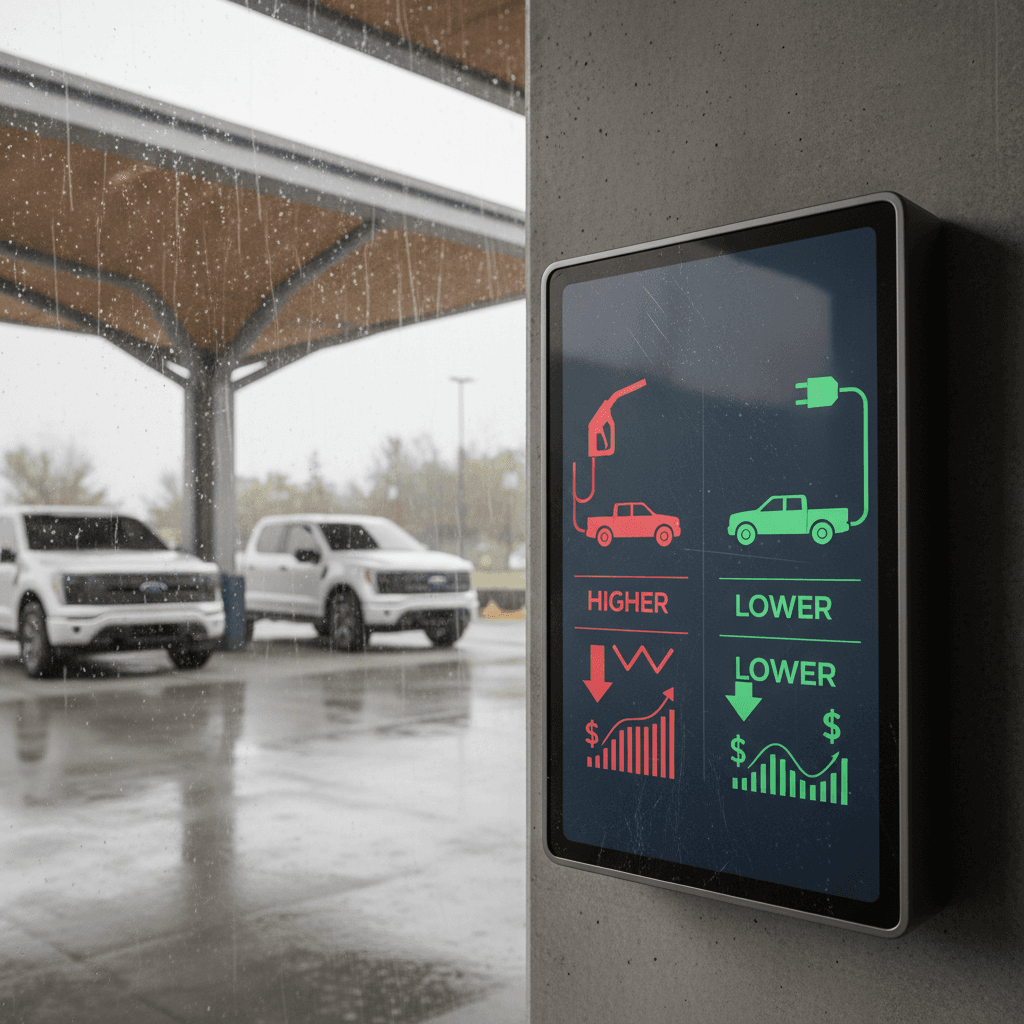
Fuel vs electricity: What you’ll really pay per mile
Step 1: Agree on some realistic assumptions
Real‑world numbers vary a lot with driving style, climate and load, but these are reasonable working figures for a modern F-150 and an F-150 Lightning used as a daily driver in the U.S.:
Working assumptions for energy cost comparison
These aren’t lab numbers, they’re ballpark real‑world figures for mixed driving.
| Item | Gas F-150 (3.5L EcoBoost class) | F-150 Lightning |
|---|---|---|
| Realistic efficiency | ~20 mpg combined | ~2.3 mi/kWh mixed use |
| Fuel / electricity price | $3.60 per gallon (U.S. average ballpark) | $0.15 per kWh (typical home rate; public fast charging is often 2–3x higher), |
| Annual mileage (scenario A) | 12,000 miles | 12,000 miles |
| Annual mileage (scenario B) | 20,000 miles | 20,000 miles |
If your driving is more city, more highway, or very tow‑heavy, your personal numbers will differ, but the relationships tend to hold.
Per‑mile cost: gas vs electrons
Using those assumptions, you can calculate rough energy cost per mile:
- Gas F-150: At 20 mpg and $3.60/gal, fuel cost ≈ $0.18 per mile.
- F-150 Lightning (home charging): At 2.3 mi/kWh and $0.15/kWh, electricity cost ≈ $0.065 per mile. Add a bit for charging losses and variability and you’re around $0.08–$0.10 per mile in many markets.
Watch your DC fast charging costs
Annual and 5‑year fuel vs electricity spend
Estimated fuel vs electricity spend
Rounded estimates for comparison; your local prices may differ.
| Scenario | Gas F-150 | F-150 Lightning (home charging) |
|---|---|---|
| 12,000 mi/year (daily driver) | ~$2,160 per year | ~$1,150 per year |
| 5 years at 12,000 mi/yr | ~$10,800 | ~$5,750 |
| 20,000 mi/year (high‑mileage) | ~$3,600 per year | ~$1,900 per year |
| 5 years at 20,000 mi/yr | ~$18,000 | ~$9,500 |
Assumes stable gas and electricity prices, which is never perfectly true in the real world, but good enough to compare directions.
In both mileage scenarios, the Lightning can save around $900–$1,700 per year on energy if you’re primarily charging at home. Over 5 years, that’s real money, on the order of $5,000–$8,000 in your favor.
Maintenance and repair: Where EVs usually win
Routine maintenance differences
Gas F-150s are known for relatively reasonable maintenance costs for a full‑size truck, but they still need oil changes, transmission service, exhaust work, spark plugs, belts and more. The Lightning eliminates many of those line items entirely. You’re mainly dealing with tires, cabin air filters, brake fluid service and general inspections.
Typical maintenance needs: Gas F-150 vs F-150 Lightning
Exact schedules vary by model year and usage, but the pattern is consistent.
Gas F-150
- Oil and filter changes several times per year (depending on mileage).
- Transmission fluid service at manufacturer intervals.
- Engine air filter, spark plugs, ignition components.
- Exhaust system, emissions controls, fuel system cleaning.
- More fluids overall to monitor and replace.
F-150 Lightning
- No engine oil, spark plugs, or exhaust system.
- Fewer moving parts in the drivetrain.
- Brake wear can be lower thanks to regenerative braking.
- Still needs tires, suspension, cabin filters and brake fluid service.
What the data tends to show
Rough annual maintenance ballparks
Published estimates and real‑world reports suggest a late‑model gas F-150 often averages in the $700–$1,000 per year range for combined routine maintenance and repairs, depending on use. A Lightning tends to land meaningfully lower, especially in the first 5–8 years while it’s under full factory coverage, because it simply has fewer consumable parts.
- Gas F-150: plan on roughly $700–$1,000 per year across a longer ownership window, more if you tow hard, run larger tires, or put on serious mileage.
- F-150 Lightning: budgeting in the $400–$700 per year range is common in the early years, trending up as the truck ages but still generally lower than a comparable gas truck.
Insurance, taxes and registration fees
Insurance premiums can cut both ways. The F-150 Lightning’s higher MSRP and expensive battery pack can push collision and comprehensive rates higher than a similarly equipped gas F-150. On the other hand, advanced driver‑assist tech and lower annual mileage for some owners can offset that somewhat. In many markets, it’s reasonable to expect the Lightning to cost a bit more to insure than an equivalent gas F-150, but the gap is often modest compared with fuel and maintenance swings.
State EV registration fees
Battery warranty, degradation and replacement risk
For many truck shoppers, the biggest question around Lightning ownership isn’t charging, it’s the battery. Ford backs the F-150 Lightning’s high‑voltage battery and related EV components for 8 years or 100,000 miles, with a guarantee that the pack will retain at least around 70% of its original usable capacity within that window. That coverage transfers to subsequent owners, which matters if you’re buying used.
Battery replacement is expensive, but unlikely early on
- If you plan to sell or trade the truck within 5–8 years, most of the degradation and failure risk is already priced into resale values and absorbed by factory coverage.
- If you plan to keep the Lightning well past 10 years, it’s smart to treat potential range loss or eventual repair as part of the long‑term cost picture, just like engine or transmission work on a high‑mileage gas F-150.
Depreciation and resale value for F-150 vs Lightning
Depreciation is where this comparison gets tricky, especially in 2024–2026, as EV prices and incentives move quickly. Historically, used F-150s have enjoyed strong resale value thanks to broad demand. The F-150 Lightning, by contrast, has already seen aggressive price cuts and shifting incentives, which have pulled used values down faster than many early buyers expected.
How depreciation trends differ
The exact dollars will shift with the market, but the patterns are clear.
Gas F-150
- Deep, liquid used market in every region.
- Values heavily influenced by mileage, configuration and condition.
- Historically strong resale if you avoid severe abuse.
- Less exposure to sudden MSRP cuts.
F-150 Lightning
- Market still finding its footing; values can move quickly.
- Early price drops and new incentives have pressured used values.
- Battery health and remaining warranty play a major role in resale.
- As EV trucks normalize, depreciation may stabilize, but you should plan conservatively.
How to think about depreciation in your decision
5-year cost scenarios: Commuter vs work-truck use
To make this more concrete, let’s walk through two simplified 5‑year scenarios using realistic, but still rounded, numbers. These aren’t quotes; they’re decision‑making frameworks you can adapt to your own situation.
Scenario A: 12,000 miles/year, light towing, mostly home charging
High‑level 5‑year cost comparison for a typical daily driver that works on weekends but doesn’t tow heavy every day.
| Category (5 years) | Gas F-150 | F-150 Lightning |
|---|---|---|
| Energy (fuel vs electricity) | ≈$10,800 | ≈$5,750 |
| Maintenance & repairs | ≈$4,000–$5,000 | ≈$2,000–$3,000 |
| Insurance (incremental difference) | Baseline | +≈$500–$1,500 total |
| Registration & EV fees | Baseline | +varies by state (0–$1,000 total) |
| Net after typical federal/state EV incentives | N/A | Upfront cost reduced if you qualify |
| Total 5‑yr running costs (ex‑depreciation) | Higher | Meaningfully lower in many home‑charging scenarios |
Assumes similar trim levels, no major accidents, and stable fuel/electricity prices.
Scenario B: 20,000 miles/year, frequent towing, mixed charging
High‑mileage work‑truck use with regular towing and more reliance on DC fast charging when on the road.
| Category (5 years) | Gas F-150 | F-150 Lightning |
|---|---|---|
| Energy (fuel vs electricity) | ≈$18,000 | ≈$9,500–$13,000 (more fast charging) |
| Maintenance & repairs | ≈$5,000–$7,000 | ≈$3,000–$4,500 |
| Insurance | Baseline | +similar modest bump |
| Operational flexibility | Refuel almost anywhere in minutes | Must plan charging, especially when towing |
| Total 5‑yr running costs (ex‑depreciation) | Still higher energy & maintenance | Savings may narrow; convenience may outweigh dollars for some owners |
Here, the Lightning’s energy advantage shrinks and convenience factors loom larger.
Where the Lightning clearly shines
Buying used: F-150 Lightning vs gas F-150
The used market is where total cost of ownership gets particularly interesting, especially for a model like the Lightning that has already experienced steep early depreciation. By the time a Lightning reaches the used market, much of that initial price drop is already baked into what you pay.
Used F-150 vs used Lightning: what to check
1. Battery health and warranty window
On a used Lightning, prioritize trucks that still fall within Ford’s 8‑year/100,000‑mile EV component warranty, and look closely at any available battery health data. At Recharged, every used EV comes with a <strong>Recharged Score Report</strong> that quantifies real battery health, so you’re not guessing.
2. Prior usage pattern
A lightly used Lightning that mostly did commuting and light hauling will likely have better range and less wear than a truck that spent its life towing at highway speeds. The same goes for gas F-150s, heavy towing accelerates wear on engines, transmissions and brakes.
3. Charging setup at home or work
If you can’t install a Level 2 charger or access reliable workplace charging, some of the Lightning’s TCO advantage disappears. For many used buyers, your charging reality is more important than the exact purchase price delta.
4. Local fuel vs electricity economics
In regions with high power prices and cheap gas, the gap between Lightning and gas F-150 operating costs narrows. In areas with lower electricity costs and high fuel prices, the Lightning’s TCO advantage can be significant, especially when you stack that with a lower used purchase price.
On the gas side, used F-150s remain a known quantity with strong parts availability and a deep bench of independent shops. That helps keep maintenance and repair costs predictable, even past 100,000 miles.
How Recharged helps you pick the cheaper truck to own
Choosing between a Ford F-150 and an F-150 Lightning isn’t just about which truck you like more, it’s about which one lets you do the work and trips you care about for the lowest all‑in cost. That’s where concrete data helps.
What you get when you shop used EVs with Recharged
Especially relevant if you’re considering a used F-150 Lightning.
Recharged Score battery health report
Transparent pricing & TCO context
Financing, trade‑ins and delivery
Ready to find your next EV?
Browse VehiclesFAQ: Ford F-150 vs F-150 Lightning ownership costs
Frequently asked questions
Bottom line: Who should pick F-150 vs F-150 Lightning?
You’ll likely come out ahead with an F-150 Lightning if…
- You can install or already have Level 2 charging at home or work.
- You drive at least 12,000–15,000 miles per year, mostly within daily round‑trip range.
- You tow only occasionally, or mostly at shorter distances.
- You can take advantage of new or used EV incentives and don’t mind learning the charging ecosystem.
A gas or hybrid F-150 probably makes more sense if…
- You can’t reliably charge at home or work and would live on public fast charging.
- You frequently tow heavy loads over long highway stretches, especially in regions with sparse chargers.
- Your annual mileage is relatively low, so the Lightning’s fuel and maintenance savings don’t add up as quickly.
- You prioritize maximum refueling flexibility and the deepest possible used‑truck market when it’s time to sell.
Both trucks can be smart financial choices, it just depends on how and where you use them. If you want help running the numbers on a specific used F-150 Lightning or another electric truck, Recharged can walk you through energy, maintenance and resale scenarios using real battery‑health data, not just guesses. That way, the truck you pick isn’t just the one you like; it’s the one that quietly costs you less to own, year after year.