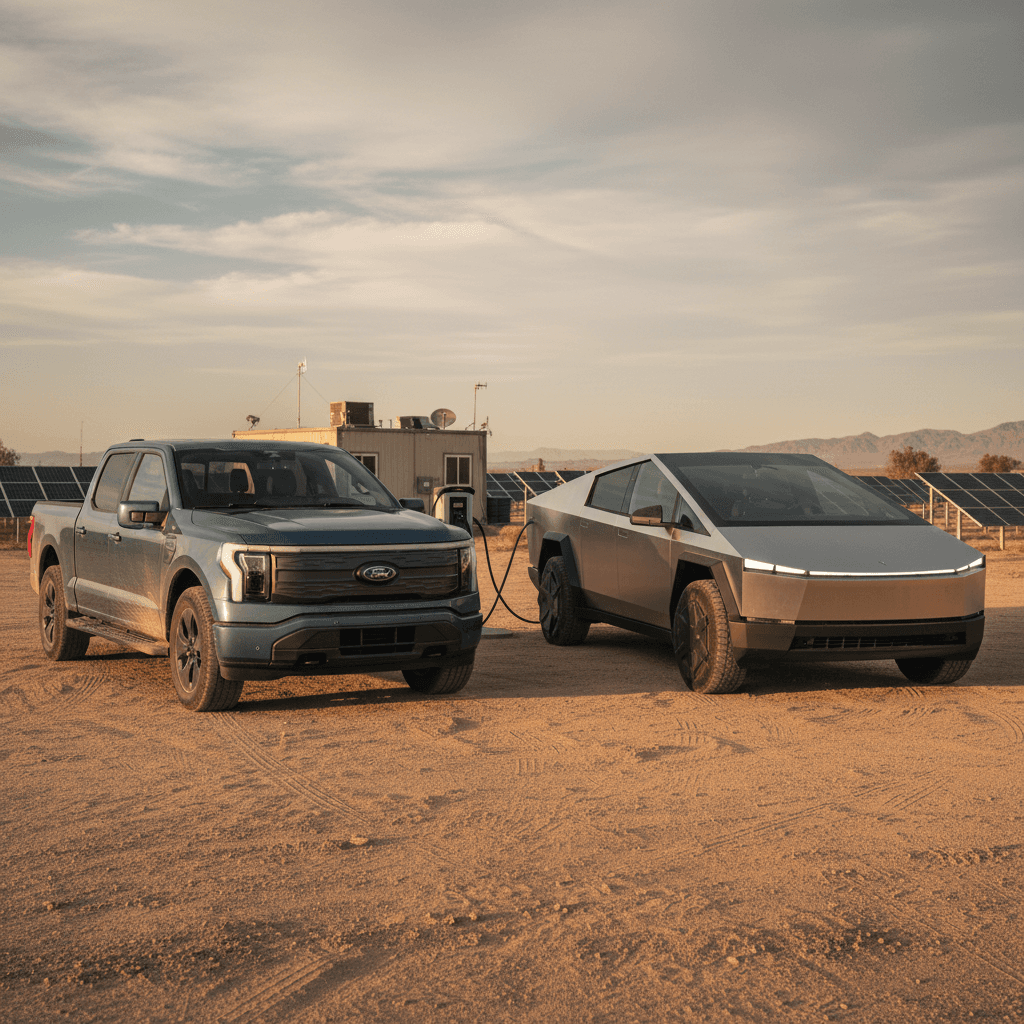
You don’t cross-shop the Ford F-150 Lightning and Tesla Cybertruck by accident. One is a familiar F-Series that happens to be electric; the other looks like it escaped from a PlayStation cutscene. If you’re asking “Ford F-150 Lightning vs Tesla Cybertruck, which is better?” what you’re really asking is: which one fits my life, my driveway, and my appetite for weird?
Two very different answers to the same question
F-150 Lightning vs Tesla Cybertruck: quick overview
Ford F-150 Lightning: the familiar choice
- Looks and feels like a modern F-150, just quieter and quicker.
- Excellent for buyers already comfortable with full-size pickups.
- Friendlier ergonomics, more straightforward controls, easier dealer support.
- Strong work-truck features (Pro Power Onboard, traditional bed and cab).
Tesla Cybertruck: the moonshot
- Radical stainless-steel body and wedge profile, love it or loathe it.
- Serious towing and off-road numbers, plus wild straight-line performance.
- Integrated frunk, sail storage and covered vault bed; fewer old-school truck cues.
- Best paired with an owner who doesn’t mind being stared at everywhere, always.
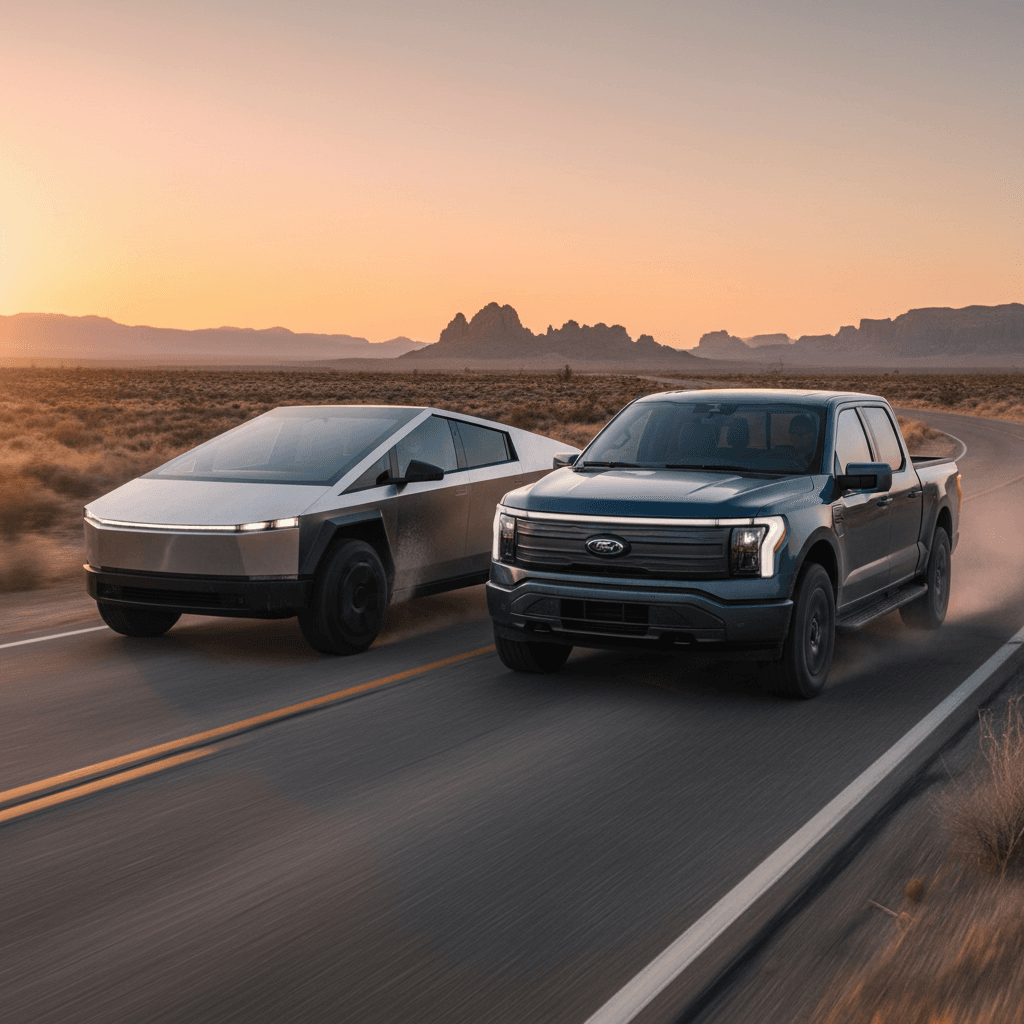
Headline numbers: Lightning vs Cybertruck
Key specs at a glance
Ford F-150 Lightning vs Tesla Cybertruck: core specs
Approximate specs for popular configurations as of early 2026. Always confirm exact numbers for the trim you’re buying, especially on the used market.
| Spec | F-150 Lightning (common trims) | Tesla Cybertruck (AWD / Cyberbeast) |
|---|---|---|
| Power & motors | Dual-motor AWD, up to ~580 hp | Dual- or tri-motor AWD, up to ~845+ hp |
| 0–60 mph | ~4.0 sec (Extended Range), ~5 sec others | ~4.1 sec AWD, ~2.6–2.7 sec Cyberbeast |
| Battery | ~98–131 kWh usable depending on pack | Large structural pack, capacity undisclosed but similar ballpark |
| Max range (EPA/est.) | Around 240–320 mi depending on trim | Around 340+ mi AWD; ~320+ mi Cyberbeast (est., wheel/tire dependent) |
| Max towing | Typically 7,700–10,000 lb depending on configuration | Up to 11,000 lb on higher trims, less on cheaper variants |
| Max payload | ~1,800–2,000 lb depending on trim | Up to ~2,500 lb quoted on certain configurations |
| Fast-charging | Peak around 150–170 kW, CCS/NACS depending on year | Up to 250 kW or more on Tesla Superchargers (800V architecture) |
| Bed | Traditional open bed, multiple lengths in broader F-150 line | Integrated 6' vault with powered tonneau; fixed layout |
| Body style | Conventional aluminum body on ladder-style EV chassis | Stainless-steel exoskeleton, angular design |
Specs vary by trim, wheel/tire choice and options. Treat these as ballpark comparisons, not lab results.
Specs look clean on paper. Real life is messy.
Range, efficiency and real-world driving
On a spec sheet, the Cybertruck generally wins the range fight. Its 800‑volt architecture and slippery(ish) aero help it post higher official numbers than most F-150 Lightning trims. In the real world, though, both trucks are big, heavy bricks on off-road tires, think more "rolling condo" than "Prius." Neither will give you Model 3 efficiency.
- In mixed commuting without towing, many Lightning owners report practical ranges in the 180–260 mile window depending on wheel size, weather and speed.
- Cybertruck drivers see similar real-world ranges, often 230–300 miles when driven gently on highway-biased tires.
- Put big off-road rubber or accessory racks on either truck and you’ll watch the range display fall like a stock chart on bad news day.
Think in legs, not in tankfuls
Towing, payload and real truck work
If you buy with your heart, you’ll stare at the Cybertruck’s 11,000‑lb tow rating and 0–60 time and believe you can drag Wyoming behind you at 80 mph. If you buy with your head, you’ll know every EV truck today loses a heartbreaking amount of range when you hitch up something heavy.
How they really behave when you tow
Both can tow. The game is how far, how fast, and how often you want to stop.
Ford F-150 Lightning at work
- Typical max tow ratings in the 7,700–10,000 lb neighborhood depending on trim and packages.
- Traditional trailer brake controls, mirrors and hardware feel familiar to F‑Series owners.
- Well suited to contractors and weekend towers who do shorter hauls or can charge at both ends.
Tesla Cybertruck at work
- Advertised 11,000‑lb max tow rating gives it bragging rights.
- Massive torque makes merging with a trailer feel comically easy.
- Range still drops sharply under heavy load, but you start from a slightly higher baseline.
The ugly truth about EV towing
Cabin comfort, usability and tech
Why the Lightning is easier to live with
- Inside, it’s recognizably an F‑150: big knobs, dedicated climate controls, normal door handles and mirrors.
- Seats are generously padded, visibility is excellent, and most people can hop in and drive without reading a PDF first.
- Pro Power Onboard turns the truck into a giant rolling generator, contractors love being able to run tools or even backup parts of a house.
- Infotainment is solid rather than spectacular, but CarPlay and Android Auto simplify life for most owners.
Why the Cybertruck feels like a sci‑fi prototype
- Ultra-minimalist cabin with a single massive center screen and steering yoke or squircle wheel depending on build.
- Fewer physical controls; almost everything happens through the screen or steering-wheel buttons.
- Visibility is a mixed bag: excellent straight ahead, more compromised out back due to the sloped vault and high beltline.
- Tech integration (navigation, app, over-the-air updates, camera views) is classic Tesla, powerful but occasionally idiosyncratic.
If your spouse or crew has to like it too…
Charging, road trips and networks
Charging used to be Tesla’s automatic win thanks to the Supercharger network. That advantage is shrinking as Ford, GM and others gain access to NACS Superchargers and new high-power CCS/NACS sites pop up on major corridors. By 2026, both the Lightning and Cybertruck can realistically serve as road‑trip vehicles if you’re willing to plan.
Lightning vs Cybertruck: charging experience
Same electrons, different ecosystems.
Home charging
Both trucks are happiest plugged into a 240V Level 2 charger overnight.
- Expect to add 20–30+ miles of range per hour depending on charger and trim.
- Either truck can be your only vehicle if you can reliably charge at home.
On the road
- Cybertruck integrates seamlessly with Tesla’s Supercharger network; plug in, walk away.
- Newer Lightnings with NACS access can also use many Superchargers, plus legacy CCS fast chargers.
- Both can see peak rates above 150 kW; Cybertruck’s 800V architecture can hold higher power longer in ideal conditions.
Planning trips
- Tesla’s in-car trip planner is excellent at routing via chargers and accounting for elevation and weather.
- Ford’s system has improved, but many Lightning owners still lean on third‑party apps like A Better Routeplanner or PlugShare.
Apartment dwellers, read this twice
Pricing, value and resale outlook
Sticker prices on new electric trucks have swung wildly since 2022. Tesla has yo‑yoed Cybertruck pricing and added cheaper variants with less capability. Ford has raised, lowered and reconfigured Lightning trims in response to demand and battery costs. By 2025, we started to see the real story: both trucks selling well below early hype and used prices settling into reality.
How pricing and value stack up
High-level view of how the money side tends to shake out by 2026. Exact numbers will vary by market, incentives and configuration.
| Factor | F-150 Lightning (used market) | Tesla Cybertruck (used market) |
|---|---|---|
| Purchase price | Often meaningfully discounted vs original MSRP; more supply, especially work-oriented trims. | Still carries an "early adopter" tax in many areas, though price cuts and new trims are cooling demand. |
| Incentives | Some model years may qualify for used EV tax credits depending on price and buyer eligibility. | Used Cybertrucks can sometimes fit under price caps, but eligibility is more hit-or-miss. |
| Depreciation | Follows the pattern of other F‑150s: big first hit, then more predictable. Fleet and work buyers soften resale drops. | Novelty keeps values afloat for now, but volatility is high, public sentiment and updates can move prices fast. |
| Running costs | Common truck tires, glass and body panels are easier and cheaper to source; repairs more conventional. | Stainless body panels and unique glass can be eye‑wateringly expensive; not every body shop is eager to learn on yours. |
| Brand ecosystem | Dealer network for service, plus independent truck shops learning the platform. | Direct-service model with mobile technicians and service centers; parts and appointment availability vary by region. |
Treat these as directional trends, not quotes. Always check real-time pricing and incentives.
Resale is where sensibility tends to win
What they’re actually like to live with
Strip away the Twitter arguments and you’re left with two full-size electric trucks that both do mundane things extremely well: school runs, Costco, commuting through traffic that moves like cold honey. The split is how they make you feel while you do it.
Questions to ask yourself before you pick a side
1. Do you regularly park in tight garages or old downtown lots?
Both trucks are massive, but the Lightning’s familiar shape and mirrors make it easier to judge. Cybertruck’s wedge profile and thick pillars demand more acclimation.
2. Who else has to drive this thing?
If the answer is “everyone in my household plus a rotating cast of coworkers,” the Ford’s conventional controls and visibility are friendlier. Cybertruck rewards patient, tech-tolerant drivers.
3. How often will you actually tow heavy?
If towing is a once-a-month activity, either truck works. If you tow long distances weekly, you’re buying into a life of high-speed charging stops, where Cybertruck’s extra range helps, but not enough to suspend physics.
4. Is your personality okay with being a spectacle?
The Lightning disappears into a jobsite or driveway. The Cybertruck does not. Some people love that. Some don’t want to explain their truck to strangers every time they pump windshield fluid.
5. What’s your service and support comfort zone?
Ford’s dealer network is imperfect but familiar. Tesla’s direct model can be efficient when it works, frustrating when it doesn’t. Talk to owners in your region about real-world experiences.
Which truck is better for which buyer?
Ford F-150 Lightning vs Tesla Cybertruck: who should buy what?
Instead of chasing one winner, match the truck to the life.
F-150 Lightning is better if…
- You want an electric truck that still looks and works like an F‑150.
- You care more about towing stability and work‑friendly features than shock-and-awe acceleration.
- Multiple people will drive it and you want a shallow learning curve.
- You value easier body repairs, more conventional parts and broader dealer support.
- You’re planning to keep the truck a long time and want something the next owner will “get” instantly.
Cybertruck is better if…
- You want your truck to be a rolling conversation starter and you enjoy the attention.
- Maximum performance and highest published tow numbers matter to you.
- You’re comfortable living in Tesla’s software-first world, warts and all.
- You mainly tow moderate loads or toys and are willing to plan your charging stops.
- You like the idea of owning something closer to a technology showcase than a traditional work tool.
Buying a used electric truck with Recharged
Whether you lean Lightning or Cybertruck, the smartest place to buy is where someone has already done the homework on battery health, pricing and history. That’s the entire premise of Recharged, a marketplace built around used EVs, including electric pickups, with obsessive transparency.
- Every vehicle comes with a Recharged Score Report that includes verified battery health, detailed range expectations and fair market pricing benchmarks.
- You can get financing, a trade‑in or instant offer on your current vehicle, and nationwide delivery without ever setting foot in a traditional showroom.
- If you’re local to Virginia, you can visit the Recharged Experience Center in Richmond and talk through whether a Lightning, Cybertruck, or another EV truck actually fits your use case.
- Our EV specialists can help you sanity‑check towing plans, home charging, and long‑term ownership costs before you commit.
Not sure which truck to chase on the used market?
Ford F-150 Lightning vs Tesla Cybertruck FAQs
Frequently asked questions: F-150 Lightning vs Cybertruck
Bottom line: Lightning vs Cybertruck, who wins?
If you park emotion at the curb and buy with your head, the Ford F-150 Lightning is the better all‑rounder for most people. It’s easier to live with, easier to repair, and easier to explain to the next owner. If you buy with your heart and your heart wants stainless steel, absurd acceleration and a rolling design manifesto, the Tesla Cybertruck will make every grocery run feel like a premiere, even when it’s overkill for the job.
The honest answer to “Ford F-150 Lightning vs Tesla Cybertruck, which is better?” is that they solve different problems. Pick the one that fits your daily life, your charging situation and your appetite for attention. Then, if you’re shopping used, let Recharged put real data, battery health, pricing sanity and expert guidance, between you and buyer’s remorse.