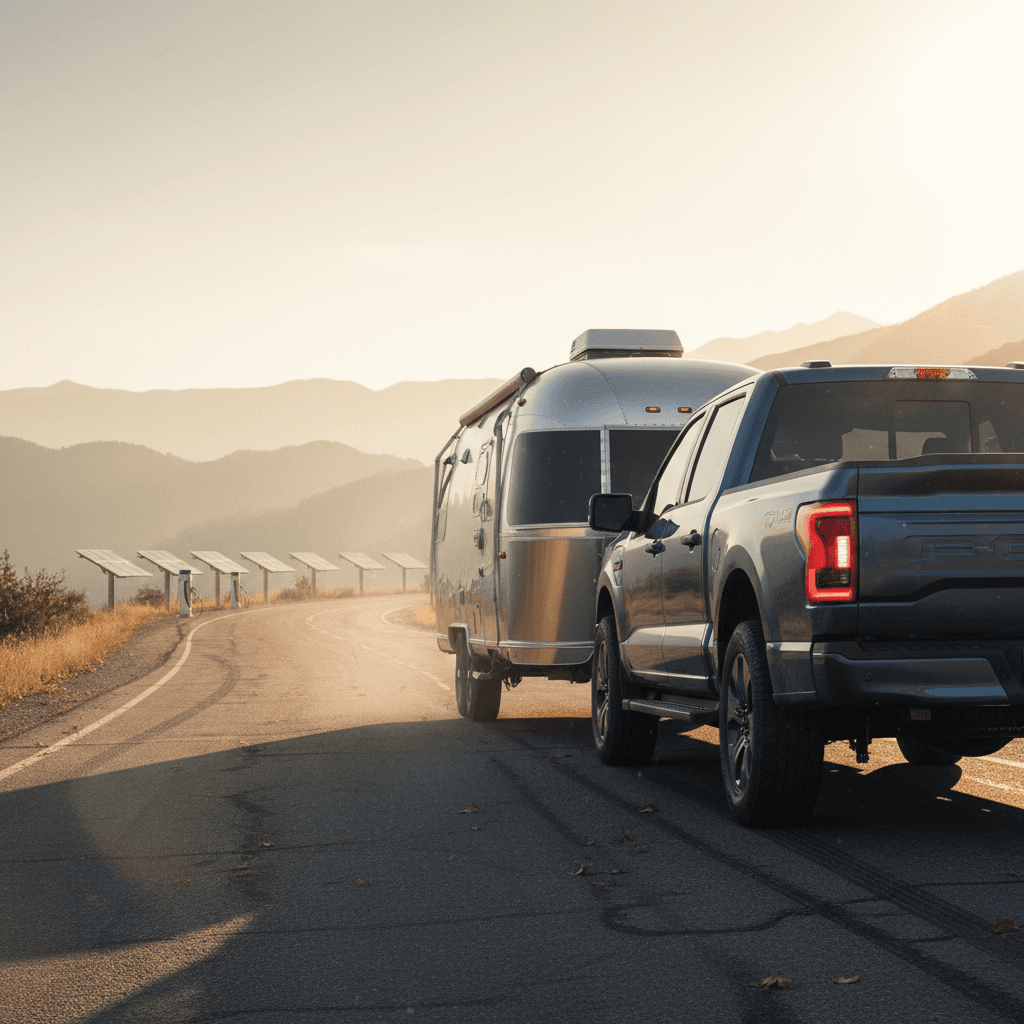
If you’re looking at a Ford F-150 Lightning, you’ve probably heard two things: the truck can tow up to **10,000 pounds**, and its **range drops hard with a trailer**. Both are true. The key is understanding how Ford F-150 Lightning towing capacity and range actually work in the real world, so you know whether this truck fits your boat, camper, or work trailer, especially if you’re considering a used Lightning.
Quick snapshot
Why F-150 Lightning towing feels different from gas trucks
On paper, the F-150 Lightning looks like a towing natural: instant torque, standard 4WD, and big numbers on the spec sheet. In practice, towing with an electric truck is a different game from a gas F-150. You’re playing with energy density, aero drag, and charging access, not just engine grunt.
- Instant torque makes getting a heavy trailer moving effortless, even on grades or in stop‑and‑go traffic.
- Battery energy is precious and finite; a big trailer at 70 mph feels like you’ve poked a hole in the tank.
- Charging stops become part of the plan, especially on trips over 100–150 miles with a heavy trailer.
- Thermal management (battery heat, ambient temps) matters more than in a gas truck.
The mental shift
F-150 Lightning towing capacity by trim and package
Let’s start with the hard numbers. Official tow ratings vary by battery, trim, and whether the truck has the Max Trailer Tow Package. Below is a simplified snapshot for the first‑gen Lightning (through the 2025 model year). Exact figures can vary slightly by year and configuration, but this will get you in the ballpark.
Ford F-150 Lightning conventional towing capacity (approximate)
Max conventional towing for common trims with and without the Max Trailer Tow Package.
| Trim | Battery | Max tow (no Max Trailer Tow) | Max tow (with Max Trailer Tow) |
|---|---|---|---|
| XLT / STX | Standard-range | 5,000 lbs | 7,700 lbs |
| Flash | Extended-range | 7,700 lbs | 10,000 lbs |
| Lariat | Extended-range | 7,700 lbs | 10,000 lbs |
| Platinum | Extended-range | 8,500 lbs (Max Trailer Tow std.) | 8,500 lbs |
Always confirm exact ratings on the driver’s door jamb and in the owner’s manual for your specific truck.
Payload matters too
Core Lightning towing & range specs at a glance
EPA range vs. real-world Lightning range
EPA numbers for the F-150 Lightning assume no trailer, moderate driving, and relatively friendly weather. In that world, you’ll see something like:
EPA-rated range for common F-150 Lightning configurations
Unloaded, under typical EPA test conditions.
Standard-range battery
- Approx. 230–240 miles EPA-estimated range depending on model year and trim.
- Best for local work, short commutes, and lighter towing within 50–80 miles of home.
Extended-range battery
- Approx. 300–320 miles EPA-estimated range on many trims.
- Gives you the headroom to tow, especially if you keep speeds down.
Think in energy, not miles
How towing affects F-150 Lightning range
With a gas truck, tow ratings are mostly about structure and cooling. With an EV truck, aerodynamics and weight become existential questions. A big, square camper can turn that slick aero F-150 Lightning into a rolling wall.
- Trailer weight: Heavier trailers demand more energy to accelerate and climb hills, and they load the rear suspension, which can subtly change aero.
- Frontal area & shape: A tall, blunt travel trailer adds massive drag. A low car hauler or boat is comparatively gentle on range.
- Speed: Above about 60 mph, aerodynamic drag grows quickly. Going from 65 to 75 mph can feel like driving into a headwind all day long.
- Grade & terrain: Long climbs eat range; long descents give some back via regen, but never as much as you spent going up.
- Temperature: Cold weather hits EV range even without a trailer. Add a camper, and the penalty stacks: more drag, more heater use, colder battery.
- Wind: A headwind effectively raises your speed relative to the air. A stiff 20–30 mph headwind can feel like you added another 1,500–2,000 lbs behind you.
Low, slippery loads
Think open car hauler, utility trailer, or boat. The truck still sits mostly in clean air, and the trailer hides in the wake. Owners often report range reductions nearer the 30–40% side of the spectrum at moderate speeds.
Tall travel trailers
A big boxy camper adds frontal area and turbulent drag. In this scenario, seeing 50–60% or more range loss at 65–70 mph is not unusual, especially in hilly terrain or cold weather.
The cold-weather double penalty
Real-world towing range: what drivers actually see
Independent tests and owner reports tend to converge on the same rough truth: with a significant trailer, expect your Lightning’s range to roughly halve at highway speeds. The exact number depends on your trailer and your right foot.
Example towing scenarios for an extended-range Lightning
Not guarantees, just realistic ballparks to start your planning.
Mid-size camper (~6,000 lbs)
- Truck: Extended-range Lightning, 320‑mi EPA rating.
- Scenario: 70 mph highway, mild weather, rolling terrain.
- What testers have seen: roughly 90–130 miles of comfortable towing range between fast charges.
Car hauler (~4,000–5,000 lbs loaded)
- Truck: Extended-range Lightning.
- Scenario: 60–65 mph, mixed two‑lane and highway.
- Typical reports: 140–180 miles of range, assuming you’re not climbing mountain passes all day.
Boat or low utility trailer (~3,000 lbs)
- Truck: Either battery, short‑distance use.
- Scenario: Back‑and‑forth to the lake, 55–60 mph tops.
- Many owners treat this almost like normal driving, seeing perhaps a 20–35% range hit.
Why the spread is so big
How to plan Lightning towing trips without range anxiety
If you play to the Lightning’s strengths, towing can be smooth, and surprisingly relaxing. The trick is to plan like a pilot, not a passenger: know your route, your weather, and your bailout options.
Planning a towing trip in a Ford F-150 Lightning
1. Start with a conservative range estimate
Take your truck’s EPA rating and mentally cut it by <strong>50–60%</strong> for a tall camper at highway speeds, or by <strong>30–40%</strong> for a lower, more aerodynamic trailer. Use that as your initial planning number, not the dash display.
2. Map fast chargers that work with a trailer
Look for <strong>pull‑through or easily accessible DC fast chargers</strong> near major routes. Apps that show real‑world photos are invaluable, you don’t want to discover a tight parking lot with a 25‑foot trailer behind you.
3. Plan to arrive with 15–20% battery, not 0%
Just like fuel, you don’t want to run the pack down to fumes. Towing in wind, traffic, or unexpected detours can chew through your buffer. Arriving with 15–20% charge gives you room for surprises.
4. Keep speeds reasonable
Every 5 mph at highway speeds is a meaningful range penalty with a box trailer. Dropping from 75 to 65 mph can extend your range more than almost any other single decision you make.
5. Weigh your trailer once
Hit a CAT scale or local weigh station with your rig loaded as you’d normally use it. Knowing your <strong>real</strong> trailer and tongue weight is crucial for both safety and for understanding why your range is what it is.
6. Use the truck’s towing tech
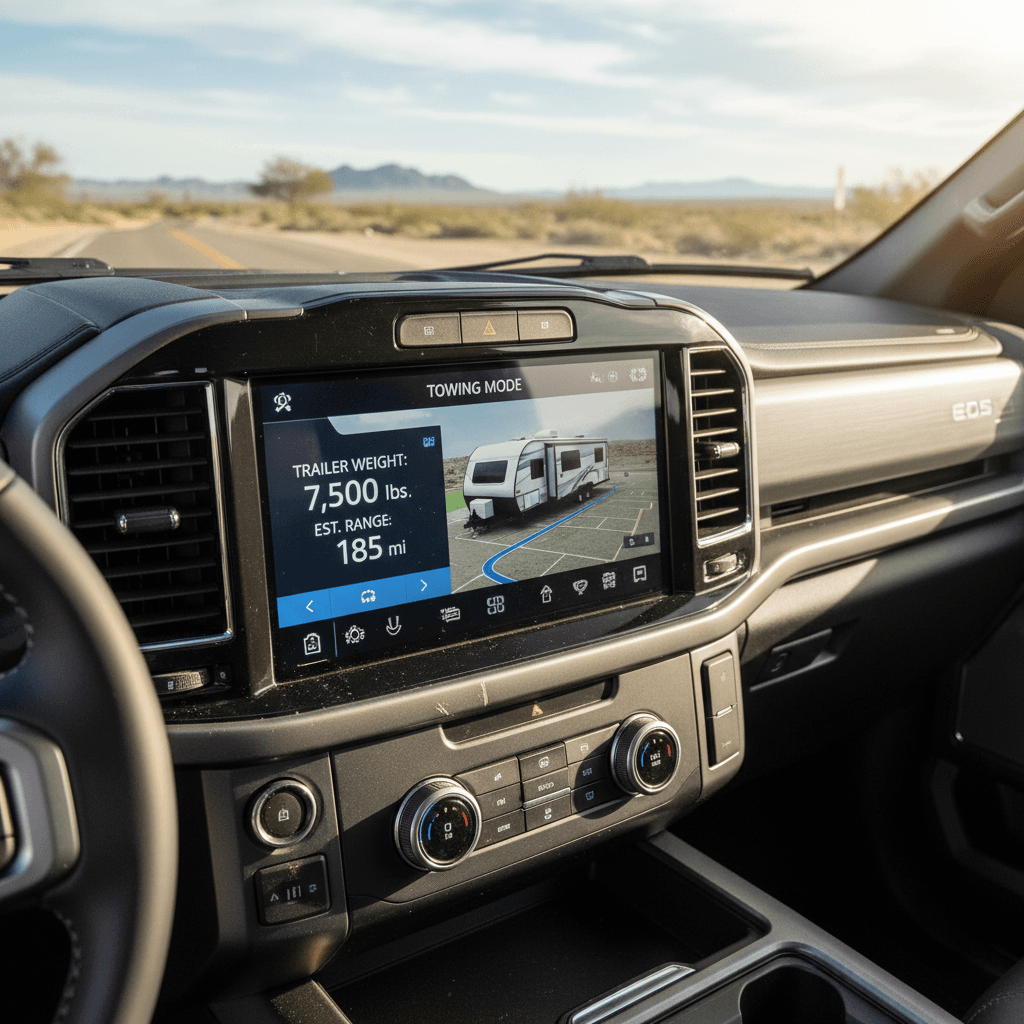
The Lightning’s onboard tools, like <strong>trailer profile setup and dynamic range estimates</strong> based on sensed tongue weight, are there to help. Build a trailer profile and update it when you change cargo or campers.
Play to its strengths
Shopping a used F-150 Lightning if you plan to tow
If you’re eyeing a used Lightning, the towing story isn’t just about the brochure numbers. It’s about the specific truck in front of you: battery, trim, options, and how it’s been driven and charged. This is where a structured approach, and some objective battery data, really pays off.
Key questions when buying a used Lightning for towing
A little homework now prevents some very long days on the side of the highway later.
Does it have the capacity you need?
- Confirm the Max Trailer Tow Package if you’re aiming for 10,000 lbs. Don’t assume it’s equipped, many trucks aren’t.
- Check the actual tow rating and payload on the driver’s door jamb sticker, not just the online listing.
What’s the real battery health?
- Battery degradation directly affects your towing range. A truck that’s lost 10–15% of its usable capacity will feel that much smaller “tank” every mile.
- Ask for objective battery data or a third‑party test, not just someone saying “it seems fine.”
How was it used?
- Trucks that spent life as short‑trip grocery getters with occasional DC fast charging usually age better than ones DC‑fast‑charged daily and flogged as rolling generators.
- Heavy commercial use isn’t a deal breaker, but factor it into price and expectations.
Can someone sanity‑check the numbers with you?
- If you’re new to EV towing, it helps to talk to an EV‑savvy specialist who’s seen lots of these trucks, not just one.
- A good advisor will push back if your dream trip doesn’t match the truck’s physics.
Where Recharged fits in
Pros and cons of the Lightning as a tow vehicle
Where the Lightning shines
- Effortless low‑speed control: Backing a trailer up a tight driveway or boat ramp is almost comically easy with instant torque and one‑pedal feel.
- Quiet, low‑vibration towing: Long days with a trailer are less fatiguing when there’s no engine droning away up front.
- Built‑in power supply: The Lightning can power tools, campsites, and even homes during outages, no separate generator needed.
- Smart towing tech: Trailer profiles, load‑based range estimates, and strong driver‑assist features make the learning curve gentler.
Where it asks for compromise
- Limited long‑haul towing radius: Cross‑country camper trips become chess matches around charging, if they’re realistic at all.
- Trailer‑unfriendly charging layouts: Many DC fast chargers assume you’re a Corolla, not a crew cab and 24‑foot trailer.
- Range swings with weather: A snowy day with a headwind can cut your towing range to a fraction of the EPA sticker.
- Payload trade‑offs: Heavier batteries mean lower payload on high‑trim trucks, which matters if you’re loading people, gear, and tongue weight together.
Tough love moment
Ford F-150 Lightning towing & range FAQ
Frequently asked questions about F-150 Lightning towing and range
Bottom line: who the F-150 Lightning tows best for
The Ford F-150 Lightning is both exactly what the spec sheet says it is and something the brochure politely understates. It’ll tow up to 10,000 pounds, launch that load off the line like a muscle car, and then calmly inform you that physics has taken a serious bite out of your range. If your towing life is regional, predictable, and mostly under about 150 miles a day, the Lightning can be a brilliant partner, quiet, controllable, and surprisingly civilized with a trailer in tow.
If, on the other hand, you live for cross‑country fifth‑wheel odysseys or 500‑mile horse‑trailer days, a first‑generation Lightning is the wrong dance partner. In that case, a gas or hybrid truck, or the next‑gen range‑extended Lightning Ford has signaled, is the smarter bet.
If you’re shopping the used market, especially, don’t just memorize tow ratings. Look at battery health, real‑world range, and your routes. That’s where a platform like Recharged earns its keep: every truck comes with a Recharged Score battery report, transparent pricing, nationwide delivery, and EV‑savvy specialists who can walk through your specific towing plans. Match the right Lightning to the right job, and you’ll wonder how you ever lived with a roaring V8 at the end of every long day on the road.