If you own or are eyeing a Ford F‑150 Lightning, you’re probably asking one simple question: how fast does this truck actually charge in the real world? This Ford F‑150 Lightning charging speed guide walks through home and DC fast charging times, how battery size and model year change the numbers, and the tricks seasoned owners use to cut time at the plug.
Quick charging snapshot
Why F‑150 Lightning charging feels different from other EVs
The F‑150 Lightning is a big, bluff‑fronted truck with a huge battery. That’s part of its charm, and it’s also why charging can feel slower than it does in a smaller crossover, even when the charger is working as advertised. You’re simply moving more energy in and out of the pack.
Big battery, big appetite
The Lightning’s usable battery ranges from roughly 98 kWh in early Standard Range trucks to about 123–131 kWh in Extended Range versions. That’s nearly twice the capacity of some compact EVs, so every 10% of charge is a big chunk of energy.
Truck aerodynamics and weight
Aero and mass work against you at highway speeds. The Lightning’s shape and weight mean higher energy use per mile, especially at 70–80 mph or while towing. That doesn’t change the charger’s power, but it shrinks how many miles you gain per minute plugged in, which is what you feel on a road trip.
Don’t compare it to a small crossover
Battery sizes and what they mean for charging speed
Ford has tweaked the F‑150 Lightning’s battery lineup over the years, and those changes matter for charging speed and timing. Here’s the high‑level view, focused on what you’ll actually experience at the plug rather than spec‑sheet trivia.
F‑150 Lightning battery versions at a glance
Approximate usable capacities and how they translate into real‑world charging behavior.
| Model years / trim | Battery type | Approx. usable capacity | EPA rated range (typical) | Max AC charging (home) | Max DC fast charge (peak) |
|---|---|---|---|---|---|
| 2022–2023 SR | Standard Range | ~98 kWh | ~230–240 mi | Up to 80A (19.2 kW) with Ford Charge Station Pro on some trims | Up to ~150 kW |
| 2022–2025 ER | Extended Range | ~131 kWh (earlier), ~123 kWh (2024–2025) | Up to ~320 mi (trim‑dependent) | Up to 80A (19.2 kW) on 2022–2023; ~48A (11.3 kW) on many 2024–2025 trucks | Up to ~150 kW |
| 2026 Lightning (final BEV year) | Extended Range only | ~123 kWh | Similar to late ER trucks | Generally 48A (11.3 kW) onboard charger | Up to ~150 kW |
Numbers are rounded for simplicity; always check your specific truck’s window sticker or owner’s manual for exact specs.
Production changes after 2025
What those battery numbers feel like in minutes
Home charging speeds: Level 1 and Level 2
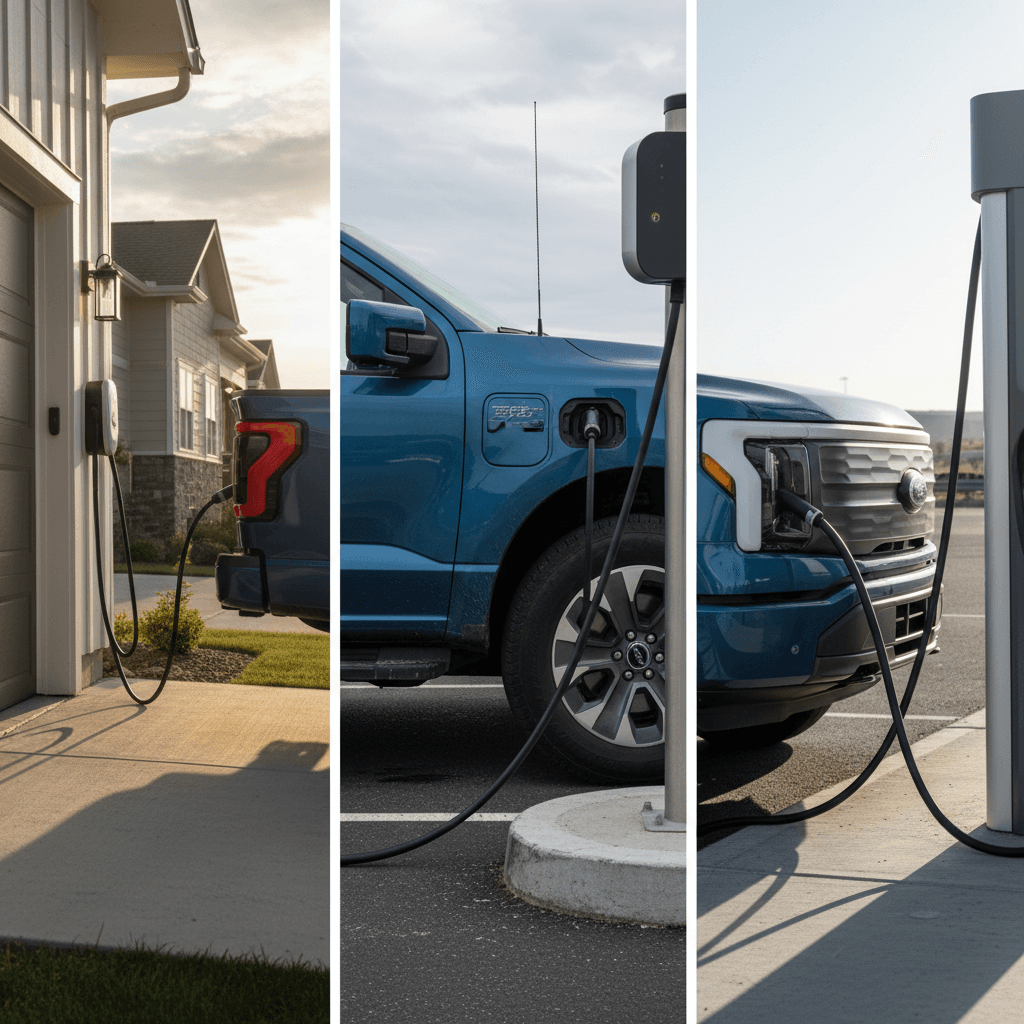
Most Lightning owners quickly realize that home charging is where the truck really makes sense. You plug in overnight and wake up to a full pack, no gas‑station detour required. The key is matching your home setup to your driving needs.
- Level 1 (120V household outlet): About 2–3 kW. Expect only a handful of miles of range per hour. This is emergency‑only for most Lightning owners.
- Level 2 (240V, 30–48A typical): 7–11.5 kW depending on your breaker and EVSE. This is what most owners install and what we’ll focus on here.
- Ford Charge Station Pro (up to 80A on early trucks): On 2022–2023 Extended Range models, this can deliver up to 19.2 kW, cutting full‑pack charge times dramatically, but only if your electrical service and wiring can support it. Newer trucks generally top out at about 48A (~11.3 kW).
Typical F‑150 Lightning home charging times
Approximate times from a low state of charge (around 10–15%) to full, assuming a healthy battery and typical conditions.
| Outlet / charger | Breaker / amps | Approx. power | Standard Range (98 kWh) | Extended Range (~123–131 kWh) |
|---|---|---|---|---|
| 120V wall outlet (Level 1) | 15A | ~1.4 kW | Over 2 days from low to full | 2–3 days from low to full |
| 240V dryer‑style plug | 30A | ~5.7 kW | ~19–21 hrs | ~23–26 hrs |
| Typical home wall box | 40A | ~9.6 kW | ~11–12 hrs | ~14–15 hrs |
| High‑output home wall box | 48A | ~11.3 kW | ~9–10 hrs | ~11–13 hrs |
| Charge Station Pro on early ER trucks | 80A | Up to ~19.2 kW | N/A (SR limited by onboard charger) | As little as ~6–8 hrs |
Think in ranges, not exact minutes, your driving style, climate, and battery conditioning will shift these numbers slightly.
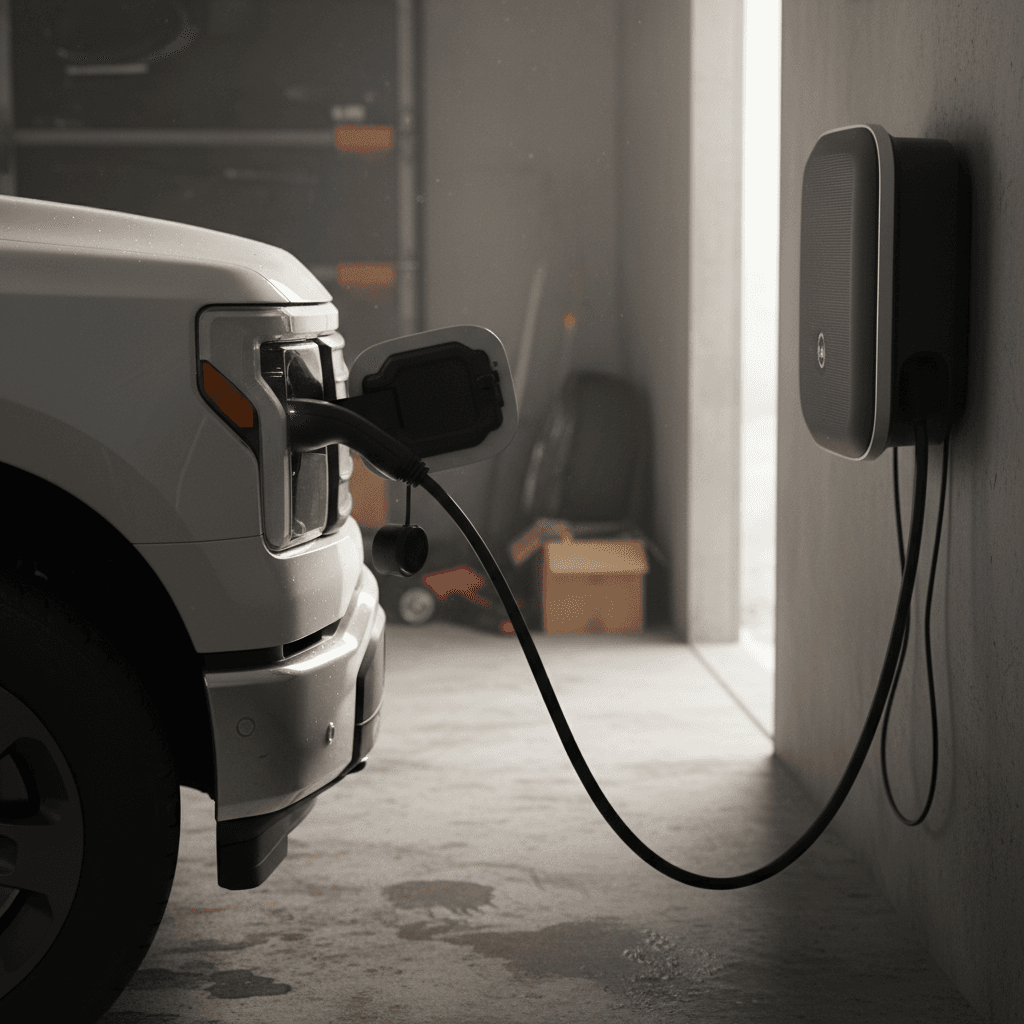
Why the 48A limit matters on newer trucks
How to pick the right home charging speed for your Lightning
1. Add up your real daily miles
If you drive 30–50 miles a day and plug in overnight, even a 30–40A Level 2 setup can quietly refill your battery by morning. High‑milers, heavy towers, or folks who skip nights will benefit from 48A and up.
2. Check your electrical panel capacity
A 48A EV circuit needs a 60A breaker; an 80A EV circuit needs a 100A breaker. Have a licensed electrician confirm what your panel and service can safely support before you order hardware.
3. Match the EVSE to your truck, not the brochure
Early ER Lightnings can use 80A home charging; many later trucks top out at 48A. There’s no reason to pay for an oversized wall box if the onboard charger will never ask for that power.
4. Prioritize location and cable management
A perfectly sized charger on the wrong wall is a daily annoyance. Make sure the cord comfortably reaches your charge port without dragging across walkways or under garage doors.
DC fast charging: How quick is the Lightning, really?
On the road, DC fast charging is your friend, if you understand what the Lightning is good at and where its limits are. Ford’s own guidance for 2024–2025 trucks pegs a 15–80% DC fast charge at roughly 32–38 minutes on a capable station, and that lines up with what careful testing and owner logs show.
What happens when you plug into a DC fast charger
Same truck, different behavior than at home
High early peak
Arrive near 10–20% state of charge (SoC), and a healthy Lightning can briefly spike to around 150 kW on a 150 kW or 350 kW unit.
Then a steady plateau
After that spike, many owners see the truck settle into a plateau near 110–130 kW through the heart of the session.
Taper as you fill up
Once you cross roughly 70–80% SoC, the truck starts to taper harder, stepping down to double‑digit kilowatt levels to protect the battery.
Typical F‑150 Lightning DC fast charging times
How long common charging stops really take when you’re traveling.
| Charge window | Why you’d do it | Approx. time on 150 kW+ charger | What it adds (Extended Range) |
|---|---|---|---|
| 10–60% | Short hop to next stop | ~20–25 minutes | Roughly 130–170 miles at highway speeds |
| 15–80% | Standard road‑trip stop | ~30–38 minutes | Roughly 180–220 miles, depending on speed and conditions |
| 20–90% | Stretch stop, charger scarce ahead | ~45–55 minutes | A bit more buffer, but last 10% is slow |
| 40–80% | Top‑off while eating | ~20–25 minutes | Nice bump before an overnight destination |
These times assume a functioning, high‑power charger and a warmed‑up battery. Cold packs and underpowered stations will add time.
Don’t chase 100% on DC fast chargers
Charging strategies for daily driving vs. road trips
Daily driving: let home charging do the work
For commuting and errands, your goal is convenience, not squeezing every mile out of each kilowatt‑hour. Plug in most nights, set a target charge (often 70–80%), and let the truck sip energy while you sleep. Even on a modest Level 2 setup, you’ll replace a day’s worth of miles overnight without thinking about it.
If you’re short on panel capacity, you can still make a Lightning work by plugging in whenever you’re home and keeping your daily range needs realistic.
Road trips: think in segments, not full charges
On long drives, the trick is treating the Lightning like a fuel‑cell truck with invisible tanks between chargers. Instead of obsessing over 0–100%, plan your day around 10–60% or 15–80% hops. Those are the sweet spots where charging is fastest.
Apps like A Better Routeplanner (ABRP), PlugShare, and Ford’s built‑in navigation can help you target reliable high‑power stations spaced 100–150 miles apart.
Planning a smoother Lightning road trip
1. Start the day near 90–100%, at home
Use your home Level 2 charger to fill up before you leave. A slow overnight charge is gentle on the battery and avoids premium fast‑charging prices.
2. Aim to arrive around 10–20%
Arriving low gives the battery reason to accept higher power. Pulling in with 50–60% left in the pack just means you’ll sit longer for fewer usable miles.
3. Stop earlier than you think
Because of tapering, two shorter 15–80% stops usually take less total time than one long push to 95–100%. Plan around your meals and restroom breaks.
4. Prefer high‑power, newer stations
Not all 150 kW signs mean the same thing in the real world. Newer 150–350 kW sites from major networks tend to deliver steadier power than older or single‑stall installations.
Use the truck’s battery conditioning to your advantage
How towing, weather, and load affect your charging stops
Here’s where the truck part of this electric truck really shows up. A Lightning towing a big camper up a cold, windy interstate is a very different animal from a lightly loaded truck cruising on a spring day, both in how often you need to stop, and how much time each stop takes.
Three big factors that change your charging rhythm
They don’t change charger power, but they change how far that power takes you
Towing & payload
A heavy trailer or full bed can slash range by 40–60%, especially at highway speeds. You’ll stop more often, but your actual time at the charger may be similar, you’re just burning through segments faster.
Cold weather
Cold packs are slower to charge, especially if you haven’t preconditioned. Expect lower average power early in a session and more modest gains per minute until everything warms up.
Heat and heat‑soak
Extreme heat can also limit charging. After back‑to‑back hard pulls and fast charges in summer, the battery may pull down power to protect itself. Build in a little extra margin between stops.
Avoid “cold‑soaking” then fast charging from dead
Smart settings to protect your battery and save time
Charging speed isn’t just about the hardware; it’s also about how you use the truck. A few setting tweaks in the Lightning’s menus can keep your battery happier and your sessions faster over the long haul.
- Set a lower daily charge limit: For everyday use, many owners cap the truck around 70–80%. Use higher limits only before long drives. This helps reduce battery stress over time.
- Schedule charging for off‑peak hours: If your utility offers cheaper overnight rates, let the Lightning start charging after midnight. You’ll save money without losing a minute of sleep.
- Use departure scheduling: Tell the truck when you plan to leave. It can finish charging and condition the battery just before departure, which improves comfort and can nudge DC fast charging speed in your favor later in the day.
- Keep an eye on max current: In the charger or the truck’s settings, you can dial back from 48A if your wiring is marginal or you share a circuit. Full‑power AC charging is safe when installed correctly, but there’s no shame in running more gently if your use case allows it.
Fast enough, long enough
Charging considerations when buying a used F‑150 Lightning
Because Ford has already announced the end of this first‑generation all‑electric Lightning, the used market is where most shoppers will encounter the truck. Charging behavior is one of the biggest real‑world quality‑of‑life factors to consider when you’re cross‑shopping trims and model years.
Questions to ask about charging on a used Lightning
These details are easy to overlook when you’re dazzled by the Mega Power Frunk
Which battery and onboard charger?
Confirm whether the truck is Standard or Extended Range, and whether it supports 80A home charging or is limited to 48A. That answer tells you what kind of home infrastructure is worth paying for.
How was it charged before?
A truck that lived on a home Level 2 charger, usually kept between 20–80%, has had a gentler life than one that fast‑charged from near‑empty to 100% several times a week.
Any charging‑related service history?
Ask about software updates, charging faults, or replacement high‑voltage components. Consistent logging at public chargers can reveal patterns of reduced DC fast charge speed if there’s a lurking issue.
Every used EV listed on Recharged comes with a Recharged Score Report, which includes a detailed view of battery health and charging behavior. That makes it much easier to compare a well‑cared‑for Lightning to one that’s spent too many weekends living on a stressed fast‑charge diet.
Look beyond the odometer
Ford F‑150 Lightning charging speed FAQ
Frequently asked questions about Lightning charging
Key takeaways: Making your Lightning easier to live with
The Ford F‑150 Lightning asks more of your charging setup than a compact EV, but when you understand its appetite, it becomes a remarkably easy truck to live with. At home, a properly sized Level 2 charger turns every night into a refueling stop you don’t have to think about. On the road, planning around 10–60% or 15–80% DC fast‑charge windows keeps your stops short and predictable, even when you’re hauling serious weight.
If you’re shopping for a used Lightning, pay close attention to battery size, onboard charging limits, and charging history. Those details shape everything from your electrical upgrade budget to how relaxed you’ll feel heading out on a cross‑country tow. With tools like the Recharged Score Report, transparent battery data, and nationwide delivery, Recharged is built to help you find an F‑150 Lightning whose charging story matches the way you really drive.