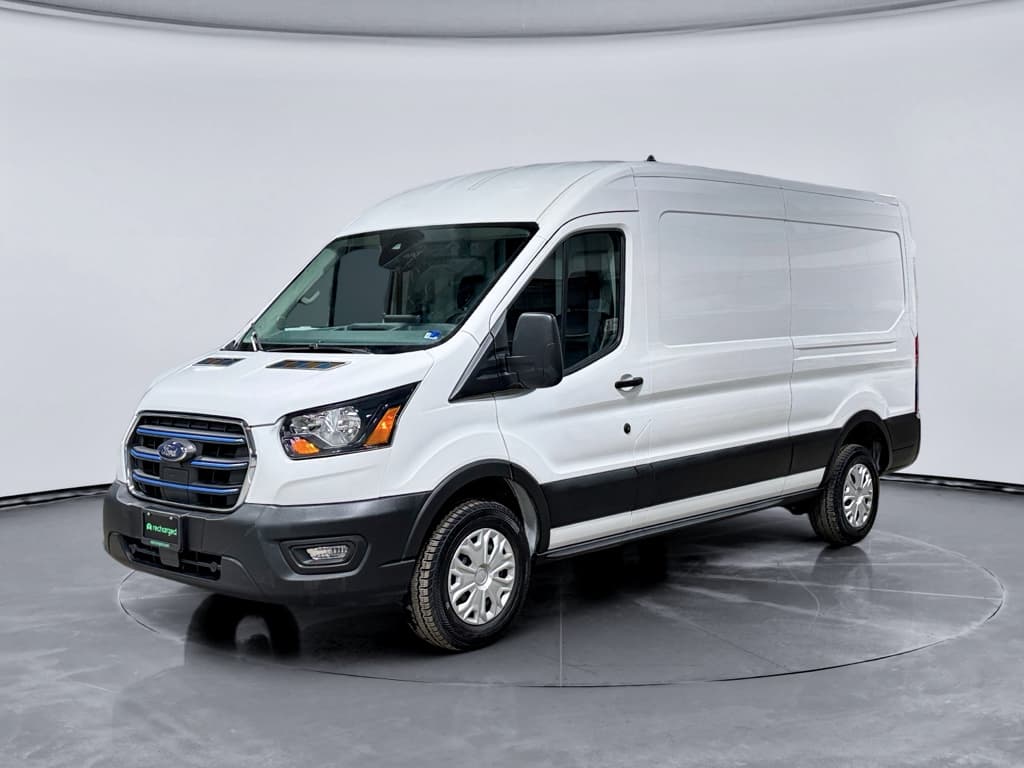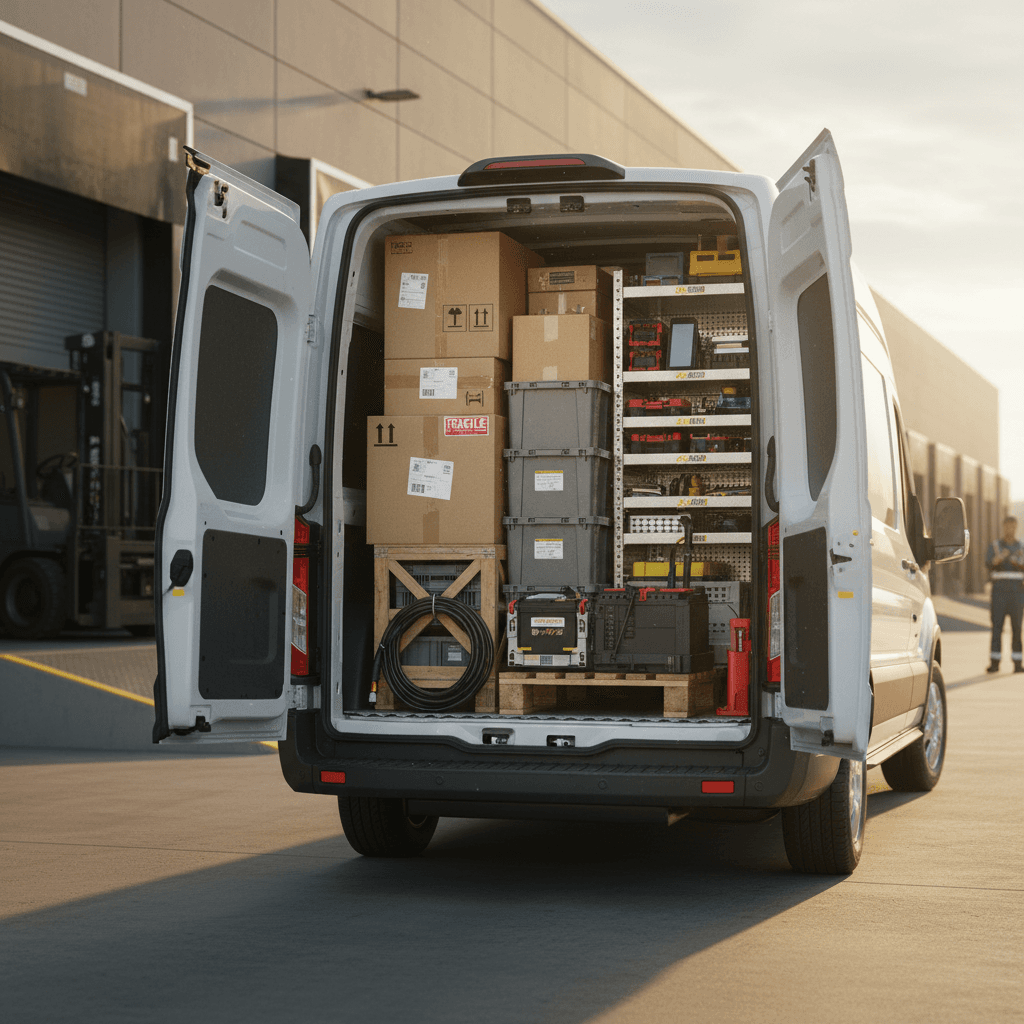
If you’re considering a Ford E-Transit for your business or van build, cargo capacity is probably your first question. How much can it actually carry, how big is the load space, and how does it compare to the regular gas Transit? This guide breaks down E-Transit cargo volume, payload, and real‑world usability so you can decide if it fits your routes, your gear, and your budget.
Quick takeaway
Ford E-Transit cargo capacity overview
At a high level, the E-Transit is just a Transit with an electric powertrain. Ford intentionally kept the body shell and cargo box the same, which means interior space is familiar to anyone who’s run a Transit fleet before. Where things diverge is weight: the battery and electric hardware eat into payload compared with a diesel or gas Transit, so you’ll want to pay close attention to how heavy your loads really are.
Headline Ford E-Transit cargo numbers
Names can be confusing
Cargo volume by E-Transit roof height and wheelbase
In the U.S., the Ford E-Transit cargo van is offered in several combinations of wheelbase and roof height. Exact availability changes slightly by model year, but the key cargo volumes have remained consistent because the body is shared with the standard Transit.
Approximate Ford E-Transit cargo volume by configuration
These figures are based on commonly available 2023–2024 E-Transit cargo van specs for U.S. models. Always confirm exact numbers against the window sticker or Ford’s most recent spec sheet for the specific van you’re considering.
| Wheelbase / Length | Roof Height | Approx. Cargo Volume (cu ft) | Typical Use Case |
|---|---|---|---|
| Regular (130") | Low roof | ≈ 246–248 | Urban deliveries, trades, basic service van |
| Regular (130") | Medium roof | ≈ 277 | More headroom without a long body |
| Long (148") | Medium roof | ≈ 357 | Contractors, parcel delivery with shelving |
| Long (148") | High roof | ≈ 404 | Mobile workshops, tall shelving, light RV builds |
| Extended (148" EL) | High roof | ≈ 487 | Maximum cube for parcel, upfitters, and conversions |
Cargo volume is measured behind the front seats to the rear doors, to the roof, with no upfits installed.
Why the range of numbers?
E-Transit payload capacity vs gas Transit
Cargo volume tells you how much stuff you can physically fit. Payload tells you how much weight you can legally carry, including people, cargo, racks, and upfits. Because the E-Transit carries a large battery pack, its payload is lower than an equivalent gas Transit, but still competitive with other electric vans.
Typical Ford E-Transit payload ratings (U.S. market)
Approximate maximum payload numbers for recent E-Transit model years. Individual vans vary by GVWR package and options, always check the tire‑and‑loading sticker on the driver’s door jamb.
| Configuration | Approx. Max Payload (lbs) | Notes |
|---|---|---|
| Cargo Van (various roof/lengths) | ≈ 3,300 – 3,880 | Higher GVWR trims support the biggest payloads |
| Cutaway | Up to ≈ 4,500 | Intended for box bodies and specialty upfits |
| Chassis Cab | Similar to cutaway | Exact payload depends on body installed |
Payload includes driver, passengers, cargo, and any installed equipment or upfits.
Don’t ignore payload stickers
Cargo volume limits your cube
If you haul bulky but light items, think parcels, HVAC ducting, or insulation, you’ll typically run out of space before you hit payload. For these use cases, the high‑roof, extended‑length E-Transit is ideal.
Payload limits your weight
If your business moves dense material, tools, liquids, stone, or heavy equipment, you may hit the payload limit long before the van is physically full. In that scenario, a lower‑roof, shorter‑wheelbase E-Transit with a higher GVWR might be the smarter choice, or even a different vehicle class entirely.
Key interior dimensions: length, width, and height
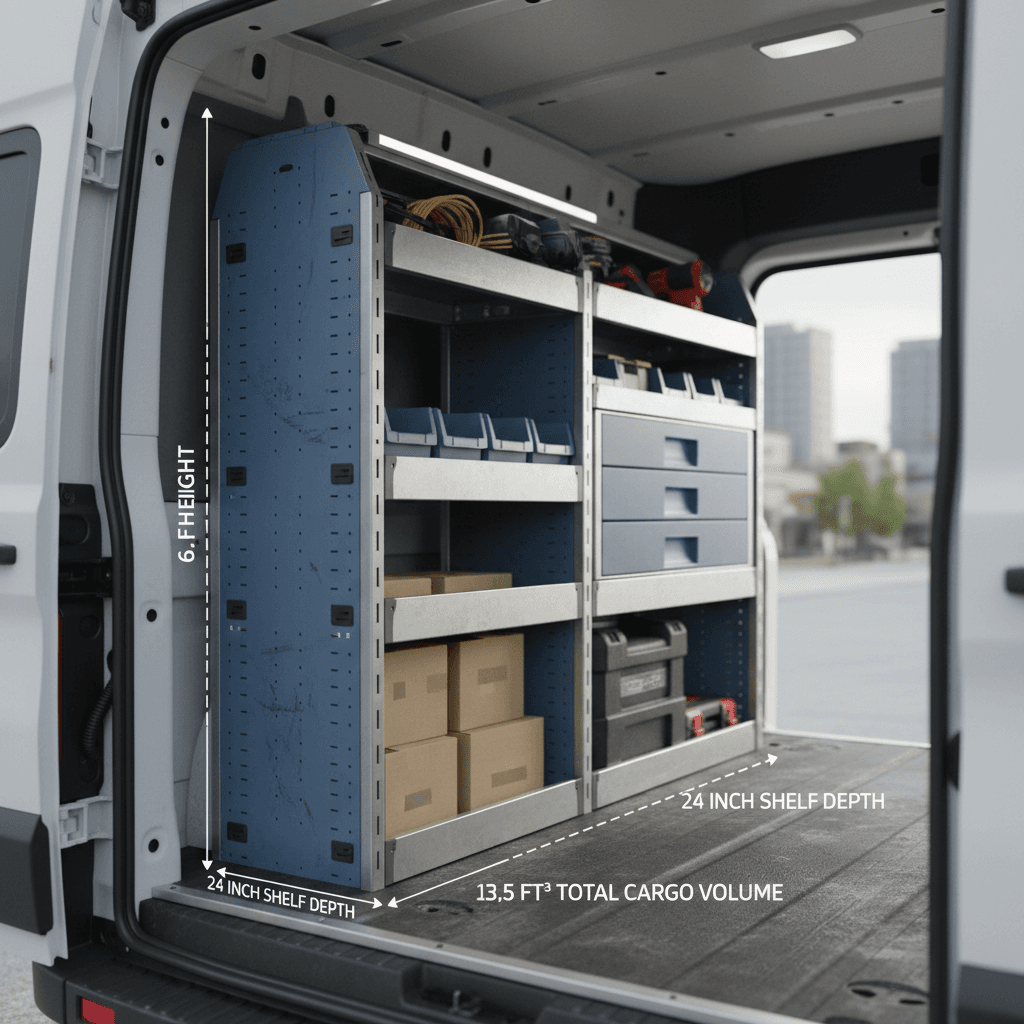
Cubic‑foot numbers don’t tell you whether a specific piece of equipment, pallet, or motorcycle will actually fit. For that, you need basic interior dimensions. Exact numbers vary slightly by model year and trim, but the Transit body shell has stayed consistent enough that these ranges are a good starting point.
Core Ford E-Transit cargo dimensions (typical ranges)
Use these ballpark measurements when planning shelving, pallet layouts, or conversions.
Load floor length
Regular WB: roughly 10–11 ft behind the seats
Long WB: roughly 11.5–12 ft
Extended WB: up to ~14 ft to the rear doors.
Length is measured on the floor; interior roof curvature shortens effective length up high.
Width between wheel arches
Transit vans offer about 4 ft between the rear wheel arches, meaning you can load a standard 48" pallet on the floor between them.
Overall interior width is higher, over 5 ft, outside the arches.
Interior standing height
Low roof: a bit under 5 ft inside, no standing room for most adults.
Medium roof: roughly 6 ft bare interior height, many people up to about 5'10"–6'0" can stand before build‑out.
High roof: around 6'8"–6'9" bare, leaving usable standing room even after insulation and ceiling panels.
Measure your tallest person, not just your cargo
How to choose the right E-Transit cargo configuration
Spec’ing a commercial EV is about matching range, capacity, and operating profile. Cargo capacity is only one piece of that puzzle, but it heavily influences long‑term usability. Here’s how to think through the decision.
Step-by-step: match E-Transit cargo capacity to your needs
1. List your heaviest realistic load
Don’t just think about average days. Add up the weight of a worst‑case load, tools, inventory, crew, and any racks or lifts. Compare that number to the door‑jamb payload rating on the specific E-Transit you’re evaluating.
2. Map your largest, bulkiest items
Measure ladders, HVAC air handlers, pallets, kegs, or anything that reliably eats space. Translate those dimensions into required floor length, width, and height. This will quickly tell you if you need long or extended wheelbase and which roof height.
3. Decide if you need true standing room
If the van doubles as a mobile workshop or office, prioritize a <strong>high roof</strong>. For pure parcel work or light service with frequent urban parking, a low or medium roof may save energy and make parking easier.
4. Consider shelving vs. open floor
If you’ll install full‑height shelving, the limiting factor is usually <strong>body height</strong>, not cube. For pallet work, clear floor length and forklift access at the rear doors matter more than total cubic feet.
5. Align routes with range
Heavier vans use more energy. If you’re running E-Transits near the edge of their daily range envelope, leaving some payload margin (and avoiding constant max‑weight days) can improve both efficiency and battery longevity.
6. Think about future upfits
Roof racks, lifts, generators, or heavy interior build‑outs all eat into payload and usable space. If you know you’ll be adding gear later, leave yourself a capacity buffer now.
Where Recharged fits in
Ready to find your next EV?
Browse VehiclesReal-world use cases: what actually fits
Specs are one thing; deciding whether an E-Transit will do the job on your actual route is another. Here are common use cases and how different cargo configurations tend to work out in practice.
Common E-Transit use cases and best configurations
Match your job to the body style that keeps you productive without over‑ or under‑buying.
Parcel & last-mile delivery
Best fit: Long or extended wheelbase, medium or high roof, depending on driver height and package mix.
- High‑roof, extended vans maximize cube for light parcels.
- Medium‑roof, long vans balance capacity with better efficiency in dense cities.
Trades (HVAC, plumbing, electrical)
Best fit: Long wheelbase, medium or high roof.
- Enough length for pipe or conduit with closed rear doors.
- Standing room makes on‑site work and parts access far easier.
Mobile workshop or service van
Best fit: High‑roof, long or extended wheelbase.
- Room for workbench, tool chests, and wall‑to‑wall shelving.
- Standing room even after insulation and ceiling panels.
Powersports & moto transport
Best fit: Regular or long wheelbase, medium roof.
- Clear floor length for bikes plus gear.
- Height for loading while still fitting into more parking garages than a high roof.
Always test-fit before you commit
Ford E-Transit vs other electric cargo vans on capacity
If you’re cross‑shopping the E-Transit with other electric vans like the Mercedes‑Benz eSprinter, BrightDrop, or smaller compact EV vans, cargo capacity is one of the cleanest ways to compare them.
Against other full-size EV vans
The E-Transit slots into the heart of the traditional full‑size van market. Its largest configuration offers just under 500 cubic feet of cargo space, slightly less than some purpose‑built electric vans that are optimized purely for parcel work, but more than enough for most mixed‑use fleets.
Where the E-Transit shines is body choice and upfit ecosystem: multiple roof heights, wheelbases, and the vast network of existing Transit upfitters make it easy to adapt the van to your use case.
Against compact electric vans
Ford also sells smaller electric vans in other markets, like the E-Transit Courier. Those are better for tight European cities or light‑duty urban work, but their cargo volume, on the order of 2½–3 cubic meters (≈ 90–105 cu ft), is far below a full‑size E-Transit.
If you regularly haul pallets, tall shelving, or multiple workstations, a full‑size E-Transit is the safer choice. Compact vans shine when maneuverability and low operating cost matter more than sheer capacity.
Capacity is just one axis of comparison
Buying a used E-Transit: capacity, battery health, and value
On the used market, E-Transits are starting to show up as fleets refresh early pilots. Cargo capacity doesn’t change with age, but battery health and prior use do, and they interact with how much weight the van has been hauling.
- Heavier daily payloads can increase energy use and make range feel tighter, even if the battery is healthy.
- Stop‑and‑go, high‑utilization parcel duty is harder on batteries than light‑duty service work with lots of idle time at a depot.
- Roof racks, lifts, and heavy upfits reduce remaining payload even if the van’s cube is wide open.
How Recharged de-risks used E-Transit shopping
Ford E-Transit cargo capacity FAQ
Frequently asked questions about Ford E-Transit cargo capacity
Bottom line: Is the Ford E-Transit big enough for you?
If you’re already familiar with the gas Ford Transit, the easiest way to think about the E-Transit is simple: you’re getting essentially the same box with an electric drivetrain. In cargo‑space terms, that’s a win, upfitters, shelving, and workflows built around the Transit body carry over almost unchanged. The constraint to watch is payload and range: if you run max‑weight loads or long rural routes, you’ll need to do a little more math before you electrify.
For many urban and suburban fleets, parcel delivery, trades, mobile services, the E-Transit’s combination of usable cargo volume, familiar dimensions, and zero tailpipe emissions makes it a compelling option. If you’re considering a used E-Transit, working with Recharged gives you an extra layer of confidence: verified battery health, transparent capacity and configuration data, and expert support to match the right van to your routes and your business model.