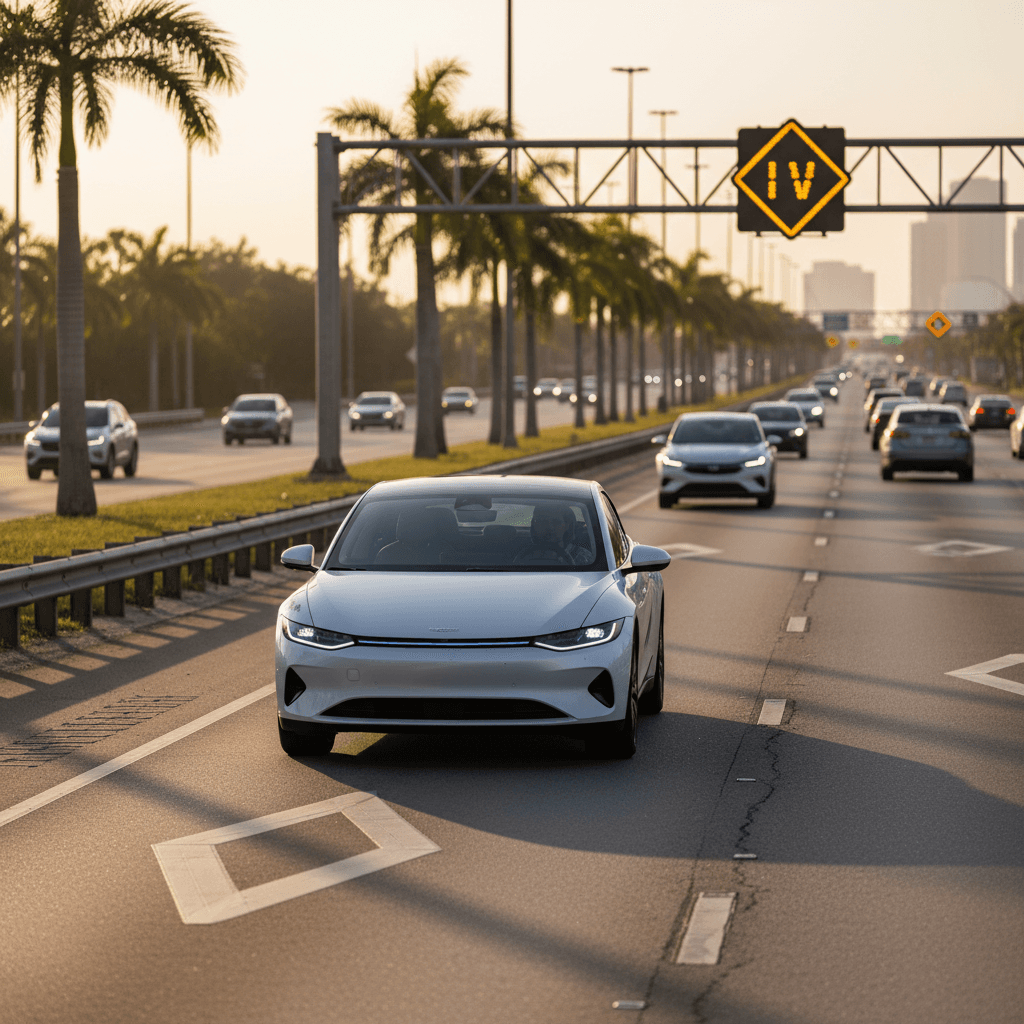
If you drive an electric vehicle in Florida, you’ve probably wondered whether those HOV and express lanes are your personal fast pass. The phrase “Florida EV HOV lane rules” gets thrown around a lot, usually right after someone flies by in the left lane with a lonely driver and a mysterious decal. Let’s untangle what’s actually legal, what’s just wishful thinking, and how it all applies if you’re driving, or buying, a used EV.
Quick takeaway
Overview: How Florida Treats EVs in HOV and Express Lanes
Start with this: Florida is not California. In California, the right sticker turns your EV into a one‑person carpool. Florida takes a more traditional view. HOV lanes are for high-occupancy vehicles, period, and express lanes are a pay-to-play congestion management tool. Your powertrain, gas, hybrid, or electric, is secondary to how many warm bodies are in the vehicle and whether your toll transponder is funded.
Why HOV and Express Lanes Matter for Florida EV Drivers
If you’re commuting daily on I‑95, I‑595, I‑4, or I‑75, understanding how your EV fits into these rules isn’t a nice-to-have, it’s the difference between a predictable commute and a daily stress test.
HOV vs Express Lanes in Florida: Know the Difference
HOV (High-Occupancy Vehicle) lanes
- Marked with a diamond symbol on the lane and signs.
- Designed to reward carpooling and reduce congestion.
- Eligibility is based on occupants, not your fuel type.
- Typically require 2+ people in Florida (check corridor signs).
- No additional toll just for being in a designated HOV lane.
Express or “managed” toll lanes
- Often separated by plastic pylons or barriers.
- Use dynamic pricing, tolls rise as traffic increases.
- Open to most vehicles (no special fuel-type perks).
- Require a SunPass or compatible transponder and a funded account.
- Some segments may combine HOV and toll rules, always read the sign.
Don’t trust habits from other states
Who Actually Qualifies for HOV Lanes in Florida?
Here’s where a lot of EV owners get tripped up. Florida’s HOV rules are written around vehicle occupancy and specific exemptions, not around your choice of drivetrain. In plain English: the state cares more about who’s in the car than what’s under the floor.
- Vehicles with at least the minimum occupants shown on the HOV sign (usually 2+).
- Certain registered vanpools and transit vehicles.
- Authorized emergency and law enforcement vehicles when performing official duties.
- Motorcycles (because they take up little space and ease congestion).
Historically, some states created special programs allowing alternative fuel, hybrid, or electric vehicles to use HOV lanes solo with a decal. Florida has not embraced that model in any broad, long-term way. Any one‑off pilot programs have either sunsetted or apply only to very specific corridors and vehicle classes, and even then, they don’t tend to revolve around pure EVs the way you might hope.
How to read the sign (and stay out of trouble)
Do EVs Get Special Treatment in Florida Express Lanes?
EV drivers often hope that if HOV perks are limited, maybe express lanes are where Florida makes it up to them. Unfortunately, that’s mostly wishful thinking. Express lanes in Florida are fundamentally a toll product, and the rules are built around revenue and traffic flow, not emissions.
EVs in Florida Express Lanes: What You Do, and Don’t, Get
Think of your EV as a regular car with better efficiency, not a magic ticket.
1. You still pay tolls
2. You still need a transponder
3. The real perk is predictability
What about future EV perks?
Decals, Registration & Used EVs: What You Need
Because other states lean heavily on windshield decals and plates to manage HOV access, many Florida EV owners go hunting for a similar program. For day‑to‑day HOV and express‑lane use in Florida, there is no broad, EV‑specific decal that suddenly changes the rules for your carpool access or tolls.
What Matters for Florida EV Lane Use
Think in terms of occupants, toll accounts, and registration, not just your battery pack.
| Item | Does It Affect HOV Access? | Does It Affect Express Lane Access? | Notes |
|---|---|---|---|
| Number of occupants | Yes | No | HOV lanes require the posted minimum (usually 2+). Express lanes generally don’t care how many people are in the car. |
| Electric or hybrid powertrain | Usually no | No | In most Florida corridors, EV status alone does not grant solo HOV or free express access. |
| SunPass or other transponder | No | Yes | Required for most express lanes; ensures you’re billed correctly and legally. |
| Special plate or decal | Rarely | Sometimes | Any special program will be clearly described on FDOT or turnpike signage. Don’t assume EV equals exemption. |
| Vehicle registration address | No | No | Where your EV is registered affects insurance and taxes, not lane eligibility. |
Use this as a quick reference before you assume your EV earns special privileges.
If you’re buying a used EV, don’t assume any plate, decal, or lingering rumor from the prior owner still applies. Treat the car as a clean slate: your registration, your SunPass account, your responsibility.
Beware of inherited decals
Real-World Scenarios for Florida EV Drivers
Let’s put all of this into situations you might actually face. The devil in Florida’s HOV and express rules isn’t the fine print, it’s the assumptions people carry over from other states, or from half‑remembered anecdotes at a fast charger.
Scenario 1: Solo in a used EV, morning I‑95 commute
You’re alone in your used Nissan LEAF heading into Miami on I‑95. You see a left‑hand lane marked with a diamond, and another set of separated lanes marked as express with posted tolls.
- HOV lane: You cannot legally use it solo just because you drive an EV.
- Express lanes: You can enter if you have a SunPass and accept the posted toll rate.
Scenario 2: Family in a Tesla Model Y, weekend Disney run
You, your partner, and two kids are heading up I‑4 in a Model Y you bought used from an online retailer.
- HOV lane: If that corridor has HOV segments and the sign says 2+, you’re fine, four occupants easily clears the bar.
- Express lanes: Again, your occupancy doesn’t matter; your SunPass and tolls do.
Scenario 3: Out-of-state EV with old HOV decal
You brought a plug‑in hybrid from a state that awarded solo HOV access with a decal. The sticker is still on the bumper.
- Florida troopers and tolling systems don’t care what that decal meant elsewhere.
- Assume you are treated as a standard vehicle for both HOV and express lanes.
Scenario 4: Carpooling to work in a used Bolt EUV
You and a coworker commute daily in a Chevy Bolt EUV you just bought used.
- If your route has an HOV lane signed as "2+", you’re good, your second person is your ticket.
- EV status is a bonus for your wallet and conscience, but not the basis for your legal access.

Checklist: Staying Legal in Florida HOV and Express Lanes
Before You Slide Into the Left Lane…
1. Read every overhead sign, every time
Don’t drive on autopilot just because you "know" the road. Speed, occupancy requirements, and toll rules can change by time of day and by segment.
2. Count the actual people in your car
For HOV lanes, the rule is usually 2+ occupants in Florida. Kids and teens generally count, but pets do not. EV status alone is not a substitute for a passenger.
3. Treat your EV as a regular car for tolls
Assume you will pay the <strong>posted express-lane toll</strong> like any other driver. If some future EV discount appears, treat it as a pleasant surprise, not an entitlement.
4. Keep your SunPass account current
For express lanes, a funded transponder account matters more than your drivetrain. Make sure your plate and vehicle info are up to date, especially after buying a used EV.
5. Don’t rely on old decals or plates
If you bought the vehicle used, consider any existing HOV- or toll-related decals as cosmetic until you’ve verified an active program backing them up.
6. Check corridor-specific rules before a new commute
If you switch jobs or move within Florida, glance at FDOT corridor information or local DOT pages so you’re not basing decisions on outdated lane rules.
Common Mistakes, Fines, and How to Avoid Them
Lane rules may not be sexy, but the tickets certainly sting. Violations in HOV and express lanes can stack up quickly, fines, points on your license, and, in some cases, administrative fees from toll agencies.
The Missteps That Trip Up Florida EV Drivers
If you avoid these, you’re already ahead of the pack.
Assuming EV = "free pass"
Ignoring dynamic toll signs
Relying on someone else’s old account
Why enforcement is tougher than you think
FAQ: Florida EV HOV and Express Lane Rules
Frequently Asked Questions
How This Affects Buying a Used EV, and How Recharged Helps
If you were hoping Florida’s EV HOV lane rules would turn your commute into a private left‑lane utopia, the reality is more modest. Your electric car earns you lower fuel costs, smoother power, and a quieter drive, but not a get‑out‑of‑traffic‑free card. The smart play is to understand the rules, work within them, and choose an EV that makes the rest of your life easier.
That’s where Recharged comes in. When you’re shopping for a used EV, our Recharged Score battery health report, transparent pricing, and expert EV specialists help you focus on the right questions: real‑world range for your commute, charging options at home and along your route, and total operating costs, not speculative lane perks that may never materialize. You can browse vehicles, arrange financing, trade‑ins, and nationwide delivery, and even visit our Experience Center in Richmond, VA, all with the confidence that the car you pick will handle Florida’s daily grind, HOV or no HOV.
If you’re ready to pair a better commute with a better EV, start by exploring used electric models that fit your budget and driving pattern. Then, the next time you slide past a line of idling traffic, it’ll be because you planned well, not because you gambled on a misunderstood sticker program.