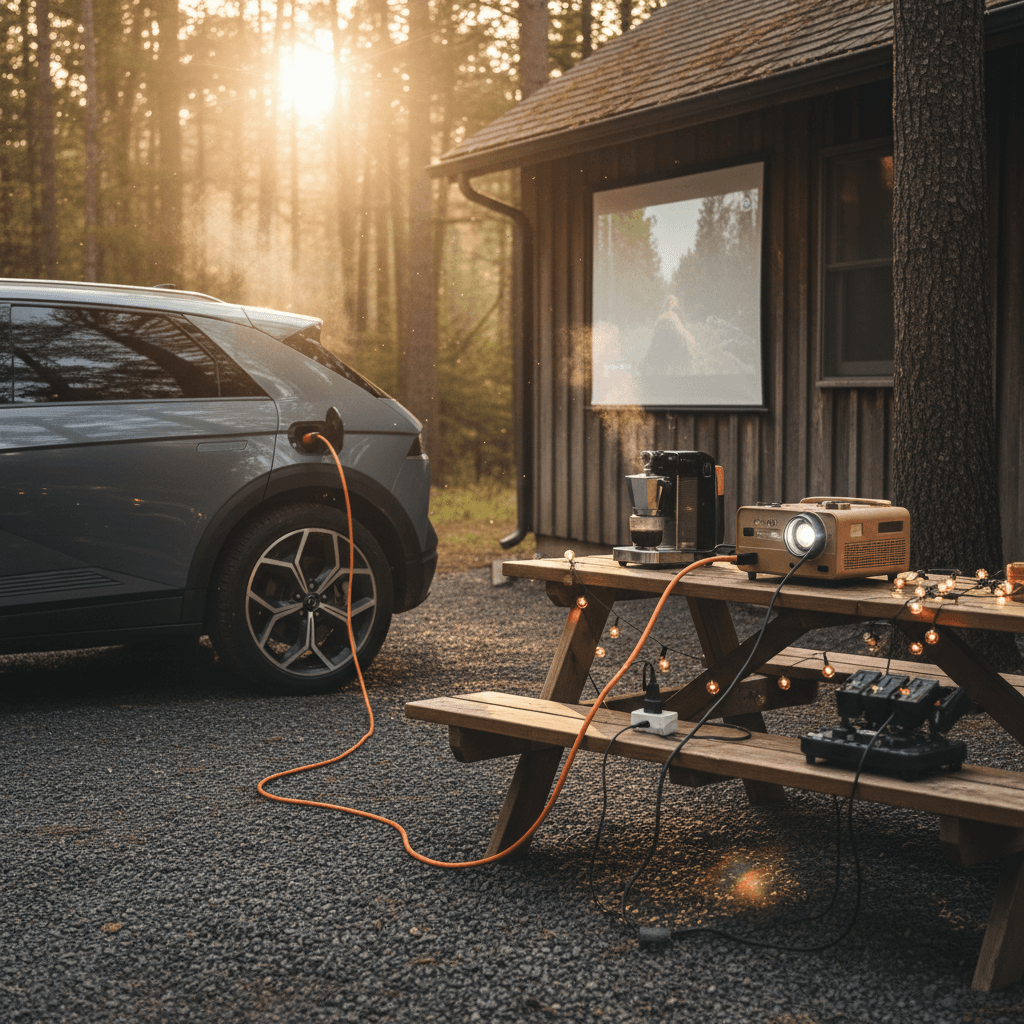
If you’ve ever wished your car could double as a quiet generator, EVs with vehicle-to-load (V2L) are exactly what you’re looking for. These electric vehicles can push power out through built‑in outlets or adapters, letting you run tools, camping gear, or even parts of your home right from the battery pack.
Why V2L Is a Big Deal
What Is Vehicle-to-Load (V2L)?
Vehicle-to-load (V2L) is a feature that lets an EV send AC power out of the battery to external devices. Practically, that usually means one or more 120V (sometimes 230–240V) outlets built into the car, or an adapter you plug into the charge port. You can then plug in normal household devices, laptops, space heaters, coolers, power tools, without a separate generator.
- The car’s high‑voltage battery feeds an onboard inverter.
- That inverter creates standard AC power (like your wall outlet).
- You access it through built‑in sockets in the cabin, cargo area, frunk, or via a special V2L adapter that plugs into the charge port.
- Most systems let you monitor and cap how much power you’re drawing to protect driving range.
Think of It as a Silent Generator
V2L vs V2H vs V2G vs Ford Pro Power Onboard
V2L (Vehicle-to-Load)
V2L is about plugging devices directly into the vehicle. It’s usually limited to a few kilowatts and is aimed at powering loads like tools, appliances, and electronics through standard outlets or a V2L adapter.
- Great for camping, tailgating, or light work.
- Typically 1.8–3.6 kW on crossovers/sedans.
- Up to ~9.6 kW on some trucks.
V2H & V2G
Vehicle-to-home (V2H) and vehicle-to-grid (V2G) send power back into a home’s electrical panel or the utility grid. These systems are more complex, require special hardware, and often utility approval.
- V2H: Whole‑home backup or peak‑shaving.
- V2G: The grid can pay you to export power.
- Still emerging in the U.S. and heavily policy‑dependent.
You’ll also see Ford’s Pro Power Onboard mentioned alongside V2L. Functionally, it’s similar, outlets powered by the traction battery, but Ford brands it separately and leans into the "truck as generator" story. On the F‑150 Lightning, Pro Power Onboard can provide up to 9.6 kW through multiple 120V outlets and a 240V/30A socket, enough to run serious tools or an RV‑style load for hours.
Terminology Is Still Messy
EVs With Vehicle-to-Load (V2L) Available Today
Model availability and specs change quickly, but as of early 2026, here are the major EVs, especially relevant in the U.S., that offer V2L or similar onboard power. Always confirm exact equipment by trim and model year when you’re actually buying, especially on the used market.
Common EVs With V2L or Onboard Power
Representative examples of EVs available in North America that offer vehicle-to-load or similar AC output features. Exact specs vary by year and trim.
| Brand / Model | Type of System | Approx. Max Output | Outlet / Adapter Style | Typical Use Cases |
|---|---|---|---|---|
| Hyundai Ioniq 5 | V2L | ≈1.9 kW (US), up to ≈3.6 kW in some regions | External V2L adapter plus interior outlet | Camping, tools, small appliances |
| Hyundai Ioniq 6 | V2L | Similar to Ioniq 5 | External V2L adapter | Remote work setups, light outdoor use |
| Hyundai Kona Electric (new gen) | V2L on select trims | ≈1.7–3.0 kW (region-dependent) | Adapter or interior outlet, depending on market | Urban use, emergency backup |
| Kia EV6 | V2L | ≈1.9–3.6 kW depending on region | Adapter from charge port, plus interior outlet on some trims | Camping, tailgating, light jobsite power |
| Kia EV9 | V2L | Up to ≈3.6 kW | Multiple interior outlets and V2L adapter | Family camping, power for events |
| Genesis GV60 | V2L | ≈3.6 kW (global spec, US analog similar) | External adapter + interior outlet | Premium camping and remote work |
| Ford F‑150 Lightning | Pro Power Onboard (V2L-like) | Up to 9.6 kW depending on configuration | Multiple 120V outlets + 240V/30A in bed | Construction sites, RVs, home backup with transfer switch |
| Ford F‑150 PowerBoost Hybrid | Pro Power Onboard | Up to 7.2 kW | Bed outlets incl. 240V option | Work trucks, tools, jobsite power |
| Ford E‑Transit (select trims) | Pro Power Onboard | ≈2.4 kW | Cargo area outlets | Mobile workshops and fleets |
| Some European EVs (VW, Renault, MG, etc.) | V2L | Often 2.0–3.6 kW | Charge‑port adapter | Region‑specific; limited U.S. relevance today |
Use this table as a starting point, then verify details for the specific model year and trim you’re considering.
Always Check Trim and Options

How Much Power Can V2L Actually Provide?
Typical V2L Power Levels by Vehicle Type
Most V2L‑equipped crossovers and sedans in the U.S. sit in the 1.8–3.6 kW range, roughly what you’d get from a mid‑size portable generator. That’s more than enough to run several small appliances at once, or a single power‑hungry device like a toaster oven or space heater.
Electric trucks like the Ford F‑150 Lightning push this concept further. With up to 9.6 kW of Pro Power Onboard available across multiple 120V outlets and a 240V/30A socket, you can power a small construction site, a serious RV setup, or (with the right home hardware) critical household circuits during an outage.
Rule of Thumb: Watch Amps and Watts
Best Real-World Uses for V2L
Six Practical Ways Drivers Use V2L
From weekend fun to real emergencies, V2L shines when the grid or an outlet isn’t where you are.
Camping & Overlanding
Run LED lights, a portable fridge, induction cooktop, laptops, and even an electric blanket without a noisy generator. With a mid‑size battery, you can comfortably power an efficient campsite for multiple nights if you’re not driving far in between.
Tailgating & Events
V2L easily covers sound systems, TVs, slow cookers, warming trays, and lighting. An EV6 or Ioniq 5 can power a full game‑day setup, while an F‑150 Lightning can keep a multi‑tent event running for hours.
Jobsites & DIY Projects
Charge tool batteries, run a saw, or power jobsite lighting right from the truck. Ford’s Pro Power Onboard in particular is designed to replace a separate contractor generator for many use cases.
Emergency Home Backup (Limited)
Even without full V2H integration, you can plug in essentials like a fridge, modem/router, phones, or a space heater during an outage. It’s not whole‑home backup, but it’s a lot better than sitting in the dark.
Remote Work Anywhere
V2L turns your EV into a fully powered mobile office, monitors, laptop, Wi‑Fi hotspot, even a small printer. Great for people who work between client sites or just want to escape to a scenic overlook between meetings.
Charging Other Devices & Small EVs
Some drivers use V2L to top up e‑bikes, scooters, or even another EV at a very low rate in a pinch. It’s inefficient compared to a charger, but in an emergency, a few extra miles can make the difference.
Where V2L Really Pays Off
Limitations, Risks, and Safety Tips
V2L Safety & Practical Limitations Checklist
Understand Your Power Budget
Know your EV’s V2L or Pro Power Onboard rating (in kW) and keep your total connected loads comfortably below that number. Remember that many devices draw more power at startup than their label suggests.
Protect Driving Range
Most systems let you set a reserve state of charge, once the battery reaches that level, V2L shuts down to preserve range. Use it, especially if you’re far from a charger or relying on public infrastructure.
Use Proper Cords & Outlets
Treat V2L outlets like any other high‑power AC source. Use appropriate extension cords, avoid daisy‑chaining power strips, and keep connections off wet ground.
Avoid DIY Home Backfeeding
Never "backfeed" your home by plugging V2L into a wall outlet. Without a proper transfer switch and electrician‑installed hardware, you risk damaging your home wiring or endangering utility workers.
Manage Heat & Ventilation
High loads turn your EV into a big inverter and cooling system. Don’t block vents or park where exhaust fans are closed off, and pay attention to any temperature warnings in the vehicle’s app or infotainment.
Know Warranty & Fine Print
Some automakers limit continuous V2L use or exclude certain misuse from warranty coverage. It’s worth scanning the owner’s manual or warranty guide before you rely on your EV as a daily worksite generator.
Grid Isolation Isn’t Optional
Should You Prioritize V2L When Buying an EV?
V2L is one of those features that sounds like a gimmick until you actually use it, then it’s hard to give up. Whether it should be a must‑have depends entirely on how you live and drive.
V2L Is Probably Worth Paying For If…
- You camp, tailgate, or attend outdoor events several times a year.
- You work with tools away from buildings and occasionally haul a generator.
- You live in an area with frequent storms or unreliable grid power.
- You like the idea of your EV as an all‑purpose energy tool, not just transportation.
V2L Might Be Nice-to-Have If…
- You mostly drive in urban areas with stable power and rarely spend nights off‑grid.
- You already own a good inverter generator and don’t mind hauling it.
- Your budget is tight and you’d rather pay for range, DC fast‑charging speed, or driver‑assist tech instead.
Think in Use Cases, Not Spec Sheets
V2L on the Used EV Market & How Recharged Helps
On the used market, V2L is a double‑edged sword. On one hand, it’s still rare enough that many listings don’t call it out clearly, so strong deals slip through the cracks. On the other, you need to be sure the specific trim and hardware you’re looking at actually has the feature, and that the battery underneath it is still healthy enough to rely on for off‑grid power.
That’s where a platform like Recharged changes the equation. Every EV sold through Recharged includes a Recharged Score Report with verified battery health, fair market pricing analysis, and an expert review of major features, including things like V2L, Pro Power Onboard, DC fast‑charging capability, and more. If you’re specifically hunting for an Ioniq 5, EV6, or F‑150 Lightning to use as a mobile power station, Recharged’s EV specialists can help you confirm that the exact car you’re considering has the right hardware and options.
Trade In Your Old Vehicle, Power Your Next Adventure
Ready to find your next EV?
Browse VehiclesFrequently Asked Questions About EVs With V2L
V2L & Onboard Power: Common Questions
Bottom Line: Is an EV With V2L Right for You?
EVs with vehicle-to-load (V2L) or similar onboard power systems are quietly redefining what a car can be. For some drivers, it’s a neat party trick they’ll rarely use. For others, campers, tradespeople, event organizers, or anyone in a region with fragile grid infrastructure, it’s the feature that makes an EV more than just a way to get from A to B.
If you see yourself plugging in tools, lights, or appliances away from buildings more than a couple of times a year, it’s worth targeting models like the Hyundai Ioniq 5 and Kia EV6, or going all‑in on a truck like the F‑150 Lightning with Pro Power Onboard. And if you’re shopping used, letting a specialist marketplace like Recharged help you verify V2L hardware, battery health, and fair pricing can save a lot of guesswork, so the next time the power goes out, you’ll already be ready to plug in.