If you live in New Jersey and drive a lot of Parkway or Turnpike miles, you’ve probably wondered what the **real EV vs gas savings in New Jersey in 2026** look like. The short answer: electricity is usually cheaper than gas on a per‑mile basis, and maintenance is way lower, but your exact savings depend on where you live, how you charge, and whether you buy new or used.
New Jersey is an EV sweet spot
Why EV vs gas savings in New Jersey look different
New Jersey is not Texas, and it’s not rural upstate New York. Your **EV vs gas math** is shaped by a few uniquely Jersey factors:
- Relatively high gasoline prices compared with the national average, especially near the Turnpike and shore towns in summer.
- Dense traffic on the Garden State Parkway, Turnpike, Route 3, and local arterials that punishes idling gas cars but barely affects EV efficiency.
- Plenty of public charging along major corridors, but tight parking in older towns where off‑street parking, and therefore home charging, isn’t guaranteed.
- Cold, slushy winters that trim EV range a bit, but also hammer fuel economy on gas SUVs and crossovers.
Your neighbor’s math may not be yours
2026 cost basics: electricity vs gas in New Jersey
To make **EV vs gas savings in New Jersey in 2026** concrete, let’s use round, realistic numbers. These are approximations, but they’re close enough to show directionally where the money goes.
Typical 2026 New Jersey cost assumptions
Now let’s translate those into **cost per mile**. We’ll keep the math simple so you can swap in your own numbers:
Electric vs gas cost per mile in NJ (2026, typical values)
Using a typical compact SUV and a mainstream EV driven in mixed New Jersey conditions.
| Vehicle type | Key assumption | Fuel/energy cost | Effective cost per mile |
|---|---|---|---|
| Gas compact SUV | 28 MPG | $3.75/gal | ≈ 13.4¢/mile |
| Modern EV (home charging) | 3.0 mi/kWh, 18¢/kWh | ≈ 6.0¢/mile | ≈ 6.0¢/mile |
| Modern EV (DC fast, paid) | 3.0 mi/kWh, ~40¢/kWh session average | ≈ 13.3¢/mile | ≈ 13.3¢/mile |
Actual costs will vary by vehicle, driving style, and how much you use home vs public charging.
The home‑charging secret
Real-world cost per mile for NJ commuters
Let’s get more specific: How does this play out for a typical commuter putting 12,000 miles a year on the odometer, a mix of Turnpike, Parkway, and local traffic?
Scenario A: Gas compact SUV
- Mileage: 12,000 miles/year
- Real‑world economy: 28 MPG
- Fuel cost: $3.75/gal
Annual fuel cost:
12,000 ÷ 28 ≈ 429 gallons × $3.75 ≈ $1,610/year
Scenario B: Mainstream EV (home charging 80%)
- Mileage: 12,000 miles/year
- Efficiency: 3.0 mi/kWh
- Energy needed: 4,000 kWh/year
- Charging mix: 80% home at 18¢, 20% public at 35¢ effective
Annual electricity cost (approx.):
Home: 3,200 kWh × $0.18 ≈ $576
Public: 800 kWh × $0.35 ≈ $280
Total ≈ $856/year
With these very realistic assumptions, the EV saves roughly **$750 per year on fuel alone** for a typical New Jersey commuter. Drive more than 12,000 miles, or charge more cheaply (off‑peak rates, employer charging), and the gap widens.
Multi‑year savings add up fast
Home charging vs public charging in New Jersey
Where you plug in is almost as important as what you drive. The same EV can be a money‑saving machine in one ZIP code and merely break even in another.
How your charging mix changes EV vs gas savings
Think in percentages, not perfection, you don’t have to be at 100% home charging to win.
Mostly home (70–90%)
Best‑case savings. You pay residential rates and can schedule charging overnight if your utility offers time‑of‑use plans. This is where EVs can cut your "fuel" cost per mile roughly in half vs gas.
Mixed (40–70% home)
Still solid. You may live in a townhome or small driveway situation and top up on DC fast chargers during road trips or busy weeks. Savings shrink but often still beat gas, especially if you drive a lot.
Mostly public (10–40% home)
Run the math carefully. If you rely heavily on paid DC fast charging in New Jersey, your cost per mile can look similar to a gas car. Your big wins then come more from maintenance savings and incentives.
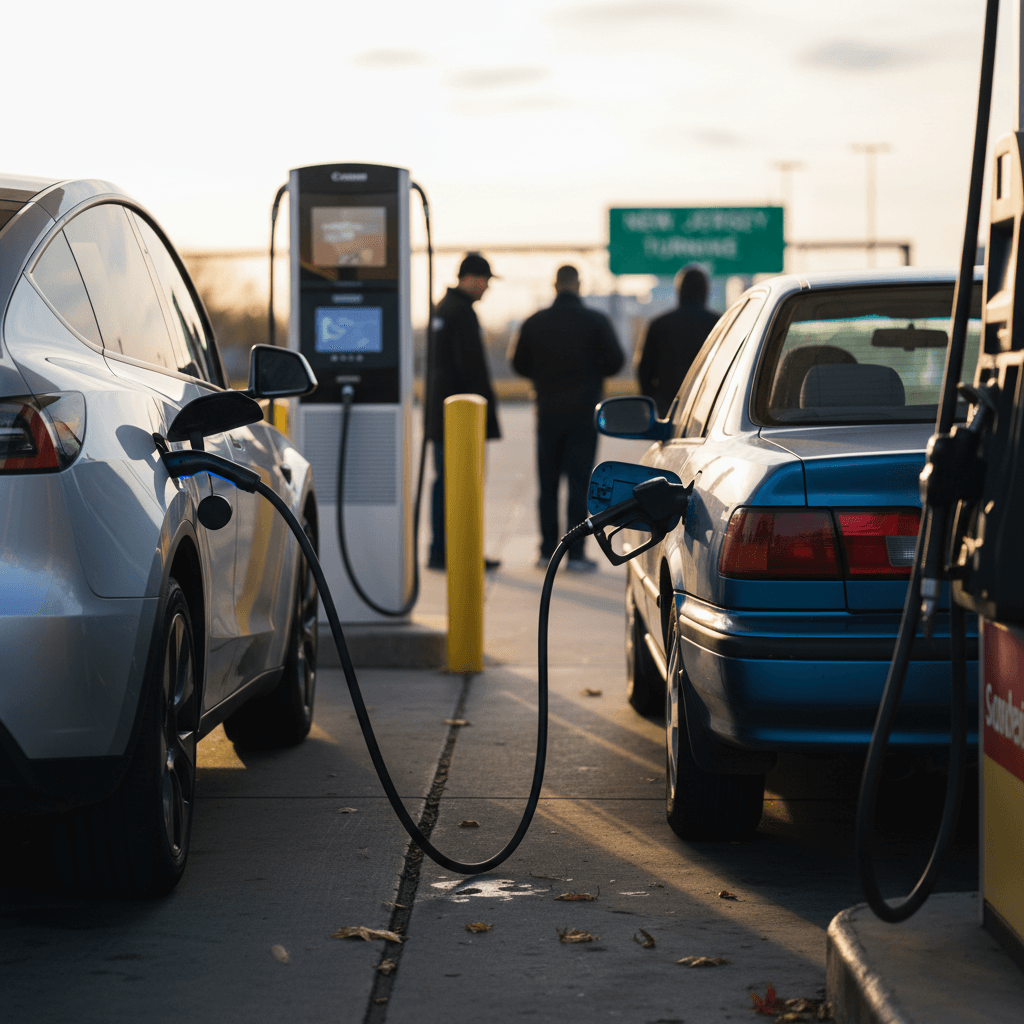
Apartment and street‑parking reality
Maintenance, parking, and other hidden costs
Fuel is only half the story. **Maintenance and city‑life costs** are where EVs quietly keep putting money back in your pocket over time.
Typical annual maintenance and running costs: EV vs gas in NJ
Representative numbers for mainstream compact crossovers driven ~12,000 miles/year in and around New Jersey.
| Cost category | Gas vehicle (est./year) | EV (est./year) | Notes |
|---|---|---|---|
| Oil changes & engine service | $200–$300 | $0 | EVs skip oil changes, timing belts, spark plugs, etc. |
| Brake wear | $150–$250 | $50–$100 | Regenerative braking means pads and rotors last longer on EVs. |
| Fluids & filters | $100–$150 | $50–$100 | Cabin filters and occasional coolant service for both. |
| Unexpected repairs over time | Variable, often higher | Variable, often lower | Fewer moving parts can mean fewer surprise repairs, though battery and electronics are expensive if they fail outside warranty. |
| Inspection/emissions | $50–$90 | $0–$50 | EVs skip emissions testing where required for gas vehicles. |
Individual results will vary, but the pattern, less routine maintenance and no oil changes for EVs, tends to hold across models.
Tolls, HOV, and parking
Incentives and tax credits in New Jersey (2026 snapshot)
Incentives shift from year to year, and New Jersey has been more active than many states. For 2026, always confirm current programs before you buy, but here’s the general shape of what to look for:
- Federal clean vehicle credit: Depending on income limits, vehicle price caps, and where the EV is assembled, you may qualify for a federal tax credit on new EVs. This can effectively knock thousands off the sticker price when it applies.
- New Jersey EV rebates: New Jersey has historically offered point‑of‑sale rebates for qualified EV purchases through programs like Charge Up New Jersey. Funding levels and qualifying vehicles change, check the latest rules before you shop.
- Sales tax breaks: New Jersey has treated zero‑emission vehicles favorably on sales tax in the past. If that continues, it’s an instant, easy‑to‑understand savings compared with a gas car.
- Utility EV programs: Several New Jersey utilities have offered rebates for home charger installations, off‑peak charging discounts, or bill credits just for enrolling an EV in their programs. These don’t grab headlines, but they improve your long‑term math.
Don’t buy on yesterday’s incentive
Why used EVs can supercharge your savings
New EVs get the headlines, but **used EVs are often where the real value is hiding**, especially in a state like New Jersey where many vehicles are leased, then turned in after just a few years.
How a used EV changes the savings equation
Lower purchase price + lower running costs is a powerful combination.
Lower upfront price
Depreciation hits early. Many EVs lose a chunk of value in the first 3–4 years. If you’re shopping used, you’re letting the first owner eat that hit while you enjoy lower running costs.
Battery health transparency
Modern EVs hold up better than early skeptics predicted, but you still want data. A verified battery health report helps you understand how much range you’re actually getting on day one.
More predictable TCO
With a well‑inspected used EV and known battery condition, you can estimate your total cost of ownership more accurately than with a complicated modern gas drivetrain full of possible future repairs.
Where Recharged fits in
How long until an EV pays for itself in NJ?
The payback question is simple: When do the lower running costs of an EV make up for any higher purchase price? Let’s walk through two common New Jersey scenarios.
Scenario 1: New EV vs new gas SUV
- EV costs $5,000 more up front after any rebates.
- Fuel + maintenance savings ≈ $1,000/year vs similar gas SUV (typical for 12,000–15,000 miles in NJ).
Simple payback: Around 5 years. Drive more than average or keep the EV longer and it keeps paying you back.
Scenario 2: Used EV vs used gas SUV
- Well‑priced used EV is similar in price, or even cheaper, than a comparable gas SUV.
- You still enjoy $700–$1,000/year in running‑cost savings.
Simple payback: In many cases it’s effectively instant, because you’re not paying extra up front to get the cheaper‑to‑run vehicle.
Think total cost, not just monthly payment
Checklist: is an EV worth it for your New Jersey driving?
Quick self‑check for New Jersey drivers
1. Where will you park most nights?
If you have a driveway, garage, or reliable off‑street parking, you’re in a great position. Street parking doesn’t rule out an EV, but you’ll need to lean harder on workplace and public charging.
2. How many miles do you drive each year?
If you’re under 8,000 miles a year, savings are modest but still real. From 12,000–15,000 miles and up, EVs usually start saving serious money in New Jersey, especially on fuel.
3. Can you install or share a home charger?
Even a basic Level 2 charger at home can cut your per‑mile energy cost in half compared with paying for DC fast charging. If you own your home, check with your utility and a licensed electrician.
4. How often do you road‑trip?
Frequent Turnpike or I‑95 road trips mean more fast charging. That narrows the fuel‑cost gap a bit, but EVs can still make sense if your daily driving is mostly local and home‑charged.
5. Are you open to buying used?
A well‑vetted used EV in New Jersey often delivers the best bang for your buck: lower purchase price, lower running costs, and plenty of remaining battery life if you choose carefully.
6. What does your budget really care about?
If you’re chasing the absolute lowest monthly payment, a cheap older gas car might win on day one, but could lose badly over time. If you care about predictable costs and fewer surprises, a solid used EV is often the calmer choice.
FAQ: EV vs gas savings in New Jersey (2026)
Frequently asked questions about EV vs gas savings in NJ
The bottom line for New Jersey drivers
When you stack everything together, energy prices, maintenance, New Jersey traffic, and available incentives, the story is clear: for many Garden State drivers, an EV is **cheaper to live with than a comparable gas car by 2026**, especially if you can plug in at home and you’re open to buying used.
Your exact answer to the **EV vs gas savings New Jersey 2026** question will depend on where you live, how you park, and how far you drive. But if you’re a typical commuter logging 12,000–15,000 miles a year, doing most of your charging at home, and you shop smart, possibly in the used EV market, there’s a good chance an electric car will keep more money in your pocket over the long haul.
If you’re ready to run the numbers on a specific car, explore used EV listings with battery health verified and pricing laid out clearly. That’s where a marketplace like Recharged earns its keep, helping New Jersey drivers go electric with fewer surprises and a much clearer picture of what they’ll actually spend over the years ahead.