Maryland isn’t a cheap place to drive. Gas prices swing wildly with global events, and residential electricity rates sit well above the U.S. average. If you’re trying to understand EV vs gas savings in Maryland in 2026, you have to look past national averages and do the math with Maryland-specific numbers. That’s what we’ll do here, step by step, in plain English.
Quick takeaway for busy readers
Why EV vs gas savings look different in Maryland
Most national EV savings calculators assume cheap electricity and average gas prices. Maryland breaks those assumptions. Residential power routinely lands in the high‑teens to low‑20s cents per kWh, while gas prices lately have pushed well above $3.50 per gallon and can spike toward $4.00 when oil markets get rattled. That combination narrows the gap compared with low‑cost‑power states, but EVs still come out ahead for many drivers, especially those who can charge at home.
- Higher electricity prices than the U.S. average, especially in winter heating months
- Higher‑than‑average gas prices, amplified by East Coast supply constraints
- Dense traffic around Baltimore–Washington that punishes stop‑and‑go gas efficiency but favors EVs
- A growing web of DC fast chargers along I‑95 and urban corridors, making EVs more practical across the state
Why local math matters
2026 Maryland energy prices: the baseline for savings
Maryland 2026 energy price snapshot (rough ranges)
We’ll use the following “good but realistic” benchmarks for the comparisons in this article:
- Home electricity: 20 ¢/kWh as a representative residential rate
- Public DC fast charging: 35 ¢/kWh as a mid‑range effective cost
- Gasoline: $4.00 per gallon as a round number between recent Maryland highs and lows
- Efficient EV: 3.0 miles per kWh (roughly 33 kWh/100 miles), realistic for many 2023–2026 compact EVs in mixed driving
- Typical gas car: 30 mpg combined for a compact or midsize non‑hybrid, 40 mpg for a hybrid where noted
How to adapt this math for your bills
Cost per mile: EV vs gas in Maryland (2026)
EV vs gas cost per mile in Maryland (2026 assumptions)
Using a 3.0 mi/kWh EV and a 30 mpg gas car at representative 2026 Maryland energy prices.
| Scenario | Energy price | Vehicle efficiency | Cost per mile |
|---|---|---|---|
| EV – mostly home charging | $0.20 per kWh | 3.0 mi/kWh | $0.067/mi (6.7¢) |
| EV – mostly DC fast charging | $0.35 per kWh | 3.0 mi/kWh | $0.117/mi (11.7¢) |
| Gas car – typical | $4.00 per gallon | 30 mpg | $0.133/mi (13.3¢) |
| Hybrid gas car | $4.00 per gallon | 40 mpg | $0.100/mi (10.0¢) |
Even with relatively expensive electricity, home‑charged EVs still undercut gasoline on cost per mile for most Maryland drivers.
A few big picture takeaways jump out:
- A home‑charged EV at 20 ¢/kWh costs roughly half as much per mile as a 30‑mpg gas car at $4.00/gallon.
- If you lean heavily on DC fast charging, your energy cost per mile gets close to that gas car, and can even exceed a fuel‑sipping hybrid.
- Compared with a 40‑mpg hybrid, a home‑charged EV in Maryland still usually wins, but by a slimmer margin (around 30–40% per mile instead of 50%).
Where EV savings can disappear
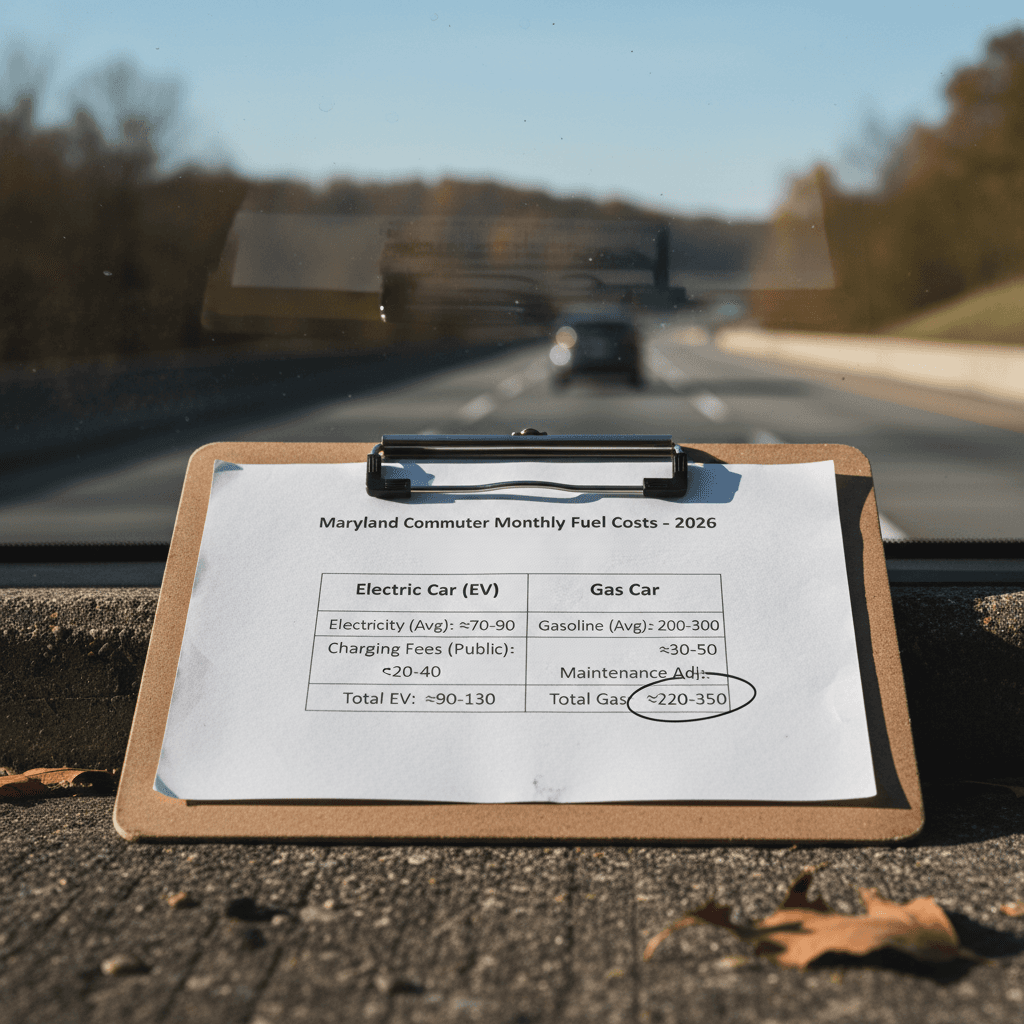
Annual savings for typical Maryland drivers
Most households don’t think in cents per mile; they think in monthly and yearly budgets. Let’s translate those numbers into annual savings for three common Maryland driving profiles. We’ll keep the assumptions simple and conservative so you can adjust for your own situation.
Three Maryland driving profiles and EV fuel savings
Using 20 ¢/kWh home electricity, $4.00/gallon gas, a 3.0 mi/kWh EV, and a 30‑mpg gas car.
Suburban commuter (~12,000 mi/yr)
Profile: Baltimore or DC commuter, mostly highway but plenty of traffic.
- EV energy cost: 12,000 mi × 6.7¢ = $804/yr
- Gas energy cost: 12,000 mi × 13.3¢ = $1,596/yr
Approx. annual savings: about $800 just on energy.
Heavy driver (~15,000 mi/yr)
Profile: Sales, field service, or long commutes.
- EV energy cost: 15,000 mi × 6.7¢ = ≈$1,000/yr
- Gas energy cost: 15,000 mi × 13.3¢ = ≈$2,000/yr
Approx. annual savings: around $1,000 per year.
Urban light driver (~8,000 mi/yr)
Profile: City dweller, short trips, lots of stop‑and‑go.
- EV energy cost: 8,000 mi × 6.7¢ = ≈$540/yr
- Gas energy cost: 8,000 mi × 13.3¢ = ≈$1,060/yr
Approx. annual savings: about $500 per year.
Add maintenance and it gets better
Maryland EV incentives and fees for 2026
Policy moves quickly and Maryland’s EV incentives have seesawed over the last few years, especially the state excise tax credit. As of early 2026, here’s the landscape to keep in mind when you compare EV vs gas savings:
- Federal clean vehicle credit: Many new EVs and some used EVs can qualify for a federal tax credit (up to $7,500 for new, up to $4,000 for used) if income, price, and assembly rules are met. That’s separate from Maryland policy, but it directly affects your out‑of‑pocket price.
- Maryland excise tax credit (stop‑and‑go funding): The state has offered a one‑time excise tax credit for qualifying EVs registered between July 1, 2023, and July 1, 2027, but funding pools have repeatedly run dry before each fiscal year ended. For 2026, think of this credit as a “nice surprise” if funding is available, not a guaranteed part of your savings plan.
- Registration fees: Like many states, Maryland has explored and implemented higher registration or special fees for EVs to replace lost gas‑tax revenue. The annual impact is usually in the low‑hundreds of dollars, material, but far smaller than typical fuel savings for medium‑ and high‑mileage drivers.
- Utility and local incentives: Individual utilities and counties sometimes offer rebates on home chargers, off‑peak charging rates, or time‑of‑use plans that can drop your overnight rate by several cents per kWh. If you can get your effective home rate closer to 15–17 ¢/kWh, your per‑mile savings grow quickly.
How to keep incentives from skewing your math
Home charging vs public fast charging in Maryland
If you live in a single‑family home in Columbia or Bowie with driveway access, EV math is pretty straightforward: install Level 2 charging, plug in at night, and watch your fuel bill shrink. But in a Baltimore rowhouse or a Silver Spring high‑rise, your charging mix may look very different, and that’s where the savings picture gets more nuanced.
Mostly home charging
- Who: Homeowners or renters with reliable driveway/garage parking.
- Energy cost: ~6–7¢/mile at 20 ¢/kWh and 3.0 mi/kWh.
- Upside: Predictable bills, easy overnight top‑offs, and the best odds of big fuel savings.
- Tip: Look for off‑peak programs or EV‑specific rates from your utility to nudge costs even lower.
Mostly public/DC fast charging
- Who: Apartment dwellers without workplace or on‑street options.
- Energy cost: Often 11–15¢/mile at 35–45 ¢/kWh, similar to or higher than gas.
- Upside: Convenience and speed on long trips.
- Risk: If 80–100% of your charging is fast charging, your EV fuel savings in Maryland may be modest compared with a good hybrid.
Don’t ignore workplace and Level 2 public charging
Other ownership costs: maintenance, insurance, and resale
Fuel isn’t the only line item where EVs and gas cars diverge. To understand EV vs gas savings in Maryland, you also need to look at what you’ll spend, or avoid spending, on maintenance, repairs, and depreciation.
Beyond fuel: how EVs and gas cars stack up on other costs
These are general trends; specific models will vary.
Maintenance & repairs
- EVs: No oil changes, fewer filters, regenerative braking extends brake life, far fewer moving parts.
- Gas: Routine oil and filter changes, spark plugs, exhaust system, complex transmissions.
Typical edge: EVs often save $300–$600/yr over a similar‑age gas car for moderate to high mileage.
Insurance
- EVs: Can be 5–15% more expensive to insure new, mainly due to higher vehicle value and repair complexity.
- Gas: Lower sticker price can mean slightly lower premiums.
Net effect: Insurance can nibble away at some EV savings, but usually doesn’t erase large fuel + maintenance advantages.
Resale value & depreciation
- EVs: Early‑generation models depreciated hard; newer EVs with stronger range and NACS‑compatible charging tend to hold value better.
- Gas: Stable but facing long‑term headwinds as more drivers go electric.
Used EV sweet spot: Buying a 2–5‑year‑old EV often means someone else has already eaten the steepest depreciation.
Battery health is the wildcard, here’s how to control it
How long until an EV pays for itself in Maryland?
The payback story depends heavily on what you’re comparing. A brand‑new premium EV versus a ten‑year‑old paid‑off gas sedan is a tough financial case to make. But a fairly priced used EV versus a similar‑age gas crossover is another matter, especially at Maryland’s gas prices.
Sample 5‑year payback scenarios for Maryland buyers
1. Used EV vs used gas crossover
Say you’re cross‑shopping a 3‑year‑old compact SUV and a 3‑year‑old electric hatchback, both around $22,000. If you drive 15,000 miles per year and save roughly $1,000 annually on energy plus $400 on maintenance, that’s about <strong>$7,000 in 5‑year running‑cost savings</strong>. Even if the EV costs $1,500 more up front, you’re still well ahead.
2. New EV vs new gas car
A new EV that’s $5,000 more expensive than a comparable gas car but qualifies for a $7,500 federal credit might effectively be cheaper out of the gate. Add $800–$1,200 per year in fuel and maintenance savings at Maryland prices, and you can often recoup any remaining price gap in <strong>3–6 years</strong>, depending on miles driven.
3. Low‑mileage city driver
If you only drive 6,000–7,000 miles per year and keep cars a long time, your annual fuel savings might be just $300–$400. In that case, a pricier EV can take a decade or more to “pay off” on fuel alone. A used EV at a fair price, or keeping your efficient gas car longer, may be smarter.
4. Heavy commuter or rideshare driver
If you log 20,000+ miles per year and can charge at home in Maryland, EV math gets almost irresistible. It’s not unusual to see <strong>$1,500–$2,000 per year</strong> in combined fuel and maintenance savings, meaning a higher‑priced EV can pay for itself in well under five years.
Used EVs shift the odds in your favor
Who saves the most with an EV in Maryland?
EVs aren’t a universal slam dunk for every driver in Maryland, but some profiles clearly come out ahead. Ask which of these buckets you fall into:
Maryland drivers who typically benefit most from EVs
Match your situation to see how strong the savings case is.
Homeowners with driveway or garage parking
If you can install Level 2 charging and pay standard residential rates, you’re in the EV sweet spot. Your “fuel” is cheap and predictable, and you only need fast charging for road trips.
Likely outcome: Strong long‑term savings, especially if you buy used and drive at least 10,000 miles per year.
Heavy commuters and gig‑economy drivers
For 20,000+ miles per year, every penny per mile matters. Cut your energy cost from ~13¢/mile in a gas car to ~6–7¢/mile in a home‑charged EV and the math gets compelling.
Likely outcome: Fast payback, even with slightly higher insurance and registration costs.
Drivers with access to cheap workplace charging
Some Maryland employers offer low‑cost or even free workplace Level 2 charging. Combine that with occasional home charging and your effective kWh rate can drop well below the residential average.
Likely outcome: Savings that rival or beat the best‑case home‑charging scenarios.
Apartment dwellers without low‑cost charging
If most of your charging happens at high‑priced DC fast chargers or expensive Level 2 stations, your EV energy costs may end up close to a hybrid’s gas costs.
Likely outcome: Convenience and emissions benefits, but only modest financial savings unless you find cheaper charging options.
How Recharged helps Marylanders maximize EV savings
Even with the math laid out, shopping for the right EV can feel like a risk, especially when you’re buying used and worrying about battery health and resale value. That’s exactly the problem Recharged was built to solve.
- Recharged Score battery health diagnostics: Every vehicle comes with a Recharged Score Report that includes verified battery health and range estimates, so you’re not guessing about degradation that could eat into your savings.
- Transparent, fair market pricing: Because Recharged focuses on used EVs nationwide, pricing is anchored to real‑world EV market data, not wishful thinking, helping you avoid overpaying and stretching your payback period.
- Financing and trade‑in options: You can pre‑qualify for EV financing with no impact on your credit, roll in a trade‑in, or get an instant offer, keeping your monthly payment aligned with your fuel and maintenance savings.
- EV‑specialist support: Recharged’s EV experts can walk you through home‑charging options, Maryland‑specific incentives, and how your driving pattern affects costs so you pick the right model the first time.
- Nationwide digital buying with local experience: Shop and complete your purchase online, then have the car delivered to Maryland, or visit the Recharged Experience Center in Richmond, VA if you want to see how the process works in person.
Use savings to shape your budget, not just your choice
FAQ: EV vs gas savings in Maryland 2026
Frequently asked questions about EV vs gas savings in Maryland
Bottom line: EV vs gas savings in Maryland (2026)
Maryland’s high electricity costs mean EV savings headlines from cheap‑power states don’t translate directly. But when you look at the numbers through a local lens, the story is still compelling. For most Marylanders who can charge at home or at low‑cost Level 2 stations, an efficient EV in 2026 typically cuts fuel costs by 30–60% and trims hundreds more off the maintenance line, especially if you drive at least 10,000 miles per year.
The key is to match the right EV to your charging reality, buy at a fair price (often in the used market), and insist on clear data about battery health and total cost of ownership. That’s where platforms like Recharged can tilt the math in your favor, turning Maryland’s expensive pump prices into a long‑term advantage for drivers ready to plug in.