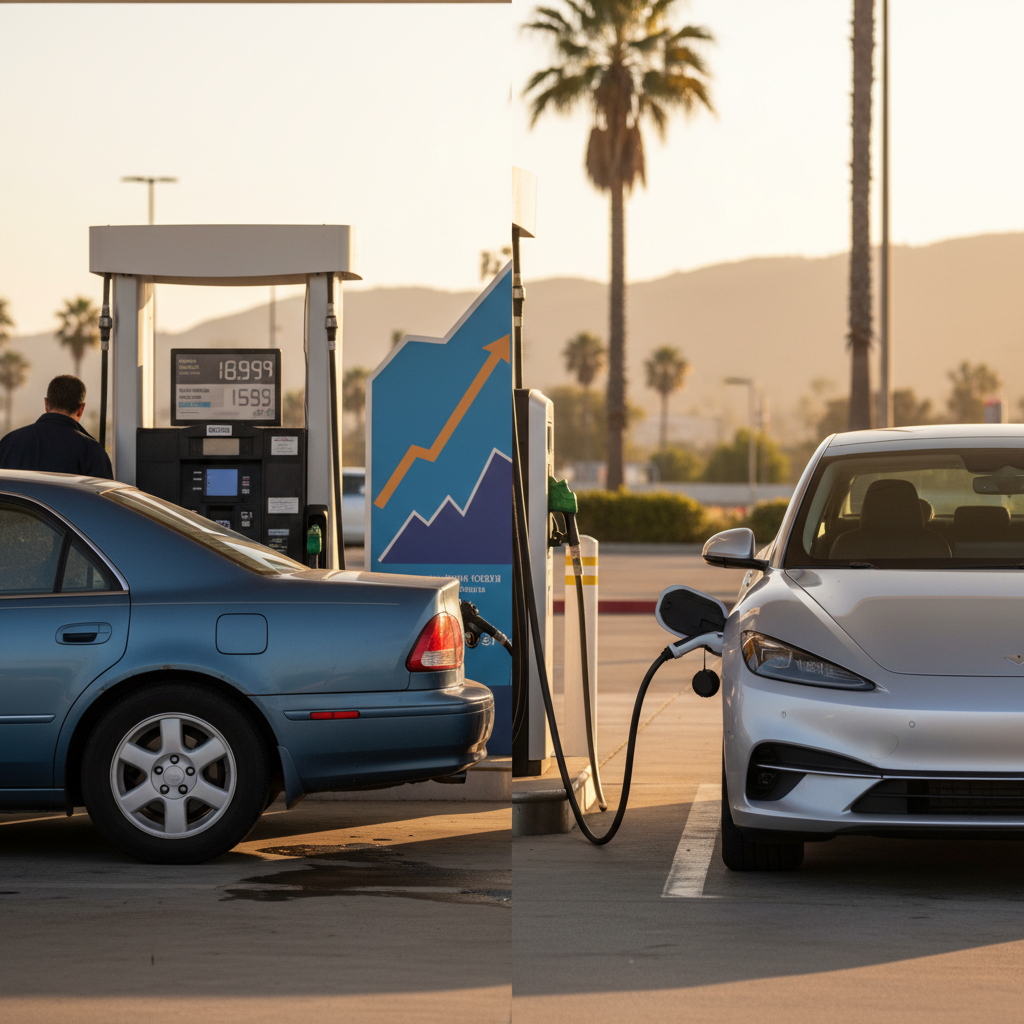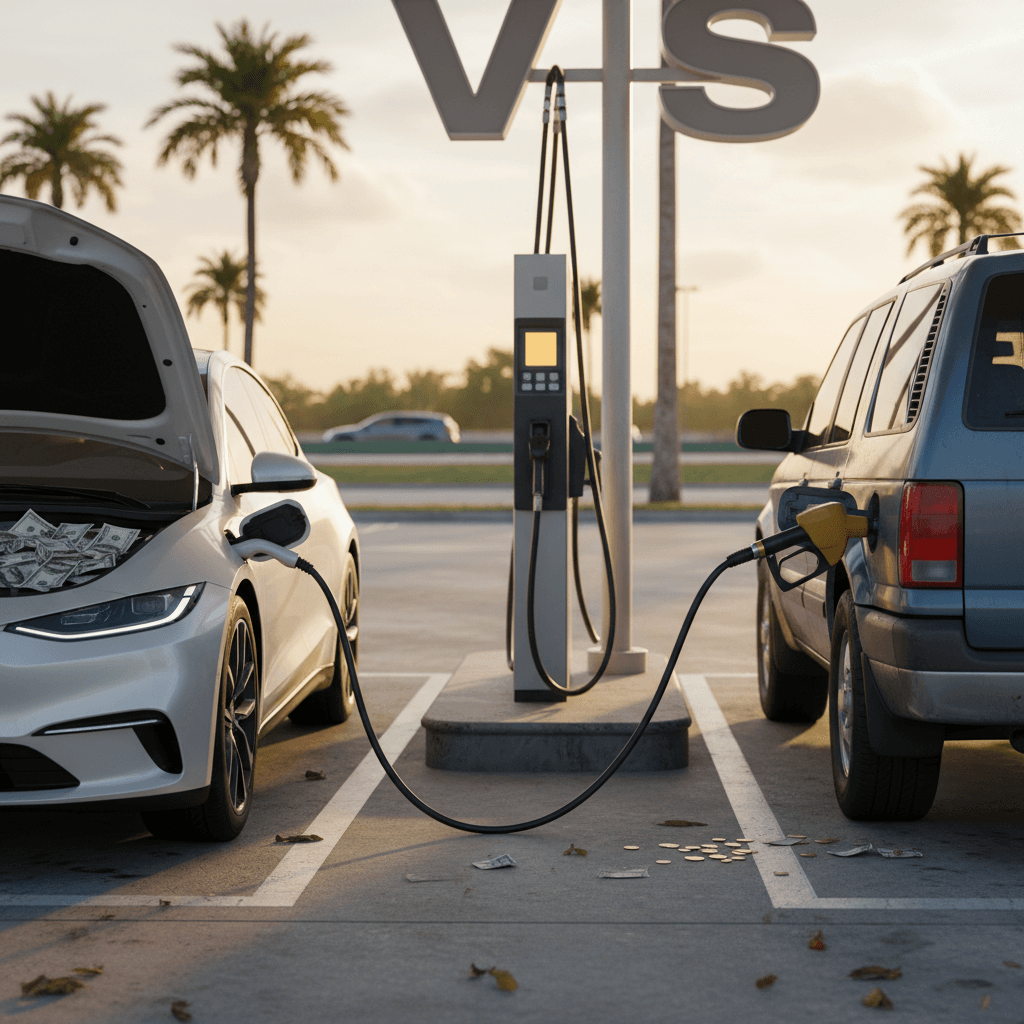
If you live in Florida in 2026, you’re feeling the pain at the pump. With regular gas hovering around $4 a gallon and summer road‑trip season ahead, it’s natural to ask: **how much would you actually save driving an EV vs a gas car in Florida in 2026?** This guide runs the numbers using current Florida gas and electricity prices, then shows how those savings change if you buy a new EV vs a used one.
Florida snapshot: April 2026
Why EV vs gas savings look different in Florida in 2026
National “EV vs gas savings” charts don’t always match what you see in Florida, and 2026 is a good example. Florida has **higher‑than‑average gas prices** and **slightly below‑average residential electricity rates**, plus a warm climate that’s generally friendly to EV range. At the same time, frequent highway driving and air‑conditioning use can raise consumption for both gas and electric vehicles. The result: if you can charge mostly at home, an EV’s fuel savings are **meaningful and predictable**, but if you rely heavily on DC fast charging, your savings shrink fast.
Florida advantages for EV savings
- High gas prices: Regular often above the U.S. average, so every avoided gallon is worth more.
- Mild winters: No deep‑cold range loss like northern states.
- Plenty of solar potential: Some homeowners pair EV charging with rooftop solar to cut costs further.
Florida challenges for EV savings
- Heavy A/C use: Summer air‑conditioning draws energy in both EVs and gas vehicles.
- Highway speeds: Long, fast highway stretches (I‑4, I‑95, Turnpike) reduce EV efficiency.
- Public charging premiums: Fast chargers can cost 3–4x residential electricity per kWh.
Key fuel and energy numbers for Florida drivers in 2026
Key 2026 numbers: Florida gas and electricity
To make EV vs gas savings concrete, we’ll use conservative, Florida‑specific assumptions that reflect conditions in spring 2026. You can adjust them later to match your exact vehicle and rates, but these are realistic for many households.
- Gasoline price: $4.20 per gallon of regular (Florida average, early April 2026).
- Residential electricity: 15.9¢ per kWh (Florida’s average residential rate in early 2026).
- Public DC fast charging: ~40–45¢ per kWh at many Florida highway fast chargers in 2026.
- Typical gas car efficiency: 27 mpg real‑world (compact/midsize sedan or crossover).
- Typical EV efficiency: 3.0 miles per kWh in real Florida driving (plenty of highway, A/C running).
Adjust the math for your car
Cost per mile: EV vs gas in Florida
With those assumptions, we can translate fuel and electricity prices into an easy‑to‑compare **cost per mile**. This is the clearest way to see EV vs gas savings in Florida for 2026.
2026 cost per mile: Florida EV vs gas (typical driver)
Using realistic Florida prices and real‑world efficiency assumptions, here’s how much you spend on energy to drive each mile.
| Scenario | Inputs used | EV cost per mile | Gas cost per mile | Who this fits |
|---|---|---|---|---|
| Home‑charged EV (typical) | 3.0 mi/kWh, 15.9¢/kWh | 5.3¢ | – | Florida driver with Level 2 home charging or consistent overnight Level 1. |
| Mostly city / slower speeds EV | 3.5 mi/kWh, 15.9¢/kWh | 4.5¢ | – | Urban or suburban drivers with lower speeds and lighter A/C use. |
| Heavy highway EV | 2.5 mi/kWh, 15.9¢/kWh | 6.4¢ | – | Long‑distance Turnpike/Interstate commuters, frequent 75+ mph driving. |
| Gas car (27 mpg) | 27 mpg, $4.20/gal | – | 15.6¢ | Typical compact/midsize sedan or small crossover. |
| Gas SUV (22 mpg) | 22 mpg, $4.20/gal | – | 19.1¢ | Popular compact/2‑row SUVs and crossovers. |
Home‑charged EVs undercut gas by roughly 40–45% per mile in Florida. Heavy reliance on fast charging can erase most of that advantage.
The bottom line on cost per mile
Three real‑world Florida driving scenarios
Per‑mile numbers are helpful, but you probably think in **monthly fuel bills**. Below are three Florida‑centric examples using 1,200 miles per month (about 14,400 miles per year), right in line with a lot of commuters and active households.
Sample monthly fuel costs for Florida drivers (2026)
All scenarios assume 1,200 miles per month driven in 2026.
1. Orlando local commuter
Profile: 30–40 mile round‑trip commute, mix of city traffic and suburban arterials, some weekend trips to the attractions.
- EV @ 3.3 mi/kWh, home charging: ~$58/month.
- Gas car @ 27 mpg: ~$187/month.
Approximate savings: $120+ per month, $1,400+ per year.
2. Tampa–St. Pete highway commuter
Profile: 50–60 mile round‑trip on I‑275 and bridges, 70+ mph, heavy A/C in summer.
- EV @ 2.7 mi/kWh, 80% home / 20% fast charge: ~$83/month.
- Gas car @ 25 mpg real‑world: ~$202/month.
Approximate savings: around $120/month if most charging is at home.
3. South Florida road‑trip family
Profile: Mix of weekday school runs and errands plus frequent Miami–Orlando or Naples–Orlando trips.
- EV @ 2.8 mi/kWh, 70% home / 30% fast charge: ~$96/month.
- Gas SUV @ 22 mpg: ~$218/month.
Approximate savings: ~$120/month, though high fast‑charging use narrows the gap.
When EV savings can disappoint
Beyond fuel: Maintenance and longevity savings
Fuel is only part of the EV vs gas savings story. EVs eliminate or sharply reduce several maintenance items that matter a lot over five to ten years of Florida driving.
Key long‑term savings when you go electric
No oil changes or transmission service
EVs don’t need oil changes or multi‑speed automatic transmission service. Over 10 years, a Florida commuter can easily skip **$1,200–$2,000** in routine fluid and service visits compared with a gas car.
Fewer brake jobs thanks to regen
Regenerative braking lets the motor slow the car and recapture energy, so brake pads and rotors last longer. Even in stop‑and‑go Orlando or Miami traffic, many EV drivers go **70,000+ miles** before their first major brake job.
Simpler drivetrains, fewer moving parts
There’s no exhaust system, no catalytic converter, no spark plugs, and no complex multi‑gear transmission. Fewer moving parts generally means fewer surprise repair bills, especially as vehicles age in Florida’s heat.
Tires and A/C: similar or slightly higher
EVs tend to wear tires a bit faster because they’re heavier and quicker off the line. In Florida, both EVs and gas cars lean heavily on A/C, so expect **similar climate‑control service costs** either way.
Battery longevity in Florida’s climate
High heat is tough on any battery, but modern EVs carefully manage pack temperature. Florida EVs still degrade, but buying a **used EV with verified battery health** can minimize risk and keep long‑term costs predictable.
Watch the battery health on used EVs
Time to payback: How long until an EV pays for itself?
Drivers often ask, “If an EV is more expensive up front, **how long until the fuel and maintenance savings catch up**?” In 2026 Florida conditions, the answer depends on what you’re cross‑shopping and whether you buy new or used.
New EV vs new gas car
Suppose you’re choosing between a $40,000 new EV and a $34,000 new gas SUV. That’s a $6,000 price gap before incentives.
- Fuel savings: $1,200–$1,500 per year for a 1,200‑mile‑per‑month driver.
- Maintenance savings: perhaps $200–$300 per year on average once you’re out of warranty.
Rough payback: around 3–5 years depending on your exact driving and how much fast charging you use.
Used EV vs used gas car
Now compare a late‑model used EV at $26,000 to a similarly equipped used gas SUV at $24,000. The upfront price gap narrows to $2,000 or disappears entirely.
- Fuel and maintenance savings can still total $1,000+ per year.
- With incentives or dealer discounts, the EV might even be cheaper up front.
Rough payback: often 1–3 years, sometimes immediate if you snag a well‑priced used EV with strong battery health.
Run the numbers with your own commute
Home charging vs public charging in Florida
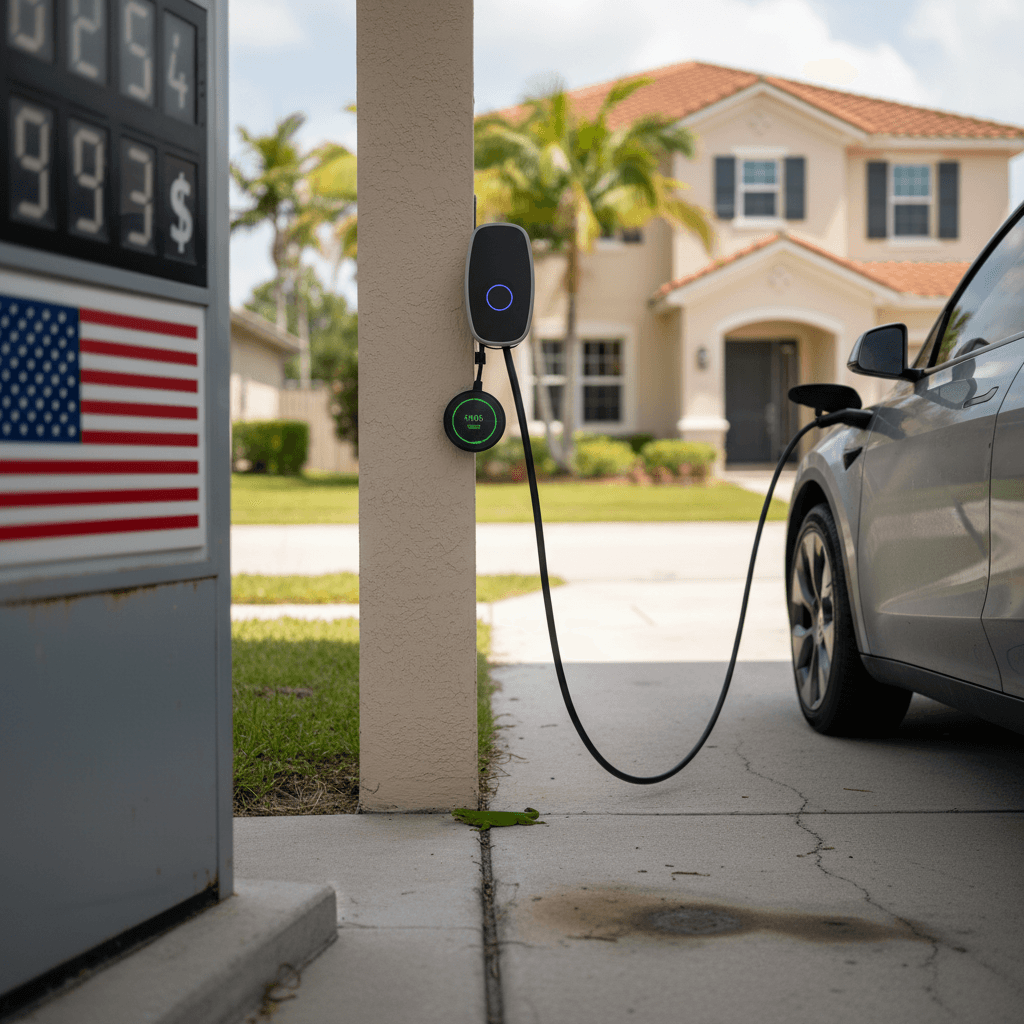
Your personal EV vs gas savings in Florida depend heavily on **where you charge**. The cheapest, most predictable option is almost always **residential charging**, either Level 1 (standard 120‑volt outlet) or Level 2 (240‑volt) at home.
How charging location changes your EV savings
Same EV, different charging mix, very different cost per mile.
Mostly home charging
- 90–100% of kWh from home at ~15.9¢.
- EV cost per mile often **4–6¢**.
- Best savings vs gas: **$100–$150/month** for typical Florida commuters.
Ideal if you own your home or have a dedicated parking spot with an outlet.
Mixed home and public
- 50–70% home, 30–50% DC fast charging at ~40–45¢.
- EV cost per mile often **7–10¢**.
- Savings vs gas may shrink to **$50–$90/month**.
Works if you road‑trip often but can still plug in at home most nights.
Mostly DC fast charging
- 80–100% high‑priced fast charging.
- EV cost per mile can approach or exceed a 30–35 mpg gas car.
- Financial case weakens unless you drive a lot of miles or have other reasons to prefer an EV.
Common for renters without home parking; fuel savings may be modest.
Don’t skip the charging‑access homework
Tax credits, utility programs, and local perks
Savings aren’t just about fuel and maintenance. Statewide and local programs can lower both your **upfront EV cost** and your **charging costs** in Florida, even though Florida doesn’t currently offer a large statewide purchase rebate like some other states.
- Federal EV tax credit: Many new EVs still qualify for up to a $7,500 federal income tax credit in 2026 if they meet battery sourcing and assembly rules. Some used EVs can qualify for up to $4,000 in federal incentives as well, depending on income and vehicle price caps.
- Utility off‑peak EV rates: Several Florida utilities offer time‑of‑use (TOU) plans or EV‑specific pricing that makes **overnight charging cheaper** than daytime use. That can drop your real cost per kWh, and per mile, below the statewide averages used in this article.
- Home charger rebates: At various times, Florida utilities and local programs have offered rebates or bill credits for installing Level 2 home chargers or participating in managed‑charging pilots. Availability changes, so it’s worth checking directly with your local utility.
- HOV and parking perks: Florida’s HOV rules and parking incentives for EVs evolve over time. Even when direct rebates are limited, **priority or discounted parking and toll discounts** can add hidden value for frequent commuters.
Check incentives before you sign
How a used EV from Recharged changes the math
New EV vs gas comparisons get the headlines, but in 2026 **the most compelling savings story in Florida is often a used EV**. That’s where Recharged is focused: helping you buy or sell a used EV with clear, verified data on battery health and pricing.
Why the EV vs gas savings gap is wider with a used EV
Lower upfront price plus known battery health compresses your payback timeline.
Fair market pricing and battery transparency
Every EV listed with Recharged includes a Recharged Score Report with verified battery health and fair market pricing. In a hot, humid market like Florida, that battery data matters: it helps you avoid cars with hidden degradation and focus on ones that will maintain strong range, and strong savings.
Financing and trade‑in support
Recharged offers financing, trade‑in, and consignment options, plus an instant offer for your current vehicle. That can shrink or erase the upfront price gap vs a comparable gas car. When you combine a competitive used EV price with $100+ per month in fuel savings, the math becomes compelling quickly.
You can shop and complete your purchase fully online, get **nationwide delivery**, or visit the Recharged Experience Center in Richmond, VA if you prefer to see vehicles in person before they ship down to Florida. Either way, having a clear handle on fuel and maintenance savings makes it easier to decide whether it’s time to move on from your gas vehicle.
FAQ: EV vs gas savings in Florida 2026
Frequently asked questions about EV vs gas savings in Florida
So, should you switch to an EV in Florida in 2026?
For many Florida drivers in 2026, especially those with **reliable home charging**, an EV can cut fuel costs nearly in half and shave meaningful money off maintenance over the life of the vehicle. Those savings build quickly when gas is around $4 a gallon and residential electricity still sits in the mid‑teens per kWh.
If you’re a high‑mileage commuter in Orlando, Tampa Bay, South Florida, or Jacksonville and you can plug in at home, the numbers usually favor going electric. If you’re locked into street parking and almost all of your charging would be at fast‑charge rates, the math is tighter, and you’ll want to model your exact situation carefully.
Where things get especially interesting is the **used EV market**. With a well‑priced used EV, solid battery health data, and straightforward financing, you can keep your upfront cost close to a comparable gas car while unlocking hundreds of dollars in annual savings. That’s the problem Recharged was built to solve, making EV ownership in places like Florida **simple, transparent, and financially compelling**.