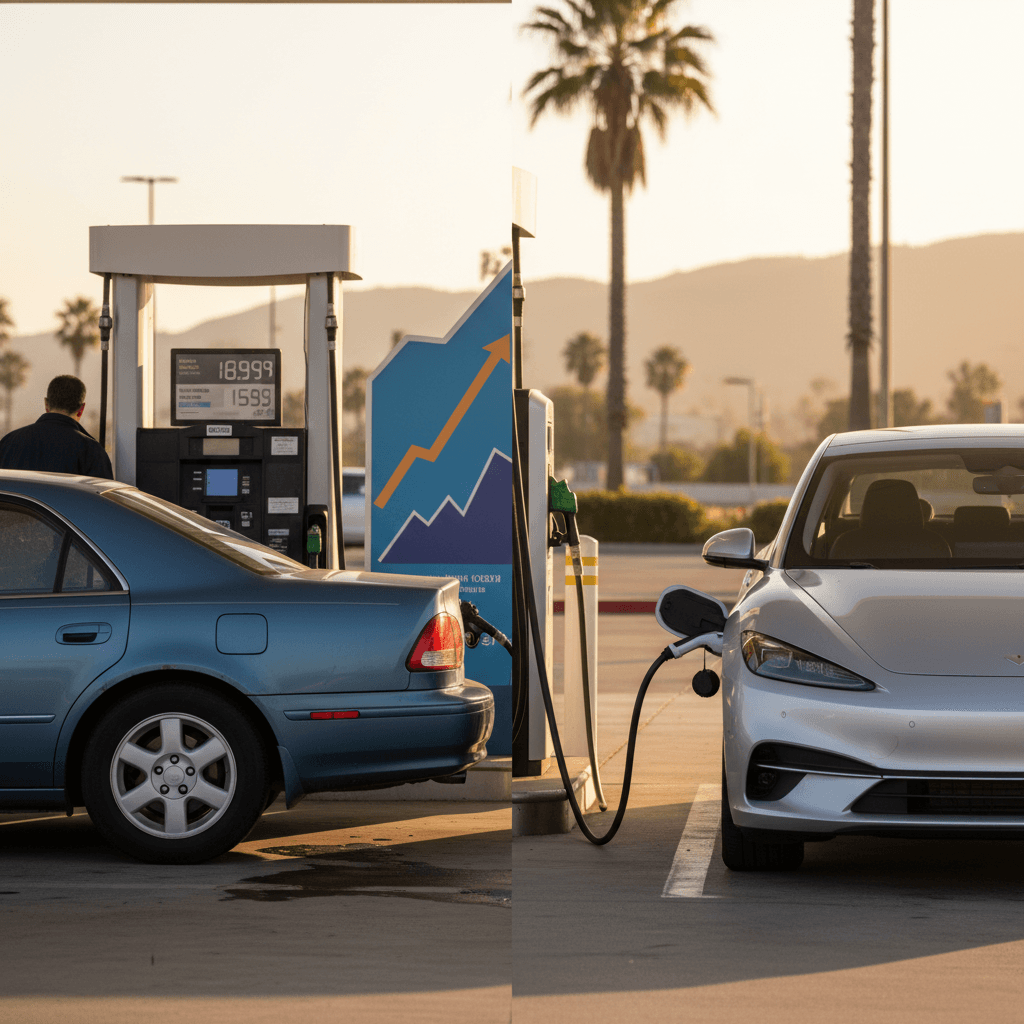
If you live in California, you’re probably hearing two things at once in 2026: gas is still expensive, and electricity isn’t cheap either. So when you run the math on EV vs gas savings in California in 2026, the answer isn’t as simple as it was a few years ago, but the savings can still be real, especially if you charge smart and consider a used EV.
What this guide covers
Why California EV vs gas savings look different in 2026
From 2020 to 2023, the EV vs gas story in California was simple: gas prices spiked and many utilities still had relatively cheap off‑peak electricity, so EV savings could feel dramatic. By 2026, the picture is more nuanced. Gas is still costly by national standards, but California’s electricity rates have climbed and more utilities are using time‑of‑use (TOU) pricing. That means when and where you charge your EV matters almost as much as what you drive.
- Gas remains high relative to the U.S. average, so efficient EVs still have a strong edge on fuel costs.
- Residential electricity rates are among the highest in the country, but off‑peak TOU plans can cut charging costs by 30–50%.
- Public DC fast charging is convenient on road trips but usually costs more per mile than home charging.
- Used EV prices have normalized since the 2021–2022 spike, while many still qualify for incentives or sales‑tax advantages.
The 2026 rule of thumb
Key numbers: 2026 EV vs gas costs in California
Snapshot: EV vs gas costs for a typical CA commuter (2026)
Those ranges hide a lot of detail, so let’s anchor them with a concrete example. We’ll assume an efficient compact gas car and a typical compact EV, exact models matter less than their fuel economy and efficiency.
Fuel vs electricity cost: typical California commuter, 2026
Estimated annual fuel and electricity costs for a 12,000‑mile/year driver in California, assuming mostly home charging on a time‑of‑use plan.
| Scenario | Assumptions (summary) | Energy cost per mile | Annual fuel/energy cost |
|---|---|---|---|
| Gas compact car | 32 MPG, $4.75/gal gas | $0.15/mi | ≈ $1,780/yr |
| EV – home off‑peak | 0.28 kWh/mi, $0.24/kWh off‑peak | $0.07/mi | ≈ $840/yr |
| EV – mixed home + some DC fast | 70% home at $0.24/kWh, 30% DC at equivalent $0.45/kWh | ≈ $0.09/mi | ≈ $1,080/yr |
| EV – mostly DC fast | 0.33 kWh/mi (less efficient), $0.45/kWh | ≈ $0.15/mi | ≈ $1,800/yr |
These are estimates, not guarantees. Your actual costs depend on your local gas price, utility rate plan, and driving style.
Why some EV drivers don’t see savings
Example commuter: what a typical driver pays
Let’s run the math for a specific 2026 California commuter: 1,000 miles per month, mostly around town, with occasional weekend trips. We’ll assume they have access to overnight home charging and can enroll in a TOU plan.
Gas compact (32 MPG)
- Miles per month: 1,000
- Gas price: $4.75/gal
- Gallons used: 1,000 ÷ 32 ≈ 31.3
- Monthly fuel cost: 31.3 × $4.75 ≈ $149
This assumes a relatively efficient gas car. Larger SUVs or trucks can easily double this cost.
EV compact (0.28 kWh/mi)
- Miles per month: 1,000
- Energy used: 1,000 × 0.28 = 280 kWh
- Off‑peak rate: $0.24/kWh
- Monthly electricity cost: 280 × $0.24 ≈ $67
On a TOU plan, this is realistic if you program the car to charge mostly overnight.
Monthly savings for this example driver
Where the real savings show up
How electricity rates shape your EV savings
In California in 2026, electricity is not a flat number. Most major utilities use time‑of‑use pricing with lower overnight rates and higher late‑afternoon and early‑evening rates. If you’re evaluating EV vs gas savings, your specific rate plan is the first thing to check.
Common California EV charging rate patterns (2026)
Exact prices vary by utility, but the structure is similar.
Overnight off‑peak
Often 11 p.m.–7 a.m. or similar.
- Lowest cents per kWh
- Best time to schedule home charging
- Can nearly double your savings vs on‑peak charging
Midday shoulder
Daytime hours outside late‑afternoon peaks.
- Moderate pricing
- Sometimes cheaper with strong solar generation
- Good backup window if overnight doesn’t work
Late afternoon/evening peak
Typically 4–9 p.m.
- Highest cents per kWh
- Worst time to plug in at home
- Can erase much of your EV cost advantage
Easy win: set a charge schedule
Public fast charging vs home charging: cost impact
California has one of the densest public charging networks in the U.S., including growing access to Tesla’s Supercharger network for non‑Tesla EVs. That’s great for convenience, but it changes the math. DC fast charging is usually priced like premium gas, worth it for road trips, not ideal for daily use.

Home vs public DC fast charging costs (typical 2026 CA ranges)
Illustrative per‑mile cost comparisons for an efficient EV in California, assuming 0.28–0.33 kWh/mi depending on driving conditions.
| Charging type | Typical CA price signal | Assumed efficiency | Approximate fuel cost per mile |
|---|---|---|---|
| Home, TOU off‑peak | $0.22–0.26/kWh | 0.28 kWh/mi | ≈ $0.06–$0.07/mi |
| Home, flat/high daytime | $0.34–0.40/kWh | 0.28 kWh/mi | ≈ $0.10–$0.11/mi |
| Public Level 2 | Often $0.30–0.45/kWh or session‑based | 0.30 kWh/mi | ≈ $0.09–$0.14/mi |
| DC fast (various networks) | Often $0.40–0.60+/kWh | 0.33 kWh/mi | ≈ $0.13–$0.20/mi |
Public DC fast charging improves road‑trip flexibility but eats into your per‑mile savings if used as your primary fuel source.
Apartment and condo charging
Maintenance, insurance and long‑term ownership costs
Fuel or electricity is only part of the EV vs gas equation. Over a 5–8‑year window, the maintenance and repair profile of an EV looks very different from a gas car, and usually better for your wallet, especially in California where labor rates are high.
EV vs gas: where long‑term costs diverge
Broad trends for mainstream vehicles in 2026.
Gas vehicle costs
- Regular oil and filter changes
- Spark plugs, belts, exhaust work over time
- More complex transmissions and cooling systems
- Engine‑related repairs as mileage climbs
In a high‑labor‑cost state like California, these repairs add up quickly after year 5–6.
EV maintenance profile
- No oil changes, fewer moving parts
- Brake pads often last longer thanks to regen braking
- Focus on tires, cabin filters, coolant intervals
- Battery and high‑voltage components designed for long service life
Out‑of‑warranty battery issues can be expensive, so understanding battery health on a used EV matters.
What about insurance?
Why used EVs can supercharge your savings
Depreciation hits new vehicles hardest in the first 3–4 years, and EVs have historically dropped faster than comparable gas cars. In 2026, that means a lot of 2019–2022 EVs on California roads are now priced attractively on the used market, often well below a new equivalent gas model once you factor in total ownership costs.
How a used EV stacks savings in California
Lower purchase price vs new
You avoid the steepest years of depreciation. That can translate into a lower monthly payment than a new gas car, even before fuel savings.
Strong fuel savings remain
A 3–5‑year‑old EV charged mostly at home still beats a gas car on per‑mile energy cost in most California scenarios.
Reduced maintenance exposure
Major components are still relatively young, but you no longer pay new‑car pricing. Routine items, tires, cabin filters, are predictable.
Battery health visibility
With tools like the <strong>Recharged Score</strong>, you can see verified battery health and range expectations upfront instead of guessing.
How Recharged helps in California
Ready to find your next EV?
Browse VehiclesHow to calculate your own EV vs gas savings in CA
Average numbers are helpful, but your driving pattern and utility bills are what really matter. Use this quick framework to build a personalized EV vs gas savings estimate for 2026 California conditions.
DIY EV vs gas savings calculator (California‑style)
1. Write down your annual miles
Check your service records, odometer history, or telematics app. Many California commuters sit between 10,000 and 15,000 miles per year.
2. Capture your real gas cost
Look at your last few fill‑ups and take the average price per gallon. Use that, not the lowest price you’ve ever seen.
3. Estimate EV efficiency
For compact/midsize EVs, start with 0.27–0.30 kWh/mi. For larger SUVs and trucks, 0.33–0.40 kWh/mi is more realistic.
4. Pull your utility’s TOU rates
Visit your utility’s website and look for EV or TOU plans. Note the off‑peak cents/kWh you’d expect to use for charging.
5. Model your charging mix
Estimate what % of miles you can do at home off‑peak vs workplace/public Level 2 vs DC fast. Even 70–80% home charging makes a big difference.
6. Compare annual totals
Multiply miles × cost per mile for each scenario. Remember to add an estimate for maintenance: gas cars typically run higher over time.
Common pitfalls that erode EV savings
Most California EV owners who feel disappointed with their savings tend to run into the same avoidable traps. Keeping these in mind while you shop, or adjust how you use your current EV, can preserve the advantage you were expecting.
- Relying on DC fast charging for daily commuting instead of reserving it for trips.
- Never switching to a TOU or EV‑specific rate plan, so you pay peak residential prices for every kWh.
- Driving well above the speed limit and accelerating hard, which can push EV consumption into inefficient territory.
- Buying a used EV without checking battery health, then being surprised by reduced range and more frequent charging stops.
- Ignoring tire maintenance, under‑inflated tires hurt efficiency for both EVs and gas cars.
The most expensive mistake
FAQ: EV vs gas savings in California 2026
Frequently asked questions
Bottom line: is an EV worth it in California 2026?
For many California drivers in 2026, an EV still makes strong financial sense, if you can charge smart. Home or workplace Level 2 charging on a time‑of‑use plan keeps your fuel costs well below those of a comparable gas car, and lower maintenance helps over a multi‑year ownership window. If you’re willing to shop the used market and focus on verified battery health, your total cost of ownership can undercut a new gas car by a comfortable margin.
If you’re comparing specific cars, consider looking at used EVs with a transparent battery report. At Recharged, every vehicle comes with a Recharged Score Report so you can see exactly what you’re getting, how the battery is performing, and how the price compares to the broader market. That way, when you run your EV vs gas savings math for California in 2026, you’re working from real data, not guesswork.