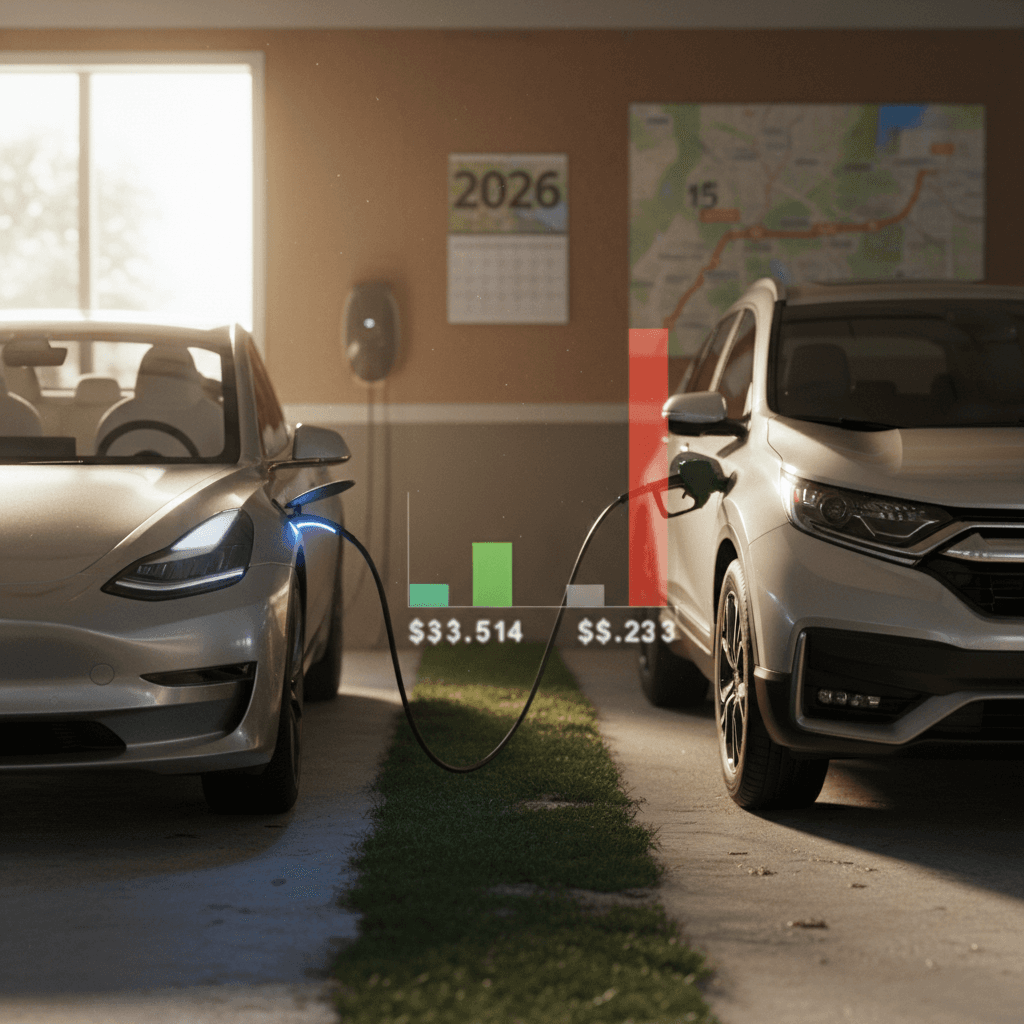
You would think that a tiny 15‑mile commute wouldn’t move the financial needle either way. But once you start comparing **EV vs gas cost for a 15 mile commute**, the numbers turn into a surprisingly sharp critique of gasoline. Even at modest distances, fuel and maintenance add up, quietly, relentlessly, like interest on a bad loan.
Snapshot: 15‑mile commute in 2026
Why a 15‑Mile Commute Is a Special Case
Most EV cost calculators assume 30–50 miles a day. If you only commute 15 miles round‑trip, you sit in a weird middle ground: **fuel savings still matter**, but they won’t single‑handedly justify a brand‑new $50,000 EV. What they *can* do is quietly turn a sensible, affordable **used EV** into the lowest‑stress, lowest‑cost commuter you’ve ever owned.
- 15 miles a day is about **3,750 miles a year** if you commute 5 days a week, 50 weeks a year.
- That’s far below the U.S. average of ~12,000–15,000 miles per year, which many EV vs gas comparisons use.
- With fewer miles, **fuel savings stack more slowly**, but **maintenance savings and convenience** still show up every single week.
- Battery wear is generally slower on short‑range, low‑mileage use, which is friendly territory for a used EV.
Think in cost per *year*, not just per mile
Assumptions and Baseline Numbers for 2026
To keep this grounded, let’s anchor everything to **recent U.S. averages** and a typical commuter car, not a hyper‑efficient unicorn or a lifted truck on mud‑terrains.
Baseline assumptions for EV vs gas cost math (United States, 2025–2026)
These are ballpark averages. You can later plug in your own numbers using the same formulas.
| Variable | Reasonable 2025–2026 average | What we’ll use for examples |
|---|---|---|
| Residential electricity price | Many U.S. households are paying **$0.15–$0.18/kWh** in 2025–2026. | **$0.17/kWh** home charging baseline |
| Public Level 2 charging | Often **$0.25–$0.35/kWh** before idle fees and parking. | **$0.30/kWh** public Level 2 baseline |
| Public DC fast charging | Commonly **$0.40–$0.55/kWh** on major networks. | **$0.45/kWh** fast‑charge baseline |
| Gasoline price (regular) | National average in 2025 was about **$3.10/gal**, rising toward and above **$4.00/gal** in early 2026. | We’ll show both **$3.25/gal** (calm) and **$4.00/gal** (spiky). |
| Typical EV efficiency | Modern EV commuter: about **3.0–4.0 mi/kWh** (roughly 25–33 kWh/100 mi). | We’ll use **3.5 mi/kWh** (≈28.6 kWh/100 mi). |
| Typical gas car efficiency | Everyday compact/midsize: roughly **28–32 mpg** combined. | We’ll use **30 mpg** as a clean middle ground. |
Use your actual electricity rate, local gas price, and car efficiency to refine this table for your situation.
Your mileage will vary, literally
EV vs gas cost for a 15 mile commute: the simple math
Let’s do the thing you came for: compare **daily and annual fuel cost** for a 15‑mile round‑trip commute, EV vs gas, under normal conditions. We’ll start with the clean, best‑case EV scenario: **home charging**.
Headline numbers: 15‑mile round‑trip commute
Step 1: EV cost for a 15‑mile commute (home charging)
We’ll assume you can plug in at home at night, pay a fairly typical **$0.17/kWh**, and your EV averages **3.5 miles per kWh** over the year.
- Daily energy use: 15 miles ÷ 3.5 mi/kWh ≈ **4.3 kWh per day**.
- Daily cost: 4.3 kWh × $0.17 ≈ **$0.73 per day** just for the commute.
- But you don’t drive only to work. Let’s say the commute is **half** your daily driving, errands, school runs, life fill in the rest. So total daily miles ≈ **30**, total energy ≈ 30 ÷ 3.5 ≈ **8.6 kWh/day**.
- Total daily cost: 8.6 × $0.17 ≈ **$1.46/day** for *all* driving on a typical weekday. The 15‑mile commute’s “share” of that is ≈ **$0.73/day**.
- Annual commute‑only fuel cost (5 days/week, 50 weeks): 0.73 × 250 ≈ **$183/year** in electricity.
Why include non‑commute miles?
Step 2: Gas cost for a 15‑mile commute
Same idea, different dinosaur juice. We’ll use **30 mpg** as our commuter car, which is generous for crossovers and compact SUVs and realistic for sedans.
- Daily fuel for commute: 15 miles ÷ 30 mpg = **0.5 gallons per day**.
- Daily commute cost at $3.25/gal: 0.5 × 3.25 = **$1.63/day**.
- Daily commute cost at $4.00/gal: 0.5 × 4.00 = **$2.00/day**.
- Annual commute‑only fuel cost (5 days/week, 50 weeks): - At $3.25/gal: 1.63 × 250 ≈ **$408/year**. - At $4.00/gal: 2.00 × 250 = **$500/year**.
Daily fuel cost: 15‑mile commute
- EV (home, $0.17/kWh): ≈ $0.73/day
- Gas, $3.25/gal: ≈ $1.63/day
- Gas, $4.00/gal: $2.00/day
On fuel alone, the EV saves about **$0.90–$1.30 per workday** compared with gas at today’s prices.
Annual fuel cost: 15‑mile commute only
- EV (home charging): ≈ $183/year
- Gas @ $3.25/gal: ≈ $408/year
- Gas @ $4.00/gal: ≈ $500/year
So even with a short commute, you’re looking at **$225–$320 per year** in fuel savings in favor of the EV, quiet, boring money that never leaves your account.
Scenarios: Home charging vs public charging
Home charging is the slam dunk. The story gets more nuanced if you **can’t** plug in at home and rely on public charging. Let’s break down three common patterns for a 15‑mile‑a‑day commuter.
Three charging scenarios for a 15‑mile commute
How your charging mix shifts the EV vs gas equation
1. Mostly home charging
You have a driveway or garage and charge overnight.
- 90% of kWh at $0.17
- 10% at public Level 2 ($0.30)
- Effective rate ≈ $0.19/kWh
Your EV stays clearly cheaper than gas per mile in nearly all price environments.
2. Mix of home & workplace
You plug in some at home, some at work or nearby public stations.
- 50% at $0.17
- 50% at $0.30 (work/public)
- Effective rate ≈ $0.24/kWh
Fuel savings shrink but often still favor the EV, especially when gas spikes.
3. Mostly public fast charging
Apartment living, no reliable overnight plug, heavy DC fast use.
- 80% at $0.45
- 20% at $0.30
- Effective rate ≈ $0.42/kWh
Now your fuel cost per mile can creep up close to, or even above, a thrifty gas car.
The expensive EV trap: DC fast as your “gas station”
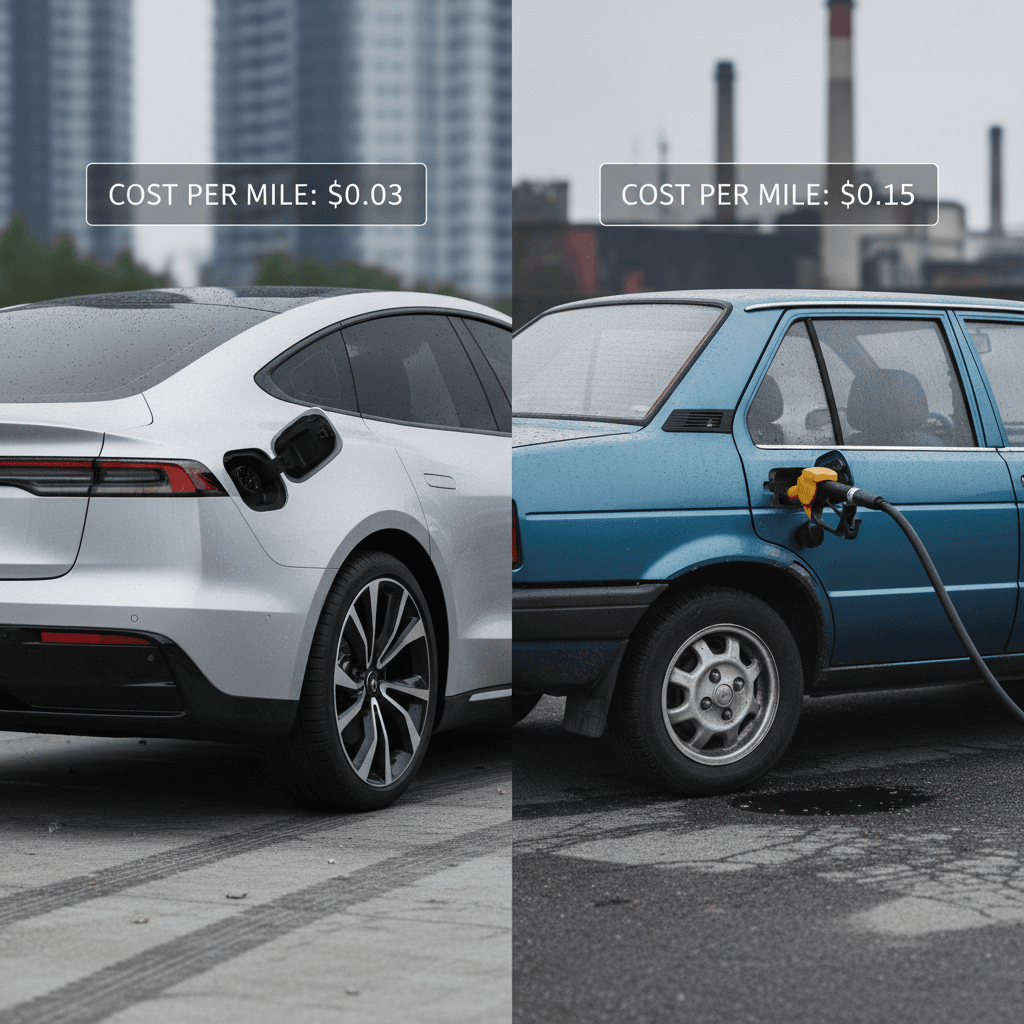
Does a short commute delay EV payback time?
Here’s the uncomfortable truth for EV fans: with only **3,750 commute miles per year**, **fuel savings alone** won’t pay back a big price premium quickly. The car simply doesn’t drive enough to exploit its efficiency.
Example: New EV vs new gas car
Imagine a new EV priced **$10,000** higher than a comparable gas car.
- Annual commute fuel savings: roughly **$250/year**
- Other driving might add another **$300–$400/year** in savings if you’re a heavier driver.
At **$500–$650/year** total savings, payback on a $10,000 premium takes **15+ years**. You’ll likely change cars before the math catches up.
Example: Used EV vs used gas car
Now consider a **used EV** that’s only **$2,000–$4,000** more than an equivalent used gas car.
- Total annual fuel + maintenance savings can easily hit **$500–$800/year** for many drivers.
- Now you’re looking at a **3–6 year** payback horizon.
For a short‑distance commuter who tends to keep cars a while, this is where EV economics start to shine.
Where Recharged fits into that payback story
Ready to find your next EV?
Browse VehiclesBeyond fuel: maintenance, time, and daily experience
The fuel column is only half the spreadsheet. EVs tilt the rest of the ownership stack, maintenance, repairs, time, even the way your morning feels, quietly in their favor, especially when you don’t rack up big miles.
EV vs gas on a 15‑mile commute: what spreadsheets miss
Short trips amplify some of the quiet advantages of electric
Maintenance and repairs
- EVs: No oil changes, fewer fluids, no exhaust, far less brake wear thanks to regen. On a 15‑mile commute you might do years between brake jobs.
- Gas cars: Oil changes every 5,000–7,500 miles, more wear from constant cold starts and idling in traffic.
Even conservative estimates put EV maintenance hundreds per year below a comparable gas car over time.
Time and convenience
- EVs: You “refuel” while you sleep. For a 15‑mile commute, you might plug in just a few times a week.
- Gas cars: 10–15 minutes at the pump every week or two, more if prices are spiky and stations are busy.
What’s your hourly rate? Subtract that from any apparent fuel savings a gas car seems to have.
Cold starts vs quiet starts
How to estimate your own 15‑mile commute costs
Rather than memorizing anyone’s averages, you’re better off knowing a **simple set of formulas** you can use for any EV or gas car you’re considering. Here’s a pocket calculator you can run with just a phone and a few numbers from your utility bill and gas station sign.
DIY calculator: EV vs gas cost for your 15‑mile commute
1. Confirm your real commute distance
Use a mapping app to measure your actual **door‑to‑door round‑trip**. If it’s 14 or 18 miles, use that instead of our 15‑mile shorthand.
2. Grab your electricity rate
Look at your utility bill for **$/kWh**, including delivery fees and taxes. If you’re on a time‑of‑use plan, note the **off‑peak** rate you’ll use for overnight charging.
3. Look up your EV’s efficiency
Check the window sticker, owner’s manual, or online EPA listing for **kWh/100 mi** or **miles per kWh**. For a used EV on Recharged, the **Recharged Score Report** calls this out alongside battery health.
4. Look up your gas car’s real mpg
Use your own trip computer or a site like fueleconomy.gov for a realistic combined **mpg** figure. If your real‑world number is worse than the sticker, use the real one.
5. Apply the EV cost formula
<strong>EV cost per day</strong> ≈ (Commute miles ÷ miles per kWh) × electricity price. Repeat the math with your **total daily miles** to understand whole‑car economics.
6. Apply the gas cost formula
<strong>Gas cost per day</strong> = (Commute miles ÷ mpg) × gas price. Again, run the math for your total daily miles to compare apples‑to‑apples.
Shortcut: think in cost per mile
- EV: (Electricity price × kWh/100 mi) ÷ 100
- Gas: Gas price ÷ mpg
Multiply those cost‑per‑mile numbers by your **annual miles** to get a good year‑over‑year comparison, whether you commute 15 miles or 50.
When a used EV makes the most sense for short commuters
If you only drive 15 miles a day, you don’t need the latest 300‑mile crossover spaceship. You need something **boringly excellent**: enough range for your life, a healthy battery, straightforward charging, and a price that doesn’t make your eyebrows meet your hairline.
Best used‑EV candidates for a 15‑mile daily commute
What to prioritize when fuel savings are modest but reliability and simplicity matter a lot
Older but efficient compacts
Examples: Nissan Leaf, Chevy Bolt EV, Hyundai Ioniq Electric.
- Even with 150–200 miles of usable range, your 15‑mile commute barely dents the battery.
- Lower purchase price makes every dollar of fuel savings pull more weight.
Verified battery health
Short‑range commuting means you’ll live with the **battery you buy** for a long time.
- Look for clear battery‑health data, not vague assurances.
- Every EV on Recharged comes with a Recharged Score Report, including **independent battery diagnostics**.
Charging that fits your housing
With only 15 miles a day, even a simple setup works.
- If you can install a **Level 2 charger** at home, do it, you’ll barely think about “fuel” again.
- If you’re in an apartment, prioritize **reliable workplace or nearby Level 2** over a false promise of always‑available fast charging.
How Recharged simplifies the math for you
- A **Recharged Score Report** with verified battery health and efficiency data.
- Transparent, fair‑market pricing plus **financing** options sized to your real budget.
- Guidance from EV specialists who can help you model **fuel and maintenance savings** for your exact commute, whether that’s 15 miles or 50.
The goal isn’t to sell you the flashiest EV. It’s to help you avoid overbuying range you’ll never need, and overpaying for gas you don’t have to burn.
FAQ: EV vs gas for a 15‑mile commute
Frequently asked questions about a 15‑mile commute
Bottom line: Is an EV worth it for 15 miles a day?
If you drive long distances, an EV’s fuel savings scream at you from the spreadsheet. With a **15‑mile commute**, they whisper. The numbers say that, in 2026 America, a home‑charged EV quietly undercuts a comparable gas car by a couple hundred dollars a year on fuel alone, more when gas spikes, and piles on further savings in maintenance and time. But that only pays off quickly if you don’t wildly overpay for the car itself.
That’s where a **well‑priced used EV with a healthy battery** becomes the sweet spot. For short‑distance commuters, the right used EV isn’t a science project; it’s a better appliance. It starts every morning with a full “tank,” shrugs at traffic, and quietly spends a decade costing you less to own than the gas car you were used to. If you’re ready to see what that looks like for your actual 15‑mile routine, browsing verified used EVs and Recharged Score Reports is a much better next step than another night with a calculator tab open.