If you Google “EV tax credit Florida 2026” you’ll mostly find out‑of‑date advice and cheery blog posts written before Congress took a chainsaw to the Inflation Reduction Act. This guide is the post‑cutoff reality check: what actually ended in 2025, what’s still on the table in 2026 for Florida drivers, and how to squeeze value out of the remaining incentives, especially if you’re shopping the used EV market.
Key 2026 takeaway
EV tax credit Florida 2026: the short version
What Florida EV shoppers face in 2026
- No federal tax credit lowers the vehicle price the way the $7,500 Clean Vehicle Credit once did.
- No statewide Florida rebate steps in to replace it.
- You can still claim a federal credit for qualifying home charging equipment placed in service by June 30, 2026.
- Some local utilities and cities still offer small rebates or bill credits for EVs or chargers, but programs change quickly and many have already sunsetted.
What happened to the federal EV tax credit in 2025?
Let’s rewind. The Inflation Reduction Act created the Clean Vehicle Credit for new EVs and the Previously Owned Clean Vehicle Credit for used EVs, both originally scheduled to run through 2032. Then 2025 happened. New legislation, nicknamed the “One Big Beautiful Bill” package, phased out those credits ahead of schedule. Under that law, federal tax credits for buying or leasing an EV ended for vehicles acquired after September 30, 2025.
- If you bought or leased a qualifying EV on or before September 30, 2025 and properly transferred or claimed the credit, you can still report it on your 2025 tax return.
- If you take delivery of an EV in 2026, there is no federal purchase credit under current rules.
- That includes both the $7,500 new EV credit and the up‑to‑$4,000 used EV credit. Both are gone for 2026 purchases unless Congress revives them.
Beware stale “2025–2032” advice
Does Florida have its own EV tax credit in 2026?
Short answer: no statewide purchase credit, no statewide charger credit. Florida has flirted with various EV‑friendly policies, HOV lane decals, infrastructure funding, the occasional pilot rebate through local utilities, but the state itself does not offer a 2026 tax credit for buying an EV or a home charger. If someone is promising you a “Florida EV tax credit” at the state level, read the fine print twice.
What Florida does, and doesn’t, offer in 2026
Think of Florida as a strong EV market with weak state‑level incentives.
No state EV tax credit
Some policy perks
Patchwork local rebates
2026 home EV charger tax credit for Florida drivers
Here’s the bright spot. The EV you buy in 2026 may be on its own, but the charger you install at home is not. A separate federal incentive, the EV charging equipment tax credit, derived from Section 30C of the tax code, survived the 2025 knife with a new end date of June 30, 2026.
How the 2026 home charger credit works
1. What qualifies
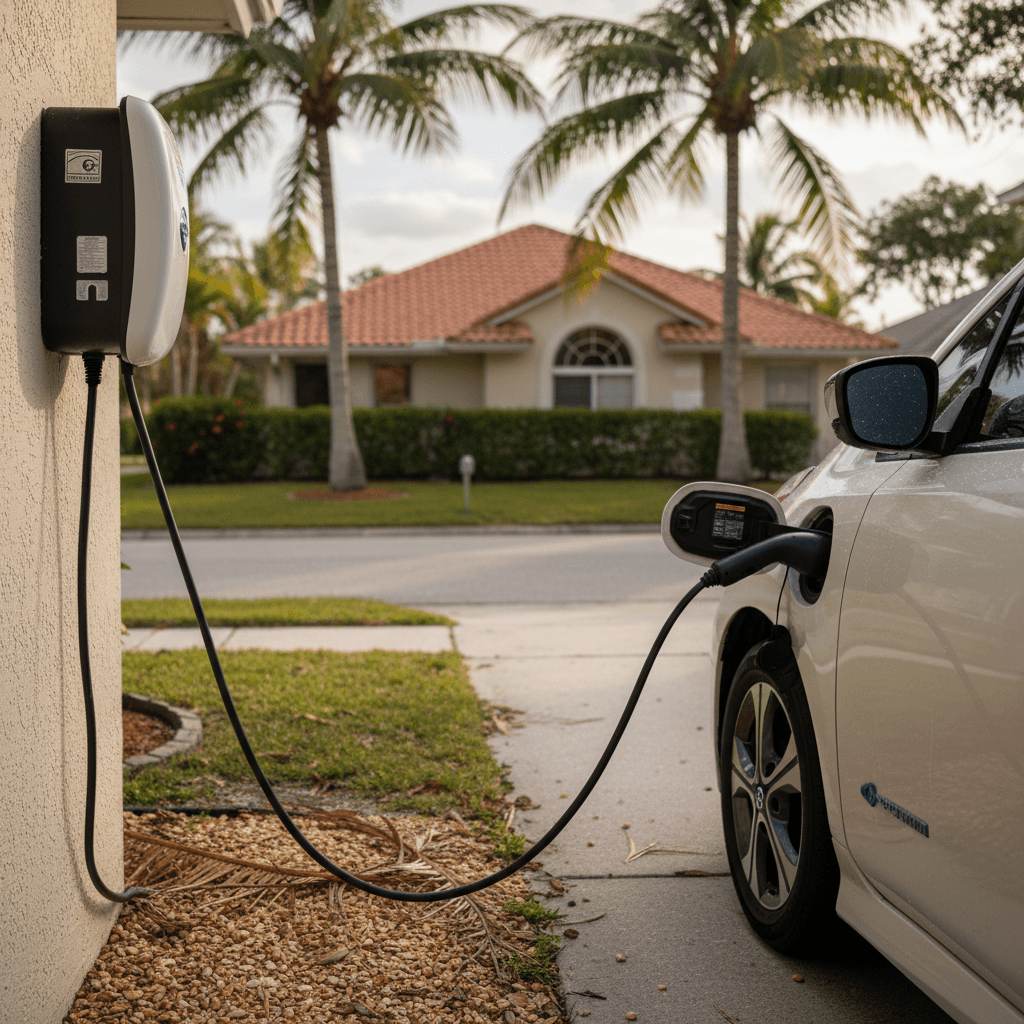
Residential EV charging hardware usually qualifies: a wall‑mounted Level 2 charger, a hard‑wired unit, or a portable Level 2 unit permanently installed as part of your home electrical system. Basic adapters and extension cords do not.
2. The value of the credit
Historically, the credit has been worth up to <strong>30% of the purchase and installation cost</strong>, capped at a fixed dollar amount. Under current law, that structure continues in 2026 but only through June 30. Exact caps and rules can depend on your location and whether the property is treated as personal or business use, so confirm with a tax professional.
3. The deadline that matters
To claim the credit for 2026, your charger must be <strong>placed in service by June 30, 2026</strong>. Waiting until fall 2026 to think about charging is a good way to miss the last meaningful federal incentive most Floridians can still tap.
4. Documentation you’ll need
Save the <strong>charger purchase receipt</strong>, the <strong>electrician’s invoice</strong>, any permit paperwork, and photos of the installed unit. Your tax preparer will use these to complete the appropriate IRS form for the charging credit.
A tactical move for Florida homeowners
Utility and local EV incentives in Florida
Even without a state tax credit, some Florida electric utilities and cities continue to quietly underwrite EV adoption with small rebates or bill‑credit programs. These offers change faster than the tide, so think of this as a playbook, not a fixed menu.
1. Utility EV and charger rebates
Historically, Florida utilities like JEA (Jacksonville), Duke Energy Florida, Florida Power & Light, Orlando Utilities Commission and a handful of municipal co‑ops have offered perks such as:
- One‑time rebates for buying a Level 2 charger
- Bill credits if you enroll an EV in a managed‑charging or off‑peak program
- Discounted electricity rates during overnight hours for EV charging
Many of the most generous 2023–2025 programs are now closed to new enrollees, but new pilots appear all the time. Always check your current utility’s EV or “Drive Electric” page.
2. City or regional programs
Cities and counties sometimes run limited‑time grants for multi‑family or workplace charging. If you live in a condo in Miami, Tampa, Orlando or Jacksonville, your HOA or property manager may be eligible for funding even when you aren’t directly.
These programs often operate with fixed funding pools, once the money is gone, the program quietly closes. Reading a 2024 blog about a “$500 charger rebate” doesn’t mean it’s still available in 2026.
Don’t buy based on expired rebates
How used EVs fit into the 2026 tax picture
Used EV shoppers got a brief golden hour under the Inflation Reduction Act: up to $4,000 off a qualifying used EV bought from a dealer, subject to price and income caps. That credit, too, was repealed for vehicles acquired after September 30, 2025. So in 2026, there is no special federal tax credit for buying a used EV in Florida.
The twist is that the used EV market did not get the memo. Prices have continued to normalize as supply catches up to demand and as three‑year‑old lease returns land on the market. In other words, the discount is now baked into the transaction price instead of being printed on an IRS form.
Why used EVs still make sense without a tax credit
The car doesn’t need a line on your 1040 to be a deal.
Depreciation already happened
Real‑world battery data
Lower running costs
How to stack remaining incentives on a used EV
Think of 2026 as the era of the DIY EV deal. You’re not getting a sponsored $7,500 haircut at the dealership; you’re building a rational cost stack from what’s left.
A realistic 2026 savings stack for Florida EV buyers
1. Push the purchase price, not the payment
In a no‑credit world, <strong>every dollar off the price is real</strong>. Focus negotiation on out‑the‑door cost instead of monthly payment gymnastics. Used EVs have room to move, especially those that no longer qualify for any manufacturer incentives.
2. Capture the home charger credit before June 30
If you’re in a house or townhome where you can install a Level 2 charger, getting that work done <strong>before June 30, 2026</strong> is one of the few true federal incentives left. Coordinate your car purchase around your electrician’s schedule, not the other way around.
3. Hunt local rebates and rate plans
Call or email your utility’s EV program contact. Ask specifically about <strong>charger rebates, off‑peak EV rates, and managed‑charging programs</strong>. A modest $150 rebate plus lower night‑time rates is worth real money over a few years.
4. Finance intelligently
With no tax credit to plow into your down payment, the structure of your loan matters. Compare rates from banks, credit unions, and EV‑focused retailers. Recharged can help you <strong>pre‑qualify for EV financing</strong> with no impact to your credit, so you walk in knowing your buying power.
Two real‑world Florida scenarios for 2026
Let’s put numbers to this. These are simplified, but they show how a Florida household can still come out ahead in 2026 without leaning on a vanished federal EV purchase credit.
Sample 2026 scenarios for Florida EV buyers
Illustrative only, your exact numbers will depend on your utility, installer quotes, and driving habits.
| Scenario | Vehicle | Key Moves | Where the Savings Come From |
|---|---|---|---|
| Suburban homeowner | 3‑year‑old used crossover EV around $24,000 | Installs a wall‑mounted Level 2 charger in March 2026; claims federal charger credit; enrolls in off‑peak EV rate plan. | One‑time tax credit on charger + lower nightly charging rate + used EV pricing already depressed by depreciation. |
| Urban apartment dweller | 5‑year‑old compact EV around $12,000 | Skips home charger; uses workplace Level 2 and DC fast charging as needed; switches to a nearby utility member with EV‑friendly rates if possible. | No hardware credit, but saves on fuel and maintenance vs. a similar used gas car; avoids paying for unused home charging infrastructure. |
How the last remaining tax credit and local incentives can offset the loss of the federal purchase credit.
You’re not “too late”
Common EV tax credit myths Florida drivers still hear
- “I’ll get $7,500 off any EV I buy.” Not anymore. For 2026 purchases, the federal new/used EV purchase credits are gone. Some dealers still talk like they exist; they’re either out of date or playing word games with lease incentives.
- “Florida gives you a state EV tax credit.” Florida doesn’t have a state income tax, and it does not write you a check for buying an EV. Any savings you see advertised are usually local utility rebates or dealer discounts, not a Tallahassee‑funded program.
- “I’ll just claim the credit myself if the dealer doesn’t.” For vehicles acquired after September 30, 2025 there is no federal purchase credit to claim yourself. You can still claim the separate charger credit on your own return if you install qualifying equipment.
- “My friend got a rebate last year, so I will too.” Most local rebates are temporary. Always verify that a program is accepting new applications in 2026 before you treat it as part of your budget.
Watch out for lease “mirages”
How Recharged can help you make the numbers work
In a world without a simple plug‑and‑play federal EV tax credit, you need more than a smiling salesperson and a stack of glossy brochures. You need clarity. That’s where Recharged comes in.
Why Florida EV shoppers start with Recharged
We can’t resurrect the 2023 tax code, but we can make 2026 make sense.
Battery health, not hand‑waving
Transparent, fair pricing
Financing built for EV buyers
Ready to find your next EV?
Browse VehiclesNationwide used EV marketplace
We’re a retailer and marketplace focused solely on used EVs. Browse online, complete paperwork digitally, and have your car delivered nationwide, or visit our Experience Center in Richmond, VA if you like to kick the tires in person.
For Florida buyers, that means you’re not limited to whatever a single local dealer has on the lot this week. You can shop the whole curated inventory and filter by range, budget, and battery health.
Guidance on incentives and charging
Our EV specialists stay on top of federal and local incentive changes. While we can’t give formal tax advice, we can help you understand which programs to ask your tax pro about, how to time a home charger installation, and what to ask your utility.
That support continues after purchase, whether you’re figuring out home charging basics or planning your first Florida road trip.
FAQ: EV tax credit Florida 2026
Frequently asked questions
Bottom line for Florida EV tax credits in 2026
The age of the easy‑button EV tax credit is over, at least for now. In Florida in 2026, you’re no longer counting on a $7,500 federal coupon or a generous state rebate to justify the switch. Instead, you’re working with a slimmer but still meaningful toolkit: a time‑limited federal home‑charger credit, a scattering of local utility incentives, and a used‑EV market that finally prices cars like used appliances rather than speculative tech stocks.
If you approach it like a rational shopper, tight on price, smart about charging, and realistic about incentives, you can still come out ahead. And if you’d like a partner that lives and breathes used EVs, Recharged is built for exactly this moment: transparent battery health, fair pricing, EV‑savvy financing, and human guides who can help you make sense of a fast‑changing incentive landscape.