
If you live in Jersey City and you’re trying to figure out which EV rebates in Jersey City and New Jersey still exist in 2025–2026, you’re not imagining it: the rules really have changed. Sales tax exemptions are being phased out, state rebates open and close based on funding, and utilities offer their own charger incentives on top. This guide walks you through what’s available right now, what’s paused, and how to build a realistic savings stack whether you’re buying a new or used EV.
Dates in this guide matter
Overview: How EV rebates work in Jersey City
Jersey City drivers tap into three main buckets of incentives: federal tax credits, state-level rebates and tax rules, and utility or local benefits. Unlike some cities, Jersey City doesn’t currently run its own headline EV rebate program, but you still benefit from New Jersey incentives and from the fact that most of the city is in PSE&G territory for charger rebates.
Key New Jersey EV incentive highlights (2025–2026)
Funding windows open and close
What’s changed in New Jersey EV incentives (2024–2026)
To understand today’s EV rebates in Jersey City, you need to know how New Jersey’s landscape has shifted since 2024. The state used to be one of the most generous markets in the country, with both a full sales‑tax exemption on zero‑emission vehicles (ZEVs) and robust purchase rebates. Both pieces have evolved.
Recent New Jersey EV incentive changes
Major New Jersey EV incentive milestones that affect Jersey City buyers.
| Date | Change | What it means for you |
|---|---|---|
| Before Oct 1, 2024 | Full sales‑tax exemption on qualified ZEVs | Buyers of eligible new and used EVs paid 0% state sales tax. |
| Oct 1, 2024 – Jun 30, 2025 | Partial ZEV exemption; 3.3125% tax rate | EVs still enjoyed a reduced rate vs. gas cars, but no longer fully exempt. |
| Jul 1, 2025 onward | Full 6.625% sales tax on ZEVs | EVs are now taxed at the standard New Jersey sales tax rate. |
| Jul 10, 2024 | Year Five of Charge Up New Jersey launched | Base rebates rose to $2,000 for eligible new EVs under a $55,000 MSRP, with an income‑based add‑on promised for fall. |
| Jul 1, 2025 – Feb 23, 2026 | Charge Up incentives open, then paused | The statewide website shows EV and charger applications open in mid‑2025 but later marked as closed in February 2026 once funds were reserved. |
Use this timeline to understand why your neighbor’s EV deal from last year may not match what’s on the table today.
No more automatic sales‑tax holiday on EVs
State EV rebates Jersey City drivers can use
From a Jersey City perspective, the most important state‑level incentives are the Charge Up New Jersey program and its income‑based add‑on, plus smaller support for home chargers. The catch: you’re playing a funding and timing game.
Core New Jersey EV rebate programs
These statewide incentives matter whether you live in Jersey City, Newark, or Atlantic City.
Charge Up New Jersey (vehicles)
What it is: A point‑of‑sale rebate on eligible new battery‑electric or plug‑in hybrid vehicles, applied directly on the purchase or lease contract.
Typical value: In the most recent funding round, a base incentive around $1,500–$2,000 was common for EVs under an MSRP cap (historically $55,000). An extra income‑based top‑up could double that for qualifying households.
Status (Feb 2026): The official site notes that EV applications are currently closed after funding was fully allocated. Future rounds are possible but not guaranteed.
Charge Up+ (income based)
What it is: An add‑on for income‑qualified New Jersey residents, stacked on top of the base Charge Up rebate.
Typical value: Previously structured as roughly an extra $2,000, bringing the total potential state rebate to about $4,000 for lower‑ and moderate‑income buyers.
Reality check: You usually must pre‑qualify before you sign a lease or purchase paperwork, and only when the program is open.
Home charger rebate
What it is: A smaller statewide rebate for buying and installing a qualifying Level 2 home charger.
Typical value: Up to around $250 as a post‑purchase rebate when funding is active, enough to offset a chunk of installation labor or hardware.
Good news: Even if this pot is temporarily dry, you may still get meaningful support from your utility (like PSE&G) and from federal tax credits.
How to monitor state EV rebate reopenings
Jersey City and local perks for EV owners
Unlike some California or Colorado cities, Jersey City does not currently headline its own EV purchase rebate. Instead, you benefit from statewide policies and some smaller, easy‑to‑miss perks that still matter over several years of ownership.
- Access to an ever‑denser DC fast‑charging corridor along I‑78, I‑95, and the Turnpike, which makes lower‑range EVs more practical for Hudson County commuters.
- Potential discounts through Green Pass style toll programs offered at the state level for qualifying low‑emission vehicles, worth checking if you’re a heavy E‑ZPass user.
- Reduced fuel‑cost exposure as New Jersey’s gas tax ratchets up through 2029, a big deal if you do a lot of weekend driving out of the city.
Don’t overlook parking and HOA policies
Charger rebates for Jersey City apartments and homes
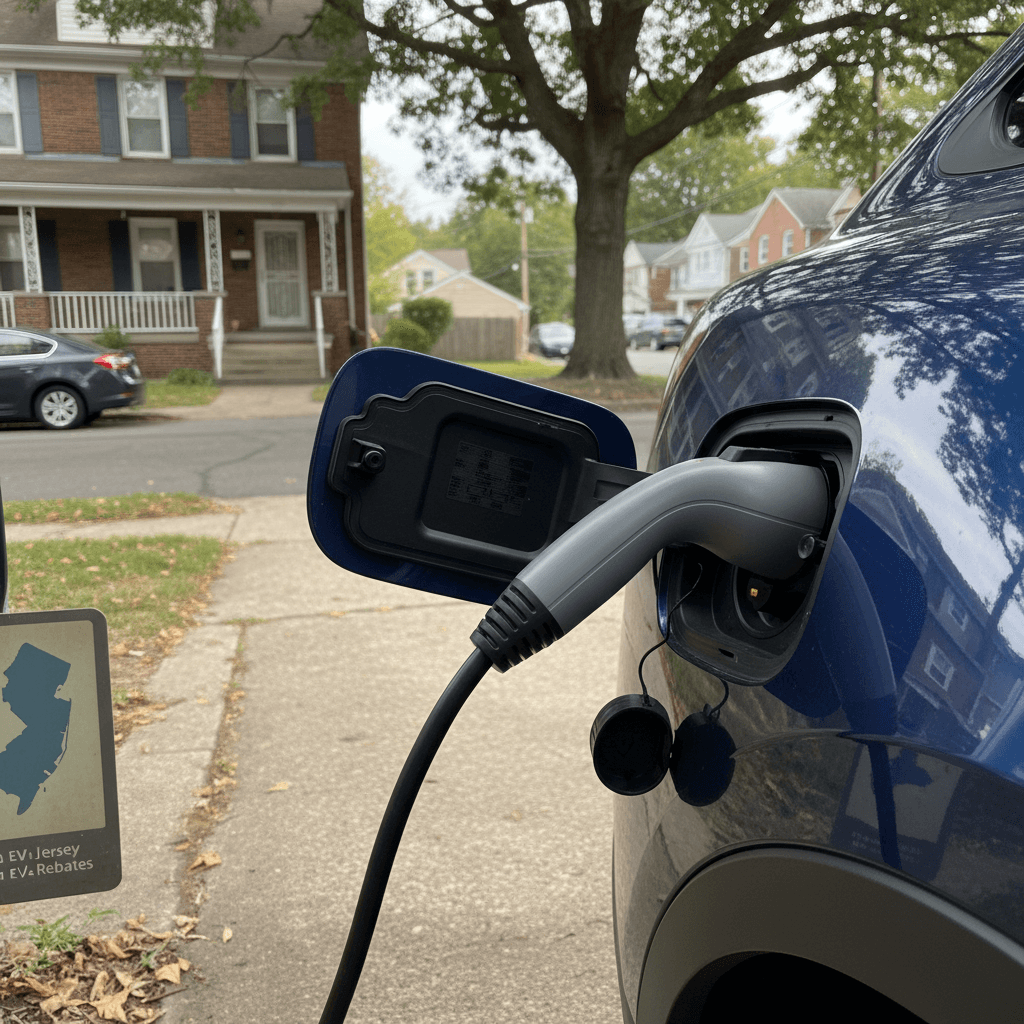
Charging is where New Jersey, and PSE&G territory in particular, still shines. Even if the headline state vehicle rebate is temporarily closed, you can often cut the cost of home charging by thousands between state and utility programs, plus federal tax credits.
PSE&G EV Residential Charging Program
Most Jersey City addresses are served by PSE&G, which runs one of the stronger utility EV programs in the region.
- Customer-side make‑ready credit: Up to $1,500 in on‑bill credits to help cover panel upgrades, wiring, or other work on your side of the meter.
- Utility-side make‑ready support: Up to $5,000 reduction in any required deposit if PSE&G has to upgrade transformers, service drops, or other grid hardware to support your charger.
- Hardware not included: You still buy the charger itself, but these credits soften the blow of installation in older buildings.
Note: As of early 2026, PSE&G is phasing out its separate off‑peak charging bill credits, but make‑ready incentives remain available.
State & federal charger incentives
- State charger rebate: When funded, Charge Up New Jersey offers around $250 back on a qualifying Level 2 charger installation; applications are currently closed but could reopen.
- Federal 30% tax credit: The IRS offers a tax credit worth 30% of eligible home charger costs, up to $1,000, if the property and equipment qualify under the latest rules.
- Multifamily & fleet grants: Programs like NJEDA’s Take Charge pilot focus more on commercial and fleet infrastructure, but they can indirectly benefit renters by bringing more plugs into garages and parking lots.
Stacking utility and federal incentives can easily cover half, or more, of a typical Jersey City home charger project.
How to stack EV rebates on new vs. used cars
For a Jersey City buyer, the stacking logic now looks different for new EVs versus used EVs. The state’s main rebate is aimed at new vehicles, while the federal tax code opened a surprisingly strong lane for used EV shoppers as of 2023.
New vs. used EV incentive stack
Where the money comes from will depend heavily on what you buy.
New EV purchased or leased
- State: When Charge Up is open, you’re looking at roughly $1,500–$2,000 in point‑of‑sale savings, plus a possible income‑based add‑on.
- Federal: A clean vehicle credit up to $7,500 if the car, your income, and the assembly/battery sourcing rules line up.
- Sales tax: Full 6.625% New Jersey sales tax as of July 1, 2025, no automatic exemption.
- Charger incentives: State and PSE&G support for home charging, plus a federal 30% tax credit on installation costs (capped at $1,000).
Used EV purchased from a dealer
- State: New Jersey’s main purchase rebate targets new EVs, so used buyers lean on federal and local levers.
- Federal: The used clean vehicle credit can provide up to $4,000 (or 30% of the sale price) on qualifying used EVs bought from a dealer, with income and price caps.
- Sales tax: Same 6.625% as new, now that the ZEV exemption is fully phased out.
- Charger incentives: Identical to new: state charger rebate (if funded), PSE&G make‑ready support, and the federal 30% charger tax credit when applicable.
Used EVs can be the sweet spot
Rebate strategies by budget and living situation
In a dense, expensive housing market like Jersey City, the right EV and rebate strategy depends a lot on whether you rent or own and how much highway driving you actually do. Here are three practical playbooks that fit how people really live in Hudson County.
Three realistic Jersey City EV rebate playbooks
Renter with street parking or shared garage
Prioritize an EV with strong DC fast‑charging capability since you may rely heavily on public stations.
Look for <strong>used EVs</strong> that qualify for the federal used‑vehicle credit; state purchase rebates may not be available when you buy.
Push your building manager or HOA to tap NJEDA and utility programs for shared chargers, these are often funded at higher levels than individual home installs.
Use apps to identify cheaper off‑peak public charging rates, and compare those costs to your current gas spending.
Condo or homeowner with off‑street parking
Treat the <strong>home charger</strong> as your main rebate target: combine PSE&G make‑ready credits with state and federal charger incentives.
If future Charge Up funding opens, time a <strong>new EV purchase</strong> to grab both state and federal vehicle credits in the same transaction.
Run the numbers on total ownership cost: even with sales tax back, low fueling and maintenance costs usually win over a 5–8‑year horizon.
Work with a licensed electrician who’s familiar with PSE&G’s documentation requirements so you actually receive the full make‑ready credit.
Budget‑conscious commuter
Start with your monthly payment ceiling and commute mileage, then work backward to <strong>used EV options</strong> that qualify for the federal used‑vehicle credit.
Avoid overspending on range if you have reliable access to charging, short‑range EVs are often heavily discounted and still practical in North Jersey.
Compare insurance, parking, tolls, and charging costs, not just sticker price. The cheapest EV on paper can be more expensive to own in practice.
Consider buying a used EV from a retailer that <strong>verifies battery health</strong>, so you don’t trade gas costs for an early, expensive battery problem.
Action steps before you buy an EV in Jersey City
1. Map your charging reality
Before you price out rebates, figure out whether you’ll mostly charge at home, at work, or in public. This dictates how much utility and charger support you can actually use.
2. Confirm program status and rules
Check the latest <strong>Charge Up New Jersey</strong> and PSE&G EV program pages. Note whether applications are open, income caps, MSRP limits, and any pre‑approval steps.
3. Run federal credit scenarios
Use an online estimator or talk to a tax professional to see whether you qualify for the new or used clean vehicle credit and how much of the credit you’re likely to actually use.
4. Decide new vs. used based on total value
Don’t chase a single rebate. Compare a new EV with state money to a discounted used EV plus federal used‑vehicle credit, factoring in sales tax, insurance, and charging costs.
5. Get written pricing with and without incentives
Ask the seller to show you a line‑item breakdown that clearly separates vehicle price, fees, estimated taxes, and any rebates applied at the point of sale so you know what’s guaranteed.
6. Prioritize vehicles with transparent battery health
Battery condition is the hidden variable in any EV deal. Especially on used cars, look for a detailed, third‑party battery health report rather than just an odometer reading.
How Recharged helps Jersey City buyers use incentives
New Jersey’s EV incentive landscape is in flux, and for used EV shoppers especially, the difference between a smart buy and a headache often comes down to information. That’s the gap Recharged is built to close.
Clarity on pricing and incentives
- Transparent, digital pricing: Every vehicle on Recharged is listed with clear, upfront pricing you can review from your apartment or office in Jersey City.
- Incentive walkthrough: EV‑specialist advisors help you understand which federal credits and local charger rebates you may qualify for based on your situation.
- Financing support: You can pre‑qualify for financing online with no impact to your credit, then see how different vehicles and incentives affect your monthly payment before you commit.
Battery‑savvy used EV shopping
- Recharged Score Report: Every vehicle comes with a detailed battery health and fair‑market‑value report, so you can see how much usable range you’re actually buying.
- Trade‑in and instant offer options: If you’re moving out of a gas car, Recharged can give you an instant offer or help you consign it, making the math on your EV upgrade easier.
- Nationwide delivery with local mindset: Vehicles can be delivered to Jersey City, and you can visit the Recharged Experience Center in Richmond, VA if you want to see the process in person.
The goal is simple: make sure the EV you choose, and the incentives you rely on, actually fit how you live and drive in Jersey City.
FAQ: EV rebates in Jersey City
Frequently asked questions about EV rebates in Jersey City
Bottom line for EV rebates in Jersey City
New Jersey’s days of ultra‑simple, ultra‑generous EV incentives are over, but for a Jersey City driver who’s willing to do a little homework, there’s still meaningful money on the table. The state’s flagship Charge Up rebate now comes and goes with each funding round, the sales‑tax exemption is gone, and utilities are quietly doing more of the heavy lifting on home charging. That means your best move is to treat incentives as a bonus, not the foundation of your EV decision, and to lean on transparent information about vehicle pricing and battery health so the economics still work even if a program closes between now and delivery.
If you want help translating this shifting policy landscape into a concrete monthly payment, Recharged can walk you through used EV options, battery reports, and financing side‑by‑side. Whether you buy from us or not, the guiding principle is the same: understand your charging, verify your incentives, and make the math work on the car itself. The rebates should make a good decision better, not rescue a bad one.