If you’ve tried to make sense of EV sales statistics for 2025, you’ve probably bumped into two seemingly opposite headlines: “global EVs are booming” and “EV demand is slowing down.” Both are true. The story of 2025 is a market that’s growing fast overall, but unevenly, on the new-car side, by region, and especially between new and used EVs.
Key takeaway
Global EV sales statistics in 2025
Global EV sales snapshot, 2024–2025
Globally, EVs are still in a classic growth phase. In 2024, automakers sold more than 17 million electric vehicles worldwide, about 25% more than in 2023. That pushed EVs to around 20% of all new vehicle sales, a psychological tipping point where they’re no longer a niche experiment but a mainstream drivetrain choice.
By November 2025, global sales had already hit about 18.5 million EVs year‑to‑date, up roughly 21% compared with the same period in 2024. At that pace, 2025 is on track to set yet another global record, even as some individual markets wobble.
How to read global EV stats
Regional breakdown: where EVs are growing fastest
2025 EV sales by region
Same global wave, very different surf conditions
China
2024: Around 11 million EVs sold, nearly half of all new cars.
2025 YTD: About 11.6 million EVs sold by November, up ~19% year-over-year.
China remains the gravitational center of the EV universe, huge volume, aggressive pricing, and brutal competition.
Europe
2024: EV share held at roughly 20% of new sales, even as some incentives were cut.
2025 YTD: About 3.8 million EVs sold by November, roughly 33% growth vs. 2024.
Europe is back in growth mode in 2025 thanks to fresh incentives and a flood of new models.
North America
2024: U.S. EV sales reached about 1.6 million, just over 10% of new vehicle sales.
2025 YTD: Around 1.7 million EVs sold by November across North America, actually down ~1% from 2024.
The story in 2025: growing model choice, but a hangover from fading subsidies and higher interest rates.
If you zoom out, 2025 looks like a textbook S‑curve: China is in the steep middle, Europe is climbing again after a breather, and North America is in a messy transition between early adopters and the mainstream.
Don’t confuse region with destiny
U.S. EV sales statistics 2025: growth hangover
In the U.S., 2024 closed on a high note for electrified vehicles: hybrids, plug‑in hybrids, and pure EVs together made up about 20% of all new light‑vehicle sales. Roughly 1.3–1.6 million of those were full battery EVs, enough to push pure EV share past the 10% mark for the first time.
Analysts at Cox Automotive had expected pure EVs to reach around 10% of new U.S. sales in 2024 and climb to roughly 15% in 2025, with hybrids taking another 18% as buyers hedge their bets between gasoline and full electric. That forecast assumed stable incentives and slowly falling prices.
The tax credit rug pull
Why new EV growth cooled
- Incentive uncertainty: When buyers aren’t sure which models qualify for credits, or whether credits will survive the next election, many just delay the purchase.
- Higher interest rates: A $50,000 EV looks very different at 7–8% APR than it does at 2–3%.
- Dealer readiness gap: Some dealers doubled down on EV training and charging infrastructure; others quietly steered shoppers back to ICE SUVs that are easier to move.
What kept EVs moving anyway
- More models: From three‑row SUVs to small crossovers and work trucks, the EV showroom finally looks like the rest of the market.
- Price cuts and leasing: Tesla and others cut prices, and leasing emerged as a way to sidestep some of the incentive chaos.
- Corporate and fleet demand: Delivery companies, utilities, and ride‑hail fleets kept buying even when retail shoppers got skittish.
Good news if you’re shopping used
Used EV sales statistics 2025: the quiet boom
While headlines obsessed over new‑car demand, the used EV market quietly took off in 2025. By early 2026, industry trackers were reporting that used EV sales were up roughly 20%+ year‑over‑year, even as new EV sales in the U.S. fell close to 30% from a year earlier. That gap tells you where real consumer value is right now.
Used EV market highlights, 2025
Cox and other analysts describe this period as an “EV winter” on the new side and a thaw on the used side. When new‑car incentives vanish, buyers don’t just give up on EVs; many of them simply go hunting for value in the pre‑owned market.
Why used EVs suddenly make so much sense
EV market share and model leaders in 2025
Most popular used EVs in 2025 (U.S., 1–5 years old)
Tesla still dominates the used EV market, but competitors are starting to show up on the leaderboard.
| Rank | Model | Share of used EVs | Notable context |
|---|---|---|---|
| 1 | Tesla Model 3 | 19.5% | Affordable, abundant supply; many examples now under $25,000. |
| 2 | Tesla Model Y | 19.3% | America’s best‑selling new EV also dominates on the used side. |
| 3 | Ford Mustang Mach‑E | 5.0% | Strong brand and increasing inventory make it a used EV staple. |
| 4 | Volkswagen ID.4 | 3.9% | Big jump in ranking as early leases return off‑lease. |
| 5 | Tesla Model S | 3.0% | Older luxury sedans with big depreciation but strong performance. |
| 6 | Tesla Model X | 3.0% | Family hauler with niche appeal and steep initial sticker price. |
| 7 | Chevrolet Bolt EV | 2.8% | One of the cheapest paths into an EV; popular with value‑seekers. |
| 8 | Hyundai Ioniq 5 | 2.4% | Fast‑charging darling now starting to show up in meaningful volumes. |
| 9 | Chevrolet Bolt EUV | 2.2% | Slightly larger Bolt that benefits from the same value story. |
| 10 | Mercedes‑Benz EQS | 2.2% | Flagship luxury EVs with dramatic depreciation curves. |
Share of one‑ to five‑year‑old used EV sales by model, 2025.
On the new‑car side, Tesla’s grip on pure EV sales is loosening but still firm. In 2024, Tesla accounted for roughly half of U.S. EV sales, down from about 55% in 2023 as Hyundai–Kia, GM, Ford, and others gained share. That diversification is healthy: more choice, more price points, and more formats.
Market share vs. shopper experience
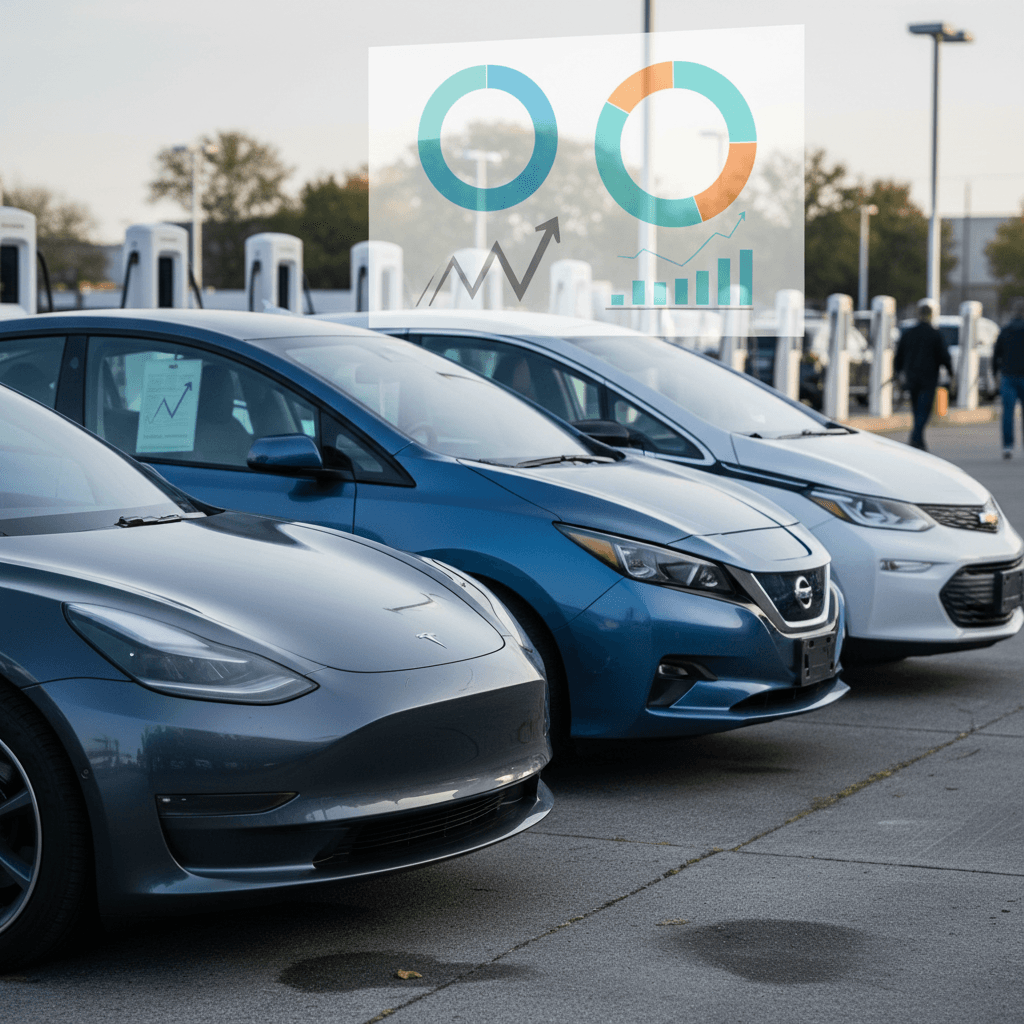
Prices, incentives, and the economy behind the numbers
1. Incentives drive timing, not belief
When a $7,500 credit comes or goes, buyers behave like rational mammals: they rush in before it disappears or wait to see if it returns. That creates spikes and cliffs in monthly EV sales that have little to do with the underlying appeal of electric drivetrains.
If you’re looking at a used EV, you’re cushioned from a lot of that drama. Transaction prices are driven more by supply, mileage, and battery health than by the latest policy headline.
2. Interest rates punish expensive, reward efficient
High rates hit expensive new EVs hardest. A few percentage points of APR on a $70,000 luxury EV can add hundreds of dollars a month to your payment.
On the flip side, modest‑priced used EVs, think $20,000–$35,000, often slot neatly into the same or lower monthly payment than a new gas crossover once you factor in fuel and maintenance savings.
Watch the fine print on financing
- Average new EV transaction prices fell in 2024–2025 as Tesla and others cut stickers to chase volume.
- Used EV prices for non‑Tesla models slipped a few percentage points, especially for older, shorter‑range cars.
- Used Tesla prices bucked the trend and ticked up as new‑car tax credits expired and rumors swirled around Model S and X production cuts.
What 2025 EV stats mean if you’re buying a used EV
Statistics only matter if they help you make a better decision. Here’s how to translate 2025’s EV sales data into a smarter used‑EV purchase today.
Used EV buying playbook, informed by 2025 stats
1. Shop in the “depreciation valley”
The surge in EV sales from 2020–2023 means there’s a growing pool of three‑ to five‑year‑old EVs now hitting the used market. Those cars have already taken their biggest depreciation hit but still offer modern range and safety. This is where many of the best values live.
2. Prioritize battery health over model year
Because EV mileage is so cheap, some early adopters drove their cars hard. Instead of obsessing over calendar age, look for <strong>verified battery health data</strong>. At Recharged, every vehicle includes a <strong>Recharged Score Report</strong> with independent battery diagnostics, so you can compare cars apples‑to‑apples.
3. Take advantage of brand gaps
The data says Tesla dominates used EV sales, but that doesn’t mean a Tesla is always your best buy. Lesser‑known models like the VW ID.4 or Hyundai Ioniq 5 sometimes list thousands less than a comparable Tesla, even when they fast‑charge just as well.
4. Use sales volume as a parts proxy
High‑volume models (Model 3, Model Y, Bolt, Mach‑E) tend to have better aftermarket support, more independent repair expertise, and a deeper inventory of used parts. That can lower your long‑term cost of ownership.
5. Let incentives shape, not dictate, your timing
If your state offers used‑EV rebates or low‑interest green loans, great, use them. But don’t chase a hypothetical future program at the cost of another year in a thirsty gas SUV if the numbers already work for you now.
6. Consider total cost, not sticker shock
A used EV that’s $3,000 more than a comparable gas car might still be the cheaper choice over five years once you factor in electricity vs. fuel, lower maintenance, and potential HOV or parking perks.
Where Recharged fits in
Ready to find your next EV?
Browse VehiclesFAQ: EV sales statistics 2025
Frequently asked questions about 2025 EV sales
Bottom line: reading the road ahead
Taken together, EV sales statistics in 2025 tell a nuanced story. Globally, electric vehicles are still marching toward the mainstream. Regionally, the U.S. is catching its breath after a sprint powered by cheap money and generous credits. And in the background, the used EV market is maturing into a space where informed buyers can make genuinely excellent deals.
If you’re shopping for a used EV, that’s the real headline. You’re not late to the party, you’re arriving right as the bar tab gets reasonable. Focus on battery health, total cost of ownership, and models with strong support, and you can turn 2025’s noisy charts into a quietly smart decision. And if you want help translating market stats into the right car in your driveway, Recharged can walk you through every step, from trade‑in or instant offer to financing, selection, and delivery.