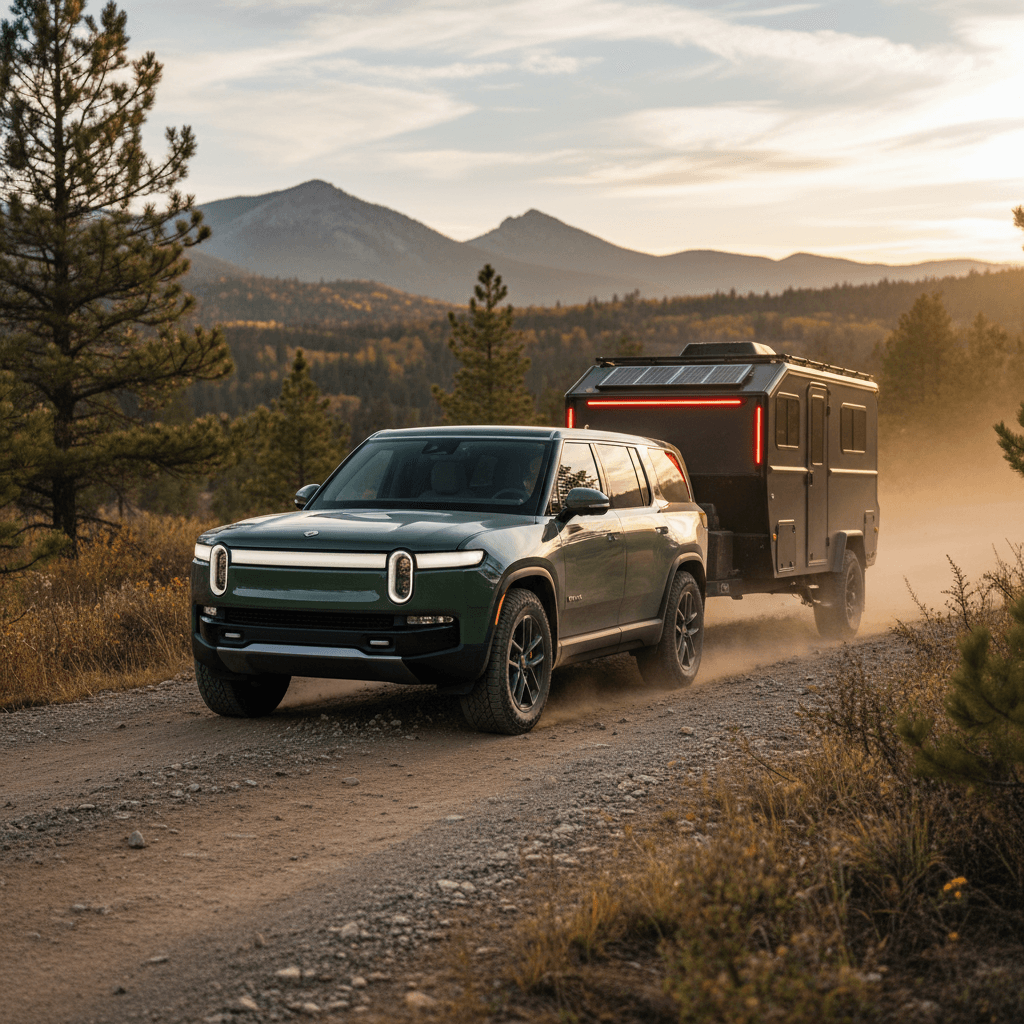
Yes, a Rivian R1S absolutely can tow a trailer. In fact, it’s one of the few electric SUVs on the market that’s truly comfortable pulling real‑world loads like campers, boats, and utility trailers. But if you’re coming from a gas SUV or pickup, the big question isn’t just “can it tow?”, it’s how far you can go, what size trailer actually makes sense, and what to watch for if you’re shopping a used R1S.
Key Takeaway
Can the Rivian R1S Tow a Trailer? Short Answer
If your question is simply, “Can a Rivian R1S tow a trailer?” the answer is a clear yes. Whether you’re thinking small utility trailer, pop‑up camper, or a mid‑size travel trailer, the R1S has the hardware, torque, and chassis to do it. What you need to understand is where its limits are and how towing changes your charging and trip‑planning routine.
- Factory‑integrated Class IV 2‑inch receiver with 7‑pin wiring is standard on R1S.
- Official max tow rating: 7,700 lbs with a properly set up weight‑distributing hitch.
- Without a weight‑distributing hitch, Rivian limits you to 5,000 lbs of trailer.
- Tongue weight should be around 10% of loaded trailer weight, and must stay within the vehicle’s payload rating.
Don’t Just Look at the 7,700‑lb Number
Rivian R1S Tow Ratings and Hitch Basics
Rivian R1S Towing Specs at a Glance
Rivian’s own towing documentation for the R1S is very explicit: to access the full 7,700‑lb tow rating, you must use a weight‑distributing hitch. Without it, the limit is capped at 5,000 lbs. That applies across current R1S model years through mid‑2025.
From the factory, the R1S includes an integrated Class IV 2‑inch receiver behind a removable panel in the rear bumper, plus a 7‑pin trailer wiring connector for lights and trailer brakes. Trailer brake control is handled through the truck’s software, no aftermarket controller required, though you’ll want to confirm it’s enabled and set correctly before your first tow.
Quick Rule of Thumb
What Kind of Trailer Can a Rivian R1S Tow?
Because EV range is so sensitive to weight and aerodynamics, the better question is not just what the R1S *can* tow, but what it can tow comfortably for the kind of trips you actually plan to take.
Good Versus Challenging Trailers for the R1S
Focus on weight, frontal area, and trip distance
Trailers the R1S Handles Well
- Small utility trailers with yard equipment, lumber or motorcycles (1,000–3,000 lbs).
- Single‑axle cargo trailers with low rooflines.
- Teardrop and compact campers with 2,000–3,500‑lb loaded weight.
- Small boats and personal watercraft on streamlined trailers.
Trailers That Push the Limits
- Full‑height travel trailers near 6,000–7,700 lbs loaded.
- Wide, tall toy haulers, even if technically under 7,700 lbs.
- Large enclosed car trailers, especially 8.5‑ft‑wide versions.
- Any trailer that, when loaded, pushes tongue weight toward the R1S’s payload ceiling.
Watch the Trailer’s GVWR, Not Just “Dry Weight”
In practical terms, the R1S is fantastic with 2,000–4,500‑lb trailers and usable but range‑limited with 5,000–7,700‑lb, full‑height campers. If you’re mostly doing weekend trips within 80–120 miles of home, you’ll have a much easier time than someone planning 300‑mile days across the Mountain West.
How Towing Affects Rivian R1S Range
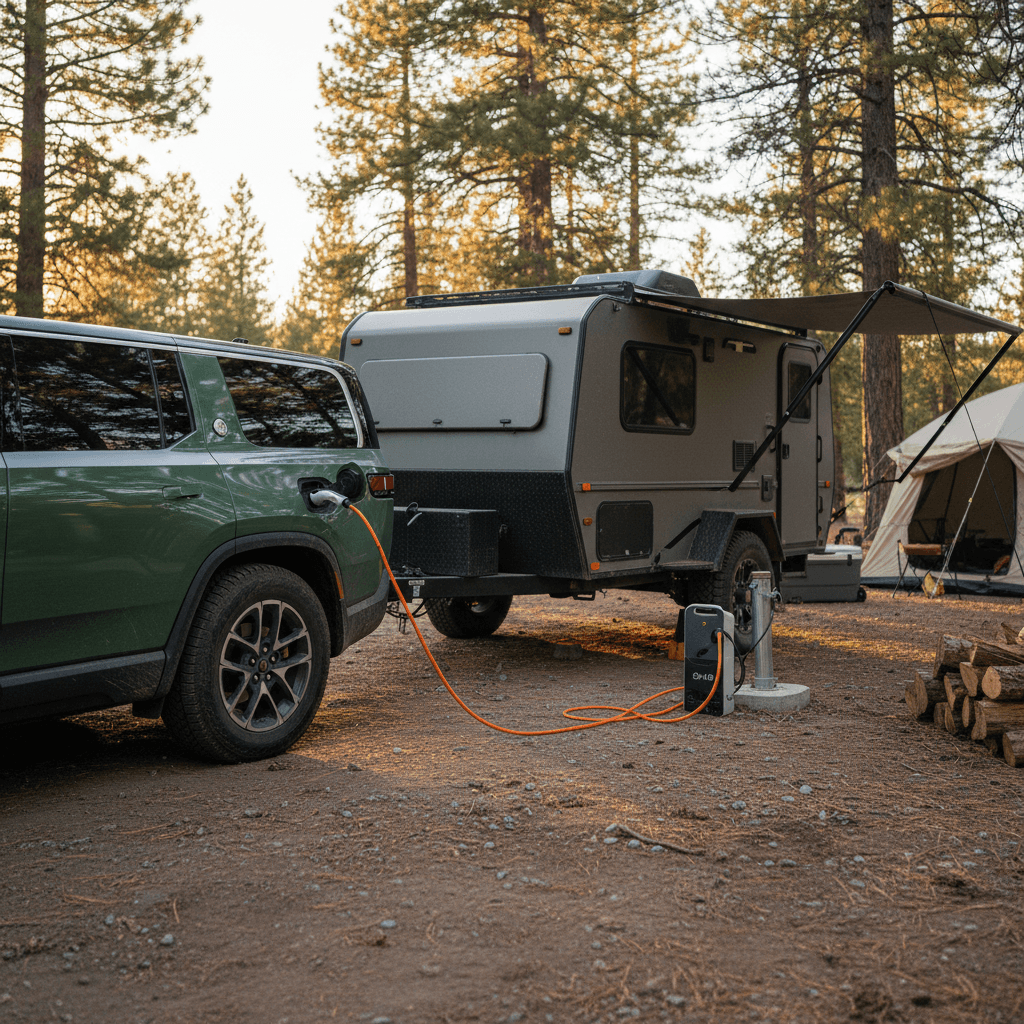
On paper, an R1S with the larger battery pack can offer well over 300 miles of rated range. Hook up a trailer, head out on the highway, and that number shrinks quickly. That’s not a Rivian problem; it’s basic physics that affects every EV, and every gas truck, for that matter.
Real‑World Range Expectations
- Light trailers (under ~3,000 lbs, low profile): Many owners see roughly 20–35% range loss at highway speeds.
- Moderate trailers (3,000–5,000 lbs): Expect 30–50% range loss, depending on height and speed.
- Heavy, boxy trailers (5,000+ lbs): It’s common to see 40–60% less usable range than solo driving.
- High speeds hurt: Running 70–75 mph can easily cost you another 10–15% versus staying closer to 60 mph.
Planning Around Charging
- Use Rivian’s built‑in trip planner in Tow Mode to estimate range and plan DC fast‑charging stops.
- Look for pull‑through chargers where you don’t need to drop the trailer.
- On busy corridors, consider charging to 80–90% more often instead of deep cycles to 5%.
- If you’re new to EV towing, plan your first trip with 30–40% extra buffer until you learn your rig’s real numbers.
Pro Move: Do a “Shakedown Trip” First
Loading Safely: Payload, Tongue Weight and Passengers
Tow ratings make headlines, but what actually limits many R1S owners is payload and tongue weight. Payload is everything in the vehicle, people, cargo, and the downward force of the trailer on the hitch. Exceed it and you’re outside the SUV’s engineered safety envelope for braking and stability.
How Payload and Tongue Weight Relate on the R1S
Illustrative example of how quickly you can run out of payload when towing near maximum capacity. Always reference your specific door‑jamb label for exact numbers.
| Scenario | Loaded Trailer Weight | Assumed Tongue Weight (10%) | Passengers & Cargo in R1S | Approx. Payload Used |
|---|---|---|---|---|
| Light camper weekend | 3,500 lbs | 350 lbs | 2 adults + light gear (~400 lbs) | ≈750 lbs |
| Family camping trip | 5,000 lbs | 500 lbs | 2 adults + 3 kids + gear (~700 lbs) | ≈1,200 lbs |
| Max tow scenario | 7,700 lbs | 770 lbs | 2 adults + moderate gear (~400 lbs) | ≈1,170 lbs (near many R1S payload limits) |
Numbers below are rounded and for example only. Check your individual R1S for its certified payload sticker.
Why Tongue Weight Matters So Much
For many families, a 4,000–5,000‑lb loaded trailer is the sweet spot. That leaves enough payload for four or five people and gear while staying within Rivian’s guidelines. Once you’re flirting with 7,000+ lbs of trailer plus a full cabin, you’re into “weigh it all carefully” territory where it can be easy to exceed one limit or another.
Towing Features and Driving Experience in the R1S
On paper specs only tell half the story. Out on the road, the R1S is a very different tow vehicle from a traditional body‑on‑frame SUV. The instant torque and low center of gravity make it feel planted and confident, even with a substantial trailer in tow.
What Helps the R1S Tow So Well
Key hardware and software features that matter when you’re hitched up
Instant Electric Torque
Low Center of Gravity
Adaptive Air Suspension
Tow Mode
On‑screen Range Estimates
Stability & Sway Control
Pulling a 6,000‑pound camper, the R1S still felt composed and powerful, range was the limiting factor, not muscle.
Good News for Daily Life
Setting Up Your R1S for Towing
If you’ve towed with pickups and SUVs before, most of the basics will feel familiar. The differences with an R1S are mainly around trip planning, hitch setup, and charging logistics. Here’s a simple checklist to get you started.
Rivian R1S Towing Setup Checklist
1. Confirm Your Ratings
Open the driver’s door and read the <strong>Tire and Loading Information</strong> and <strong>GVWR</strong> labels. Note your exact payload rating, then compare it to your expected passengers, cargo, and tongue weight.
2. Choose the Right Hitch
If your trailer’s realistic loaded weight is over about 4,000–4,500 lbs, invest in a <strong>quality weight‑distributing hitch with sway control</strong> so you can safely access Rivian’s full 7,700‑lb tow rating.
3. Set Up Trailer Brakes
Make sure your trailer has <strong>functional electric brakes</strong>. In the R1S settings, select the correct brake gain and test braking at low speed in an empty lot before heading for the highway.
4. Check Lights and Connections
Verify running lights, turn signals, and brake lights through the 7‑pin connector. Double‑check the hitch pin, safety chains crossed under the coupler, and breakaway cable routing.
5. Enable Tow Mode
Before you pull away, put the R1S into <strong>Tow Mode</strong>. This adjusts power delivery, ride height, and stability systems specifically for towing and alters range predictions.
6. Plan Charging With a Trailer
Use the Rivian nav or apps like PlugShare to find <strong>pull‑through or trailer‑friendly fast chargers</strong>. In tight stations, you may need to briefly unhitch, build that time into your plan.
Used Rivian R1S Buying Tips if You Plan to Tow
If you’re looking at a used Rivian R1S specifically because you want an electric tow vehicle, you’re in a smart place, early depreciation can work in your favor. But towing adds heat cycles and load to the battery, motors, and suspension, so it’s worth asking a few extra questions and looking at objective data.
Questions to Ask the Seller
- “What did you tow and how often?” Occasional light‑duty towing is very different from monthly cross‑country camper trips.
- “Did you use a weight‑distributing hitch?” That reduces stress on the rear suspension and improves control near max capacity.
- “Any issues with overheating or derating while towing in hot weather or mountains?”
- “Any suspension or brake work done?” Heavy towing can accelerate wear.
How Recharged Helps
Every used EV on Recharged comes with a Recharged Score Report that includes verified battery health and a detailed condition overview. That’s especially valuable if you plan to tow, because you want to start with a strong pack and a chassis that hasn’t been abused.
- Battery diagnostics that go beyond simple state‑of‑charge readings.
- Transparent, fair‑market pricing that factors in mileage and usage.
- Expert EV specialists who can talk through whether a specific R1S is a good match for your trailer and travel plans.
You can browse used R1S listings, compare ranges and specs, and even arrange nationwide delivery, all online.
Smart Move for Towing‑Focused Buyers
FAQ: Common Rivian R1S Towing Questions
Rivian R1S Towing FAQ
Bottom Line: Can the Rivian R1S Tow Your Trailer?
If you’re wondering whether a Rivian R1S can tow a trailer, the answer is an enthusiastic yes, as long as you match the trailer to the vehicle and are realistic about range. With up to 7,700 lbs of rated towing capacity, an integrated Class IV hitch, and serious electric torque, the R1S is a capable tow vehicle for everything from utility trailers to well‑chosen campers.
Where it differs from a gas SUV is in trip planning. Aerodynamic, appropriately sized trailers in the 2,000–5,000‑lb range are where the R1S really shines, especially if most of your journeys are a few hours from home. Large, boxy travel trailers near the limit are possible, but they demand careful attention to payload, tongue weight, and charging opportunities.
If you’re shopping for a used R1S to tow with, starting from a clean bill of health matters. Recharged’s Recharged Score battery and vehicle report, plus transparent pricing and EV‑specialist support, can help you find an R1S that fits both your family and your trailer. Get those basics right, and the R1S can be a remarkably refined, quiet, and capable tow partner for years to come.