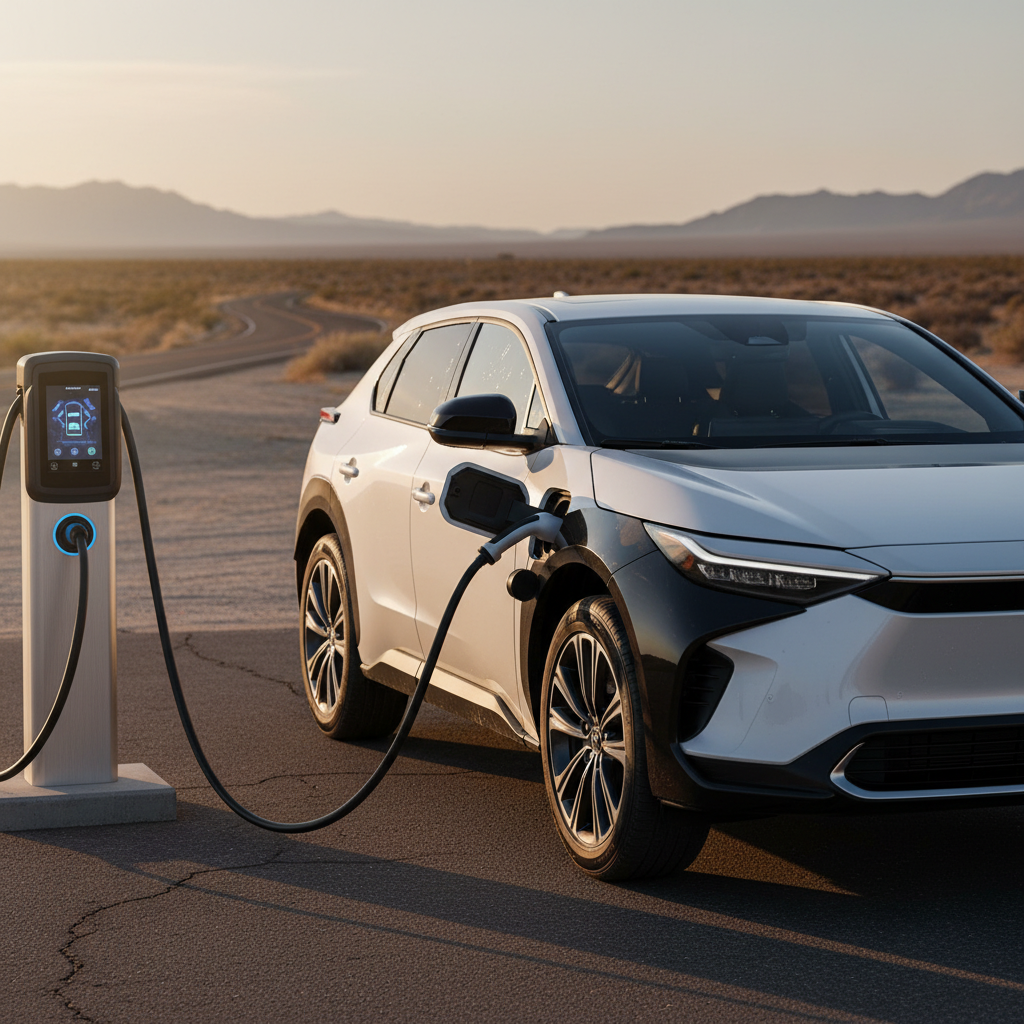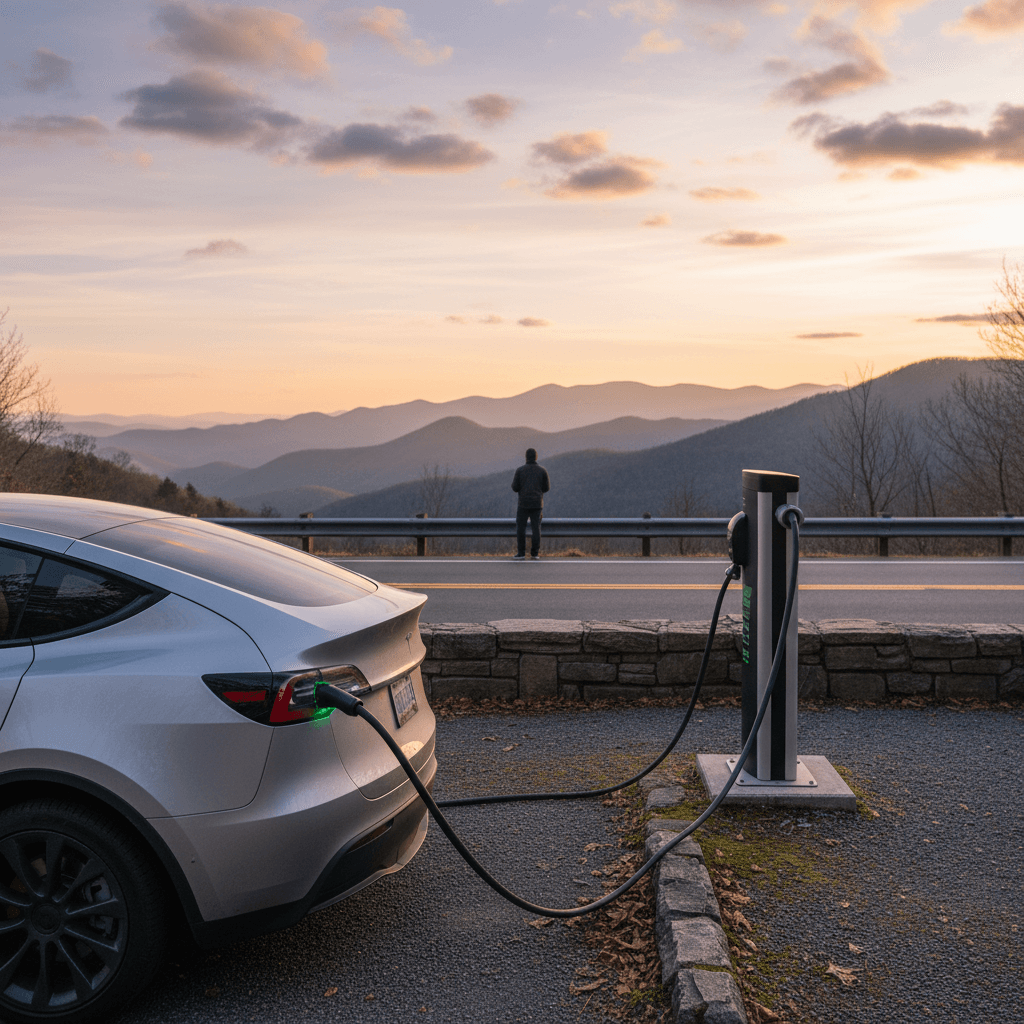
An EV road trip on the Blue Ridge Parkway is the kind of drive that will spoil you for everything else. Low speeds, sweeping curves, and 469 miles of ridgeline views mean your battery goes farther while your shoulders finally drop from around your ears. With some smart planning around charging, this is one of the easiest national-park-style trips you can do in an electric car, especially if you’re starting from the East Coast.
Quick Take
Why the Blue Ridge Parkway Is Perfect for EVs
Blue Ridge Parkway by the Numbers for EV Drivers
Unlike long interstate slogs where you’re running 75 mph into a headwind, the Parkway’s modest speeds and constant elevation changes actually work in your favor. You’ll spend more time in the efficiency sweet spot and recover energy on descents through regenerative braking. That makes the route surprisingly friendly even for earlier-generation or used EVs with smaller packs, exactly the kind of cars you’ll find on Recharged.
Real-World EV Advantage
Route Overview & EV-Friendly Itineraries
Strictly speaking, the Blue Ridge Parkway runs from Rockfish Gap, Virginia (near Waynesboro) to Cherokee, North Carolina. But for an EV road trip, you’ll want to think of it as part of a larger spine of mountain driving that includes Skyline Drive in Shenandoah National Park to the north and Great Smoky Mountains National Park to the south.
EV-Friendly Segments Along the Parkway Corridor
Use this as a high-level planning tool, then layer in specific chargers with your favorite apps.
| Segment | From / To | Approx. Distance | EV Notes |
|---|---|---|---|
| 1. Skyline Drive | Front Royal, VA → Rockfish Gap, VA | 105 miles | Slow, scenic, with Level 2 chargers in Shenandoah facilities and DC fast in Front Royal/Waynesboro. |
| 2. Northern Parkway | Rockfish Gap, VA → Roanoke, VA | 120 miles | Access to DC fast in Waynesboro, Lexington, Roanoke; plentiful Level 2 in small towns off the ridge. |
| 3. Central Parkway | Roanoke, VA → Blowing Rock, NC | 150 miles | Gateway towns like Roanoke, Meadows of Dan, and Boone/Blowing Rock have strong charging coverage. |
| 4. Southern Parkway | Blowing Rock, NC → Asheville, NC | 90 miles | Shorter leg with good access to Boone, Linville, Little Switzerland, Marion, and Asheville chargers. |
| 5. Smokies Connector | Asheville, NC → Cherokee, NC → Great Smoky Mountains NP | 70–110 miles | Multiple DC fast options around Asheville and Cherokee; slow in-park driving extends range. |
Distances are approximate and don’t include side trips or in-park detours.
Seasonal Closures Matter
Where to Charge Your EV Near the Blue Ridge Parkway
Here’s the first thing to understand: you will almost always exit the Parkway to charge. There are very few chargers directly on the road itself, but gateway towns just a few miles down the hill are increasingly well-equipped with Level 2 and DC fast stations.
Key EV Charging Hubs Along the Corridor
Think in terms of hubs, not single stations, each of these towns gives you multiple options within a short drive of the Parkway.
Front Royal & Waynesboro, VA
Ideal bookends for the northern section.
- Multiple DC fast chargers in Front Royal near the Skyline Drive entrance.
- Additional fast charging and Level 2 options around Waynesboro, just off Rockfish Gap.
- Perfect places to start with a full battery before climbing.
Roanoke & Meadows of Dan, VA
Midway anchors with services, food, and lodging.
- Roanoke hosts a cluster of DC fast chargers and Level 2 options around shopping centers and hotels.
- Smaller communities such as Meadows of Dan offer Level 2 stations, good for a lunch-and-hike stop.
Boone, Blowing Rock & Asheville, NC
The EV backbone of the southern half.
- Boone and Blowing Rock have a mix of Level 2 and fast chargers clustered around downtown and highway interchanges.
- Asheville is a regional EV hub with multiple DC fast sites, college campus charging, and hotel chargers.
You’ll also find a growing number of destination Level 2 chargers at inns, breweries, and attractions near the Parkway, from coffee shops in Little Switzerland to bookstores, ski areas, and small-town parking decks. Many Blue Ridge Parkway Association member businesses now highlight EV charging in their listings, and interactive regional maps let you filter for EV-friendly stops.
How to Scout Charging Before You Go
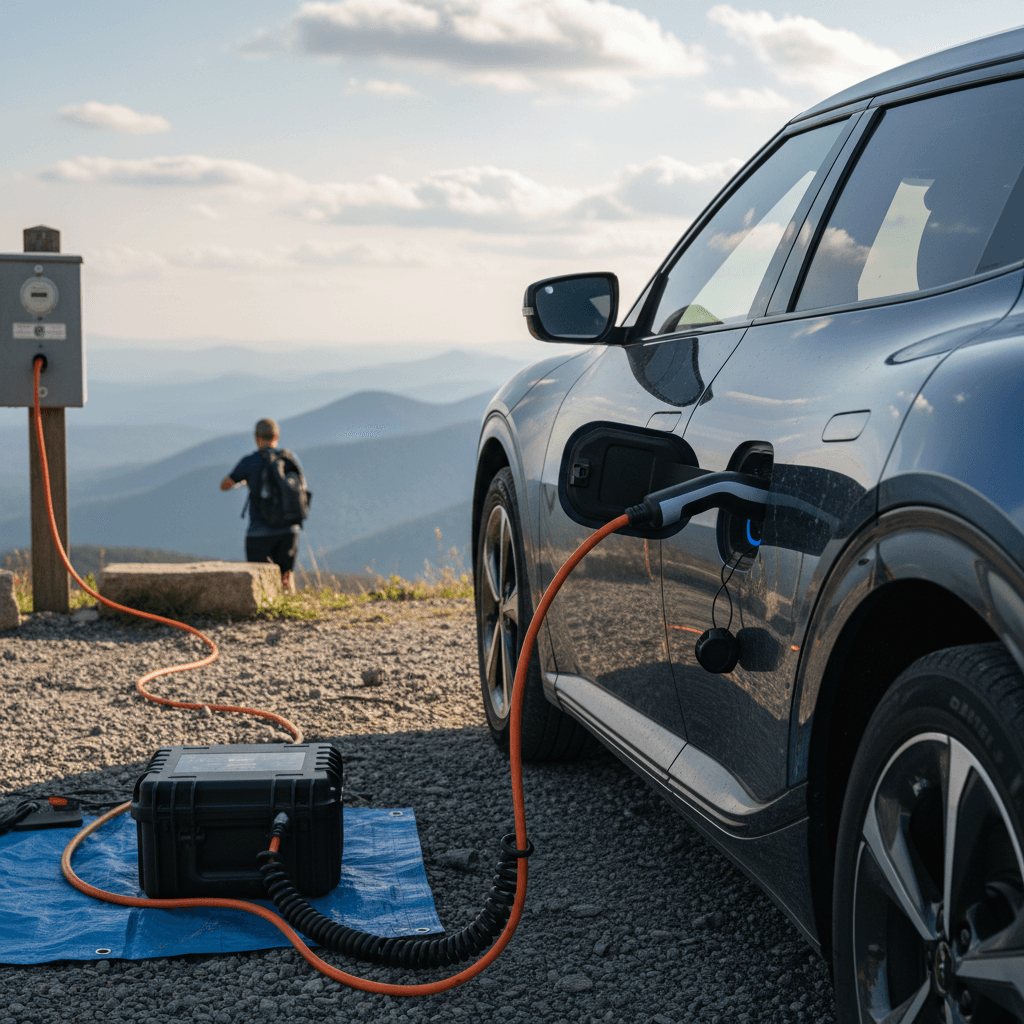
Planning Tools for an EV Road Trip
1. EV-Specific Route Planners
Before you throw bags in the trunk, run your route through an EV-aware planner. Tools like A Better Routeplanner (ABRP), your car’s native navigation, or Google Maps (for supported models) can:
- Suggest optimal charging stops based on your specific EV.
- Factor in elevation gain along Skyline Drive and the Parkway.
- Estimate arrival state of charge so you don’t flirt with zero.
2. Charger Maps & Apps
Pair your route planner with a live charger map:
- PlugShare for crowdsourced check-ins and photos.
- Network apps (ChargePoint, Electrify America, etc.) for pricing and session history.
- National Park Service EV map to see in-park Level 2 chargers at places like Shenandoah and gateway communities.
Download maps for offline use, cell service along the Parkway is famously patchy.
Mark Your “Safety Nets”
How Much Range You Really Need
One of the joys of the Blue Ridge Parkway is that you don’t need a 400-mile battery to enjoy it. Because you’re usually traveling between 35 and 45 mph and spending a lot of time coasting or regenerating, even earlier EVs with 150–220 miles of real-world range can be comfortable here with a bit of planning.
Range Comfort Levels for the Parkway
These are broad guidelines assuming you’re willing to exit for charging and keep an eye on your route planning apps.
| Usable Range (Real World) | How It Feels on the Parkway | Suggested Strategy |
|---|---|---|
| 140–180 miles | Manageable with planning | Keep segments shorter, favor overnight Level 2 at hotels and campgrounds, and top up whenever you stop in larger towns. |
| 180–250 miles | Comfortable for most drivers | You can drive one to two segments between DC fast stops and use Level 2 opportunistically. |
| 250+ miles | Easy mode | Focus on the scenery. Plan fast charging every couple of segments and arrive at trailheads with plenty of buffer. |
Numbers assume mild weather; add extra margin for winter or heavy loads.
Cold Weather Cuts Range
Charging Strategies on the Parkway
Road-tripping an EV isn’t about “filling up” once a day. It’s about weaving short, purposeful charging sessions into the rhythm of your trip. The good news is the Parkway already encourages you to slow down, your charging strategy should, too.
Smart Charging Habits for a Blue Ridge EV Trip
Aim for 10–20% → 70–80% fast-charge windows
Your battery charges fastest in the middle of its state-of-charge window. On travel days, it’s often quicker overall to stop more often and charge to 70–80% than to push to 100% every time.
Use Level 2 while you play
Whenever you stop for a hike, museum, or long lunch in town, hunt for a Level 2 charger. Adding 20–40 miles while you’re busy can save a whole fast-charge session later.
Charge before you climb
Big climbs onto the ridge are more energy-hungry than the descent. Try to start major uphill sections with a good buffer so you’re not sweating the last few miles.
Sleep where you can plug in
An overnight Level 2 session at a hotel, cabin, or campground turns a modest-battery EV into a road-trip champ. When you book, ask specifically about EV charging and connector types.
Know your adapters
Teslas now increasingly share fast chargers with other brands, and many non-Tesla EVs ship with NACS connectors. If you’re in an older CCS or J1772 car, bring the right adapters and double-check compatibility in advance.
Build Charging Into Your Day, Not On Top of It
Seasonal Weather & Driving Considerations
The Parkway runs along the spine of the Appalachians, so weather can flip from sunny to socked-in between overlooks. That matters for traction, visibility, and your battery.
- Spring: Cool temps are great for efficiency, but late freezes and ice can still close sections. Range is usually solid as long as you precondition before big climbs.
- Summer: Ideal for EVs, warm batteries, predictable grip, long daylight. Afternoon thunderstorms can sweep in fast; wet roads and wipers add a bit of energy usage.
- Fall: Peak foliage brings peak traffic. Leave extra time, and remember that chilly mornings may nibble at your range until everything warms up.
- Winter: Large stretches of the Parkway can close for snow and ice. If you’re determined to drive parts of it, build in big safety margins for range and use DC fast at lower-elevation towns whenever you can.
Don’t Chase the Weather With 5% Battery
Sample 3–5 Day EV Road Trip Itineraries
Three EV-Friendly Ways to Tackle the Parkway
Long Weekend: Shenandoah to Roanoke (3 Days)
Start with a full charge in Front Royal, VA. Drive Skyline Drive, topping up at a Level 2 in Shenandoah while you hike or have lunch.
Overnight near Waynesboro or Lexington with hotel charging if possible.
Day two, explore the northern Parkway down to Roanoke, stopping in small towns for photos and snacks. Fast charge in Roanoke before dinner.
Use your last day for a shorter out-and-back run on a favorite stretch, then head home via interstate fast chargers.
Classic Parkway: Waynesboro to Asheville (4–5 Days)
Begin in Waynesboro with a near-full battery from local DC fast chargers.
Spend day one winding toward Roanoke with a lunch stop and optional Level 2 top-up in a small town.
Day two, thread the central Parkway toward Boone/Blowing Rock, charging in Roanoke or at stations near Meadows of Dan.
Overnight around Boone or Blowing Rock at a hotel or cabin with Level 2, wake up full and unhurried.
Finish with one or two days drifting south to Asheville, charging in gateway towns and using Asheville’s dense network for a relaxed finish.
End-to-End Adventure: Front Royal to Cherokee (5+ Days)
Combine Skyline Drive, the full Parkway, and a dip into Great Smoky Mountains National Park.
Use DC fast in Front Royal, Waynesboro, Roanoke, Boone/Blowing Rock, Asheville, and Cherokee as your core spine.
Layer in overnights with hotel or campground Level 2 so your battery is always full to start the day.
Plan your Smokies visit for a low-speed, low-stress day when you’re not trying to cover huge miles, just enjoy the curves.
Pre-Trip Checklist for Your EV
Dial In Your Car Before You Climb
Confirm real-world range
Look at your usual highway consumption and recent trips to estimate a realistic range, not the brochure number. This helps your planner pick smarter stops.
Update navigation and charging apps
Install the latest software updates for your car and your favorite charger apps. New stations appear every month, especially in fast-growing EV hubs like Asheville.
Pack your charging kit
Bring your mobile charge cord, any J1772, CCS, or NACS adapters you need, and a weatherproof extension cord if you’ll be staying at cabins or rural rentals.
Check tires and brakes
Mountain roads are easier on batteries but demanding on tires and brakes. Proper pressures and healthy pads make regen smoother and save energy.
Plan for people and pets
If you’re traveling with kids or dogs, pair longer DC fast stops with parks, greenways, or downtowns where they can stretch their legs while the car sips electrons.
Traveling in a Used EV? You’re Fine.
How a Used EV from Recharged Fits This Trip
If the Blue Ridge Parkway is the kind of drive that makes you consider an EV, or finally take your EV on a real adventure, it’s worth thinking about the car itself. You don’t need the latest, priciest model to have a smooth trip; you need a car whose battery health, range, and charging behavior you can trust.
Know Your Battery Before You Climb
Every vehicle sold through Recharged comes with a Recharged Score Report that includes verified battery health. That means you go into a mountain trip knowing whether your 230-mile rated car is truly delivering 215 miles or more like 185. On a route with limited shoulders and occasional long gaps between exits, that clarity matters.
Support Beyond the Purchase
Recharged’s EV specialists can help you think through your style of trips, whether that’s Blue Ridge weekends, daily commuting, or cross-country national park tours. With financing, trade-in options, nationwide delivery, and a fully digital experience, getting into the right used EV is as smooth as the Parkway’s best curves.
If you’re near Richmond, VA, you can even visit the Recharged Experience Center, talk through road-trip plans in person, and sit in a few contenders before you buy.
EV Road Trip Blue Ridge Parkway: FAQ
Frequently Asked Questions
Final Thoughts: Relax Into the Drive
An EV road trip on the Blue Ridge Parkway isn’t about chasing kilowatts; it’s about giving yourself permission to move at mountain speed. When you treat charging as part of the experience instead of a chore, those coffee stops in Asheville, strolls through Boone, and quiet sunset walks at Parkway overlooks become the highlights of the day, not the time you “lost” to your battery.
Start with a realistic sense of your range, map out a handful of reliable charging hubs, and give yourself enough days that you’re never in a rush. Whether you’re driving a brand-new EV or a carefully chosen used one from Recharged, the Parkway will reward that preparation with one of the most satisfying, surprisingly easy electric road trips in the country.