If you live in Nassau or Suffolk County, the list of EV rebates on Long Island can feel like alphabet soup, PSEG LI, NYSERDA, Drive Clean, federal credits, Time-of-Day rates, Make Ready, and more. The good news is that, with a little planning, you can turn that alphabet soup into real money saved on your next electric vehicle and home charger.
Local focus
Why EV rebates matter on Long Island
Long Island drivers pay some of the highest electricity and gasoline prices in the country, and many residents have longer‑than‑average commutes into New York City or around the Island. That makes both fuel savings and charging costs central to whether an EV pencils out for your household. Local and state programs are designed to shrink the upfront cost of the car and the charger so you can start enjoying lower running costs sooner.
Between PSEG Long Island rebates, New York State’s Drive Clean Rebate, and federal incentives, a Long Island household can often trim thousands of dollars off the lifetime cost of driving electric, whether you buy new or used.
Snapshot of Long Island EV incentives (2026)
Quick overview of EV rebates on Long Island
Major EV incentive programs that apply on Long Island
You may qualify for more than one of these at the same time.
PSEG Long Island Residential Charger Rebate
Rebate of $100 for most customers who install a qualifying Level 2 charger at home, and up to $400 for customers in Disadvantaged Communities (DACs) or the Household Assistance Program.
New York State Drive Clean Rebate
State rebate of $500–$2,000 built into the purchase or lease of a new EV from participating dealers, based on MSRP and electric range.
Federal EV tax credits
Depending on the model and when you buy, you may qualify for a new EV or used EV federal tax credit. Rules have tightened, so always verify eligibility before you sign.
PSEG LI Make Ready & multifamily programs
Incentives that help apartment buildings, workplaces, and commercial sites install charging, important if you rent or manage property on Long Island.
Important 2026 update
PSEG Long Island home charger rebates
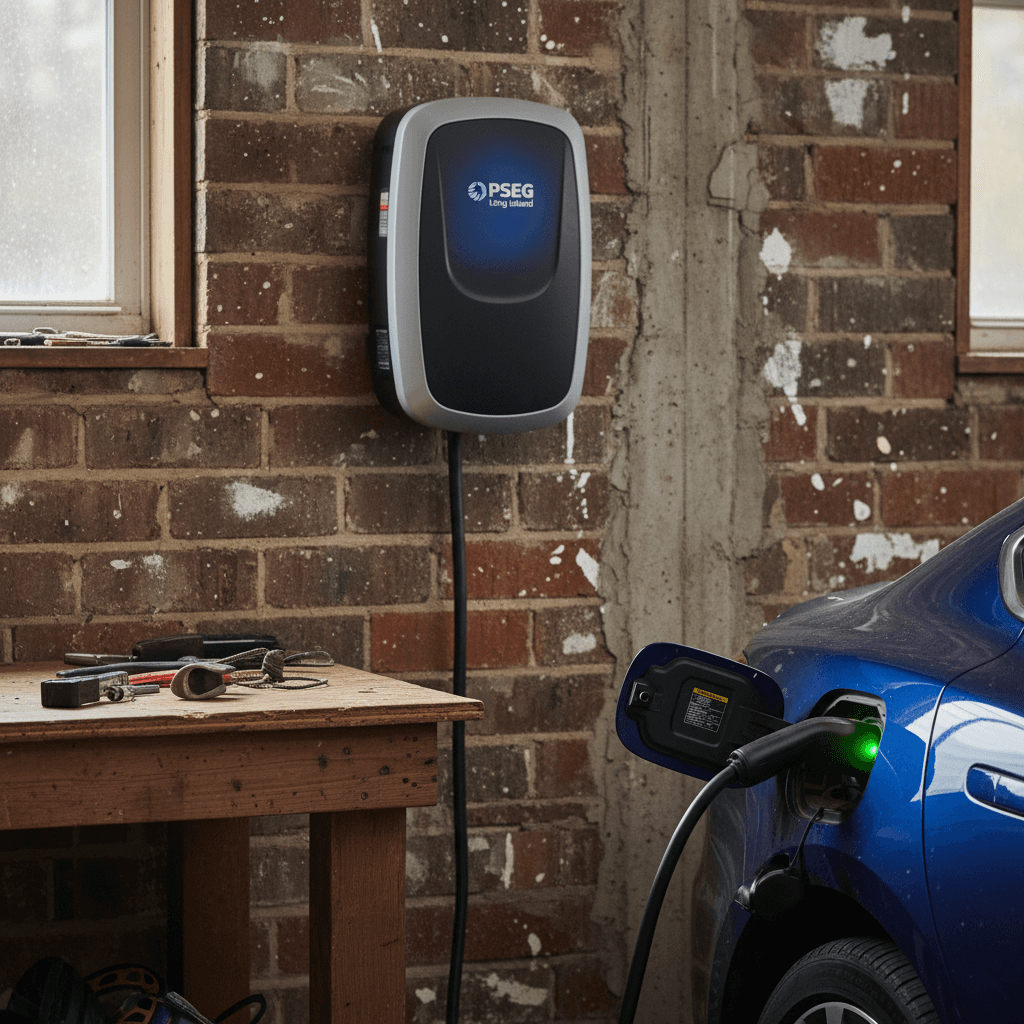
If you own your home on Long Island, or even if you rent but control your own panel, the PSEG Long Island Residential Charger Rebate is often the easiest incentive to claim. It’s a straightforward cash rebate for installing a qualifying Level 2 charger at your residence.
PSEG Long Island Residential Charger Rebate at a glance
Current rebate structure for home Level 2 chargers in the PSEG Long Island service area.
| Customer type | Eligible equipment | Rebate amount | Key requirements |
|---|---|---|---|
| Standard residential customer | Qualifying Level 2 home charger on PSEG LI’s vetted list | $100 | Must be a PSEG Long Island residential customer; charger must be installed at the service address. |
| Customer in Disadvantaged Community (DAC) | Qualifying Level 2 home charger | $400 total ($100 base + $300 additional) | Residence must be located in a designated DAC; PSEG LI verifies via NYSERDA DAC mapping. |
| Household Assistance Program customer | Qualifying Level 2 home charger | $400 total ($100 base + $300 additional) | Enrollment in Household Assistance Program required. |
| Charger bundled with EV purchase | Charger included in vehicle deal, not purchased separately | Generally not eligible | PSEG LI typically requires a separate charger purchase receipt and proof of installation. |
Rebates are subject to change; always verify details on the PSEG Long Island website before you purchase.
You can apply three ways, through the PSEG LI Online Marketplace for an instant rebate, or via online or email application after purchase. If you apply after the fact, you’ll need a copy of your sales receipt and a photo of the charger installed at your home showing the model and serial number.
Tip: Start with PSEG LI’s vetted charger list
New York Drive Clean Rebate for new EVs
Whether you’re on Long Island or in Buffalo, the New York State Drive Clean Rebate is the cornerstone incentive for new EVs. It’s a point‑of‑sale rebate that participating dealers apply directly to your purchase or lease paperwork, so you see the savings immediately instead of waiting for tax time.
- Rebate amounts currently range from $500 to $2,000.
- The exact amount depends on the vehicle’s EPA all‑electric range and the manufacturer’s suggested retail price (MSRP).
- Long‑range all‑electric models under the price cap typically qualify for the top rebate tier.
- Plug‑in hybrids with shorter electric range often qualify for smaller rebates.
Drive Clean Rebate tiers (illustrative ranges)
How range and price affect your potential Drive Clean savings.
| Vehicle characteristics | Typical Drive Clean rebate |
|---|---|
| All‑electric, >200‑mile EPA range, MSRP at or below program cap | Up to $2,000 |
| All‑electric, 40–199‑mile range | Around $1,000 |
| Plug‑in hybrid, <40‑mile electric range or higher‑MSRP EV | Around $500 |
These tiers are based on current NYSERDA guidance. Always confirm your exact model’s rebate amount with the dealer or NYSERDA’s website before purchase.
How the rebate is applied
On Long Island, nearly every mainstream EV, Hyundai IONIQ 5, Kia EV6, Ford Mustang Mach‑E, Chevy Equinox EV, and many more, shows up on NYSERDA’s eligible vehicle list. The key is to double‑check both the model and trim before you fall in love with a specific car.
Federal EV tax credits for Long Island drivers
Federal EV incentives have been in flux. Some new‑EV credits have been tightened or phased down, but as of early 2026, there is still a valuable used EV tax credit available for qualifying buyers through the 2025 tax year, and some new models may still qualify under the latest federal rules.
New EV credits
Rule changes and supply‑chain requirements have made new‑EV tax credits more complicated. Eligibility depends on:
- Where the vehicle is assembled
- Battery and critical mineral sourcing
- Your household income
- Vehicle price caps
Because these rules can change with new legislation, always verify eligibility on the IRS website and with your dealer before assuming a specific credit amount.
Used EV tax credit (through 2025)
Under rules that remain in effect through the 2025 tax year, qualifying buyers may receive up to $4,000 or 30% of the sale price (whichever is less) for an eligible used EV. There are caps on:
- Buyer income
- Vehicle sale price
- Model year and previous ownership
That makes careful shopping, and solid documentation, especially important if you plan to claim this credit.
Critical disclaimer
Programs for multifamily and workplace charging
Not everyone on Long Island has a private driveway. If you live in a condo, co‑op, or rental, or if you manage a property, PSEG Long Island’s Make Ready incentives can help bring chargers to where people actually park.
Charging programs beyond single‑family homes
These don’t put cash directly in your pocket, but they can determine whether you can own an EV comfortably.
PSEG LI Make Ready Incentive Program
Provides substantial support for the “make‑ready” electrical work needed to install chargers at businesses and multifamily properties. Depending on the project, incentives can cover a significant portion of infrastructure costs for both Level 2 and DC fast charging.
Apartments, HOAs, and condos
Property owners and HOAs can use Make Ready funds to add resident‑only or guest chargers. For EV owners, this can mean having reliable overnight charging without moving homes.
Workplace & public charging
Office parks, schools, hospitals, and retail sites on Long Island are also eligible. As these programs expand, your commute or shopping trips may double as charging time, reducing your need for home infrastructure.
How this helps renters
Demand response and Time-of-Day savings
Rebates lower your upfront costs, but your monthly bill matters just as much. PSEG Long Island offers Time-of-Day (TOD) rates and limited‑enrollment demand‑response programs that reward you for charging when the grid is less stressed.
Ways PSEG LI can help you save on ongoing charging costs
Enroll in Time-of-Day Rate 195
This TOU option gives you significantly lower per‑kWh pricing during off‑peak hours compared with the standard flat rate. If you primarily charge overnight, you can lower your cost per mile dramatically.
Schedule charging overnight
Most modern EVs let you tell the car, or your charger, to start charging at a specific time. On Long Island, that usually means starting after late‑evening peak hours and finishing before morning demand ramps up.
Consider demand‑response programs
PSEG LI has partnered with automakers such as Ford on “System Peak Relief” programs that briefly pause or slow home charging during summer peaks. In exchange, you receive enrollment bonuses or participation payments.
Watch summer peak events
Peak‑relief events typically occur on hot weekday afternoons between May and September. If you do enroll, you’ll get advance notice so you can plan your charging around those windows.
Check compatibility before enrolling
How to stack EV rebates on Long Island
Most Long Island drivers don’t just have access to one program, you can often combine state, utility, and federal incentives on the same vehicle purchase. The key is to understand which programs stack and in what order they apply.
Example: New EV + home charger
Imagine you’re buying a new all‑electric crossover from a Long Island dealer.
- Drive Clean Rebate is applied first at the dealership, reducing your selling price or lease cap cost.
- PSEG LI Residential Charger Rebate kicks in after you purchase and install a qualifying Level 2 charger at home.
- Time-of-Day Rate 195 can then lower your ongoing charging cost if you shift most charging to off‑peak hours.
- Federal tax credit(s) may apply if your new vehicle still qualifies under current rules and you meet income and price caps.
Example: Used EV buyer
If you’re shopping the used market, your stack might look different:
- Negotiate the sale price of a used EV that appears to meet federal used‑EV credit rules (model year, price limit, previous ownership).
- Confirm with your tax advisor that you meet income and filing requirements for the federal used‑EV credit.
- After purchase, install a qualifying Level 2 home charger and apply for the PSEG LI Residential Charger Rebate.
- Switch to Time-of-Day rates to keep your ongoing fuel cost as low as possible.
Don’t forget sales tax implications
What if you buy a used EV instead?
Used EVs are where Long Island shoppers can find some of the best value today, especially as new‑car pricing and incentives continue to shift. While you don’t get New York’s Drive Clean Rebate on a used car, you may still be able to pair a federal used EV tax credit with PSEG LI home‑charger rebates and low running costs.
This is where a platform like Recharged can simplify your decision. Every used EV sold through Recharged includes a Recharged Score Report with verified battery health, fair‑market pricing, and expert guidance on incentives. That’s especially important when you’re counting on a federal used‑EV credit that has strict rules around model year, sale price, and prior ownership.
Why Long Island drivers increasingly look at used EVs
In an era of shifting tax policy, used EVs can deliver predictable value.
Lower depreciation hit
Early adopters already absorbed much of the initial depreciation. You can often buy a 2‑ to 4‑year‑old EV at a substantial discount from new MSRP.
Battery health transparency
With tools like Recharged’s battery diagnostics, you can assess real‑world range instead of guessing based on an original window sticker.
More predictable incentives
Even as new‑EV credits change, the used‑EV credit rules are fairly stable through the 2025 tax year, making planning easier in the near term.
Step-by-step checklist to maximize Long Island EV savings
Your Long Island EV savings game plan
1. Confirm you’re in PSEG Long Island territory
Look at your electric bill or log into your online account. These rebates apply only if PSEG Long Island is your electric utility.
2. Decide new vs. used
If you want the Drive Clean Rebate and potentially a federal new‑EV credit, focus on new vehicles. If you’d rather target lower upfront cost and the used‑EV credit, explore used models with strong battery health.
3. Check model eligibility
For new EVs, verify Drive Clean eligibility and any remaining federal credit. For used EVs, confirm that the vehicle, sale price, and your income fit the federal used‑EV credit rules.
4. Plan your home charging
If you have a driveway or garage, choose a Level 2 charger from PSEG LI’s vetted list and confirm your panel can support it. Get quotes from licensed electricians if an upgrade might be needed.
5. Apply for the PSEG LI charger rebate
Keep your charger receipt and installation photos, then submit via the Online Marketplace, web application, or email, whichever best fits your situation.
6. Enroll in Time-of-Day rates
Contact PSEG LI or use their online tools to switch to Rate 195 or the current EV‑friendly Time-of-Day plan, then set your car to charge overnight.
7. Keep your documentation organized
Save closing documents, rebate confirmations, and charger paperwork in one folder. You’ll need these for any tax filings and potential future warranty or resale questions.
FAQ: EV rebates on Long Island
Frequently asked questions about Long Island EV incentives
Bottom line: Make Long Island incentives work for you
Long Island might have high energy costs, but that also means the payoff from switching to an EV can be substantial, especially when you fully leverage PSEG Long Island rebates, the New York Drive Clean Rebate, federal incentives that are still in effect, and smarter charging habits.
If you’re leaning toward a used EV, platforms like Recharged can simplify the math. With battery‑health diagnostics, fair‑market pricing, financing support, and guidance on which incentives apply to your situation, you can make a confident decision without spending weeks deciphering program fine print. Start by clarifying your budget and home‑charging options, then use the checklist in this guide to capture every rebate and rate plan you’re entitled to as a Long Island driver.