If you live in or around Baltimore and you’re thinking about an electric car, the good news is you don’t have to pay full price. Between federal tax credits, Maryland EV incentives, and BGE EVsmart rebates, Baltimore drivers can stack thousands of dollars in savings on both vehicles and home chargers, if you know where to look and how to claim them.
Dates and details change fast
How EV rebates work in Baltimore
When people talk about “EV rebates in Baltimore,” they’re usually mixing together three different buckets of money: federal tax credits, statewide Maryland programs, and local utility rebates from BGE. They all work a little differently, but together they can meaningfully cut your upfront cost and long‑term ownership costs.
Three layers of EV incentives for Baltimore drivers
Stack these programs to lower your purchase and charging costs.
Federal tax credits
What it is: A credit on your federal income taxes for qualifying new and used EVs.
Why it matters: Up to $7,500 off new EVs and up to $4,000 off qualifying used EVs, if you and the car meet the rules.
Maryland state programs
What it is: State-level incentives like the EV excise tax credit and MEA rebates for home and workplace chargers.
Why it matters: Can cut your purchase or installation costs by hundreds or even thousands of dollars.
BGE & local utility rebates
What it is: BGE’s EVsmart programs including rebates for Level 2 home chargers and credits for using BGE’s public network.
Why it matters: Makes daily charging cheaper and more convenient if you live in the BGE territory.
Quick rule of thumb
Federal EV tax credits for Baltimore drivers
Federal incentives are the backbone of EV savings nationwide, and Baltimore drivers can absolutely take advantage of them. The details shift as Washington rewrites the rules, but the structure is the same: you buy an eligible EV, the dealer or the IRS applies a Clean Vehicle Credit, and your tax bill shrinks.
New EVs: up to $7,500 off
- Credit amount: Up to $7,500 on qualifying new EVs and fuel‑cell vehicles.
- Who qualifies: Your income must be under set limits and the vehicle must meet price and battery/assembly requirements.
- How it’s applied: In many cases the dealer can apply the credit at the time of sale, lowering what you owe up front, then reconcile it with the IRS.
If you’re shopping mainstream models from big brands, ask the dealer to show you in writing whether the car qualifies under the current Clean Vehicle Credit rules.
Used EVs: up to $4,000 off
- Credit amount: Up to $4,000 (capped at 30% of the sale price) for qualifying used EVs.
- Vehicle price cap: The car must cost $25,000 or less and be at least two model years old.
- First resale only: Each VIN can only generate the used EV credit once in its life.
For Baltimore shoppers looking at efficient used EVs, like a Chevy Bolt, Nissan Leaf, or Hyundai Kona Electric, this is often the most important incentive on the table.
Don’t let paperwork kill your federal credit
Maryland EV excise tax credit
Maryland adds another layer of help through its excise tax credit for plug‑in electric and fuel‑cell vehicles. This isn’t a rebate you apply for at tax time, it’s a state‑level break on the one‑time titling tax you pay when you first register a qualifying new EV in Maryland.
Key facts about Maryland’s EV excise tax credit
There’s an important catch: the Maryland Motor Vehicle Administration makes it clear that the program is funding‑limited by fiscal year. When the pot of money for a given year (or upcoming year) is exhausted, new applications are put on hold until lawmakers refill it, or not. At times, including funding for fiscal year 2026, the MVA has announced that money for this credit is fully allocated and no additional credits are available for that period.
What this means if you’re buying soon
Maryland rebates for home EV chargers
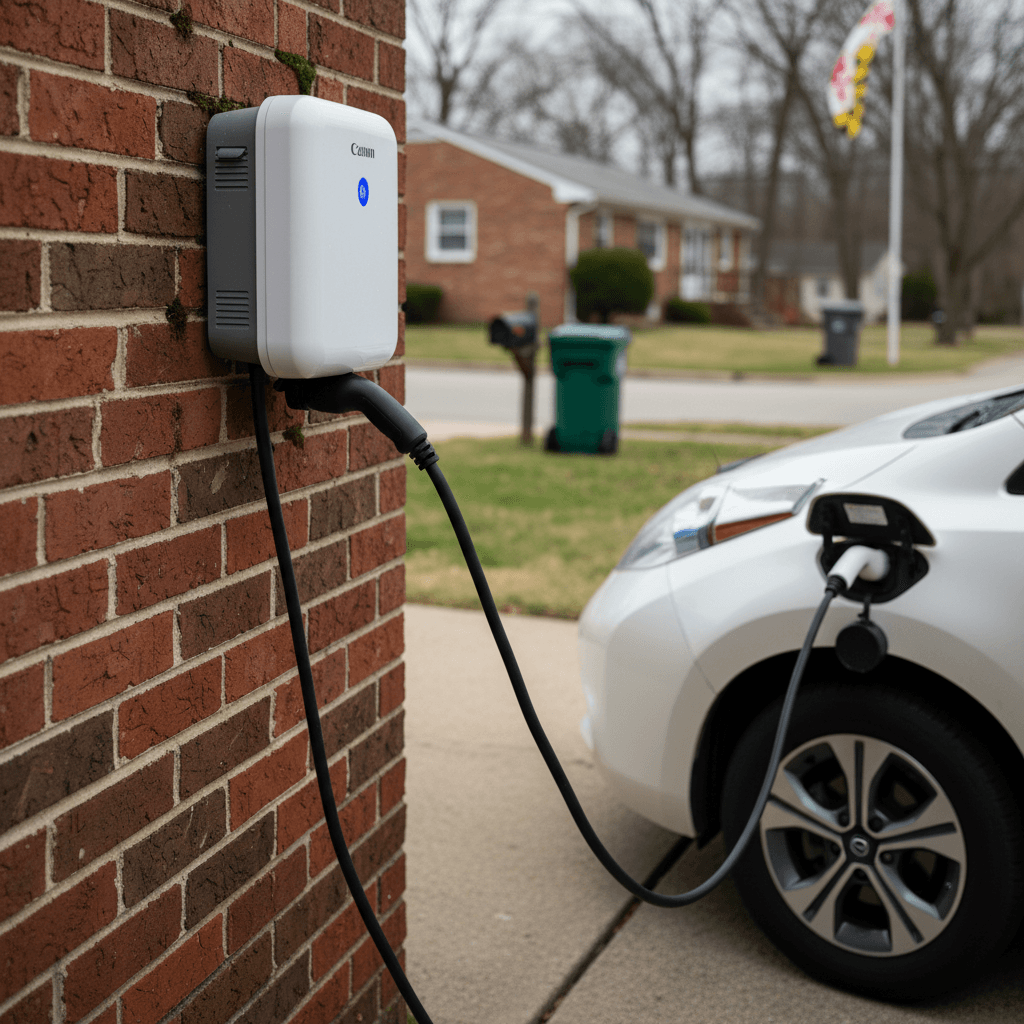
Buying an EV is only half the equation. The other half is installing a charger where you park. That’s where the Maryland Energy Administration (MEA) EVSE Rebate Program comes in, helping residents and businesses offset the cost of Level 2 charging equipment and installation.
Maryland Energy Administration EVSE rebates at a glance
Rebates can help cover charger hardware and a portion of installation costs for Baltimore residents and businesses.
| Applicant type | What’s covered | Rebate amount | Key notes |
|---|---|---|---|
| Residential | Purchase and installation of Level 2 home charger | Up to 50% of eligible costs, capped around $700 per charger | One rebate per residence; Level 1 (120V) chargers are no longer eligible. |
| Commercial / workplace | Purchase and installation of Level 2 chargers at businesses or multifamily properties | Up to 50% of costs, capped around $5,000 per charger | Total award per applicant is capped; projects must be located in Maryland. |
| General rules | Equipment, labor, permitting, site prep | Rebates issued after project is complete | Electricity usage, maintenance, taxes and shipping are not eligible costs. |
Amounts and caps are typical of recent MEA program years; always verify the latest details before you start a project.
Sequence matters for charger rebates
BGE EVsmart rebates and local perks
If your home is in the BGE service territory, which covers Baltimore City and much of central Maryland, you have access to additional EVsmart® programs. These incentives focus on chargers and public charging, not the car itself.
What BGE EVsmart can do for Baltimore EV owners
These programs evolve, but the core ideas stay the same: cheaper home charging and easier public charging.
Rebates for home chargers
BGE has offered rebates for qualifying Level 2 chargers installed at homes in its territory. You typically must:
- Buy and install an eligible Wi‑Fi–enabled charger.
- Register the device with BGE.
- Submit a rebate application with receipts.
Off‑peak charging programs
In some program years, BGE has encouraged overnight charging with time‑of‑use rates or bill credits when you charge outside peak hours.
That can save Baltimore commuters meaningful money over a year of driving.
Referral & public charging credits
BGE’s EVsmart referral program has offered $25 RFID cards, worth roughly 500 miles of charging on BGE’s public network, for eligible participants who refer friends who complete an EVsmart rebate application.
Utility programs are highly localized
Can you get EV rebates on a used car?
This is where a lot of Baltimore shoppers get confused. Traditionally, state programs like Maryland’s excise tax credit focused on new vehicles. The newer federal used EV credit, however, finally throws some love at the second‑hand market, and that’s where Recharged spends its time.
Federal used EV credit
- Vehicle price: $25,000 or less.
- Model year: At least two model years older than the calendar year of purchase.
- Buyer limits: Income caps and once‑every‑three‑years limits for claiming the used credit.
- Dealer role: For many buyers, the credit can be applied at the point of sale if the dealer is properly registered with the IRS.
This is especially powerful if you’re shopping for a practical, lower‑priced commuter EV and want to keep your monthly payment down.
Maryland & local help on used EVs
- Excise tax credit: Historically aimed at new vehicles; by the time a car reaches the used market, that one‑time benefit is usually in the rearview mirror.
- Charger rebates: Still fully in play for used‑EV buyers. If this is your first EV, you can pair a used purchase with MEA and BGE charger programs.
So while you may not see a Maryland credit directly attached to the used car itself, you can absolutely use state and utility programs to lower your charging costs.
Where Recharged fits in for used EV shoppers
How to claim your EV rebates: step-by-step
From test‑drive to rebate check: your EV incentive checklist
1. Map out which incentives you’re eligible for
Before you shop, look at your household income, whether you’ll file jointly or individually, and whether you’ve claimed an EV credit in the last few years. That will tell you whether the federal new or used credit is on the table.
2. Confirm vehicle eligibility with the seller
Ask the dealer, or in the case of a used EV marketplace like Recharged, your EV specialist, to confirm in writing which incentives the specific VIN qualifies for and whether they can process the credit at the time of sale.
3. Plan your home charging setup
Decide where you’ll charge, rowhouse alley, shared driveway, apartment garage, and talk to a licensed electrician about installing a 240‑volt circuit and Level 2 charger if possible.
4. Choose a charger that qualifies for MEA and BGE programs
Cross‑check your shortlisted charger models against the <strong>Maryland Energy Administration</strong> and <strong>BGE EVsmart</strong> approved equipment lists so you don’t miss out on rebates.
5. Keep every document
Save the purchase agreement, Monroney sticker (for new cars), paid electrician invoices, permit records, charger receipts, and any time‑of‑sale credit documentation. You’ll need this paper trail for both state and utility rebates.
6. Submit applications promptly
Complete your MEA charger rebate, BGE EVsmart rebate and referral forms, and any Maryland excise tax credit forms as soon as you have the required paperwork. Funding is often first‑come, first‑served.
Common rebate pitfalls for Maryland EV buyers
Every incentive has fine print, and in Maryland that fine print can cost you real money if you overlook it. Here are the mistakes that trip up Baltimore‑area drivers again and again, and how to avoid them.
Four mistakes that can cost you EV money
Avoid these when you’re counting on EV rebates in Baltimore.
Assuming a program is still funded
Just because a program exists on paper doesn’t mean there’s money left this year. The Maryland excise tax credit, in particular, has run out of funding mid‑cycle before.
Fix: Check current funding status before you buy, especially if you’re counting that $3,000 to make the numbers pencil out.
Missing IRS or MVA paperwork
Federal credits require accurate time‑of‑sale reporting from the dealer; Maryland credits may require forms like VR‑334 plus a copy of the vehicle’s window sticker.
Fix: Don’t leave the dealership, or finalize an online sale, until you have copies of every required form and a clear statement of who is filing what.
Installing the wrong charger
Not every Level 2 unit qualifies for MEA or BGE EVsmart rebates.
Fix: Choose your hardware from the programs’ approved lists and make sure your electrician installs it exactly as required.
Losing out on reimbursement
MEA and BGE rebates are reimbursements, not instant discounts. If you throw away invoices or don’t apply in time, the money’s gone.
Fix: Treat every charger and installation receipt like a tax document and submit applications as soon as the project is done.
Watch for new EV fees
EV rebates and the Recharged advantage
Shopping incentives while you’re also trying to judge battery health, model reliability, and fair pricing can feel like a full‑time job. That’s exactly the problem Recharged was built to solve for used‑EV buyers in Baltimore and beyond.
Transparent battery health and pricing
Every vehicle on Recharged comes with a Recharged Score Report that includes verified battery diagnostics and a full look at how the car was priced against the market. That matters when you’re pairing a federal used EV credit with a car you plan to keep several years, you want to start with strong range, not someone else’s problem.
Guided incentive support and easy delivery
Recharged’s EV specialists can help you understand which incentives are likely to apply to the cars you’re considering and connect you with financing that reflects those savings. You can handle the entire process digitally, trade in a gas car, and have your used EV delivered to your door in the Baltimore area or anywhere in the continental U.S.
It doesn’t change the fine print on federal, state, or utility programs, but it does mean you’re not trying to decode it alone.
If you’re a Baltimore driver sitting on the fence about going electric, the incentive stack is your friend. Federal credits can slash thousands from the sticker price, Maryland and BGE programs can soften the cost of home charging, and a well‑chosen used EV can turn all of that into a surprisingly affordable monthly payment. Take the time to confirm which EV rebates in Baltimore you qualify for, line up your paperwork, and work with a seller who understands the local landscape, you’ll feel the payoff every time you plug in instead of filling up.