If you’re shopping for an electric vehicle in metro Atlanta, the incentive landscape can feel confusing. You hear about generous EV rebates in states like Colorado or New Jersey, then discover Georgia killed its state EV tax credit years ago and now charges an extra registration fee for EVs. Still, there are real EV rebates Atlanta drivers can use in 2025–2026 if you know where to look and how to stack them.
Quick snapshot for Atlanta drivers
Overview: What EV rebates exist in Atlanta today?
Atlanta EV incentives at a glance (2025–2026)
Let’s get one big thing out of the way: Georgia does not currently offer a state EV purchase tax credit. The once‑popular $5,000 state credit went away several years ago and hasn’t been reinstated. What you do have in Atlanta today are: - Federal EV tax credits on many new and some used EVs - Georgia Power rebates for residential and commercial Level 2 and DC fast chargers - Occasional utility marketplace discounts on home chargers - Indirect savings like lower fuel and maintenance costs compared with gas cars The rest of this guide walks you through how each piece works, how they interact, and how to avoid the gotchas that trip up a lot of Georgia buyers.
Federal EV tax credits Atlanta buyers can use
Because Georgia doesn’t currently shoulder much of the incentive load, the federal EV tax credit will do most of the heavy lifting for you. If you buy a qualifying EV and meet income limits, you may be able to claim up to $7,500 on a new EV or up to $4,000 on certain used EVs.
Two main federal credits Atlanta shoppers should know
Stack these with local charger rebates for maximum savings.
New clean vehicle credit
- Up to $7,500 tax credit.
- Applies to qualifying new EVs and plug‑in hybrids.
- Vehicle must meet MSRP caps and final‑assembly rules.
- Income limits apply based on filing status.
- As of 2024–2025, many credits can be taken at the dealer as an instant discount.
Used clean vehicle credit
- Up to $4,000, capped at 30% of the vehicle price.
- Vehicle must be at least two years old and purchased from a dealer.
- Price cap of $25,000 for the vehicle.
- Stricter income limits than the new credit.
- Ideal for budget‑minded Atlanta buyers shopping the used‑EV market.
Pro tip for Atlanta taxpayers
When you’re comparing vehicles, don’t just ask, “Does this EV get the $7,500 credit?” Instead, ask your salesperson or tax professional: - Is this model still on the IRS eligibility list this year? - Do I meet the income limits for the credit? - Can the dealer apply the credit as a point‑of‑sale discount, or will I claim it on my return? This is also where buying a used EV through a dealer can shine for Atlanta drivers, you may qualify for the used‑vehicle credit even if you can’t swing the price of a new EV that still qualifies for the full $7,500.
Does Georgia still offer a state EV rebate?
No. Georgia once had one of the most generous EV tax credits in the country, a $5,000 state income‑tax credit. That program ended several years ago, and as of the 2025–2026 tax years, there is no statewide EV purchase or lease rebate for passenger vehicles.
Don’t confuse tax cuts with EV incentives
Georgia does, however, apply an additional annual registration fee to most fully electric vehicles to make up for lost gas‑tax revenue. For 2025, that fee is in the ballpark of $235 per year and is on top of your normal registration costs. When you’re evaluating a potential EV purchase, you’ll want to factor that fee into your total cost of ownership the same way you’d factor fuel and oil‑change costs for a gasoline car.
Georgia Power EV charger rebates for Atlanta homes and businesses
Where Atlanta drivers really can find a “local” EV rebate today is through Georgia Power, the dominant utility in the metro area. While these programs change over time, Georgia Power is currently offering cash rebates for installing qualifying Level 2 EV chargers at homes and businesses.
Georgia Power EV charger rebates relevant to Atlanta
Representative Georgia Power programs as of early 2026. Always confirm current terms before you buy or install any equipment.
| Program | Who it’s for | Rebate amount | Key requirements | Timing window |
|---|---|---|---|---|
| Residential Level 2 charger rebate | Georgia Power residential customers in single‑family homes or townhomes | Up to $300 per home charger | Must install a 208/240‑volt Level 2 charger on a dedicated circuit; home must be served by Georgia Power; provide paid invoices for charger and installation. | Installations between Jan 1, 2026 and Dec 31, 2028; application typically due within 6 months of installation. |
| Residential marketplace instant rebate | Georgia Power residential customers who buy through the Georgia Power Marketplace | Around $150 instant discount at checkout (amount can change) | Purchase an eligible Level 2 charger through the marketplace site while funds last. | Discount applied at the time of purchase; ongoing while program funding remains. |
| Business / multifamily charger rebate | Georgia Power business customers, including some multifamily properties | Roughly $250/kW for Level 2 and $150/kW for DC fast chargers, up to $30,000 per project and $60,000 per year | Must be a Georgia Power business customer; Level 2 or DC fast equipment only (no portable cords); new, NRTL‑listed chargers installed by a licensed electrician. | Chargers must be installed in the current calendar year; application usually due within 6 months of installation. |
Current amounts and dates can change, check Georgia Power’s EV page before committing to a project.
How to avoid missing your Georgia Power rebate
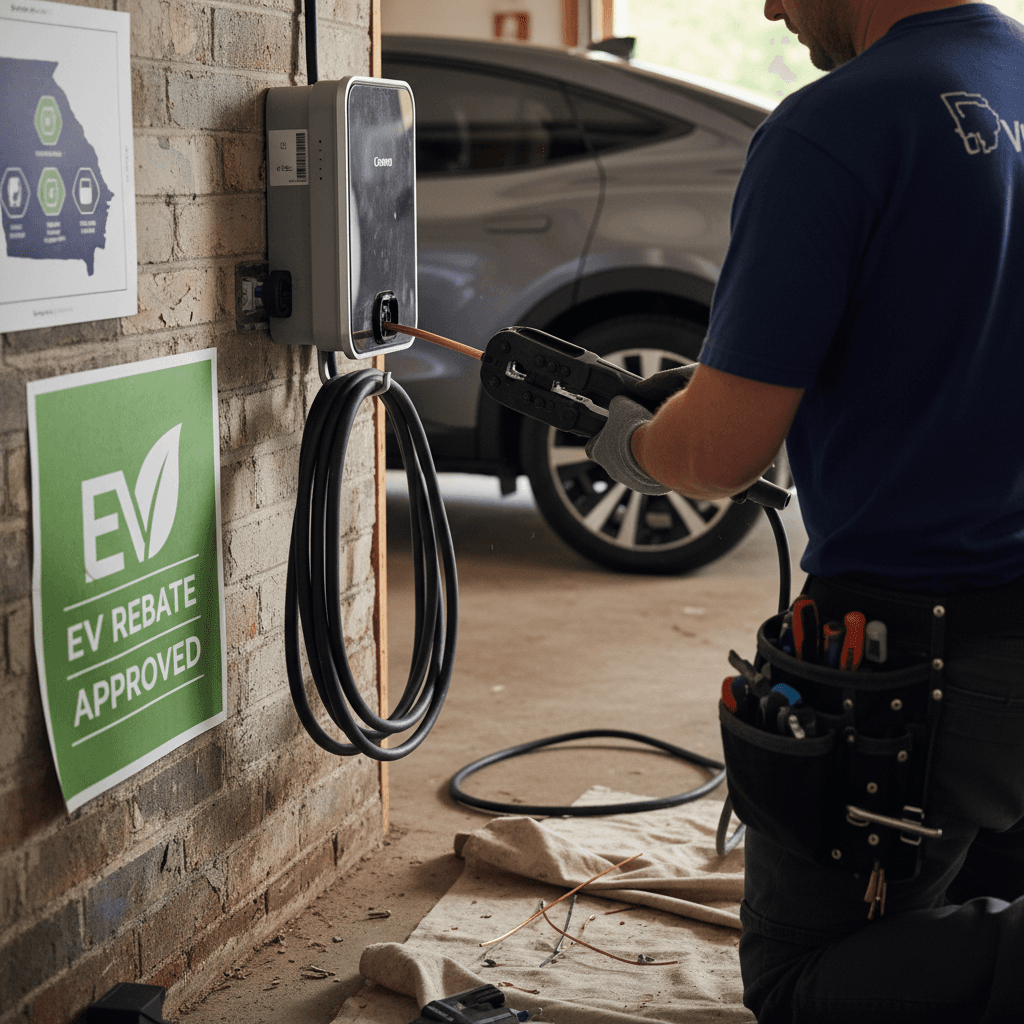
For Atlanta homeowners, the Georgia Power rebate is often the easiest local incentive to capture. A typical Level 2 home installation can run $700–$1,500 depending on panel capacity and wiring distance; a $150–$300 rebate won’t erase the whole cost, but it takes some of the sting out and speeds up your payback. If you own or manage a business, multifamily building, or workplace parking in metro Atlanta, the commercial rebates can be substantial, especially if you’re installing multiple Level 2 or DC fast chargers. Here, pre‑approval and good documentation matter even more, so start talking to your electrician and Georgia Power early in the process.
Other local perks for Atlanta EV drivers
Lower fueling and maintenance costs
Even without a state purchase rebate, Atlanta‑area EV drivers typically spend far less on fuel and maintenance than owners of similar gasoline vehicles. Off‑peak electricity is generally cheaper per mile than gasoline, and you’ll avoid oil changes, exhaust work, and many of the wear items that come with internal‑combustion engines.
Time savings and convenience
A home Level 2 charger turns your garage or driveway into your personal filling station. Instead of detouring to a gas station every week, you plug in at night and leave each morning with a full “tank.” That convenience is hard to put a dollar figure on but becomes a major quality‑of‑life benefit for many EV owners.
Watch for city‑ or employer‑level perks
How much can you actually save? Real-world example
Let’s put some rough numbers around this. Imagine you’re an Atlanta‑area driver looking at a compact EV priced at $32,000 before incentives. You qualify for the full federal credit, and you plan to install a Level 2 charger at home.
Sample savings stack for an Atlanta EV buyer
1. Federal new EV tax credit
If the car qualifies and your income and tax liability allow it, you might receive up to <strong>$7,500</strong> back via the federal clean vehicle credit, either as a point‑of‑sale discount or when you file your taxes.
2. Georgia Power home charger rebate
Suppose you spend $1,200 to install a Level 2 charger in your garage. A $300 Georgia Power rebate effectively drops your out‑of‑pocket charger cost to $900.
3. Fuel savings vs. gasoline
If you drive 12,000 miles per year, switching from a 25‑mpg gas car (buying fuel at $3.25/gal) to an efficient EV charged mostly at home can easily save <strong>$600–$900 per year</strong> on energy alone, depending on rates and driving style.
4. Maintenance savings over five years
Eliminating oil changes and reducing wear on brakes and other components could plausibly save another <strong>$500–$1,000</strong> over five years compared with a similar gasoline vehicle.
5. Subtract Georgia’s EV registration fee
You’ll need to budget for the roughly <strong>$235 annual EV fee</strong> in Georgia. Over five years, that’s about $1,175, money that somewhat offsets your fuel and maintenance savings but typically doesn’t wipe them out.
Every household’s math will look a little different, but once you factor in federal credits, Georgia Power rebates, and operating‑cost savings, an EV can compete strongly, or even come out ahead, versus a comparable gasoline vehicle, even without a Georgia state purchase credit.
Used EVs in Atlanta: incentives and hidden savings
Atlanta’s used‑EV market has grown rapidly as early adopters trade out of 3–6‑year‑old vehicles. For many buyers, a used EV plus federal used‑vehicle credit is now the sweet spot between price and technology.
Why used EVs can be a smart play in Atlanta
Particularly when you pair them with expert battery checks and federal credits.
Lower upfront price
Federal used EV credit
Battery health transparency
How Recharged helps Atlanta used‑EV shoppers
If you’re focused on value, it often makes sense to: - Target a 2–6‑year‑old EV that qualifies for the used‑vehicle credit - Verify its battery health through a third‑party test or a platform like Recharged - Put some of your savings toward a quality home Level 2 charger, taking advantage of any Georgia Power rebates that apply That’s exactly the kind of strategy that can put you into an EV at a monthly cost similar to, or lower than, a newer gasoline vehicle.
How to claim EV rebates in Atlanta: step‑by‑step
- Confirm which federal credit (new or used) your target vehicle qualifies for and whether you meet the income and price caps.
- Ask the dealership if they can apply the federal credit as a point‑of‑sale discount, and clarify how that affects your purchase contract.
- If buying used, make sure the vehicle and sale structure meet the IRS rules for the used clean vehicle credit.
- Plan your home‑charging setup: decide where the charger will go, check your electrical panel capacity, and get quotes from licensed electricians.
- Download Georgia Power’s current EV charger rebate terms and confirm your equipment and installation will qualify before work begins.
- Complete the installation, then gather all invoices, permits, and photos required for the Georgia Power rebate application.
- File your federal tax return (or work with your tax pro) to claim any remaining credit that wasn’t taken at the point of sale.
- Keep a simple folder, digital or physical, with all EV paperwork. It will be helpful for future service, resale, and any audits or documentation requests.
Mind the paperwork and deadlines
Common pitfalls to avoid with EV incentives in Georgia
- Assuming Georgia still has a state EV credit. It doesn’t. Build your math around federal credits and utility rebates instead.
- Relying on outdated online lists. EV incentive programs change constantly. Always confirm current eligibility and dates with the IRS and Georgia Power before you commit.
- Ignoring the EV registration fee. That $200‑plus annual fee in Georgia can surprise new EV owners. Factor it into your long‑term cost of ownership.
- Buying a charger that doesn’t meet rebate specs. Portable cords or non‑listed equipment can be excluded from Georgia Power programs. You generally need a hard‑wired or properly installed Level 2 unit.
- Skipping a battery health check on a used EV. Range loss is normal as EVs age, but you want to know whether you’re buying a car with 95% of its original capacity, or 70%.
Don’t let the rebate tail wag the dog
FAQ: EV rebates and incentives in Atlanta
Frequently asked questions about EV rebates in Atlanta
Bottom line: Making EV ownership pencil out in Atlanta
Atlanta drivers don’t enjoy the kind of headline‑grabbing EV rebates you’ll find in a handful of other states. But when you look past the loss of Georgia’s old state credit and focus on what’s actually available today, federal EV tax credits, Georgia Power charger rebates, and the maturing used‑EV market, you can still bring the cost of going electric well within reach.
The key is to treat incentives as one piece of a broader ownership puzzle. Start by choosing the right EV (new or used) for your commute, parking situation, and budget. Then plan a realistic home‑charging setup, double‑check the fine print on every rebate, and keep careful records. If you’d like a partner in that process, Recharged can help you compare used EVs, understand battery health, estimate incentives, and even arrange delivery to your driveway in Atlanta, so your shift to electric is as straightforward and transparent as possible.