If you live in Asheville or Buncombe County and you’re EV-curious, the question isn’t just *“Which electric car?”* It’s *“Which incentives can I stack so this thing doesn’t blow up my budget?”* The landscape of EV rebates in Asheville has changed quickly over the last two years, federal tax credits have firm end dates, North Carolina still skips a statewide EV rebate, and utilities like Duke Energy have become the quiet MVPs of home charging incentives.
Important timing note
Why focus on EV rebates in Asheville right now?
Asheville sits at an interesting crossroads: strong climate goals, lots of environmentally minded drivers, hilly terrain that begs for electric torque, and a cost of living that makes every rebate matter. At the same time, North Carolina doesn’t offer its own statewide EV purchase rebate, which surprises a lot of first‑time shoppers. Instead, most of the real savings for Asheville EV buyers come from federal tax credits, Duke Energy charger programs, and new Energy Saver NC home electrification rebates that have rolled into Buncombe County.
If you’re shopping used rather than new, which is exactly where Recharged lives, your playbook looks a little different. You probably won’t get the big headline $7,500 credit on the car itself, but you can still reduce total ownership cost with charger incentives, federal home charging tax credits, and smart financing. Think of it as building a stack of smaller discounts that add up over your first few years of ownership.
Quick overview: your EV savings stack in Asheville
Where Asheville EV savings actually come from
On top of that, you have the quieter incentive: fuel and maintenance savings. For many Asheville commuters, switching from a 25‑mpg gas crossover to a reasonably efficient EV can save $800–$1,200 per year on energy alone, depending on your driving and electricity rate. A good rebate strategy simply pulls more of those future savings forward to day one.
Federal EV tax credits through June 30, 2026
Let’s start with the elephant in the room: the federal EV tax credit has become more complicated, and it has a new, earlier end date. Thanks to recent legislation, most clean‑vehicle tax incentives are scheduled to wind down by September 30, 2025 for EV leases and purchases, with the separate home‑charger credit ending June 30, 2026.
- New EV purchase credit (up to $7,500): Still available on qualifying new EVs delivered before the phase‑out date, with limits on vehicle price, buyer income, and North American assembly and battery sourcing.
- Point‑of‑sale option: Many Asheville‑area dealers can apply the credit upfront as a discount instead of you waiting for tax time, as long as the vehicle qualifies.
- Leased EVs: Until September 30, 2025, many leased EVs can effectively get the full $7,500 via the so‑called commercial-vehicle “loophole,” which the lessor may pass through to you as lower monthly payments. After that, this goes away.
- Used EV purchase credit: Historically offered up to $4,000 on qualifying used EVs sold by dealers, with strict income and price caps. This program has seen shifting rules and partial rollbacks, treat it as a possible bonus, not a guarantee, and verify current eligibility with your tax pro before you rely on it.
Don’t bank on a credit you haven’t verified
Federal tax credit for home EV chargers
Even if the vehicle credit is limited or gone by the time you buy, the home EV charger credit is still very much alive, at least for now. The federal Alternative Fuel Refueling Property credit offers up to 30% off the cost of a home charger and installation, capped at $1,000 for residential properties, if you install and place the charger in service before June 30, 2026.
Home charger credit: what Asheville homeowners should know
1. It covers hardware and install
Both the Level 2 charger itself and the electrician’s labor can qualify, as long as you own the property and use it as your residence.
2. 30% back, up to $1,000
If your charger plus install runs $2,500, the maximum $1,000 credit applies. If the whole job is $900, you’re looking at a $270 credit, still real money.
3. It’s a tax credit, not a rebate
You claim it when you file your federal taxes, generally using IRS Form 8911. It reduces the tax you owe, but it isn’t a refundable check if you owe nothing.
4. Timing matters
To qualify under current rules, the charger must be installed and placed in service by June 30, 2026. If you’re already planning electrical work, don’t wait until the last quarter.
How this pairs with Duke Energy
North Carolina statewide EV incentives (and what’s missing)
Here’s the slightly awkward truth: as of early 2026, North Carolina still does not offer a statewide EV purchase rebate or state‑level EV tax credit. The state’s energy policy has focused more on building out charging infrastructure and leveraging utility programs than handing out checks at the DMV.
That doesn’t mean you’re out of luck in Asheville. It just means the action has shifted to utilities and special programs, plus one very big national law: the Inflation Reduction Act, which funds the federal charger credit and Energy Saver NC home rebates we’ll get to in a moment.
Duke Energy EV rebates in and around Asheville
Most Asheville‑area customers get their power from Duke Energy Carolinas, and Duke has quietly become one of the most practical sources of EV incentives in western North Carolina. Their programs don’t usually pay you to buy the car, but they do make it cheaper and easier to charge at home and install public or workplace chargers.
Key Duke Energy EV programs that matter in Asheville
Exact eligibility and amounts can vary, always confirm your rate schedule and program terms.
Charger Prep Credit (residential)
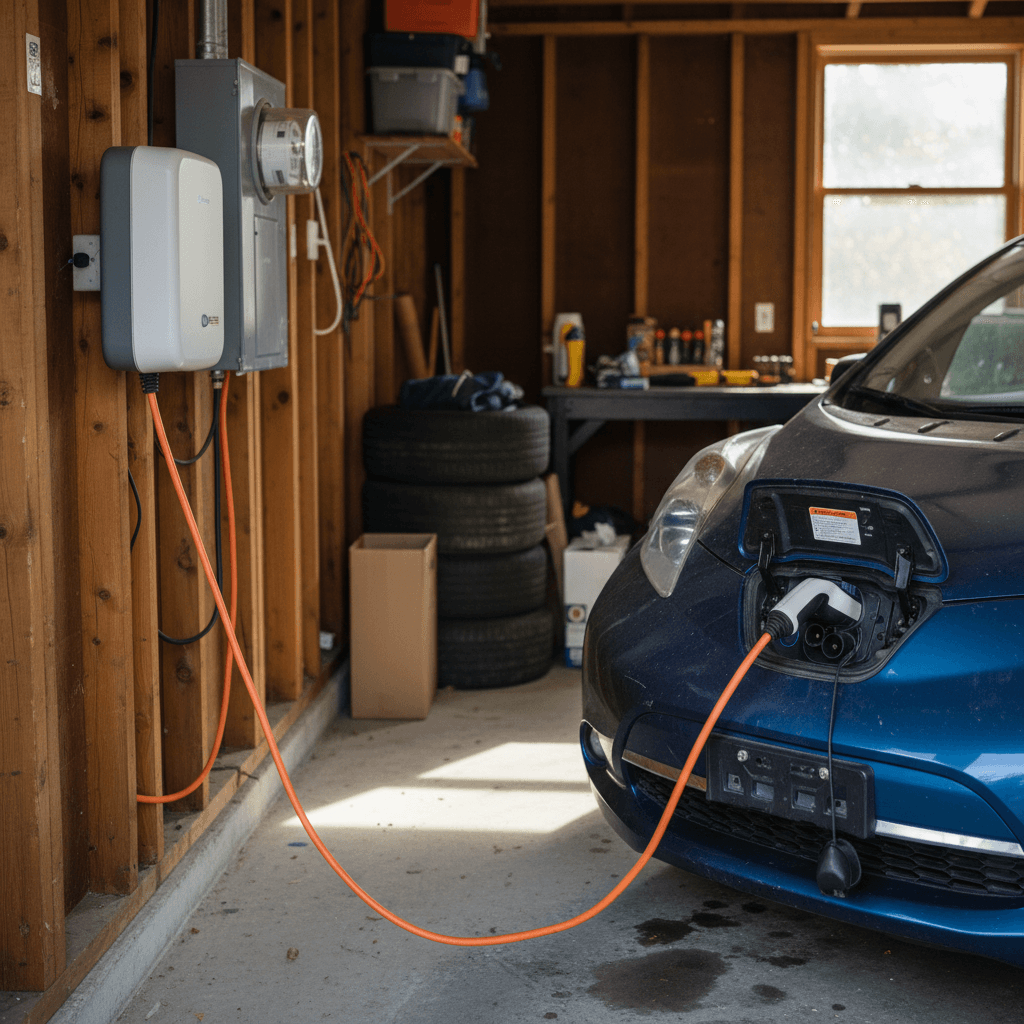
One‑time credit to help cover the make‑ready work for a Level 2 charger at home, think conduit, wiring, panel upgrades, and a new 240V outlet.
- Does cover: conduit, wiring, outlets, panel/breaker work
- Does not cover: the charger’s purchase price or mounting hardware
Typical homeowner value in North Carolina is roughly in the $500–$1,000 range, depending on work needed.
Charger Solution Program
Duke’s optional charger rental program lets you lease a Level 2 charger for ~36 months. They handle the charger hardware, installation, warranty, and maintenance. You pay separately for any substantial panel or wiring upgrades needed.
This can be appealing if you prefer a predictable monthly cost instead of an upfront $800–$1,500 install.
Commercial & multifamily prep credits
For apartment buildings, workplaces, and fleets in the Asheville area, Duke offers higher make‑ready incentives per port, often several hundred to a few thousand dollars per charger, when you install public, workplace, or multifamily Level 2 or DC fast chargers.
If you’re on an HOA board or run a local business, this is how you make EV charging pencil out.
What to watch in the fine print
Energy Saver NC: new Buncombe County home rebates
Here’s the new kid on the block: Energy Saver North Carolina, the state’s home energy rebate program funded by the Inflation Reduction Act. It launched in January 2025 and is rolling out county by county. Buncombe County enters the program in Phase 3 (June 2025), which means Asheville households can now tap into these funds.
Energy Saver NC in Buncombe County: key points
While this program isn’t an “EV rebate” per se, it can subsidize the electrical work that makes home charging possible.
| Who qualifies? | What can be covered? | Rebate level | Why it matters for EVs |
|---|---|---|---|
| Single‑family households under ~80% of Area Median Income (AMI) | Electrification upgrades like heat pumps, electrical panels, wiring | Up to 100% of qualified project cost | Panel upgrades and wiring can be done alongside installing EV‑ready circuits. |
| Households ~80–150% of AMI | Similar electrification measures | Around 50% of qualified project cost | If you need a panel upgrade to support a Level 2 charger, this can cut the bill in half. |
| Higher‑income households | Limited or no direct rebates | Varies by measure | You may not qualify here, but can still use Duke Energy and federal credits. |
Income‑based rebates for home electrification in Buncombe County can indirectly reduce your EV charging costs.
How to combine Energy Saver NC with EV plans
Local and programmatic support in Asheville
Beyond big federal and state programs, Asheville has a growing ecosystem of electrification support. The Electrify Asheville‑Buncombe initiative, for example, connects residents with vetted contractors, financing partners, and information about incentives for home electrification projects. While the program focuses more broadly on heat pumps and efficiency, the same contractors and upgraded panels often set the stage for home EV charging.
The upshot: you don’t have to DIY a spreadsheet of every rebate in the book. You can lean on local partners, including Recharged’s EV‑specialist advisors, to help you understand which mix of EV, charger, and home‑upgrade incentives makes the most sense for your situation.
How EV rebates work with used EVs
If you’re shopping the used market, and that’s where Recharged specializes, the incentives are a little more subtle, but they’re real. For most Asheville buyers today, the biggest savings on a used EV come from charging and home‑upgrade incentives, not the vehicle itself.
What you usually don’t get on used EVs
- No statewide North Carolina rebate on the car itself.
- Federal used‑EV credit rules have become narrow and subject to change; you should treat them as a potential upside, not a guaranteed $4,000.
- Manufacturer cash incentives and low‑APR offers generally focus on new vehicles.
What you do get on used EVs
- Access to the same federal home‑charger tax credit.
- Access to Duke Energy’s Charger Prep Credit and charger rental programs.
- Potentially lower insurance, lower registration, and dramatically lower fuel and maintenance costs versus a comparable gas vehicle.
- Recharged’s Recharged Score battery‑health report on every vehicle, so you’re not guessing about degradation.
Where Recharged fits in
Ready to find your next EV?
Browse VehiclesStep-by-step: how to actually claim EV rebates in Asheville
Your Asheville EV incentive game plan
1. Map your timeline against federal deadlines
If you’re considering a new EV or lease, know that major federal credits phase out by September 30, 2025, and the home‑charger credit by June 30, 2026. If you’re more than a year out, assume rules may shift again.
2. Confirm your utility and program eligibility
Check that your home is actually served by <strong>Duke Energy Carolinas</strong> and review their EV programs, especially the <strong>Charger Prep Credit</strong> and any charger rental options.
3. Evaluate your home’s electrical capacity
Before you fall in love with a Level 2 charger, have an electrician (or Energy Saver NC contractor if you qualify) look at your panel. In older Asheville homes, panel upgrades can be the single biggest line item, and also the one most likely to be subsidized.
4. Choose your car with incentives in mind
If you’re buying new, confirm whether the specific trim and build qualify for a federal credit. If you’re buying used through Recharged, focus on <strong>total ownership cost</strong>: price, range, battery health, and how cheaply you can charge at home.
5. Line up documentation as you go
Save <strong>purchase agreements, charger invoices, electrician receipts, and permit paperwork</strong>. You’ll need these for Duke Energy applications, Energy Saver NC, and your federal tax credit claim.
6. File for utility and home rebates promptly
Many programs have deadlines after work is completed, often 90–120 days. Put a reminder on your calendar the day your charger is commissioned.
7. Coordinate with your tax professional
Before filing, confirm that you’re claiming the right federal credits on the right forms, and that none of the programs you used conflict with each other. It’s much easier to ask now than amend later.
Common pitfalls to avoid
- Counting a rebate twice in your head. A dealer discount that already bakes in a federal credit is not an additional $7,500 coming at tax time.
- Assuming Energy Saver NC will pay for everything. It’s income‑based, and EV‑specific expenses may or may not be covered directly. Treat it as a boost for panel and wiring work, not a full charger subsidy.
- Waiting too long on the charger credit. Lead times for electricians in Asheville can be weeks or months. If you want that 30% federal credit before June 30, 2026, don’t wait until spring 2026 to start calling around.
- Skipping a used EV battery health check. A cheap used EV with a tired battery can eat your fuel savings in one ugly out‑of‑warranty replacement. This is exactly why Recharged created the Recharged Score battery‑health diagnostics in the first place.
- Ignoring utility rate structures. Some utilities offer time‑of‑use or off‑peak EV rates. Even if Duke doesn’t have a dedicated EV rate on your account yet, it’s worth asking, charging after 9 p.m. can materially cut your annual electricity spend.
Safety first on DIY charging
FAQ: EV rebates in Asheville
Frequently asked questions about EV rebates in Asheville
Bottom line: should you wait or buy now?
If you’re in Asheville and thinking about going electric, the perfect alignment of incentives is probably not coming. What you have today is a shrinking window of generous federal support on certain new vehicles and home chargers, backed up by Duke Energy’s ongoing make‑ready rebates and an expanding pool of Energy Saver NC funds for home upgrades in Buncombe County.
The smarter question isn’t “Will I squeeze every possible dollar out of every program?” but “Can I put together a realistic stack of savings that makes my next car both affordable and future‑proof?” For a lot of drivers here, that looks like a well‑priced used EV with strong battery health, a right‑sized Level 2 charger in the driveway or garage, and a set of incentives that quietly shave thousands off the true cost of ownership.
That’s where Recharged can help. We pair verified battery diagnostics, transparent pricing, and EV‑savvy support with a clear‑eyed view of the current rebate maze. If you’re ready to run the numbers on a used EV in Asheville, tax credits, charger rebates, Energy Saver NC, and all, we’re here to help you make the math work, not just the marketing.