If you’re considering an electric truck or SUV for work, camping, or family duty, EV payload capacity comparison charts can look all over the map. Some electric pickups boast over a ton of payload, while others tap out closer to what you’d expect from a midsize crossover. To make a smart choice, especially in the used market, you need to understand what those numbers really mean and how the leading EVs stack up.
Quick definition
What payload capacity actually means on an EV
Every EV has a gross vehicle weight rating (GVWR), which is the maximum safe weight of the vehicle plus everything and everyone in it. Subtract the curb weight (the vehicle empty, with fluids) from GVWR and you get payload. Automakers then round and publish that as a maximum payload rating for each configuration.
- Driver and passengers
- Cargo in the cabin and cargo area/bed
- Aftermarket accessories like racks, camper shells, winches, and steel bumpers
- Tongue weight from a trailer (usually 10–15% of trailer weight)
- Any gear in a frunk or underfloor storage bins
Why payload ratings vary by trim
On electric vehicles, the battery pack is often the single heaviest component. A long‑range battery can add hundreds of pounds versus a standard‑range pack, which is why you’ll sometimes see lower payload on long‑range trims even though they’re more expensive. That tradeoff matters if you’re trying to maximize both range and carrying capacity.
How EVs handle weight differently than gas trucks
EV weight & performance
- Higher curb weight: Batteries make EVs heavy before you add cargo.
- Instant torque: Electric motors handle low‑speed hauling beautifully, especially on grades or job sites.
- Low center of gravity: Packs mounted in the floor help stability when fully loaded.
- Range penalty: Extra weight directly reduces range, especially at highway speeds.
Gas truck weight & performance
- Lighter curb weight: More of the GVWR is left over as payload.
- Gear hunting: Automatic transmissions can struggle when towing or hauling near limits.
- Higher center of gravity: Weight sits higher, which can affect handling when loaded.
- Fuel economy drop: Load still hurts mpg, but refueling is quick.
Real‑world rule of thumb
Electric truck payload capacity comparison
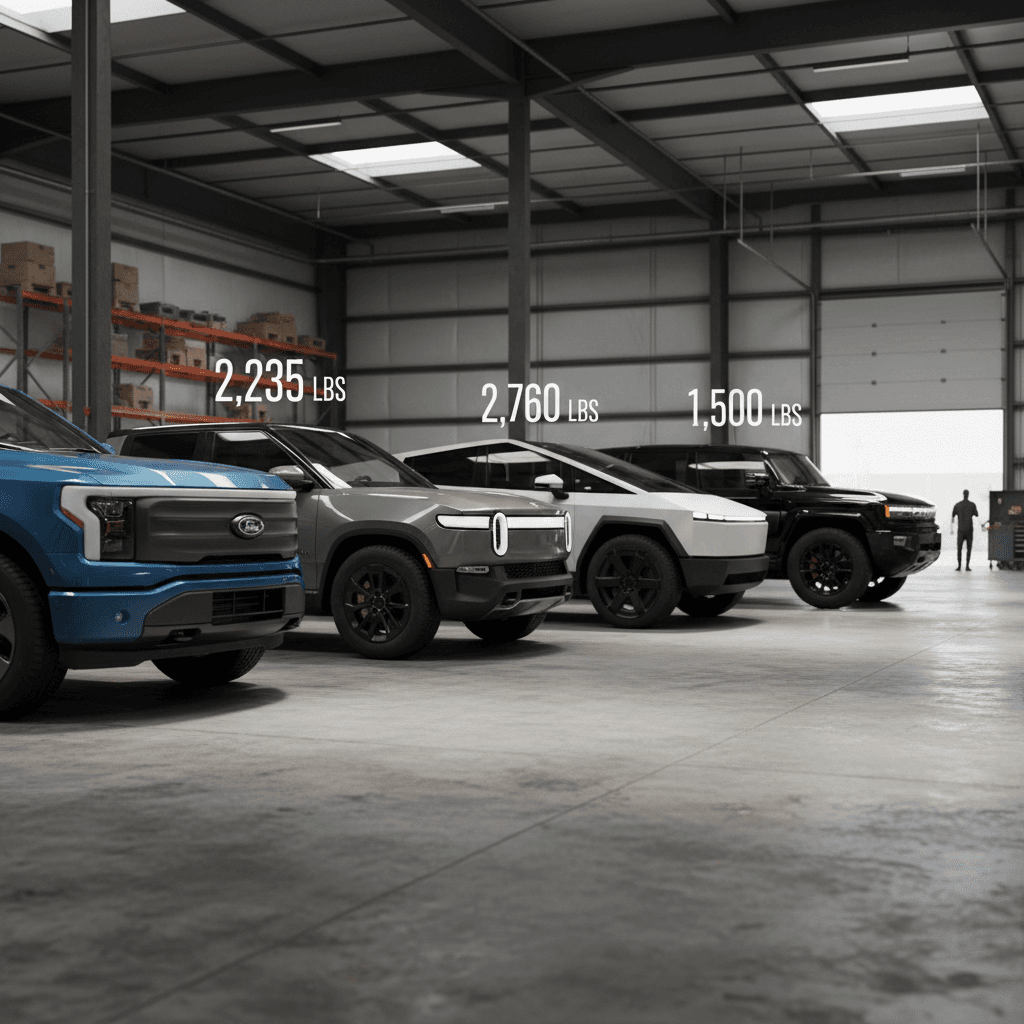
Among EVs sold in the U.S., electric pickups offer the highest payload ratings today. Here’s how some of the best‑known trucks compare on paper. Numbers below are rounded and can vary by exact configuration; always check the door‑jamb sticker on the specific truck you’re considering.
Electric pickup payload comparison (recent model years)
Approximate maximum payload ratings for popular electric trucks. Actual numbers vary by trim, battery, and options.
| Model | Approx. max payload (lbs) | Notable context |
|---|---|---|
| Chevy Silverado EV (Work Truck / LT) | ~2,100–2,350 | Some 2026 WT and LT trims are among the highest‑payload EV pickups available today. |
| Ford F‑150 Lightning | Up to ~2,000 | Select trims and shorter‑range batteries achieve the highest payload; luxury and off‑road packages typically reduce it. |
| Rivian R1T | Up to ~1,760 | Adventure‑oriented midsize‑ish truck with strong towing and a deep bed, but less payload than full‑size rigs. |
| GMC Hummer EV Pickup | ~1,300–1,500 | Extreme off‑road hardware and massive battery eat into payload compared with more work‑oriented trucks. |
| Tesla Cybertruck | ~2,500 (target, depending on spec) | Early figures suggest very high payload on certain trims, but real‑world numbers vary by configuration. |
Use this table as a starting point, then verify the exact payload on the specific VIN you plan to buy, especially in the used market.
Where these numbers come from
EV pickup payload at a glance
Electric SUV and crossover payload comparison
If you don’t need an open bed, three‑row electric SUVs and crossovers can offer very usable payload for families and road‑trippers. Capacities here tend to sit below the big trucks but are still plenty for passengers, luggage, bikes, and a hitch rack.
Typical payload ranges for popular electric SUVs
Actual numbers vary by trim and options; check the door‑jamb sticker for specifics.
Rivian R1S
Rivian’s SUV cousin to the R1T offers strong towing and a robust payload rating in line with its adventure focus. Expect roughly 1,500–1,700 lbs depending on configuration.
Kia EV9 & peers
Three‑row electric SUVs like the Kia EV9, Volvo EX90, and Mercedes EQS SUV typically land in the 1,400–1,650 lb payload range, solid for families plus cargo.
Compact crossovers
Smaller EVs such as Hyundai Ioniq 5, VW ID.4, and Tesla Model Y often offer 1,100–1,350 lbs of payload, more than many buyers realize.
Don’t forget people weigh more than you think
Payload vs towing: which matters more for you?
Marketing materials love to shout big towing numbers, 10,000, 11,000, or even 12,500 pounds. But real‑world owners run into payload limits long before they hit the max tow rating, especially on EVs where the truck itself is heavy to start with.
How towing eats payload
- Tongue weight (the downward force on the hitch) counts against payload.
- Most conventional trailers put 10–15% of their weight on the ball.
- That means a 7,000‑lb trailer can add 700–1,050 lbs of payload before you add passengers.
- Add people, a bed rack, and a cooler, and you can be at or over the rating quickly.
When payload matters more than tow rating
- You carry heavy tools or materials in the bed every day.
- You run a slide‑in camper, rooftop tent, or heavy rack system.
- You do overlanding with lots of recovery gear, water, and spares.
- Your trailer is light, but you pack a ton of stuff in the vehicle.
Never exceed the payload sticker
How to choose the right EV payload for your use case
Step‑by‑step: sizing EV payload for your needs
1. List how you actually use your vehicle
Separate your use into buckets: daily commute, weekend family trips, job‑site work, towing, off‑road, or overlanding. A contractor’s needs look very different from a suburban family’s.
2. Estimate people weight first
Multiply the number of regular passengers by 150–200 lbs each (be honest). Subtract this from the published payload, that’s what you really have left on a typical trip.
3. Add regular cargo and accessories
Include tools, boxes, strollers, coolers, dog crates, bike racks, and any bolt‑ons like sliders, steel bumpers, or a winch. These add up faster than most owners expect.
4. Factor in trailers and tongue weight
If you tow, estimate 10–15% of your trailer’s max loaded weight as tongue weight and subtract that from payload. Then ask if you still have enough headroom for people and gear.
5. Decide on your "comfort margin"
Running within 100–200 lbs of max payload all the time is stressful and leaves no room for surprises. Many owners prefer to stay at or below 80–85% of the rated payload in daily use.
6. Match use case to vehicle class
If the math keeps putting you above 1,700–1,800 lbs, look at higher‑payload EV pickups like certain Silverado EV or F‑150 Lightning trims. For lighter duty, a crossover or three‑row SUV may be plenty.
How Recharged can simplify this math
Used EV shopping: what to look at beyond the payload number
Payload ratings tell you what a vehicle can do when new, not necessarily what it has been doing. In the used market, it’s worth reading between the lines, especially with electric trucks that may have lived hard lives towing and hauling.
Key payload‑related checks on a used EV
Think of these as detective work to understand how the last owner used the vehicle.
1. Door‑jamb labels & build sheet
Verify the payload rating on the actual truck, you might be surprised how two similar‑looking trims differ. If possible, pull the build sheet to see which battery, wheels, and packages are installed.
2. Suspension, tires, and underbody
Look for sagging springs, tired shocks, or mismatched load‑range tires. On work trucks, check the bed floor and underbody for damage from overloading or repeated bottoming‑out.
3. Battery health & thermal history
Heavy hauling and frequent DC fast charging can stress packs. A Recharged Score battery health report helps you see real degradation instead of guessing from range estimates alone.
4. Hitch, wiring, and accessories
Evidence of a heavy‑duty hitch, air bags, or helper springs suggests serious towing. That’s not a dealbreaker, but it’s a clue to look more closely at brakes, tires, and suspension.
In the EV era, payload and range are joined at the hip. The trucks that do the most work also pay the biggest energy penalty when you actually use that capability.
Buying through a marketplace that understands EVs helps here. Recharged specializes in used electric vehicles, pairs every listing with battery diagnostics, and offers expert guidance on matching payload, range, and charging to your real‑world needs, plus financing, trade‑in, and nationwide delivery when you’re ready to pull the trigger.
Frequently asked questions about EV payload capacity
EV payload capacity FAQ
Bottom line: choosing an EV that can carry its weight
Payload might not be as flashy as 0–60 times or giant touchscreen sizes, but it’s one of the numbers that most directly shapes how an EV pickup or SUV will work for you. Electric trucks like the Silverado EV, F‑150 Lightning, and Rivian R1T prove that you can go electric without giving up serious hauling capability, so long as you pay attention to trim‑level details and how you actually use your vehicle.
Start by being honest about your loads, from family and luggage to job‑site gear and campers, then work backward to a realistic payload target. If you’re shopping used, add battery health, suspension condition, and past use to the equation. And if you’d rather not do the detective work alone, browsing the used EV selection at Recharged gives you transparent specs, verified battery diagnostics, financing, trade‑in options, and EV‑savvy support so the truck or SUV you pick can truly carry its weight in your life.