If you’ve noticed that EV paint quality issues, chips, scratches, peeling, or just “soft” paint, seem more common than they used to be, you’re not imagining it. Many modern EVs, from Teslas to Hyundai Ioniq 5s and beyond, use thinner, eco-friendlier paint systems that can be less forgiving in the real world. The good news: once you understand what’s going on and how to spot it, you can protect your EV’s finish and avoid surprises when buying used.
Big picture
Why EV paint feels more fragile than older cars
Walk around almost any recent EV and you’ll often find the same story: beautiful design, thin and sometimes delicate paint. That’s not just a Tesla thing, it’s increasingly an industry trend driven by regulations, manufacturing efficiency, and the way EVs are engineered.
- Water‑borne and low‑VOC paints: To reduce emissions and comply with environmental rules, most automakers have shifted to water‑based basecoats and lower‑solvent clear coats. These can be harder to apply perfectly and often end up a bit thinner than older solvent-heavy systems.
- Weight and efficiency pressure: Every kilogram matters on an EV. Thinner paint and fewer layers save weight, which helps range and cost targets, even if it costs some rock‑chip resistance.
- Fast production ramp‑ups: High-growth EV programs (like early Tesla Model 3/Y runs, and some newer EV platforms) have pushed paint shops hard. Rapid changes in processes and suppliers can mean inconsistent quality from car to car.
- Aero‑driven shapes: Many EVs have blunt, upright front ends and big, flat hoods. Those surfaces take rock impacts more directly than the sloped hoods you might remember from older gas sedans, so chips are harder to avoid even with decent paint.
Soft paint ≠ defective paint
Common EV paint quality issues to watch for
Not every EV suffers from every problem on this list, but these are the patterns owners and detailers report most often. If you’re shopping for a used EV, they’re exactly what you want to check.
The most common EV paint problems
From day-one defects to wear that shows up in year one
Thin or "soft" clear coat
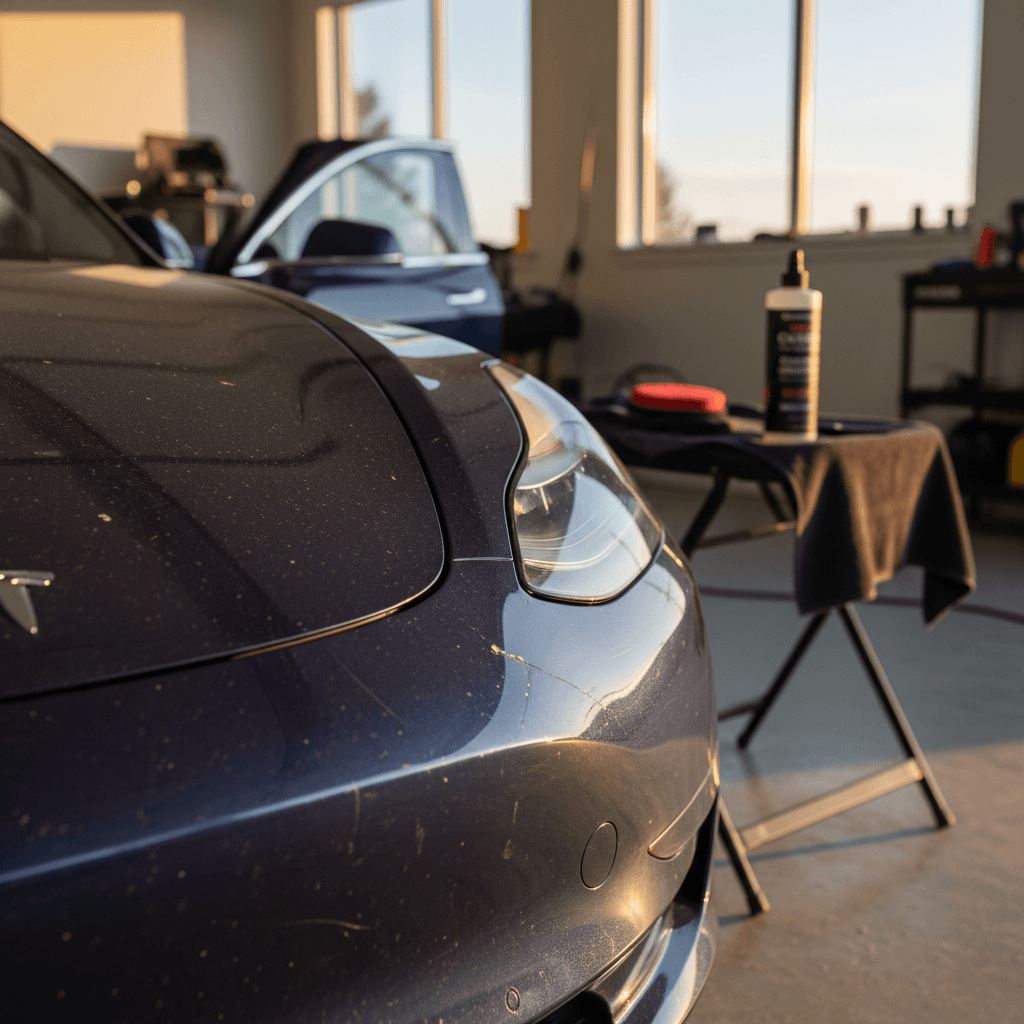
Many popular EVs use relatively thin clear coats that mar easily. Owners complain that even careful hand-washing can leave micro-scratches and swirls, especially on dark colors.
You’ll see this most clearly under direct sun or shop lights.
Rock chips & road rash
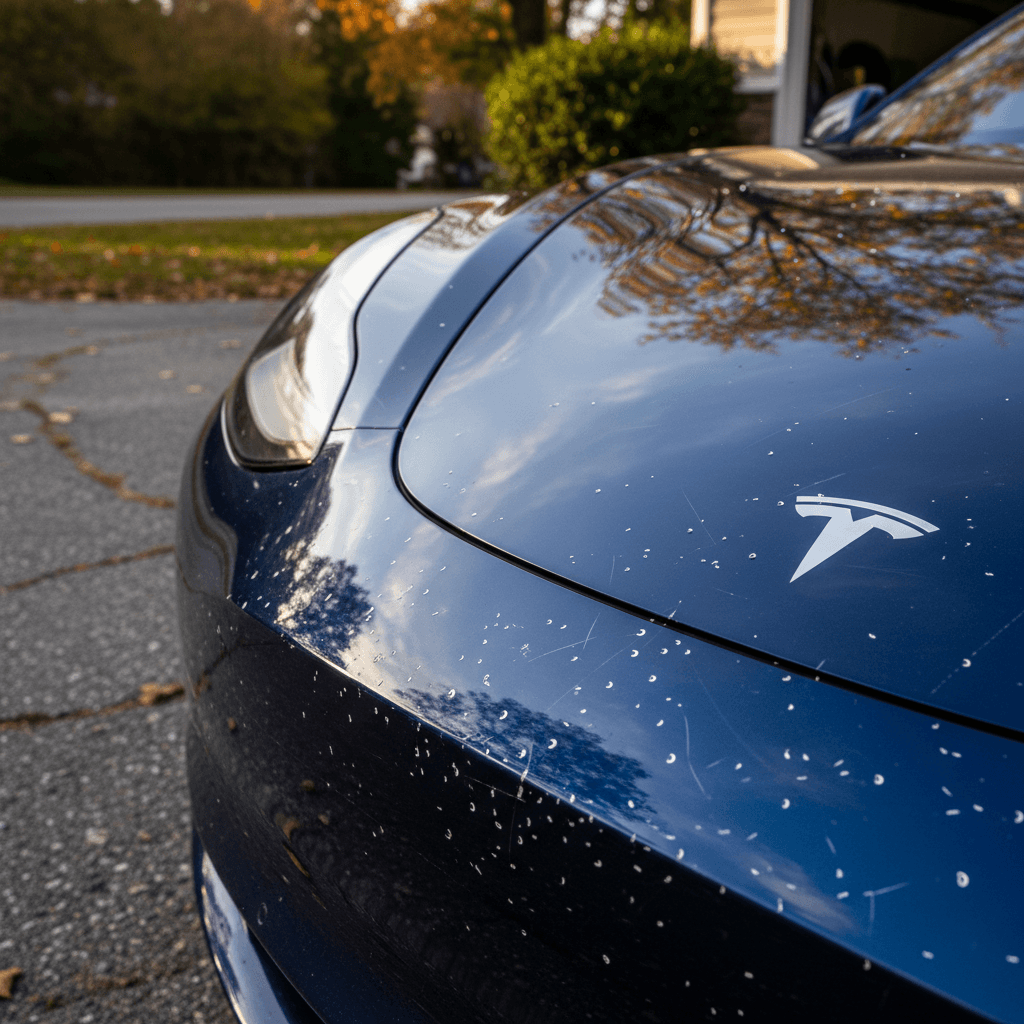
Blunt front ends and short overhangs put paint directly in the line of fire. It’s common to see chips concentrated on the hood, bumper, and mirror caps within the first 10,000–20,000 miles.
Orange peel & texture
Some EVs leave the factory with heavy orange peel, an uneven, dimpled texture in the clear coat. It may not be a functional problem, but it gives an oddly cheap look on an otherwise modern car.
Factory defects vs. real-world wear
Paint issues fall into two broad buckets
Delivery defects
- Dust nibs or dirt under clear coat
- Holograms from rushed machine polishing
- Uneven color between panels
- Runs, sags, or dry spray on edges
These are there on day one, inspect carefully at delivery or when buying used.
Environmental damage
- Etching from bird droppings or bug splatter
- Water spots from hard water drying on hot paint
- UV fading on darker colors over time
- Road salt and chemicals in winter climates
Peeling & delamination
Less common but more serious: clear coat or color coat lifting in sheets, often starting on roofs, hoods, or trunk lids. That usually points to an adhesion problem, and can expose bare metal.
Are EVs really worse than gas cars on paint quality?
There’s a persistent belief that EVs, especially Teslas and some Korean models, have uniquely bad paint. Reality is more nuanced: the industry as a whole has been trending toward thinner, more fragile finishes, but a few EV brands have definitely become lightning rods for complaints.
Where EVs do tend to struggle
- Tesla: Independent detailers routinely measure relatively thin paint and soft clear coat, especially on Model 3 and Model Y. Owners commonly report chips and swirls appearing quickly if the car isn’t protected.
- Hyundai / Kia EVs: Ioniq and EV6 owners frequently talk about easy chipping on front ends and painted plastic trims. Hyundai in particular has faced broader paint-peeling complaints on other models, which colors how people view their EVs.
- Legacy brands’ first EVs: Early runs of some dedicated EV platforms have shown inconsistent paint quality as factories dialed in new processes.
Where EVs aren’t uniquely bad
- Compact crossovers in general: The best-selling body style today, gas or electric, puts a lot of vertical surface up front. That means more chips, regardless of powertrain.
- Shared platforms: If an EV is built on the same line and body as a gas sibling, their paint quality is usually comparable. The chemistry and process are the same.
- Premium brands with strong paint shops: Some luxury automakers still maintain thicker, more durable paint even on EVs, but you typically pay for it in the MSRP.
So yes, EVs have become a focal point for paint complaints, but they’re also the part of the market where customers are looking closest and sharing most publicly.
Focus on condition, not badge
How paint issues affect used EV value and ownership costs
Cosmetic condition is one of the fastest ways a used EV can look either well‑cared‑for or neglected. Paint quality issues don’t just bother your eye, they can hit your wallet.
Why paint matters on a used EV
From a buyer’s perspective, heavy rock rash, early clear‑coat failure, or mismatched paint can all be signals. They may be purely cosmetic, or they may hint at prior accidents, poor repairs, or hard use. From an owner’s perspective, ignoring paint damage can accelerate corrosion on steel body panels, especially around wheel arches, rocker panels, and the underside of doors.
How Recharged handles paint on used EVs
How to inspect EV paint like a pro (especially on a used EV)
You don’t need a body shop’s toolkit to get a solid read on an EV’s paint. A slow walk-around, good lighting, and a few specific angles go a long way.
Seven-step EV paint inspection
1. Step back for the big picture
Start a few car lengths away and walk around. Look for any panel that seems slightly off in color or gloss compared to its neighbors, especially bumpers, doors, and quarter panels. Mismatched paint can signal prior repairs.
2. Check reflections at a shallow angle
Use the side of the car like a mirror. Wavy reflections can point to heavy orange peel or body filler beneath the paint. Sharp, clean reflections usually mean better prep and application.
3. Inspect the "high-impact" zones
Move close to the front bumper, hood leading edge, A‑pillars, lower rockers, and behind the wheels. These are the first areas to show chips and sandblasting. A few chips are normal; dense peppering suggests a lot of highway miles or no protection.
4. Look along panel edges and seams
Edges are where thin paint and adhesion issues show up first. Check hood and trunk lips, roof rails, door edges, and around the charge port. Flaking or peeling at seams is a bigger red flag than random chips in the middle of a panel.
5. Check plastic vs. metal panels
Many EVs mix painted metal with painted plastic (bumpers, wheel arches, trim). Slight tone differences can be normal, but pronounced color shifts or peeling on plastic parts may signal either poor factory work or cheap repaints.
6. Scan for overspray and tape lines
Open doors, hatch, and hood. Look inside jambs and along rubber seals. Rough texture, paint on weatherstripping, or hard tape lines suggest past bodywork. That’s not automatically bad, but it should be priced in and disclosed.
7. Use your fingertips, not your fingernails
Lightly glide your fingers over suspect areas. You’ll feel rough overspray, hardened sap, or etching even when it’s hard to see. Avoid picking at edges; if something is already marginal, you don’t want to make it worse during an inspection.
What Recharged’s inspection adds
Best ways to protect EV paint: PPF, ceramic, and more
If you’re buying an EV new, or a low‑mileage used one in great shape, this is where you can play offense instead of defense. The right protection up front usually costs less than repainting later.
EV paint protection options compared
How the main paint protection strategies stack up for a daily-driven EV.
| Option | What it is | Best for | Pros | Cons |
|---|---|---|---|---|
| Front-end PPF (paint protection film) | Clear urethane film applied to hood, bumper, mirrors and sometimes fenders | Highway commuters, road trip cars, chip-prone models | Outstanding impact protection, nearly invisible, can be replaced in sections | Upfront cost is significant; quality depends heavily on installer |
| Full-body PPF | Film on most or all painted surfaces | Premium EVs, long-term keepers | Maximum protection from chips and scuffs, preserves resale best | Very expensive; overkill for many owners |
| Ceramic coating | Hard, hydrophobic layer bonded to clear coat | Owners who hate washing and love gloss | Easier washing, better gloss, less staining from bugs and bird droppings | Does NOT stop rock chips; needs periodic maintenance |
| Traditional wax/sealant | Older-style protective products applied by hand or machine | Budget-conscious owners | Cheap and DIY-friendly, adds short-term protection | Short durability, limited impact resistance |
| No extra protection | Regular wash and occasional wax at most | Short-term leases, low-mileage city use | Zero upfront cost, simple | More chips and swirls over time; potentially lower resale |
Prices vary widely by region, vehicle size, and installer quality, but the relative tradeoffs are consistent.
Where protection pays off fastest
When to repair EV paint vs. live with cosmetic damage
Not every chip or scratch justifies a trip to the body shop. The key is separating purely cosmetic wear from damage that could cause problems later or materially hurt resale.
Probably worth fixing now
- Peeling or flaking clear coat: Once the clear starts lifting, UV damage accelerates and repairs get more complex. Address it early.
- Chips down to bare metal on steel panels: On hoods, roofs, door edges, and wheel arches, exposed metal can rust, especially in snowy or coastal areas.
- Mismatched repairs on a newer EV: If a relatively new car has obviously mismatched paint, correcting it can significantly help resale and buyer confidence.
- Lease return or imminent sale: A few hundred dollars of smart cosmetic work can save more than that in penalties or discounts.
Often okay to monitor or touch up
- Light swirls and wash marks: These are normal on soft paint. A competent detailer can usually correct them when you’re ready.
- Minor chips on plastic bumpers: Plastic won’t rust. Touch-up paint or just living with them is often fine on a driver car.
- Faded or stained trim: Cosmetic, though on some EVs with painted plastic trim it’s worth addressing if it really detracts from the look.
- Hidden damage: Scrapes on lower rockers or under bumpers that you never see may not be worth chasing unless you’re aiming for show-car perfection.
Avoid cheap resprays
Simple EV paint care checklist
You don’t need to be a detailing obsessive to keep EV paint looking good. A few consistent habits are enough to keep most quality issues from snowballing.
Routine EV paint care in 8 steps
1. Wash regularly, not aggressively
Aim for a gentle wash every 1–3 weeks, depending on climate. Use a pH‑neutral soap, clean mitt, and separate buckets for wheels and paint. Automatic brushes are convenient but brutal on soft clear coats.
2. Dry with clean microfiber towels
Letting water air-dry leaves minerals on the surface that can etch or spot. Blot with microfiber or use a blower; avoid dragging dirty towels across the paint.
3. Remove bird droppings and bugs quickly
Acidic droppings and bug splatter can etch clear coat in days when it’s hot and sunny. Keep a small bottle of quick detailer and soft cloth in the trunk for spot-cleaning.
4. Protect high-impact areas early
On a new or newly-detailed EV, consider PPF on the front bumper, hood leading edge, and mirrors. If that’s out of budget, at least apply a quality sealant or ceramic to add a sacrificial layer.
5. Be smart about parking
Whenever possible, park away from shopping cart corrals and under cover to reduce both dings and UV exposure. Avoid parking directly under trees that drop sap or heavy pollen.
6. Skip dealer "paint protection" upsells
Many dealer add‑ons are just overpriced wax or short-lived sealants. If you want ceramic or PPF, choose a reputable independent installer and know exactly what product you’re getting.
7. Touch up chips before winter
Before road-salt season, touch up chips that reach bare metal. It doesn’t have to be invisible; it just needs to seal the metal from moisture and salt.
8. Document condition for resale
If you invest in paint correction, PPF, or ceramic, keep invoices and photos. A marketplace like Recharged can use that documentation to justify stronger pricing on a sale or trade-in.
EV paint issues: Frequently asked questions
Common questions about EV paint quality
Key takeaways: Getting ahead of EV paint problems
Modern EV paint quality issues are a mix of changing regulations, cost pressure, and design trends. Thinner clear coats and blunt front ends mean chips, swirls, and occasional peeling are more common than many owners expect, especially if you’re coming from an older gas car with heavier paint.
The upside is that once you know what to look for and how to protect it, paint doesn’t have to be a deal-breaker. Inspect cars carefully, invest in smart protection where it makes sense, and treat cheap, sloppy repairs as the red flags they are. If you’d rather not decode all of that alone, buying or selling through Recharged gives you a used EV with transparent cosmetic and battery health reporting, fair pricing, and expert guidance on whether that chip‑prone EV you love is a smart long-term bet.