If you live in an apartment or condo, EV ownership in an apartment complex can feel like a fantasy: no driveway, no garage, maybe not even an assigned parking space. But the reality on the ground is changing fast. Multifamily buildings are adding chargers, public networks are filling in the gaps, and smart planning can make an EV entirely practical, even without a private home charger.
Apartments and EVs are finally meeting in the middle
EV ownership in apartments: Is it realistic?
Let’s get this out of the way: yes, you can own an EV while living in an apartment. But it requires more planning than if you had a private driveway and wall charger. Instead of assuming you’ll plug in every night at home, you design a routine around where you actually park, at your building, at work, or near places you visit regularly.
Why multifamily charging matters
Those numbers tell you two things: first, you’re not alone in wanting an EV without a house; second, the market is nudging landlords to respond. Your job is to understand your charging options and pick an EV, and a routine, that fits how you actually live.
How EV charging works when you don’t have a garage
In a single-family home, the script is simple: install a Level 2 charger, plug in overnight, wake up full. In an apartment, charging becomes a mix-and-match story built from three main ingredients: on-site charging at your building, charging at work, and public fast charging where you already drive, grocery stores, gyms, retail centers, and highway corridors.
Think in miles per week, not per day
Without a home charger, it helps to flip your mindset. Instead of asking, “Can I plug in every night?”, ask, “Where can I reliably add my weekly miles?”
- Estimate your weekly driving: commute, errands, occasional trips.
- Compare that to what you can add at work or public chargers in 1–2 sessions.
- Plan a routine: for example, fast charge on Sunday and top up midweek.
Understand the three charging speeds
- Level 1 (120V): Standard wall outlet; ~3–5 miles of range per hour. Works best if you can plug in overnight, every night.
- Level 2 (240V): Typical apartment or workplace charger; roughly 15–30 miles per hour.
- DC fast charging: Highway or retail sites; can add 150–200+ miles in 30–45 minutes depending on your EV.
Apartment life is usually a mix of Level 2 and DC fast charging, with Level 1 only if you luck into an outlet by your parking spot.
Watch out for wishful thinking
Your main charging options in an apartment complex
Most apartment EV owners rely on some combination of four charging options. Exactly which mix works for you depends on your commute, your building, and how often you take longer trips.
Four core charging strategies for renters
Mix and match based on what your building and routine actually allow
1. Dedicated or shared on-site chargers
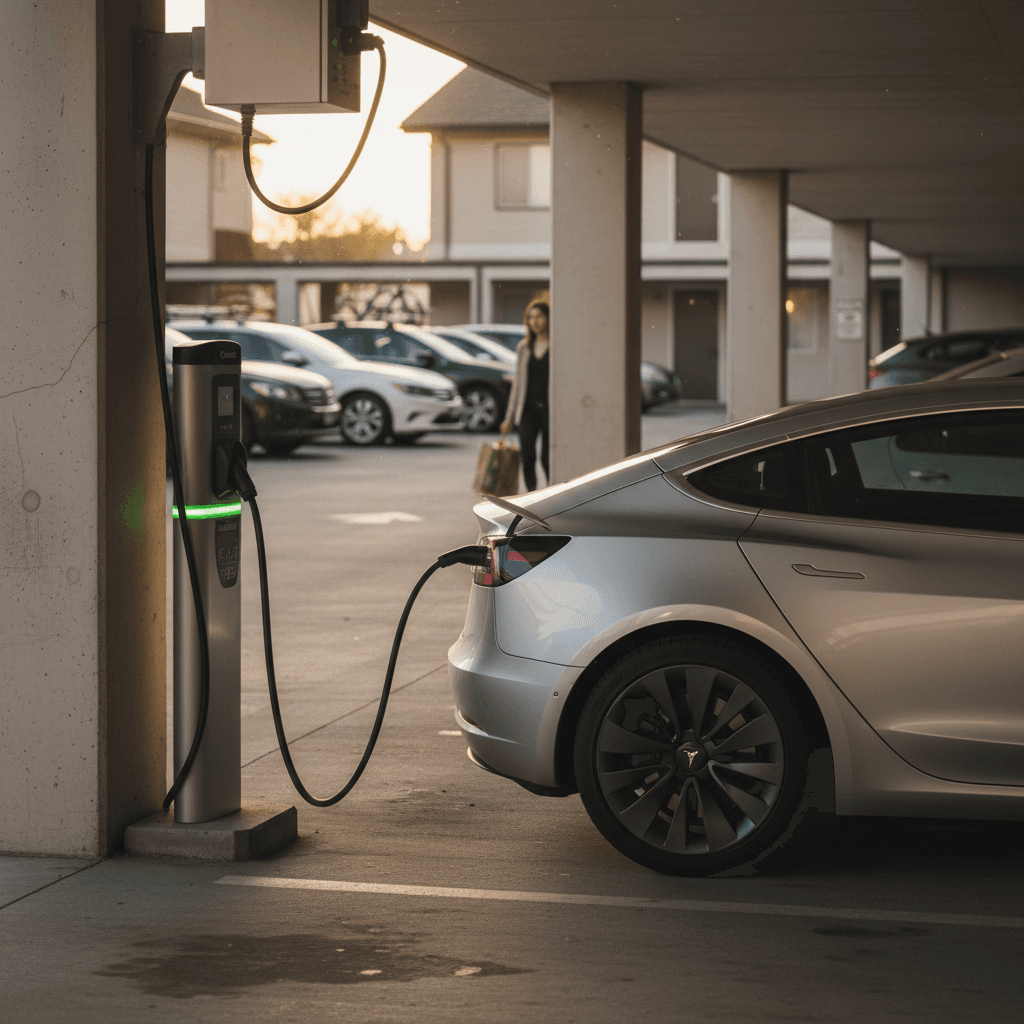
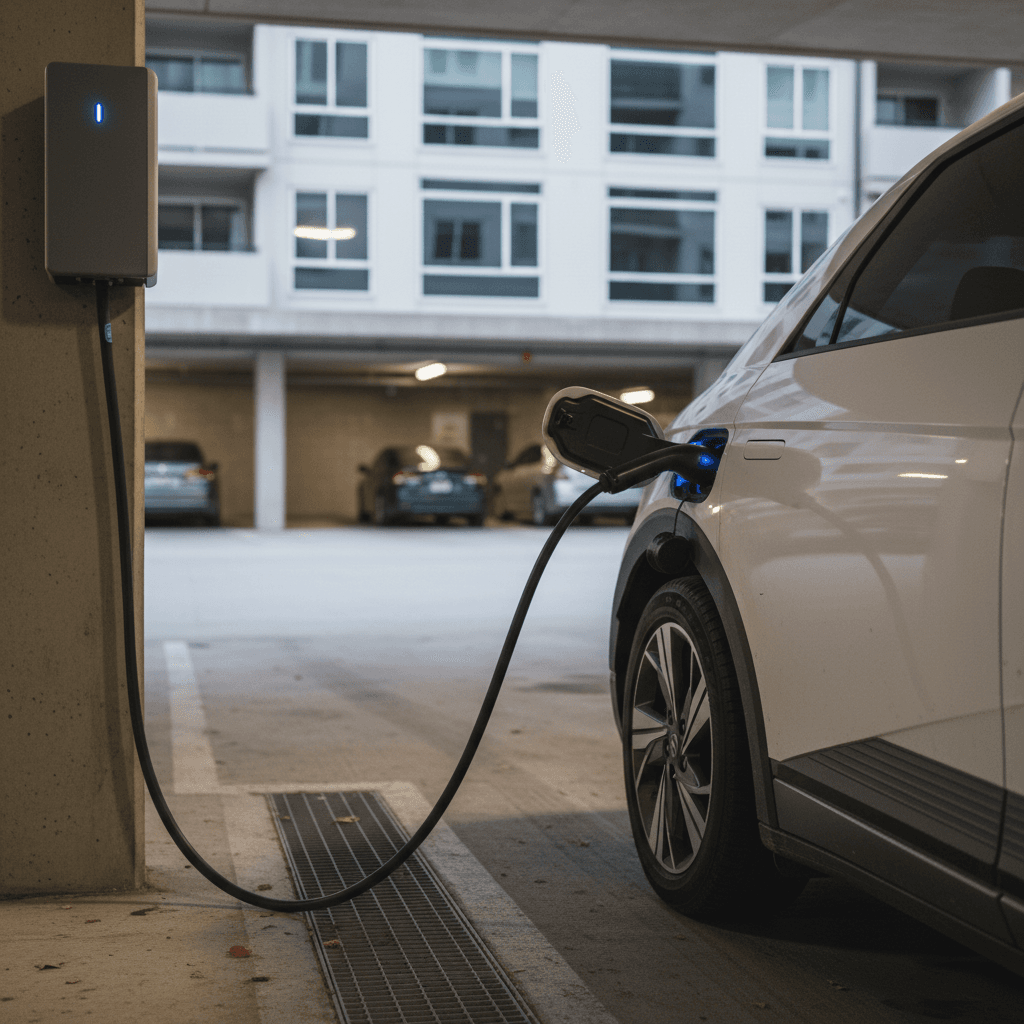
More multifamily properties now offer Level 2 chargers in resident parking or shared guest areas.
- Best case: Assigned space with a charger or outlet where you can leave your car overnight.
- More common: Shared chargers you rotate through with other residents.
- Billing: Often through an app that bills you per kWh or per hour.
If you’re apartment-hunting, treat on-site charging like in-unit laundry: a major quality-of-life upgrade.
2. Workplace charging
If you can plug in at work, that may be even more valuable than charging at home.
- Cars typically sit 8+ hours during the workday.
- Even a modest Level 2 charger can easily refill a week of commuting.
- Many employers subsidize charging or offer it free as a perk.
Ask HR or facilities about existing chargers and future plans.
3. Nearby DC fast charging
For many apartment dwellers, fast chargers near home become the backbone of their charging routine.
- Look for 50–350 kW stations along your usual routes.
- Combine charging with grocery runs, gym visits, or weekend errands.
- Plan one longer charging stop a week rather than many small ones.
This works best if your EV has good fast‑charging speeds and you don’t mind treating charge time as built‑in errand time.
4. Opportunistic Level 1 or 2 outlets
Sometimes the simplest solution is a regular outlet or a 240V receptacle in the garage.
- Ask if any spaces have access to outlets, especially in older buildings.
- Some properties allow residents to install 120V or 240V receptacles at their own expense.
- Pair a 240V outlet with a portable Level 2 charger you keep in your trunk.
You’ll need written permission, a licensed electrician, and clear agreement on who pays for electricity.
Use maps to test-drive the idea
Making the most of public and workplace charging
Public and workplace charging can either feel like a constant scramble or an easy background rhythm. The difference comes down to planning, etiquette, and choosing an EV that plays nicely with the networks you’ll use most.
Turn scattered plugs into a simple routine
1. Lock in a weekly “anchor” session
Pick one reliable charging stop that can almost cover your weekly driving, Sunday morning at the grocery store fast charger, or Monday at a workplace Level 2 station. Everything else becomes light top‑ups.
2. Build a charging map that fits your life
Favor chargers where you already spend time: your gym, favorite coffee shop, or big‑box store. You’re looking for places where 30–60 minutes passes quickly, not gloomy parking lots where you’ll stare at the percentage meter.
3. Learn each network’s quirks
Most DC stations require an app, account, or RFID card. Set up accounts for at least two major networks in your area so you’re not downloading apps at the charger with 4% battery left.
4. Respect charging etiquette
Move your car when charging is done, avoid ICEing (parking a gas car in a charging spot), and treat shared spaces in your building with the same courtesy you’d want from your neighbors.
5. Watch for time‑based fees and idle charges
Many operators add per‑minute or idle fees once your charging session slows down or finishes. That’s your cue to unplug and free up the stall.
6. Keep a backup plan for busy days
Have a “Plan B” charger in mind if your usual spot is broken or full. Knowing where you’ll go before you need it keeps the stress out of apartment EV life.
Talking to your landlord or HOA about EV charging
If your apartment complex doesn’t have chargers yet, you may be the first voice that pushes things forward. The key is to approach it like any other property improvement: with clear benefits, simple options, and minimal hassle for the owner or board.
How to make a convincing case for EV charging
Show that chargers help the property, not just your car
Lead with renter demand
Renter surveys now show that roughly one‑third of renters are interested in or rely on EV charging. In competitive markets, that’s the difference between an empty unit and a waitlist.
Position chargers as a way to attract higher‑quality, longer‑term tenants, not as a special favor to you.
Highlight incentives and low upfront cost
Many utilities and cities offer rebates or even turnkey programs that cover most of the hardware and installation cost for multifamily EV charging. Some programs even pay networking fees for the first few years.
Offer to research local incentives and bring your landlord a short list of programs they can tap into.
Know your rights, but stay collaborative
Several states now have “right‑to‑charge” laws that stop landlords or HOAs from unreasonably blocking EV charger installations, as long as tenants pay the cost and use licensed contractors.
It’s useful leverage, but you’ll almost always get better results by presenting a cooperative, win‑win plan.
Right-to-charge laws are spreading
If you’re asking for shared building chargers
- Suggest a small first phase, two to four Level 2 chargers in the most logical shared area.
- Offer to help gauge interest among other residents so the owner isn’t guessing at demand.
- Propose simple rules: time limits, EV‑only spaces, guest vs. resident priority.
The easier you make it for management, the more likely you are to see a pilot project actually installed.
If you’re asking for a charger at your space
- Ask whether you can install a dedicated 120V or 240V outlet or a wall‑mounted Level 2 unit at your assigned spot.
- Offer to cover installation, usage, and eventual removal costs through a written agreement.
- Make sure everything goes through a licensed electrician and the local permitting process.
Bring sample agreements from utilities or advocacy groups to show that you’re not asking them to reinvent the wheel.
Costs to expect when you charge without home infrastructure
Charging without a private home charger can still be affordable, but the math looks different. Instead of one low residential electricity rate, you’ll juggle workplace, public Level 2, and fast‑charging prices, and you may pay a little more for the convenience of fast juice on demand.
Typical charging cost ranges for apartment EV owners
Real prices vary by utility, network, and time of day, but this gives you a sense of how different options stack up.
| Charging location | Typical pricing model | Approx. effective cost per kWh | Best use case |
|---|---|---|---|
| Workplace Level 2 | Free or subsidized per kWh | $0.00–$0.15 | Regular commuting, weekly refill |
| On‑site apartment Level 2 | Per kWh or per hour | ~$0.15–$0.35 | Overnight or all‑day charging when you have a space |
| Public Level 2 (retail, city) | Per kWh, per hour, or flat session fee | ~$0.20–$0.40 | Errands, topping up while you shop |
| DC fast charging | Per kWh or per minute, often higher rates | ~$0.30–$0.60+ | Fast weekly refill, road trips, time‑sensitive charging |
Use this table as a relative comparison, then plug in your local electricity rates and network prices for a more exact picture.
Don’t live on fast charging alone
If you can anchor most of your miles at cheaper Level 2 stations, at work or at your building, your fuel costs will usually land comfortably below what you’d pay for gas, even if you layer in the occasional, more expensive DC fast session.
Choosing the right EV for apartment life
Not every EV fits apartment life equally well. The good news is that the used EV market is full of options, and you can tilt the odds in your favor by focusing on a few traits that matter a lot more when you don’t control your own charging hardware.
What makes an EV apartment-friendly?
Look beyond paint colors and infotainment screens, these traits determine how stressful your charging routine feels.
Solid real-world range
More range gives you more flexibility. If you can comfortably cover a full week of normal driving on one charge, you can treat charging like a weekly chore instead of a nightly concern.
For many apartment dwellers, that means aiming for at least 200 miles of realistic range, more if you regularly take longer trips.
Good DC fast charging performance
If you’ll lean on fast chargers, look for an EV that can:
- Accept at least 100–150 kW at peak on compatible stations.
- Hold strong charging speeds from 10–60% state of charge.
- Precondition the battery for fast charging in cold weather.
The faster it charges, the shorter your weekly charging stop, and the less time you’ll spend nursing a cappuccino you didn’t really want.
Healthy battery and transparent history
Battery health matters more when you can’t top up every night. A degraded pack shrinks your window between charging sessions.
When you shop used, look for verified battery health data so you know how much range you’re really getting, not just what the window sticker promised when the car was new.
Compatibility with local networks
Check which connectors and adapters you’ll need for the stations around you, CCS, NACS, or CHAdeMO for a few older models.
Also make sure your car’s navigation or smartphone app can easily route to those chargers and start sessions without drama.
Cold-weather resilience
If you live in a colder climate, understand how your chosen EV behaves below freezing: winter range hit, cabin preconditioning, and how charging speeds drop when the pack is cold.
Apartment dwellers rarely have heated garages, so winter behavior isn’t a side note; it’s your reality three months a year.
Right size for your parking situation
If you’re threading a concrete maze into a tight underground space, a slightly smaller EV can make every day easier.
Measure your spot, know your building’s turn radius, and remember that usable size sometimes matters more than cargo capacity specs.
Where a used EV shines for renters
How Recharged helps apartment dwellers go electric
Choosing and living with an EV is different when you don’t control the parking lot. That’s exactly where a transparent used‑EV marketplace can do the most good. Recharged is built for buyers who want clear answers, especially around battery health, charging behavior, and day‑to‑day costs.
- Recharged Score battery health diagnostics give you a verified picture of how much real‑world range you can expect, which is critical when you can’t casually top up at home.
- Every vehicle listing includes fair market pricing so you can see how much value you’re getting for the range and features you need.
- Recharged’s EV specialists can help you match a car to your charging reality, whether that’s a couple of fast‑charge sessions a month, regular workplace charging, or new on‑site chargers at your building.
- With financing, trade‑in options, instant offers, consignment, and nationwide delivery, you can shop and buy completely online, then have your EV delivered right to your apartment complex.
- If you’re local to Virginia, you can visit the Recharged Experience Center in Richmond to talk through apartment charging strategies in person and test how different models feel for your daily drive.
Come prepared to your EV shopping conversation
FAQ: EV ownership in an apartment complex
Common questions from apartment and condo drivers
Bottom line: Can an apartment dweller happily own an EV?
Yes, if you buy the right car for the life you actually live and line up your charging plan before you ever sign the paperwork. EV ownership in an apartment complex is no longer a fringe experiment; it’s where a growing share of EV drivers are starting their journey. Take the time to map your charging options, talk honestly with your landlord or HOA, and choose a used EV whose range, fast‑charging behavior, and battery health match that reality. Do that, and the lack of a garage becomes a detail, not a deal‑breaker, and the quiet, low‑maintenance, low‑fuel‑cost drive is yours every day, regardless of your ZIP code.