If you’re 25 and thinking about an electric car, you’ve probably heard two things: **EVs are cheaper to run**, and **they’re more expensive to insure**. Both can be true at the same time. Understanding EV insurance cost by age 25 is the key to deciding whether an electric car fits your real monthly budget, not just your fuel savings calculator.
Quick answer
EV insurance cost by age 25: the 2026 snapshot
What 25-year-olds typically pay for EV insurance
Before we zoom in on EVs, it helps to anchor on **overall car insurance for 25‑year‑olds**. National surveys in 2025–2026 put average full‑coverage car insurance for age‑25 drivers roughly in the **$1,800–$2,600 per year** range for all vehicles combined. For EVs specifically, multiple studies show average premiums running **about 20% higher than gas cars**, with many EV owners paying **around $3,400–$4,000** per year for newer, more expensive models, though that’s skewed by high‑end Teslas and performance EVs.
If you’re 25, shopping carefully, choosing a **moderately priced EV** (new or used), and you’ve kept your record clean, it’s realistic to target quotes **closer to $2,200–$2,800 per year**, especially outside of the highest‑cost states. We’ll walk through how to get there, and when an EV can actually be competitive with a gas car on insurance.
How turning 25 changes your EV insurance bill
Car insurance companies love data, and their data says drivers in their late teens and early 20s crash more often and more severely. That’s why premiums can feel brutal at 18 or 21. Once you hit **age 25**, you start to move into a safer bucket statistically, and **your rate curve finally bends down**.
- Your age is no longer in the highest‑risk band insurers use for young drivers.
- You’ve had more years to build a **clean driving history** (no at‑fault crashes, DUIs, or frequent tickets).
- Many 25‑year‑olds have a longer **continuous insurance history**, which some carriers reward.
- Some companies start offering **better tiers** or discounts once you’ve crossed mid‑20s, even for EVs.
Why this matters for EVs
EV vs gas insurance cost at 25
What EV owners are seeing
- Recent analyses show **EV drivers paying roughly 20–50% more** than gas‑car drivers on average for full coverage.
- Average EV premiums around **$3,400–$4,100 per year** reflect a mix of pricey, new EVs and younger drivers.
- Heavy, powerful EVs like some crossovers and performance models can push **claims and repair costs higher**, which insurers price into your premium.
What 25‑year‑old gas drivers pay
- For a 25‑year‑old in a mainstream gas sedan or compact SUV, full coverage is often **$1,600–$2,300 per year**, depending on state and record.
- Cheaper purchase price and simpler repair networks make gas cars **easier to price** and often cheaper to fix.
- Some insurers still view EVs as a data gap, so they price cautiously until they have more claims history.
For a 25‑year‑old, that typically means an EV premium that’s **a few hundred dollars a year higher** than a similar gas car. But that gap can shrink, or even disappear, if you choose the right EV, keep your record clean, and stack discounts. In parts of the country with high gas prices and reasonable electricity rates, **fuel savings can easily outweigh the insurance gap** over a year or two.
What actually drives EV insurance costs for 25-year-olds
Biggest factors behind your EV premium at 25
You can’t change your age, but you can change almost everything else.
Vehicle value & battery
Repair network & parts
Performance & torque
Where you live & park
Your record & history
Coverage & deductibles
Don’t forget credit and mileage
Realistic examples: EV insurance quotes at age 25
Every insurer prices risk differently, but it helps to see how the pieces fit together. These **illustrative examples** aren’t quotes, just realistic scenarios for a 25‑year‑old in 2026 with full coverage (good liability limits, comprehensive and collision) and an average‑cost state.
Sample EV insurance scenarios for 25-year-old drivers
Approximate ranges for full-coverage insurance, assuming a clean record and average-cost state. Your numbers may be higher or lower based on location and insurer.
| Driver & EV scenario | Vehicle type | Estimated annual premium | What’s driving the price? |
|---|---|---|---|
| "Careful Commuter" – 25, clean record, good credit, drives 9,000 miles/year | 2019 used Nissan Leaf or Chevy Bolt EV | $1,800–$2,300 | Smaller, older EV with lower value; clean history keeps rate down, used EV helps close the gap with gas. |
| "City Pro" – 25, clean record, average credit, urban ZIP, 12,000 miles/year | 2023 Hyundai Ioniq 5 or Kia EV6 | $2,400–$3,000 | Newer EV with higher value and costlier bodywork, plus city traffic risk. Still manageable with good discounts. |
| "Performance Fan" – 25, one speeding ticket, good credit, 10,000 miles/year | 2024 Tesla Model 3 Long Range or similar performance EV | $2,800–$3,600 | Fast EV, higher repair costs, prior ticket. Some insurers rate Teslas and other performance EVs significantly higher. |
| "Budget Rebound" – 25, clean record, recently moved, rebuilding credit | 2017–2019 used EV hatchback via Recharged | $2,000–$2,600 | Modest used EV value keeps comprehensive/collision costs in check; careful shopping and higher deductibles help. |
These examples are for comparison only, not guaranteed quotes.
How this compares to gas cars
Seven ways to lower EV insurance cost by age 25
Practical moves that actually move your premium
1. Pick an insurance-friendly EV
Before you fall in love with a 0–60 figure, compare insurance costs across models. Slower, smaller EVs with strong safety ratings and cheaper parts are usually cheaper to insure than luxury or performance models.
2. Right-size your coverage & deductibles
Keep **liability limits high**, you’ll want the protection, but consider a **$500–$1,000 deductible** on comprehensive and collision if you can afford that out of pocket. It can trim your premium without stripping protection.
3. Ask for EV and telematics discounts
Many insurers now offer **EV‑specific discounts**, plus usage‑based or safe‑driver programs that track your braking and mileage. For a responsible 25‑year‑old, those programs can shave 5–20% off your premium.
4. Bundle policies if you can
If you rent or own a home, bundling **auto + renters** or **auto + home** with the same carrier often unlocks bundle discounts. For a young EV driver, that can be the difference between a painful quote and a palatable one.
5. Clean up tickets and claims
If you’ve had a rough stretch on your record, set a two‑year plan: no new tickets, no at‑fault crashes, and no lapses in coverage. At 25, a clean 24‑month window can unlock **much kinder pricing** when you re‑shop.
6. Shop more than one carrier
Insurers do not agree on EV risk. One company may rate your EV 30% higher than a gas car; another may be nearly even. Get quotes from at least **three or four carriers**, including any that advertise EV expertise.
7. Consider mileage and usage
If you work from home or use your EV mostly on weekends, your real annual mileage might be low. Make sure your policy reflects that. Low‑mileage rating tiers can save you money, especially as a 25‑year‑old driver.
Where a used EV helps
Ready to find your next EV?
Browse VehiclesWhy a used EV can be cheaper to insure at 25
Insurance doesn’t care how shiny the paint looks. It cares what your car is worth and what it costs to fix. That’s why **used EVs can be a smart play for 25‑year‑olds** who want the electric experience without a sky‑high premium.
- A **lower vehicle value** usually means cheaper comprehensive and collision coverage, the big pieces of a full‑coverage premium.
- Older, simpler EVs (like early Nissan Leafs or Chevy Bolts) often have **smaller batteries and lower repair bills** than big luxury SUVs.
- Some used EVs have extensive real‑world claims history, which makes insurers **more comfortable pricing them competitively**.
- If you buy well below the original MSRP, the car is less likely to be totaled by moderate damage, improving the claims picture over time.
On Recharged, every used EV comes with a **Recharged Score Report** that includes verified **battery health diagnostics** and fair market pricing. That helps you and your insurer understand the car’s real value today, not just what it sold for when it was new, so you’re not over‑insuring or overpaying.
Talk value and coverage with your agent
Choosing the right EV to keep insurance costs down
Features that help, or hurt, your premium at 25
You can shop your way into a cheaper bill.
Strong safety ratings
Modest power & size
Battery placement & design
Purchase price sweet spot
Repair-friendly brand
Transparent battery health
EV insurance myths 25-year-olds should ignore
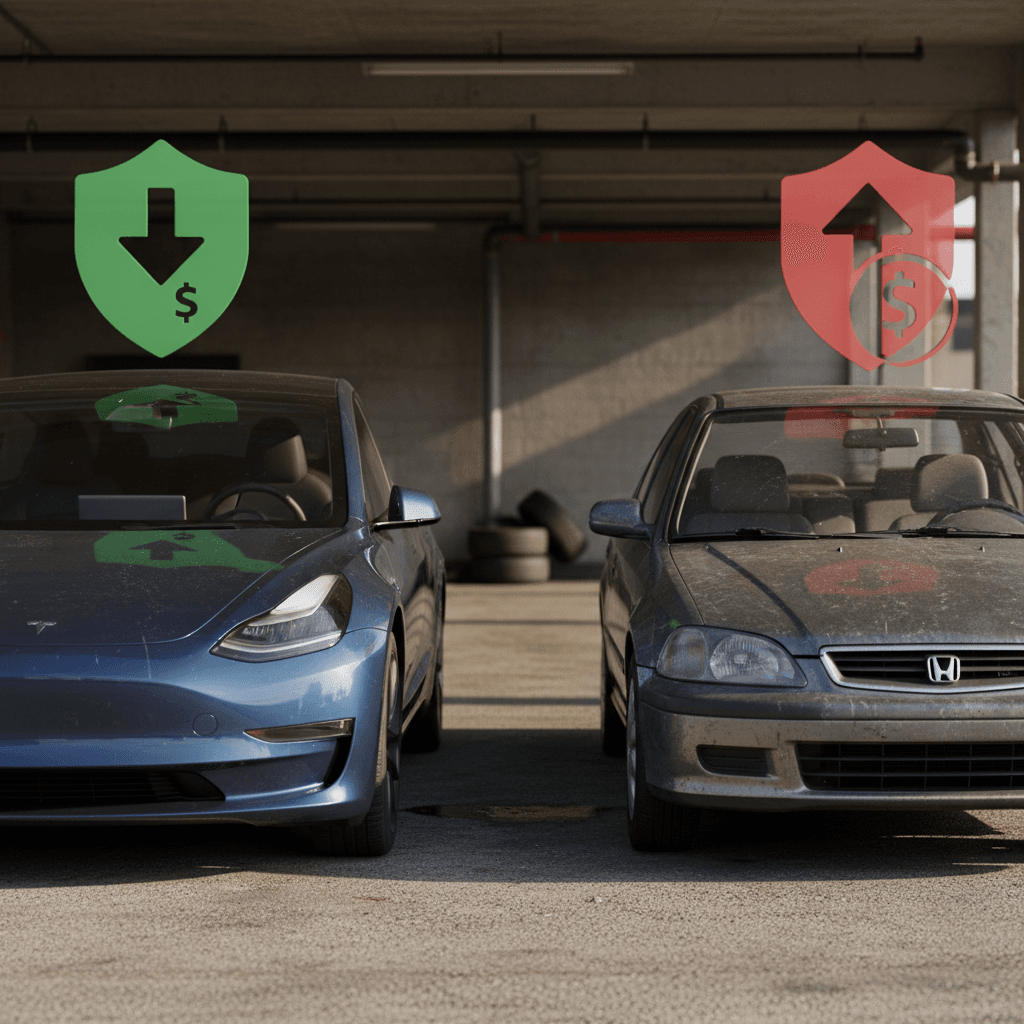
- “All EVs are insanely expensive to insure.” Reality: Some are. Many aren’t. A used compact EV with a clean‑record 25‑year‑old can land in the same ballpark as a mid‑size gas sedan, especially outside high‑cost states.
- “Insurance will eat all my fuel savings.” Reality: Yes, EVs often cost more to insure than gas cars, but they typically **save you a lot on fuel and some maintenance**. Over a few years, your total cost of ownership can still favor an EV.
- “I’m 25 now, so my rate will automatically be cheap.” Reality: Age helps, but your **record, credit, location, and car choice** matter just as much. Turning 25 isn’t a magic reset button if you’ve got recent tickets or claims.
- “Used EVs are risky to insure.” Reality: Insurers care about claims data and repair costs, not whether a car is used. A well‑maintained, lower‑value used EV can actually be easier and cheaper to insure than a pricey new one.
FAQ: EV insurance cost by age 25
Frequently asked questions about EV insurance at 25
Bottom line: is an EV at 25 worth the insurance cost?
By age 25, you’ve finally aged out of the worst insurance brackets, but EVs can still sting more than gas cars at renewal time. The good news is that **you have more control than you think**. Pick the right EV, lean toward a well‑priced used model with strong safety ratings, keep your record squeaky clean, and stack every discount your insurer offers, and your EV premium can move from "no way" to "this actually works."
If you’re shopping used, a marketplace like Recharged makes that easier. Every car includes a **Recharged Score Report** with verified battery health and fair market pricing, so you’re not guessing what you’re insuring. Pair that with a few smart conversations with insurers, and you’ll know exactly where **EV insurance cost by age 25** fits into your total cost of ownership, and whether this is the year you finally plug in for good.