If you’re trying to decode EV incentives in North Carolina in 2026, you’ve probably run into conflicting, out‑of‑date advice. The big federal purchase credits many buyers counted on ended in late 2025, and North Carolina still doesn’t have its own statewide EV tax credit. But that doesn’t mean you’re on your own. In 2026, the smart move is to understand what’s gone, what’s still on the table, and how to stack utility and home‑energy rebates so your total cost of ownership stays low, especially if you’re shopping the used EV market.
Quick snapshot for 2026
Overview: EV incentives in North Carolina in 2026
North Carolina EV landscape heading into 2026
From a distance, North Carolina looks like a **“no‑incentive” state** for EV buyers in 2026. There’s no state‑run rebate at the DMV counter, and the federal new and used EV purchase credits have sunset. But dig a bit deeper and you’ll find that the state has leaned instead on **utility programs, home‑energy rebates, and infrastructure investments**. If you plan carefully, those can still knock hundreds or even a few thousand dollars off the real cost of going electric, particularly when you combine them with a fairly priced used EV rather than a brand‑new one.
Where incentives really live now
What’s changed for federal EV tax credits by 2026
Before we zoom in on North Carolina, you need a clear picture of the **federal landscape**. Thanks to the One Big Beautiful Bill Act and follow‑on changes, the high‑profile federal **New Clean Vehicle Credit (up to $7,500)** and **Used Clean Vehicle Credit (up to $4,000)** ended for vehicles acquired after **September 30, 2025**. If you signed a purchase or lease contract before that date, you may still be dealing with the paperwork on your 2025 or 2026 tax returns, but those deals are yesterday’s news for anyone shopping today.
- For vehicles acquired **on or before September 30, 2025**: you may still claim (or may already have claimed) a federal new or used EV credit, subject to the old rules.
- For vehicles acquired **after September 30, 2025**: there is **no federal purchase tax credit** for new or used light‑duty EVs in 2026.
- The so‑called “lease loophole,” which let lessors claim the federal credit and pass some of it through as lease cash, also closed after September 30, 2025.
Don’t rely on dealer promises
State-level EV incentives in North Carolina (and what’s missing)
What North Carolina does not offer in 2026
- No state EV purchase tax credit. There’s still no statewide rebate or income‑tax credit for buying a new or used EV.
- No state EV lease incentive. Unlike some states, North Carolina doesn’t offer special lease rebates or tax perks.
- No statewide charger rebate at the DMV. Charger help comes through utilities and Energy Saver NC, not through DMV transactions.
What North Carolina does offer
- Emissions inspection exemption for battery‑electric vehicles in counties that test emissions.
- Support for utility pilots like Duke Energy’s charger rental and Charger Prep Credit programs.
- Energy Saver NC home rebates for qualifying electrical and efficiency upgrades that can support EV charging.
State policy is incentive‑neutral, not anti‑EV
Utility EV programs: Duke Energy and co-ops
For most North Carolinians, your **electric utility is the real incentive provider** in 2026. Duke Energy serves the bulk of the state, but electric co‑ops and municipal utilities often run their own EV offers as well. These programs change more often than tax law, so think of this as a **framework** and always double‑check the latest details before you buy or install equipment.
Common utility EV programs in North Carolina (2026)
Exact offers vary by service territory, but here’s what to look for.
Charger rental / turnkey programs
Duke Energy’s Charger Solution program lets eligible customers rent a Level 2 home charger for a fixed monthly fee, with hardware, warranty, and maintenance rolled in.
Great if you want a predictable monthly cost and don’t want to shop hardware yourself.
Charger Prep Credit & make‑ready
Duke’s Charger Prep Credit and related make‑ready offerings can cover part of the cost to upgrade your panel, run new wiring, or install a 240‑volt circuit for EV charging, sometimes up to around $1,100 for residential work.
You typically install the charger itself; the credit offsets electrical work.
Off‑peak or EV‑only rate plans
Several North Carolina utilities now run time‑of‑use or EV‑specific rate plans that dramatically cut the cost of overnight charging compared with daytime use.
These don’t put cash in your hand, but they can save hundreds of dollars a year.
How to uncover every EV utility incentive you’re eligible for
1. Confirm who your electric utility is
Many North Carolina buyers assume they’re on Duke, but co‑ops and city utilities cover large areas. Look at a recent bill or ask your landlord or HOA.
2. Search for "electric vehicle" on the utility site
Terms vary, “EV programs,” “electric transportation,” and “charger rebates” are common headings. Read both residential and workplace sections.
3. Look for separate charger and wiring incentives
Some utilities pay only for the charger, others only for electrical upgrades, and a few do both. You want to stack as many as your project legitimately qualifies for.
4. Check for enrollment deadlines
Pilot programs often have end dates or caps. If you’re in a Duke program area, ask whether the Charger Prep Credit or any EV‑rate pilots have limited slots.
5. Get pre‑approval in writing
Most rebates require you to apply or at least register before your electrician does the work. Don’t schedule a panel upgrade until you’ve read the fine print.
6. Keep every invoice and permit
Save detailed invoices showing labor, materials, and dates. You’ll need them for both utility rebates and the federal home charger tax credit.
Stack utility help with a used EV purchase
Home charger incentives and remaining federal credits
While the big **vehicle purchase credits** are gone for 2026 buyers, a key piece of the Inflation Reduction Act lives on for now: the **Alternative Fuel Vehicle Refueling Property Credit**, commonly called the **home EV charger tax credit**. For qualifying installations placed in service by **June 30, 2026**, many homeowners can claim a percentage of their charger and installation costs as a federal income‑tax credit, subject to dollar caps and, in some cases, income or location rules.
Home charger incentives a North Carolina homeowner might combine in 2026
Exact numbers vary, but this shows how different programs can work together.
| Program type | What it covers | Typical benefit | Key timing detail |
|---|---|---|---|
| Federal home charger tax credit | Level 2 hardware and professional installation for a primary residence | A percentage of total cost, subject to a dollar cap | Equipment must be installed and placed in service by June 30, 2026. |
| Duke Energy Charger Prep Credit (where available) | Panel upgrades, wiring, and other make‑ready work for EV charging | Credit up to roughly four figures toward eligible electrical work | Usually requires pre‑approval; program funding may be limited. |
| Local utility/co‑op rebate | Charger hardware cost or a flat incentive for installing EV charging | Often $200–$500 per charger, where offered | Rules differ widely by utility; check your provider’s 2026 EV page. |
| Energy Saver NC rebate | Broader electrical or weatherization upgrades that include EV‑ready work | Varies by program design; often income‑qualified | Rolling rollouts by county through 2025–2026; participation rules apply. |
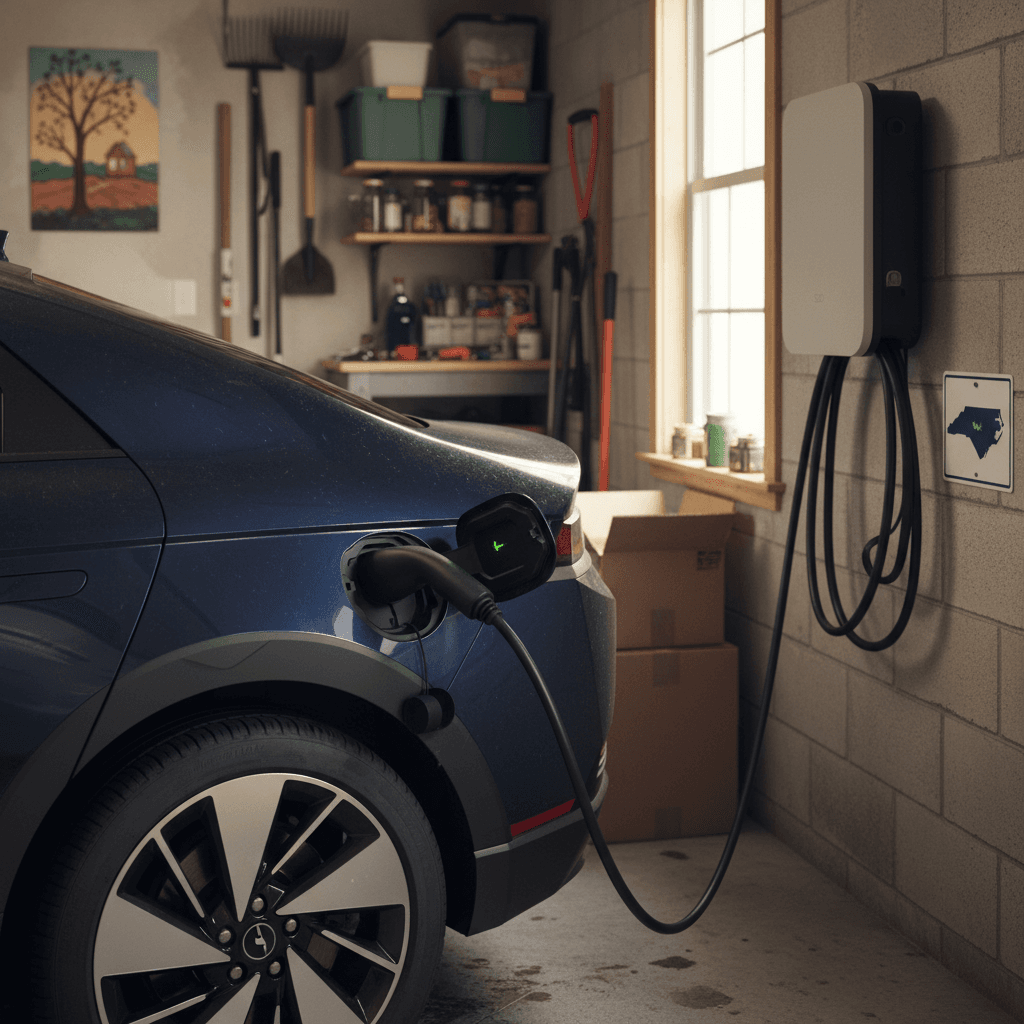
Illustrative stacking of a Level 2 charger project for a single‑family home in North Carolina.
Watch your calendar
Energy Saver NC and home upgrade rebates
North Carolina’s **Energy Saver NC** initiative is rolling out county by county through 2025 and 2026, using federal funds to help residents pay for home energy upgrades. It isn’t an EV program per se, but it can quietly make EV ownership easier by softening the cost of the same electrical and efficiency work you’d want if you’re running a car on electrons instead of gasoline.
How Energy Saver NC can indirectly help EV owners
These programs are primarily about home efficiency, but EV owners benefit too.
Panel and wiring upgrades
Many Energy Saver NC packages allow funding for electrical service upgrades, panel replacements, or new circuits when they’re part of a larger home‑energy project. That same work can make your home EV‑ready.
Ask your contractor: “Can this project be scoped so it supports a Level 2 EV charger as well?”
Whole‑home efficiency for cheaper charging
Better insulation, air sealing, and high‑efficiency heat pumps reduce your overall kilowatt‑hour use. That leaves more room in your monthly budget, and your service capacity, for plugging in an EV.
Think of it as freeing up “electric headroom” for car charging.
Coordinate contractors and incentives
Local and employer EV benefits to look for
Beyond utilities and state‑level programs, you’ll find a grab bag of **local and employer incentives** that don’t make headlines but absolutely affect what it costs to live with an EV in North Carolina. These change frequently and often aren’t branded as “EV programs,” so you have to ask.
- Free or discounted workplace charging. Many large employers in Charlotte, Raleigh–Durham, Greensboro, and the Triad offer Level 2 workplace charging, sometimes free for employees or heavily discounted during business hours.
- Parking and charging perks. A few municipalities and private garages reserve preferred parking for EVs near chargers or offer reduced parking rates when you’re actively charging.
- Local co‑op promotions. Rural electric co‑ops sometimes run limited‑time promotions, $250 here, $500 there, for members who buy an EV or install a smart charger and enroll in a load‑management program.
A quick question that can save you hundreds
Fees and costs that can offset incentives in NC
No honest guide to **EV incentives in North Carolina** would skip the part that feels like the opposite of an incentive: fees. Like many states, North Carolina charges EV owners an extra annual fee in lieu of paying gasoline tax at the pump. You’ll also see higher electricity prices at some DC fast‑charging sites than you might expect if you’re coming from a low‑cost residential rate.
EV‑related costs North Carolina drivers should budget for
These costs don’t erase the benefits of electrification, but they should be part of your 2026 budget math.
| Cost type | How it works | Why the state charges it | What to do about it |
|---|---|---|---|
| Annual EV registration fee | Battery‑electric vehicles pay an extra flat fee on top of standard registration, recently north of $200 per year and subject to change. | To replace the lost revenue from gasoline taxes when drivers switch to electricity. | Factor it into your cost‑per‑mile math and compare to your old fuel and oil‑change bills. |
| Public DC fast‑charging prices | Per‑kWh or per‑minute fast‑charging along highways can cost nearly as much per mile as gasoline, especially during peak hours. | Private networks recover infrastructure cost and demand charges through pricing. | Use fast charging mainly for road trips; rely on cheaper home Level 2 for daily driving. |
| Home electricity rates | Standard residential rates have been trending higher, and EV charging adds to your monthly kWh use. | Utilities face rising infrastructure and fuel costs; EV load also needs grid investment. | Ask about EV or off‑peak rates, and schedule charging for overnight off‑peak windows. |
Always check the latest DMV and utility schedules; these figures are directional, not official quotes.
Don’t judge EV economics by DC fast charging alone
How to stack incentives when you buy a used EV
With new‑car federal credits gone and no state EV rebate on the hood, **used EVs become the sweet spot** for many North Carolina shoppers in 2026. Instead of chasing a disappearing tax break, you’re shopping for a vehicle where the original buyer already absorbed the steepest depreciation, and you can still stack today’s charger and home‑energy incentives around it.
Playbook: Buying a used EV in North Carolina in 2026
1. Start with total cost, not just sale price
Combine the vehicle price, expected annual registration fee, insurance, home charging setup, and your driving pattern. A lower‑priced used EV can easily beat a subsidized new one on total cost over five years.
2. Prioritize verified battery health
Battery condition matters more than any incentive. When you shop with Recharged, every vehicle comes with a <strong>Recharged Score Report</strong> that includes a verified battery‑health assessment and fair‑market pricing, so you’re not guessing about the most expensive component.
3. Line up charger incentives before you close
Apply for your utility’s Charger Prep Credit or EV rate plan, and confirm your eligibility for the federal home charger credit and Energy Saver NC rebates. You want approvals in hand before the electrician shows up.
4. Choose a home charging strategy
Decide whether you’ll use a hard‑wired Level 2 station, a plug‑in unit on a NEMA 14‑50 outlet, or a utility‑provided rental charger. Your choice affects how much of your project qualifies for different rebates.
5. Time your install for the same tax year
Whenever possible, buy the used EV and complete your charging installation within the same calendar (and tax) year, ideally before June 30, 2026, to keep the federal charger credit in play.
6. Keep a clean paper trail
File away the bill of sale for the EV, your Recharged Score Report, every utility approval email, and detailed electrician invoices. A clean file makes life easier at tax time and if a utility ever audits a rebate.
How Recharged fits into the picture
Ready to find your next EV?
Browse VehiclesEV incentives North Carolina 2026: FAQ
Frequently asked questions about EV incentives in North Carolina (2026)
Bottom line: Is an EV still worth it in North Carolina in 2026?
In 2026, **EV incentives in North Carolina** don’t look like they did a few years ago. There’s no big, simple rebate check waiting at the DMV, and the headline federal purchase credits have sunset. But if you step back and look at the full picture, utility charger programs, Energy Saver NC home upgrades, a still‑active federal home charger credit through June 30, 2026, and the long‑term savings of fueling with electricity instead of gasoline, the case for the right EV is still strong.
The winning strategy in North Carolina now is to **buy smart and charge smart**. Focus on a used EV with verified battery health and honest pricing, line up your charger incentives before you sign the paperwork, and plan to do most of your charging at home or at discounted workplace stations. That’s exactly where a retailer like Recharged can help: pairing you with a thoroughly evaluated used EV and walking you through the incentive maze so there are fewer surprises after you drive home.