If you’re shopping for an electric vehicle in the Bay State in 2026, the incentive landscape looks very different than it did just a couple of years ago. Some federal credits have sunset, while Massachusetts has kept, and in some cases expanded, its own rebates. Understanding EV incentives in Massachusetts in 2026 is the difference between leaving thousands of dollars on the table and driving away with a seriously discounted EV.
Dates matter in 2026
Overview: EV incentives in Massachusetts for 2026
Massachusetts EV incentives snapshot for 2026
At a high level, here’s what you can tap into in 2026: - **State EV rebates (MOR‑EV family of programs)** for new and used passenger EVs, income‑qualified buyers, trade‑ins, and trucks. - **Federal clean‑vehicle tax rules**, the big 30D and 25E tax credits for buying EVs ended for purchases after September 30, 2025, but they still apply to earlier transactions and affect how some leases are structured. - **Federal EV charger credit** for residential installations through June 30, 2026. - **Massachusetts charging grants and utility “make‑ready” programs** that help pay for Level 2 and DC fast charging at workplaces, apartments, fleets, and public sites. The catch: these programs have different eligibility rules, caps, and deadlines. Let’s break them down one by one, then pull it all together with stacking strategies.
Key programs that matter in 2026
Core EV incentive programs touching Massachusetts drivers in 2026
Most households encounter at least two of these when they buy a new or used EV.
MOR‑EV rebates (state)
Massachusetts Offers Rebates for Electric Vehicles (MOR‑EV) is the state’s flagship cash‑back program. It pays post‑purchase or point‑of‑sale rebates on eligible new and used EVs, with extra help for income‑qualified buyers and for trading in a gasoline car.
Federal clean‑vehicle rules
The signature federal EV tax credits for new (Section 30D) and used (Section 25E) EVs expired for purchases after September 30, 2025. But they still matter if you bought earlier, or if your 2026 lease embeds that tax value into your payment.
Charger credits & grants
Homeowners can still use a federal tax credit on EV charging hardware installed by June 30, 2026. At the same time, Massachusetts’ MassEVIP grants and utility programs help workplaces, apartments and public sites offset installation costs.
Fleet & truck incentives
MOR‑EV doesn’t stop at commuter cars. There are special tracks for pickups and medium/heavy‑duty trucks and for public fleets, plus utility and federal commercial credits that can radically change the payback math for businesses.
Think in layers, not just one rebate
MOR‑EV rebates in 2026: how they work
MOR‑EV, Massachusetts Offers Rebates for Electric Vehicles, is a state program funded by the Department of Energy Resources (DOER) to accelerate EV adoption. In 2026, it continues to be the backbone of EV incentives Massachusetts offers to everyday drivers.
Common MOR‑EV rebate paths for 2026 purchases
Exact amounts and eligibility can change as DOER updates program rules and funding. Always confirm on the official MOR‑EV site before you buy.
| Rebate type | Who it’s for | Typical amount | Key conditions |
|---|---|---|---|
| MOR‑EV Standard | Most new battery‑electric (BEV) or fuel‑cell EV buyers/lessees | Around $3,500 | Vehicle must meet price cap; primarily for new personal‑use EVs registered in MA. |
| MOR‑EV+ income adder | Income‑qualified buyers of new or used EVs | Around $1,500 (added) | Household income under program thresholds; can stack on top of Standard or Used rebates. |
| MOR‑EV Trade‑In | Drivers retiring a gasoline vehicle when buying an EV | About $1,000 | You must trade in an internal‑combustion vehicle that you’ve owned for a minimum period before purchase. |
| MOR‑EV Used | Buyers of pre‑owned EVs from a dealer | Program‑dependent (often lower than new‑EV rebates) | Used EV must meet age and price caps and be purchased from a licensed dealer. |
| MOR‑EV Trucks | Pickups, vans, and heavier ZEVs | Scales from several thousand dollars up to $7,500+ | Based on weight class (Class 2b–8), vehicle type, and whether buyer is an individual or fleet. |
Illustrative structure of Massachusetts MOR‑EV passenger‑vehicle rebates for 2026.
Rules change, don’t assume 2024 numbers still apply
A few practical details about MOR‑EV in 2026: - **Application window**: You generally must apply within a set number of days after purchase or lease. Missing the window is one of the most common reasons people lose out. - **Ownership requirement**: Expect to keep the vehicle registered in Massachusetts and in your control for about **36 months** to avoid claw‑backs. - **Price caps**: There are maximum MSRP limits; luxury EVs often don’t qualify for the standard MOR‑EV rebate even if they’re zero‑emission. - **Income rules**: Base MOR‑EV rebates typically don’t have income caps, but **MOR‑EV+ adders are income‑tested**. This is where working with a seller who actually understands MOR‑EV, and is willing to help you through the paperwork, really matters.
Used EV incentives in Massachusetts for 2026
Used EVs are where Massachusetts incentives really support budget‑conscious buyers, especially now that the federal used EV tax credit ended for purchases after September 30, 2025. In 2026, your used‑EV help comes mostly from the **MOR‑EV Used** track and, if you qualify, **MOR‑EV+ income adders**.
1. MOR‑EV Used rebate
If you buy a qualifying used BEV or fuel‑cell EV from a licensed dealer and register it in Massachusetts, you can receive a state rebate check after the sale. The exact amount and eligibility criteria depend on the current MOR‑EV Used guidelines, but they’re designed to help close the price gap with comparable gasoline cars.
Because used EV pricing can move quickly, look for models that are already well under the MOR‑EV price cap so you aren’t bumping up against eligibility limits.
2. Income‑qualified bonus: MOR‑EV+
If your household income is under the program threshold, you may stack an **additional income‑based rebate** on top of your used‑EV rebate. For many buyers, this is the difference between “barely works” and a comfortable monthly payment.
Because MOR‑EV+ requires income documentation, plan ahead: have your most recent tax return and proof of residency ready when you apply.
Used EVs + Recharged can reveal surprisingly low total cost
Federal clean‑vehicle tax rules in 2026
By April 2026, the federal EV incentive story has shifted. The big headlines: - **New Clean Vehicle Credit (Section 30D)**, worth up to $7,500 for qualifying new EVs, **is no longer available for purchases after September 30, 2025**, due to federal legislation sunsetting the program early. - **Previously Owned Clean Vehicle Credit (Section 25E)**, worth up to $4,000 on certain used EVs, also ended for vehicles purchased after September 30, 2025. - Some 2026 **leases** may still effectively pass through federal clean‑vehicle value because the credit could be claimed by the lessor and reflected in your payment, but this is a contractual, not guaranteed, benefit.
Don’t plan on a federal EV tax credit for a 2026 purchase
That said, if you bought or leased in **early or mid‑2025** and are only now filing 2025 taxes, it’s worth double‑checking whether: - Your vehicle was on the IRS eligibility list when you bought it. - Your income and MSRP met the old 30D or 25E limits. - You received a **seller’s report** documenting eligibility. A qualified tax professional or the IRS FAQs can help you make sure you’re not leaving 2025 money unclaimed.
EV charger tax credit and Massachusetts charging programs
Just as important as your vehicle choice is how you’ll charge it. Here the picture in 2026 is more favorable: the federal **Alternative Fuel Refueling Property Credit** and Massachusetts charging programs are still very much in play, though on a tighter federal timeline than originally planned.
Key EV charging incentives touching Massachusetts in 2026
Programs for home, workplace, and public charging that Massachusetts residents and businesses can use in 2026.
| Program | Who it’s for | What it covers | Important 2026 details |
|---|---|---|---|
| Federal home charger tax credit | Homeowners installing Level 2 or qualifying bidirectional chargers | 30% of hardware and installation costs, up to $1,000 | Available for installations placed in service through June 30, 2026; claimed on your federal tax return. |
| Federal commercial charger credit | Businesses installing charging equipment | Up to 30% of costs, subject to project caps and labor rules | More complex eligibility; often paired with local grants for larger projects. |
| MassEVIP Workplace & Fleet Charging | Employers, fleet operators | Rebates for Level 1/2 charging hardware and make‑ready costs | Rolling application windows; used widely by MA employers and municipal fleets. |
| MassEVIP Public Access & MUD | Public sites, multi‑unit dwellings, campuses | Support for public and semi‑public charging stations | Attractive for landlords who want to add charging without eating the full capex. |
| Utility make‑ready programs | Businesses, multifamily properties | Utility covers a portion of infrastructure upgrades (trenching, panels, etc.) | Programs differ by utility (Eversource, National Grid, etc.). Check your provider’s commercial EV pages. |
Federal and state‑level support for EV charging in Massachusetts in 2026.
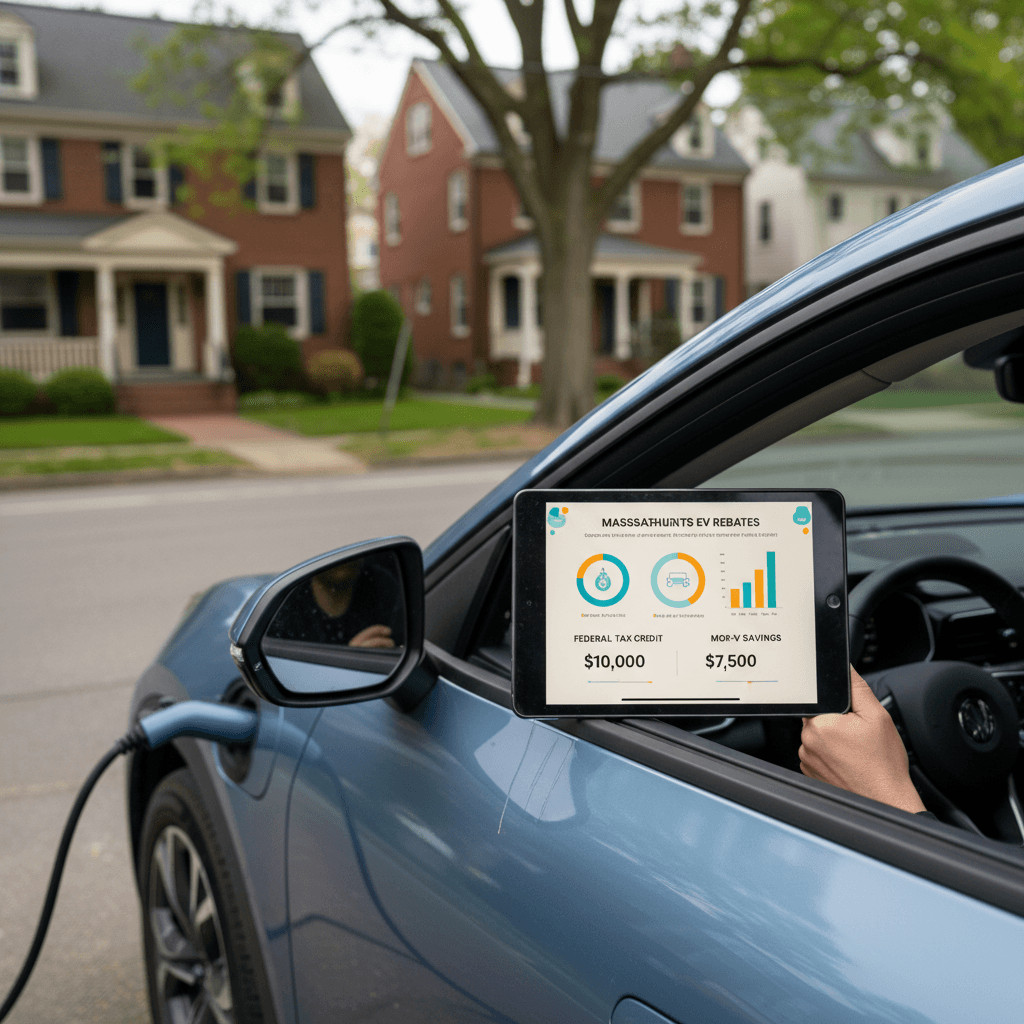
Coordinate charger incentives with your electrician
How to stack Massachusetts and federal EV incentives
In 2026, your stacking opportunities are simpler than the 2024–2025 era because the main federal purchase credits have sunset. Think of it in three layers: **vehicle rebates, financing structure, and charging support.**
Typical 2026 incentive stacks for Massachusetts buyers
1. New mass‑market EV in 2026
You buy or lease a mainstream BEV that fits under the MOR‑EV price cap from a Massachusetts‑friendly seller. You stack a **MOR‑EV Standard rebate**, possibly **MOR‑EV+** and **Trade‑In**, and structure your financing to keep payments comfortable, without counting on federal credits. Then you install a Level 2 home charger and claim the **30% federal charger tax credit** before June 30, 2026.
2. Used EV with income‑qualified support
You pick a 3–6‑year‑old EV listed on Recharged, verify it meets **MOR‑EV Used** rules, and, if you qualify, apply for **MOR‑EV+** on top. Because used purchase prices are lower, the state checks cover a larger share of your cash outlay, and Recharged’s battery‑health diagnostics reduce your risk on an older pack.
3. High‑mileage driver or rideshare
If you’re a rideshare or delivery driver, you may combine the **core MOR‑EV rebate** with specialized programs like MassCEC’s ride‑hail incentives (when available). Your total effective support can rival or even exceed what federal credits used to provide, especially when you factor in fuel savings from high annual mileage.
4. Homeowner planning a 2026 charger
You schedule a panel upgrade and Level 2 charger installation in spring 2026, making sure the project is completed and placed in service before June 30 so you can claim the **federal 30% charger credit**. If you live in a condo or rental, you push your HOA or landlord to leverage **MassEVIP** and utility make‑ready programs instead.
Recharged can help you stack the right incentives
Ready to find your next EV?
Browse VehiclesWho qualifies for which incentives?
Household factors
- Income: Matters mainly for MOR‑EV+ and, historically, for federal credits. Lower‑income households often get the steepest percentage discounts.
- Home vs. renter: Homeowners have a clearer path to the federal charger credit; renters benefit when landlords use MassEVIP and utility programs.
- Driving pattern: High‑mileage drivers (commuters, rideshare, delivery) see faster payback from fuel savings, making smaller rebates go further.
Vehicle factors
- Fuel type: Full battery‑electric and some fuel‑cell EVs are generally favored; plug‑in hybrids may qualify in some tracks but often at lower amounts.
- Price and weight: MOR‑EV has both MSRP caps and weight‑class rules. Ultra‑luxury EVs and certain heavy trucks may only fit in specialized programs.
- Use case: Personal vs. fleet, taxi vs. rideshare vs. corporate fleet each route through different sub‑programs.
Documentation is your lifeline
Incentives for fleets, trucks, and work vehicles
If you run a small business, manage municipal vehicles, or drive a pickup for work, the EV incentives Massachusetts offers in 2026 look different but can be even more generous on a per‑vehicle basis.
Key Massachusetts programs for work and fleet vehicles
Larger, heavier vehicles can tap into specialized state and federal help.
MOR‑EV Trucks
Targets Class 2b–8 zero‑emission vehicles ranging from pickups and step vans to box trucks and buses. Rebate amounts scale with vehicle weight, and some models, such as certain electric pickups and SUVs, have received rebates of several thousand dollars per unit.
MassEVIP Fleets
MassDEP’s MassEVIP Fleets program helps public entities like cities, towns, state agencies, and public colleges add BEVs and PHEVs to their fleets. It can fund both vehicles and charging infrastructure.
Federal commercial credit
The federal Commercial Clean Vehicle Credit (45W) survived the 2025 changes and can still offset a chunk of the cost of qualifying work EVs. It’s especially powerful when combined with MOR‑EV Trucks or MassEVIP fleet funding.
Think TCO, not just the sticker price
Step‑by‑step plan to capture your EV savings
Practical paths for Massachusetts EV shoppers in 2026
First‑time EV buyer
Nail down your budget and whether a **new or used** EV makes more sense for your commute and parking situation.
Search inventory on Recharged and other platforms, filtering for vehicles that appear on the current **MOR‑EV eligibility lists**.
Get pre‑qualified for financing (Recharged can help) so you know exactly how a MOR‑EV rebate will affect your payment.
Confirm incentive eligibility with the dealer or seller before signing, price caps, residency, and timelines all matter.
After purchase, apply for MOR‑EV and any income‑qualified adders **immediately**, well within the program’s application window.
Schedule a home‑charging consult so you can decide whether to install a Level 2 charger before the federal credit window closes on June 30, 2026.
Seasoned EV driver upgrading
Decide whether to **trade in** your existing gasoline or hybrid vehicle to pursue a MOR‑EV Trade‑In bonus.
If you’re coming out of an older EV, compare the total incentive stack on a new model versus a late‑model used one with a stronger Recharged Score.
Time your purchase so you can coordinate MOR‑EV paperwork with your registration renewal cycle, this keeps your admin burden lower.
If your 2025 EV purchase qualified for a federal tax credit, make sure you properly claim it on your 2025 return before focusing on 2026 decisions.
Look at your historical charging pattern (home vs. public) and decide whether a **home charger upgrade** backed by the 2026 tax credit is worth it.
For high‑mileage drivers, run a fresh total‑cost‑of‑ownership comparison using your new vehicle’s efficiency and updated electricity rates.
Massachusetts EV incentives 2026: FAQ
Frequently asked questions about EV incentives in Massachusetts (2026)
Bottom line: Making Massachusetts EV incentives work for you
By 2026, the EV incentive map has shifted: the federal purchase credits that dominated headlines in the early Inflation Reduction Act years have largely faded, while **Massachusetts’ own MOR‑EV program and charging support remain central**. For most households, the winning play is to pick an EV that fits comfortably under the MOR‑EV price caps, layer on income‑qualified or trade‑in adders if you can, and claim the federal **home charger tax credit** before its June 30, 2026 deadline.
If you’re leaning toward a used EV, platforms like Recharged give you tools the original buyer never had: transparent **battery‑health data, fair‑market value benchmarks, and EV‑savvy advisors** who can help you line up financing and incentives in the right order. Combine that with Massachusetts’ evolving incentive stack and the day‑to‑day savings on fuel and maintenance, and it’s clear that 2026 is still a strong year to electrify your driveway, even without a federal purchase credit on the hood.