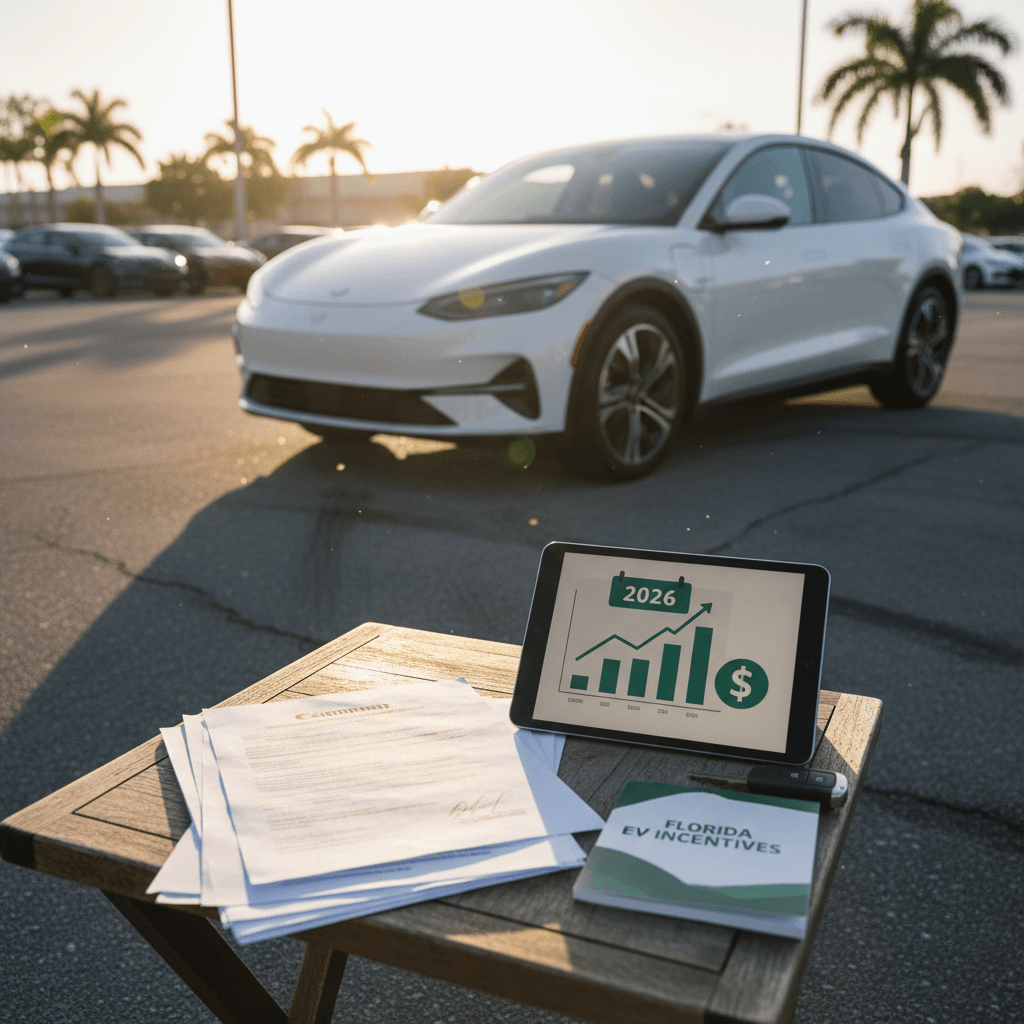
If you’re shopping for an electric car in the Sunshine State, you’ve probably discovered a harsh truth: Florida EV incentives in 2026 are more of a patchwork than a party. The big federal purchase credits that dominated headlines in 2023–2024 have changed or vanished, and Florida doesn’t offer a generous statewide rebate like Colorado or New Jersey. But that doesn’t mean you’re out of luck. With the right mix of federal tax breaks, utility programs, and smart car shopping, you can still cut thousands off the real cost of going electric in Florida.
2026 snapshot
Florida EV incentives in 2026: the big picture
Florida’s EV landscape in 2026
Florida is a paradox: it’s near the top of the charts for EV adoption and highway charging, but near the bottom for state-funded EV incentives. Instead of big checks from Tallahassee, most of your 2026 savings will come from **federal policy** and **local utility programs**. That’s why any serious look at EV incentives in Florida has to zoom out beyond just “Is there a Florida rebate?” and focus on how all the moving parts, tax credits, utility plans, and dealer discounts, stack together on a real-world deal.
Dates matter
Does Florida have its own EV tax credit or rebate?
Let’s rip off the Band‑Aid: Florida does not offer a statewide EV purchase rebate or state EV income‑tax credit in 2026. Florida has no state income tax, and lawmakers haven’t created a Colorado‑style cash rebate at the point of sale. There are also **no active statewide rebates for Level 2 home chargers**, those come from the federal government and, in some areas, your utility.
- No statewide tax credit for buying a new EV in 2026
- No statewide rebate for buying a used EV
- No statewide rebate for installing a Level 2 home charger
- Some property‑tax and sales‑tax rules apply to large commercial charging projects, but they don’t help a typical individual driver buying a car
Where Florida quietly helps EVs
Federal EV incentives that still matter in 2026
The rules that dominated the 2023–2024 EV market were built around the Inflation Reduction Act’s Clean Vehicle Credit. Since then, Congress has reshuffled the deck. By 2026, the classic **up‑to‑$7,500 federal EV purchase credit** and **$4,000 used EV credit** have been curtailed or replaced, but federal policy still plays a big role in what a Florida EV actually costs you.
Key federal EV changes Florida buyers face in 2026
What replaced the old one‑time tax credits
1. Clean Vehicle Credit phased down
By late 2025, the big, simple $7,500 one‑time tax credit for many new EVs was effectively sunset for most mainstream buyers. If you purchased and claimed it before the cutoff dates, you’ll handle it on your 2025 return, not for 2026 purchases.
2. New EV loan interest deduction
Starting with 2025 loans and running through 2028, federal law created an above‑the‑line deduction for **interest paid on qualifying car loans**, including many EVs, capped at $10,000 per year. Unlike the old credit, this is a recurring benefit, not a one‑time rebate.
3. Charger credit still alive (for now)
The IRA’s home charging credit survived longer than the vehicle credits. You can still claim **30% of qualifying charger and installation costs (up to $1,000)** for home EVSE installed **through June 30, 2026**.
For a Florida driver, the practical takeaway is this: **your biggest federal savings in 2026 are likely tied to how you finance the car and how you install your home charging**, not to a simple $7,500 sticker price haircut. That’s a mindset shift, but if you run the numbers on a typical 5‑ to 7‑year auto loan, the interest deduction plus a charger credit can still add up to serious money.
Leases vs. purchases in 2026
Home EV charger tax credit through June 30, 2026
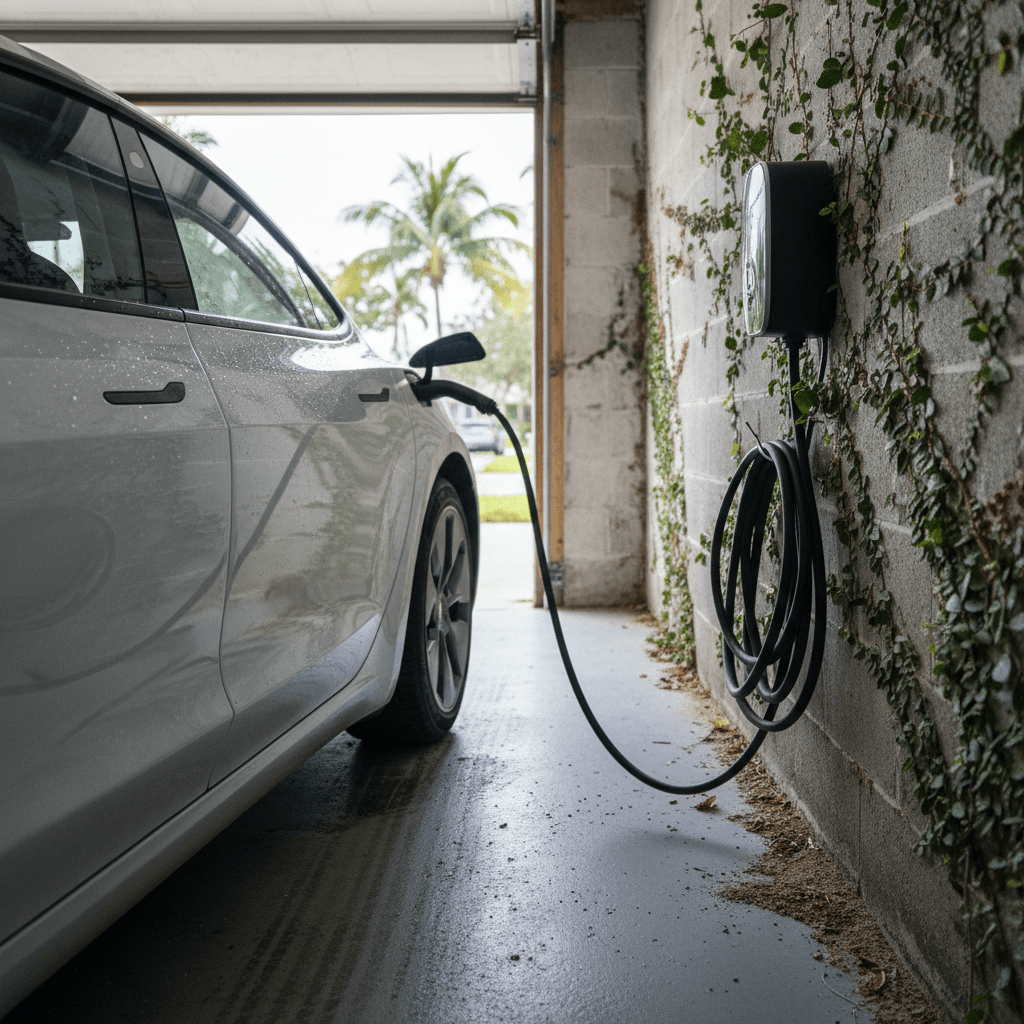
If you plan to keep an EV in Florida for more than a couple of years, home charging is where the ownership experience goes from “tolerable” to “effortless.” The good news is that the **federal Alternative Fuel Refueling Property tax credit** still helps you pay for that upgrade, up to a hard deadline in mid‑2026.
Federal home EV charger credit for 2026
How the federal EVSE tax credit works for Florida homeowners in 2026
| Question | Answer |
|---|---|
| Who qualifies? | Homeowners (and some renters) who install a Level 2 EV charger at their primary residence in the U.S. |
| What’s the benefit? | 30% of eligible hardware + professional installation costs, up to $1,000. |
| What equipment counts? | Level 2 chargers and related electrical upgrades directly tied to the EVSE (wiring, breaker, conduit, permitting). |
| What’s the timing? | Equipment must be placed in service by June 30, 2026 to claim the credit on your federal return. |
| How do you claim it? | Use the IRS form for alternative fuel refueling property (check current year instructions) with receipts and proof of in‑service date. |
This credit is available nationwide, including Florida, but installations must be completed by June 30, 2026.
Stack the credit with smart installation
Florida utility EV programs and rebates in 2026
With no state‑level rebate, **Florida’s utilities** are the real supporting cast for EV incentives. The exact benefits depend on where you live and who sends your power bill, but three patterns show up repeatedly: subscription charging plans, time‑of‑use rates, and small purchase rebates.
Common utility EV incentives in Florida
Check your own utility’s site, programs change quickly
Florida Power & Light (FPL)
FPL’s EVolution Home programs have offered to install and maintain a Level 2 charger at your home in exchange for a flat monthly fee and/or special off‑peak rates. Exact terms and prices have changed over time, recent rate cases have raised costs, but the basic idea remains: low or unlimited overnight charging for a predictable monthly cost.
Municipal & co‑op utilities
Smaller utilities like Orlando Utilities Commission (OUC) have historically offered modest rebates, think a couple hundred dollars, for buying or leasing an EV or upgrading home wiring for a charger. Availability and amounts can change year to year, so always confirm current 2026 offers directly.
Time‑of‑use (TOU) rates
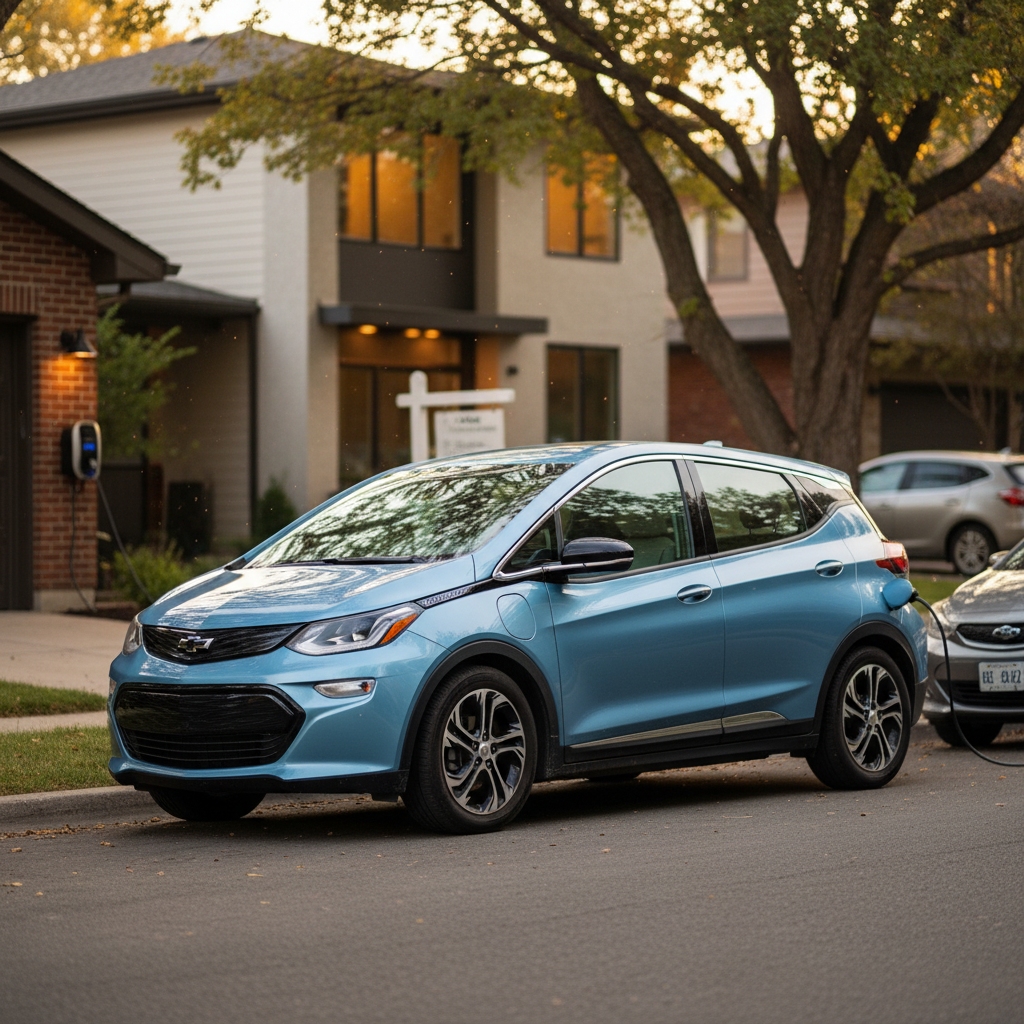
Even without a dedicated EV plan, some Florida utilities offer cheaper per‑kWh pricing during overnight hours. If you schedule your EV to charge after 9 or 10 p.m., those savings stack on top of any tax credits or rebates.
Fine print alert
How to check your EV benefits with a Florida utility
1. Identify your utility
Confirm whether you’re served by **FPL, Duke Energy Florida, Tampa Electric, OUC**, or a local municipal/co‑op. Incentives are entirely utility‑specific.
2. Find the EV or "Drive Electric" page
Search your utility’s website for terms like “EV,” “Drive Electric,” or “EVolution.” That’s usually where rebates, subscription plans, and TOU rate details live.
3. Look for both EV and charger offers
Separate pages often cover **vehicle rebates** (small cash incentives for buying/leasing an EV) and **charger programs** (installation services, monthly plans, or TOU rates).
4. Call before you commit
Before you buy a third‑party charger or sign up for a utility program, call and confirm eligibility, enrollment windows, and whether their program plays nicely with the federal charger tax credit.
Leasing, financing and the new EV loan interest deduction
Starting with loans taken out in 2025, federal law introduced a new incentive that matters a lot in 2026: an **above‑the‑line deduction for interest paid on qualifying vehicle loans**, including many EVs assembled in North America. Instead of a one‑time tax credit at purchase, you can deduct up to $10,000 of interest per year through 2028, reducing your taxable income for as long as you carry the loan.
How the new deduction works
- Applies to qualifying vehicles and loans started in the eligible years (check that your car and lender qualify).
- You deduct the **interest portion** of your monthly payment, not the full payment.
- Cap of $10,000 of interest per year, through the 2028 tax year.
- An above‑the‑line deduction means it lowers your taxable income even if you don’t itemize.
How it compares to the old $7,500 credit
- No instant “rebate” feeling at the dealership, savings arrive at tax time, year after year.
- Benefit size depends on your loan amount, term, and interest rate: long loans at higher APRs generate more deductible interest.
- Because it’s recurring, a typical Florida buyer could see **total tax savings similar to or higher than the old one‑time credit** over a 5‑ to 7‑year loan.
Run the math before you sign
How to stack EV incentives in Florida for maximum savings
In a high‑incentive state, you can practically trip over rebates. In Florida, you have to be deliberate. But if you treat your purchase like a puzzle, you can still assemble a surprisingly attractive picture.
Three example savings stacks for a Florida EV in 2026
Exact numbers depend on your income, utility, and vehicle choice
Homeowner with driveway
- Buy a mainstream EV with good dealer discounts.
- Finance with a 5‑ to 7‑year loan that qualifies for the **interest deduction**.
- Install a 40–48A Level 2 charger in your garage by **June 30, 2026** and claim the **30% federal EVSE credit (up to $1,000)**.
- Enroll in your utility’s TOU or EV plan if available.
Apartment dweller
- Prioritize models with strong **lease or dealer discounts** since you can’t claim the home charger credit easily.
- If your complex is adding chargers, encourage them to tap commercial EVSE incentives while they still exist.
- Lean on workplace or public fast‑charging networks; check if your employer offers charging perks.
High‑mileage commuter
- Choose an efficient EV with strong highway range to minimize your kWh per mile.
- Make sure your **home charger + TOU rate** combination gives you rock‑bottom off‑peak pricing.
- Use the loan interest deduction to offset the cost of a slightly higher‑trim model that makes your 70‑mile daily commute comfortable.
Where Recharged fits in
Ready to find your next EV?
Browse VehiclesWhat about incentives for used EVs in Florida?
The dedicated federal **used EV tax credit** that launched in 2023 has been dialed back along with the new‑car credit. By 2026, there’s no simple, widely available **$4,000 used EV credit** you can count on the way early‑adopter buyers did.
- There is **no statewide Florida rebate specifically for used EVs**.
- Local utilities generally don’t care if your EV is new or used, if you plug in, you can usually join their EV rate or subscription programs.
- Some credit unions and green‑focused lenders offer **preferential financing** for used EVs, which can pair nicely with the federal loan interest deduction.
- Dealers and marketplaces (including Recharged) often price used EVs with past incentives already “baked in,” which means a 2‑ to 4‑year‑old EV can undercut a new model by tens of thousands of dollars even without fresh tax credits.
Don’t chase expired incentives
What happens after 2026? The outlook for Florida EV incentives
2026 is a transition year. The U.S. has shifted from big, visible EV purchase checks to more subtle, long‑tail incentives like loan‑interest deductions and targeted infrastructure support. For Florida drivers, that means the focus is likely to stay on **lower fueling costs and infrastructure reliability** rather than handouts at the point of sale.
Two likely paths for Florida EV incentives beyond 2026
1. Infrastructure‑first strategy (most likely)
State continues to prioritize DC fast‑charging corridors, ports, and fleets over consumer rebates.
Utilities refine EV‑specific rates and subscription plans as adoption scales.
Federal support shifts into broader clean‑energy packages rather than headline‑grabbing EV coupons.
2. Targeted consumer incentives
If EV adoption slows, Florida could eventually introduce **narrow, income‑capped incentives** for low‑ and moderate‑income buyers or for rural charging.
Local governments (counties and big metros) may roll out **limited‑time rebates** to hit air‑quality and congestion targets.
Used EVs and home charging could become the focus of any new incentives, since that’s where affordability and equity intersect.
Florida’s approach isn’t about writing big checks to early adopters. It’s about quietly making sure that when a driver is finally ready to go electric, the infrastructure and financing tools are there so it just makes sense.
FAQ: EV incentives in Florida in 2026
Frequently asked questions about EV incentives in Florida (2026)
Florida may never be the land of giant EV rebates, but that doesn’t mean you have to pay full freight. In 2026, the smartest Florida EV buyers treat incentives as a **system** rather than a single coupon: a federal charger credit that expires mid‑year, a multi‑year loan interest deduction, a utility plan that slashes home charging costs, and a carefully chosen new or used EV whose price already reflects yesterday’s incentives. Put those together, and the Sunshine State can still be a very good place to plug in, especially if you let a specialist like Recharged help you decode the numbers before you sign anything.