If you live in a hurricane‑prone region and drive an electric vehicle, hurricane preparedness is no longer just about plywood and bottled water. Your EV is now one of your most important resilience tools during a power outage, but only if you understand its limits and plan ahead. This guide walks you through practical EV hurricane preparedness so you can protect your car, your range, and in some cases even power critical loads at home.
Hurricanes, outages, and EVs: the new normal
Why EV hurricane preparedness matters
Storms, outages, and home energy resilience
Climate‑driven extreme weather is colliding with an aging grid. Utilities in Florida, Texas, the Gulf Coast, and the Mid‑Atlantic openly say that no system can be 100% storm‑proof, even after billions in hardening investments. Multi‑day outages after major storms are simply part of the risk landscape now. For EV owners, that raises a specific concern: how do you keep mobility and, where possible, home power when the grid goes dark?
The good news is that EVs are inherently resilient tools. They don’t depend on fragile fuel delivery systems, they can charge opportunistically from any working source, and some models can now safely power homes or appliances. The flip side is that they’re also computers on wheels with high‑voltage batteries, so poor decisions with flooding, improvised wiring, or generators can turn an asset into a serious safety hazard.
Understanding what your EV can and can’t do in a power outage
Three roles your EV can play in a hurricane
Know which bucket your vehicle actually falls into before you plan around it.
1. Transportation only
Most EVs today are designed primarily as transportation. In an outage they:
- Get you to safety or supplies
- Serve as an air‑conditioned or heated refuge when it’s safe to idle
- Charge phones and small devices via 12V or USB
2. Vehicle‑to‑Load (V2L)
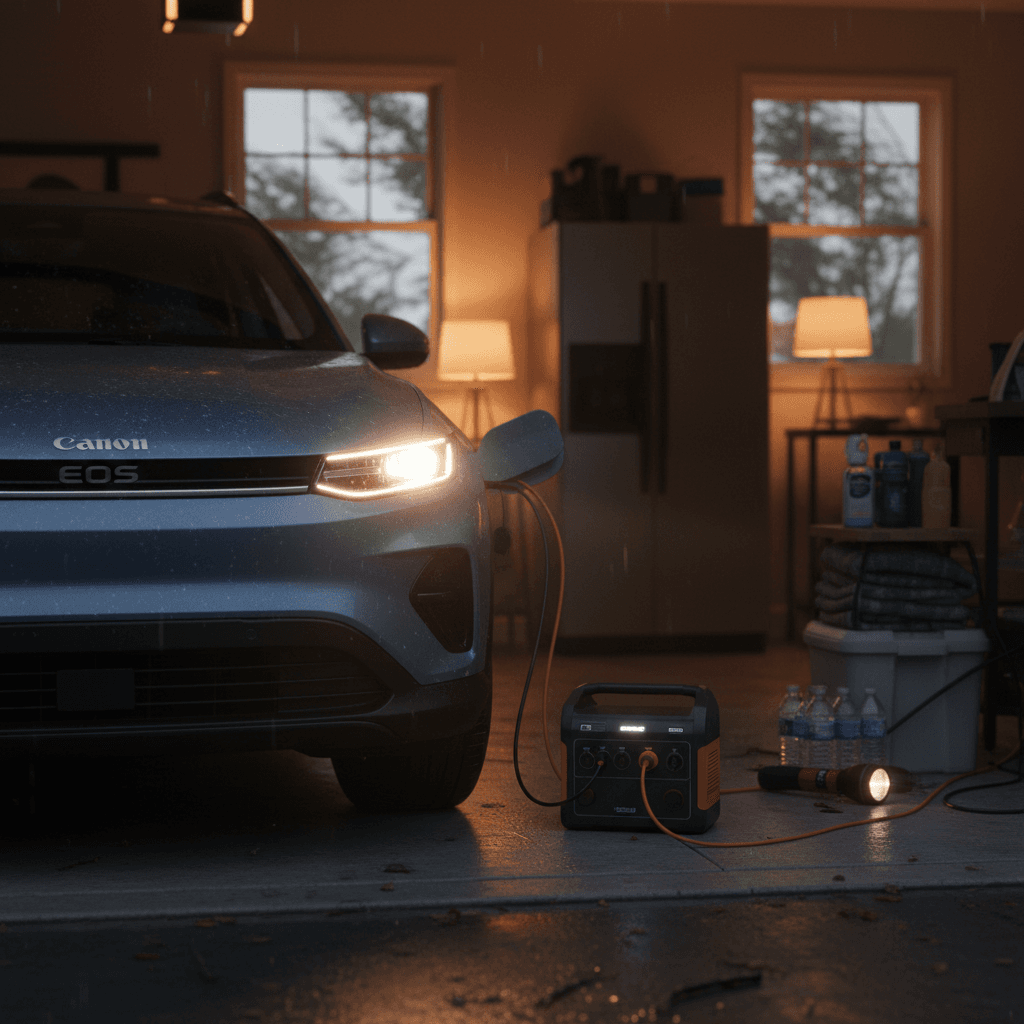
Some EVs (e.g., many Hyundai/Kia, some Ford and GM models) offer built‑in outlets or adapters that:
- Power tools and small appliances directly from the car
- Usually deliver up to ~1.9–3.6 kW from onboard inverters
- Are ideal for fridges, fans, lights, and medical devices
3. Vehicle‑to‑Home (V2H)
A smaller but fast‑growing group of EVs supports true home backup when paired with a bidirectional charger:
- Whole‑home or critical‑load backup during outages
- Typical output around 9.6–12 kW, similar to a home battery system
- Requires pro installation and utility‑compliant hardware
Don’t assume your EV can back up your house
Before hurricane season, take five minutes to review your owner’s manual or manufacturer website. Search for terms like “vehicle‑to‑load (V2L), vehicle‑to‑home (V2H),” “backup power,” or your automaker’s branded feature (for example, intelligent backup power or Powershare). If you don’t see clear language, your car almost certainly doesn’t support home backup today, and that’s okay. You’ll still follow 80% of this guide; you’ll just skip the home‑power sections.
Pre-storm checklist: EV hurricane preparedness
EV hurricane preparedness checklist (3–5 days before landfall)
1. Top off your state of charge strategically
Aim to bring your EV to 80–100% charge in the 24–48 hours before landfall, depending on battery‑health guidance for your model. If you expect to evacuate, prioritize range; if you’re sheltering in place with V2H or V2L, balance a full charge with manufacturer recommendations for short‑term storage at high state of charge.
2. Update apps, maps, and telematics
Make sure your EV and charging apps are updated while you still have reliable data service. Download offline maps for your region, including inland evacuation routes, and save key locations like DC fast chargers, shelters, and hospitals.
3. Document vehicle condition
Quickly photograph your EV’s exterior, interior, and odometer. If there’s storm‑related damage later, especially from flooding, those pictures will simplify insurance claims and, in some cases, disaster‑aid applications.
4. Protect your charging setup
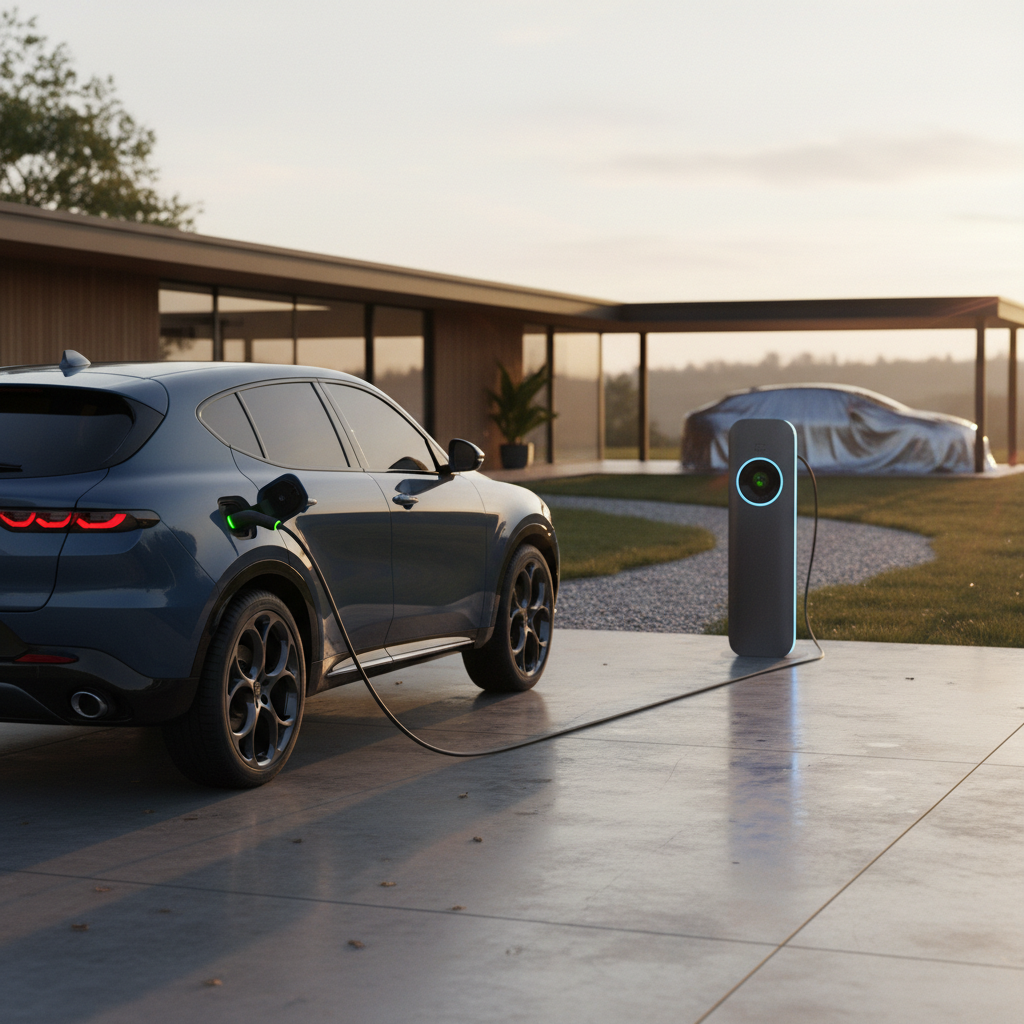
Inspect your home charger or portable EVSE. Secure cables off the ground where possible, check for frayed cords, and ensure the charger is mounted firmly. If storm surge or flash flooding is plausible at your location, know how to safely shut off power to that circuit before water arrives.
5. Plan where the car will ride out the storm
If you’re not evacuating, park on the highest, driest ground you can access, ideally in a garage away from trees, loose debris, or potential projectiles. Avoid underground garages in flood‑prone areas.
6. Build an in‑car emergency kit
Include charging cords, a 12V inverter (if recommended for your vehicle), first‑aid kit, water, non‑perishable snacks, blankets, flashlights, USB battery packs, and printed copies of insurance and registration. In a pinch, your EV becomes your rolling shelter and office.
Think about “vehicle readiness,” not just “home readiness”
Charging strategy before, during, and after the storm
Before landfall: build a cushion
Once a storm watch is issued, public fast‑charging lines can get long and gas stations may run dry. Your goal is to quietly get ahead of that rush.
- Use off‑peak hours overnight or early morning to top up at home so you’re not competing for power with neighbors.
- If you rely on public charging, charge earlier than you think you need to; plan for the possibility that your usual station loses power first.
- For multi‑EV households, decide which car is the designated evacuation vehicle and prioritize its charge.
During and after the storm: conserve and adapt
Once the grid begins to fail, you’re playing defense:
- Avoid unnecessary trips that burn range you may need later, especially if evacuation orders shift.
- Use your EV’s eco driving modes, reduce speed, and manage climate settings to stretch remaining miles.
- After landfall, expect patchy charging availability. Some DC fast chargers come back before neighborhoods do, especially along major corridors, monitor your network apps when cell service returns.
Know your inland charging corridors
Using your EV as backup power: V2L & V2H basics
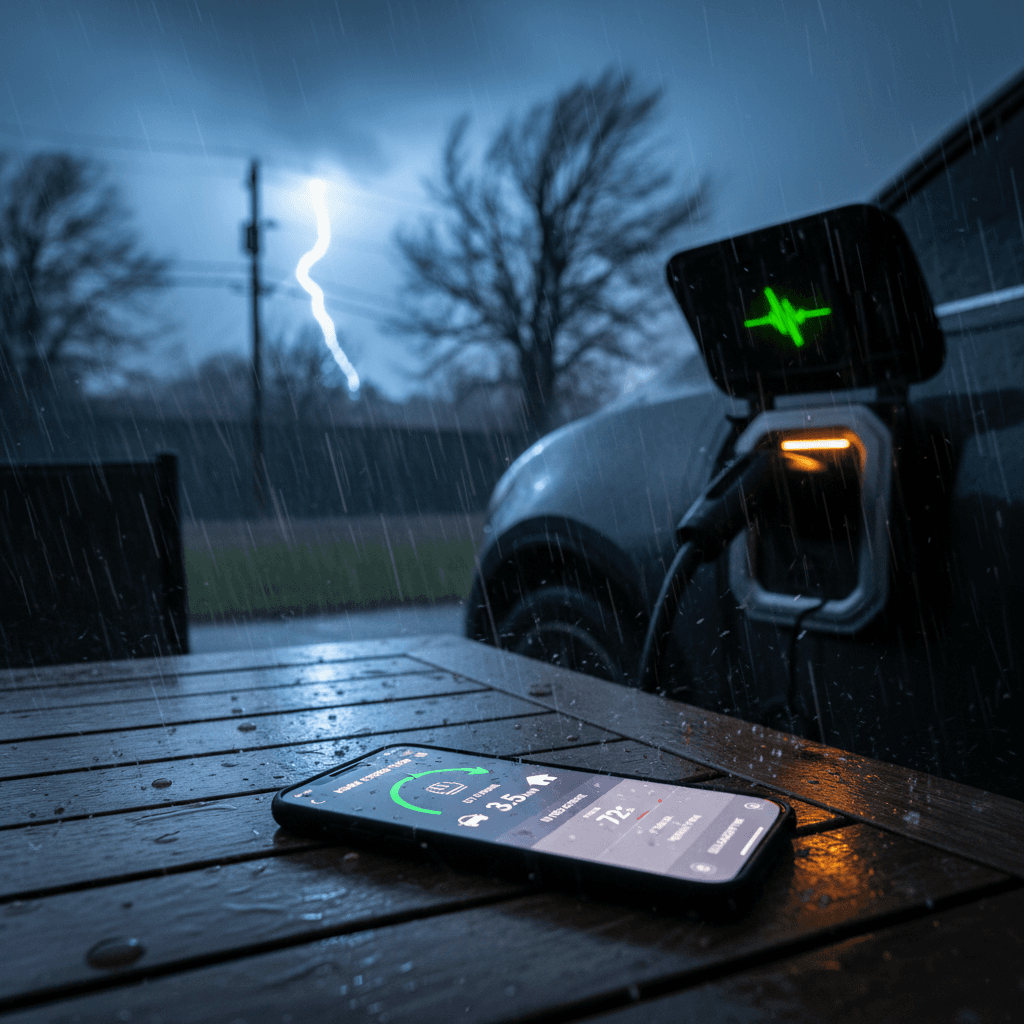
The idea of “my car powering my house” has gone from sci‑fi to mainstream faster than many expected. Modern EVs with vehicle‑to‑load (V2L) and vehicle‑to‑home (V2H) capabilities can comfortably bridge multi‑day outages, if they’re set up correctly before a storm, and used with realistic expectations.
Comparing V2L and V2H for hurricane power outages
Use this to sanity‑check what your EV and home are actually set up to do today.
| Feature | V2L (onboard outlets) | V2H (home backup) |
|---|---|---|
| Typical output | 1.5–3.6 kW | 9.6–12 kW |
| What it powers | Individual devices via extension cords | Whole home or dedicated critical‑load panel |
| Installation | Usually none beyond supplied adapter | Requires bidirectional charger + pro installation |
| Best use cases | Fridge, fans, lights, phone & medical device charging | Running HVAC, well pumps, larger appliances during outages |
| Complexity & cost | Low | Medium to high |
Always confirm exact capabilities with your automaker and electrician, this table is a general guide, not a substitute for official documentation.
To estimate how long your EV can support essential loads, divide battery capacity (kWh) by your daily consumption in an outage. A typical U.S. home using about 20–25 kWh/day on a conservation plan could see three or more days of basic service from a 70–80 kWh battery. Large trucks with 120+ kWh packs can stretch this even further, often matching or exceeding multi‑unit home battery systems.
Start small: build a “critical loads” plan
Safety risks: EVs, water, flooding, and generators
Critical: EVs and floodwater do not mix
- Never drive an EV through standing water that reaches the bottom of the door sill or higher. Apart from battery risk, modern cars hide expensive electronics low in the chassis.
- Do not park a flood‑damaged EV in a garage, against your home, or near other vehicles. Isolate it outdoors and contact professionals.
- If your home has flooded, keep the main breaker off until an electrician inspects the system, including any wall‑mounted EV charger.
- Treat every downed power line as live and keep well clear, especially around puddles, ditches, and standing water that may be energized.
- If you use a gasoline generator alongside an EV, keep it outdoors at least 20 feet from doors and windows to avoid carbon monoxide poisoning, and never plug a generator into a home outlet or EV charger input.
Don’t hack together backup power
Planning evacuation with an EV
For many owners, the most important job an EV performs during hurricane season is simple: getting you and your family out of the impact zone. That requires slightly different thinking than day‑to‑day commuting, especially if you’re used to running the battery down to single‑digit percentages before charging.
Smart evacuation tactics for EV drivers
The goal is margin, not perfection, give yourself options when things change quickly.
Leave earlier than you think
Once an evacuation order looks likely, your EV gives you a secret advantage: predictable fuel. Use it.
- Aim to depart while SOC is 80–100%, not 40–50%.
- Beat the combined traffic + charging rush that builds as landfall nears.
- Consider leaving at night or early morning when chargers are less crowded and temps are cooler for range.
Target redundant chargers
Don’t fixate on a single fast charger.
- Identify 2–3 options in each general area (e.g., two DC fast sites plus Level 2 near a hotel).
- Favor stations near major interchanges, these tend to regain grid service sooner.
- Arrive with at least 10–15% buffer in case a station is down or occupied.
Manage range conservatively
Range estimates are just that, estimates.
- Drive 5–10 mph below posted highway limits when safe.
- Use eco mode and moderate climate settings.
- Resist the urge to fully charge at every stop; in a crunch, charging from 20% to 70% is often faster than waiting for 90–100%.
Traveling with multiple vehicles
How used EV buyers should think about storm resilience
If you’re shopping the used market in coastal states, hurricane readiness is no longer a niche concern, it’s part of total cost of ownership. The same battery that makes an EV attractive as a backup‑power source can also be a hidden liability if the car has seen flood damage or repeated fast‑charge abuse during past disasters.
Storm‑smart questions to ask when buying a used EV
These apply whether you’re buying from a dealer, private party, or online marketplace.
Has this car seen flood or storm damage?
- Ask directly about any hurricane‑related insurance claims or repairs.
- Look for corrosion, moisture lines in the cabin, or musty odors.
- Check vehicle history reports for flood branding or repeated title activity around major storms.
If you suspect past flooding, walk away, high‑voltage components don’t forgive saltwater exposure.
What’s the real battery health?
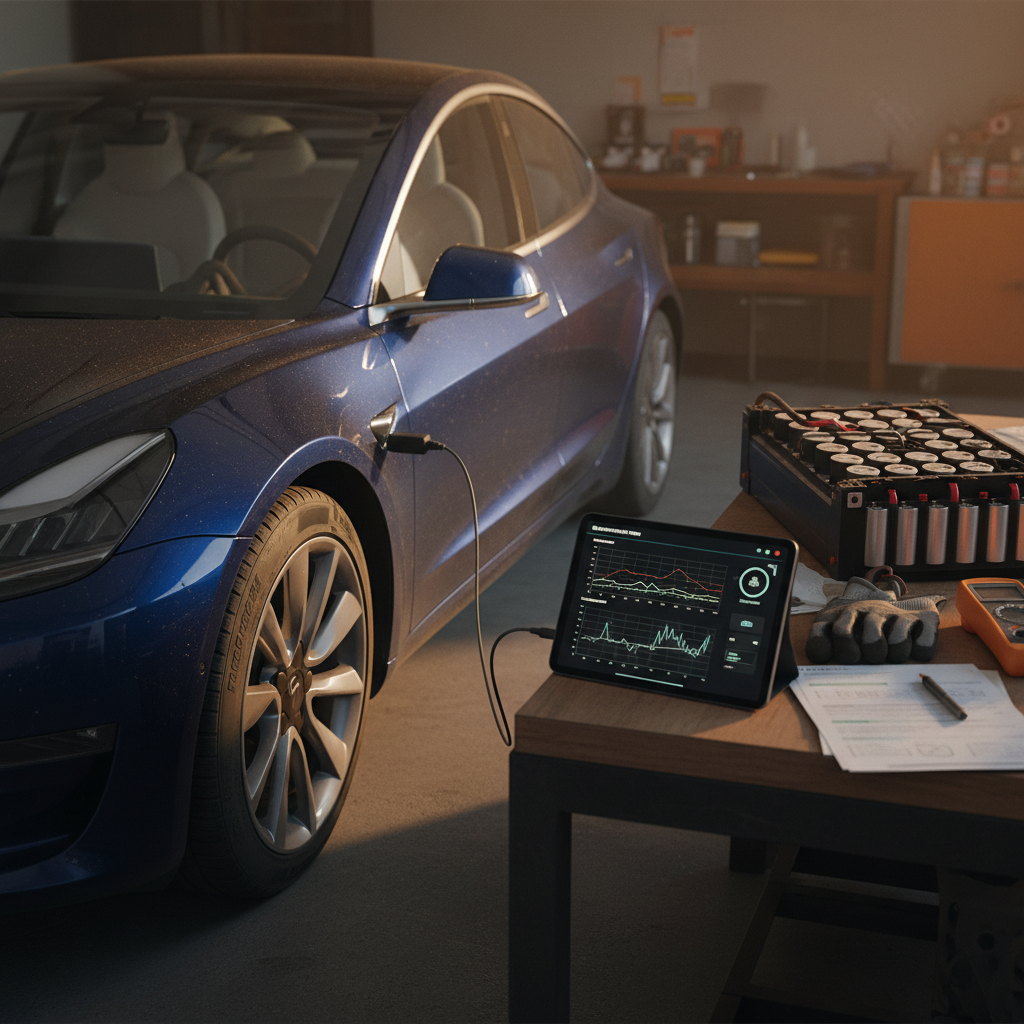
- Ask for objective, third‑party battery diagnostics rather than generic “it seems fine” claims.
- Compare state‑of‑health against similar vehicles to understand whether fast charging during past outages has taken a toll.
- If you plan to rely on V2L or V2H in the future, a healthy pack matters even more.
Where Recharged fits in
Ready to find your next EV?
Browse VehiclesFAQ: EV hurricane preparedness and power outages
Frequently asked questions about EVs, hurricanes, and outages
Bottom line: Turning your EV into a resilience asset
Hurricanes and extended power outages are stressful, but your EV doesn’t have to be another source of anxiety. With a realistic understanding of what your car can do, whether that’s simply getting you inland ahead of landfall or, with the right hardware, keeping your lights and fridge on, you can turn it into one of the most valuable tools in your emergency kit. The key is to plan before the sky turns gray: top off strategically, know your charging corridors, respect water and electrical safety, and avoid improvised "solutions" that create more risk than resilience.
If you’re considering a used EV in a hurricane‑prone area, factor storm readiness into the purchase from day one. Objective battery health data, a clean flood history, and the right charging setup will matter far more the day the grid goes down than a slightly bigger touchscreen or extra speaker. That’s why Recharged builds battery transparency and expert guidance into every sale, so when the next storm season arrives, your EV is an asset you can count on, not an unknown you have to worry about.