
If you’ve ever watched your EV’s range tumble on a cold February morning, you’ve already met the villain in this story: cabin heat. The choice between an EV heat pump vs a resistive heater can mean the difference between making it to the ski cabin, or staring at a fast charger in the snow. Let’s unpack what’s actually happening, how big the gap is in the real world, and what you should look for when you’re buying your next (or first) electric car.
Quick takeaway
Why EV heating matters more than you think
In a gas car, heating is practically free. The engine is a rolling bonfire of wasted energy, and a tiny fraction of that waste heat keeps you toasty. An EV drivetrain is the opposite: very little waste heat, so almost every watt that warms the cabin is coming straight out of the battery that moves you down the road.
Independent testing has shown that freezing temperatures can knock 16–46% off an EV’s range, depending on the car and how it’s used. A recent large-scale study of more than 18,000 EVs found that, on average, models retain about 80% of their normal range in winter, some do much better, some much worse. Cars with heat pumps typically sit at the better end of that spread, because they waste less energy on heat.
Cold hurts twice
EV heat pump vs resistive heater: the basics
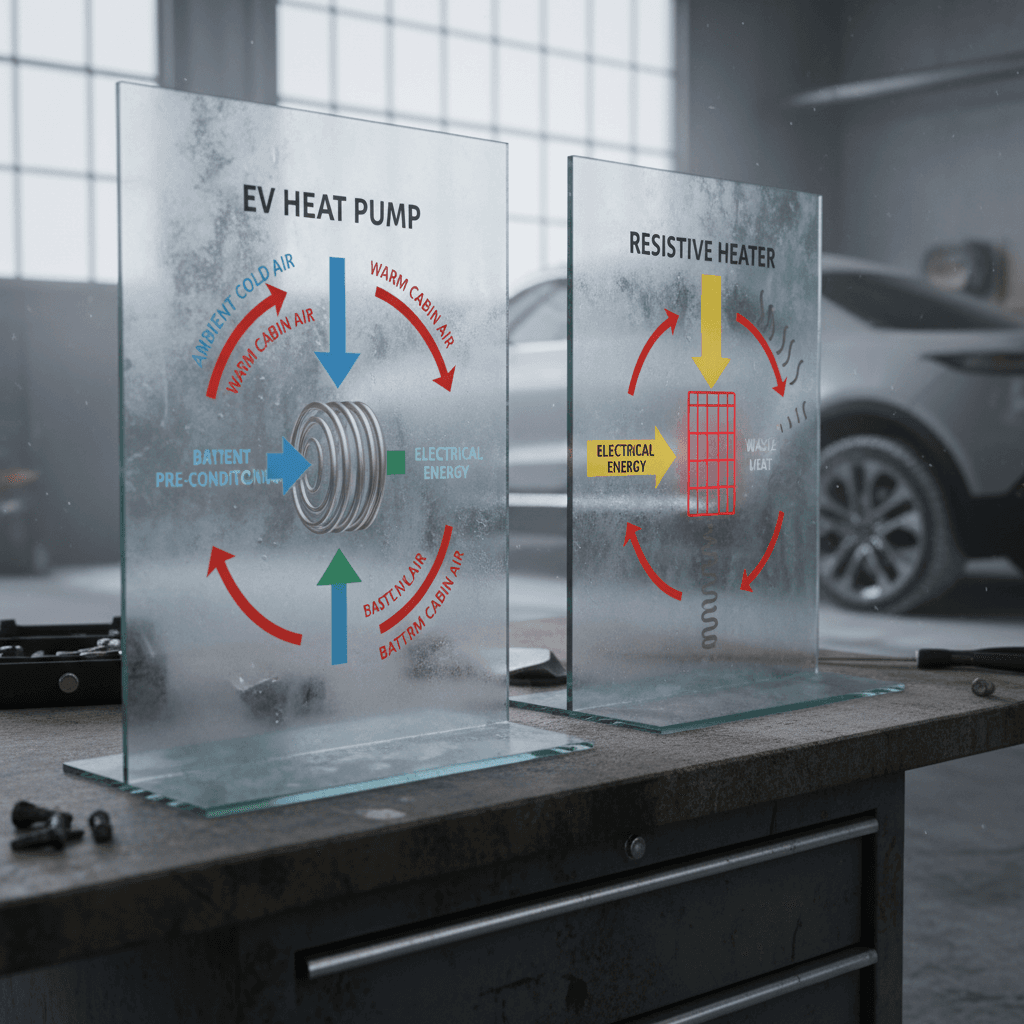
Resistive heater (PTC)
- Think of this as a super-sized space heater.
- Electric current runs through a heating element, which gets hot and warms air blown into the cabin.
- Efficiency is technically 100% (every watt turns into heat), but there’s no leverage: 5 kW in, 5 kW of heat out.
- Simple, cheap, reliable, and common in earlier or lower-cost EVs like some trims of the Nissan Leaf and Chevy Bolt.
Heat pump
- Works like a reversible air conditioner.
- Instead of creating heat, it moves heat from outside air, the battery, or electronics into the cabin.
- In moderate cold, a modern EV heat pump can deliver 2–3 kW of heat for every 1 kW of electricity used.
- Usually paired with a small resistive element as backup for extreme cold or rapid warm-up.
On paper, this is an open-and-shut efficiency case: if a heat pump can give you two or three units of heat for the energy cost of one, why use anything else? The wrinkle is that performance falls off as temperatures plunge. Below about 10–15°F, many systems lean harder on their backup resistive heater, and by the time you’re flirting with zero, even the best heat pump is mostly just an expensive way of running a resistor.
How much range does heating really cost you?
Winter range and heating at a glance
To translate kilowatts into something you actually care about: miles. Imagine your EV normally uses 250 Wh/mile on the highway. Add a 6 kW resistive heater at 70 mph, and suddenly you’re burning an extra ~86 Wh/mile just on heat. Your consumption jumps to about 336 Wh/mile, roughly a 34% increase. That’s how a 260‑mile summer car becomes a 175‑mile January car.
Swap that resistive heater for a well-tuned heat pump drawing, say, 3 kW under the same conditions, and the heating penalty drops to ~43 Wh/mile. Instead of losing a third of your range to comfort, you’re giving up more like 15–20%. Over a 150‑mile winter highway run, that can be the difference between stopping once or not stopping at all.
City vs highway
Heat pump vs resistive heater efficiency in the real world
Where each system shines (and struggles)
Because winter in Minneapolis is not the same story as winter in North Carolina.
Mild cold (30–45°F)
Heat pump sweet spot. There’s plenty of heat in the air to harvest, so COP (efficiency) of 2–3 is realistic.
- Significant range savings vs resistive.
- Fast warm-up, especially with seat and wheel heaters.
- Ideal for most U.S. coastal and southern climates.
Freezing (15–30°F)
Still a big edge for heat pumps. Many newer EVs retain 80–85% of their rated range in this band, particularly those with good thermal management.
- Heat pump may draw 2–4 kW vs 5–7 kW resistive.
- Range penalty is noticeable but manageable.
- Preconditioning while plugged in is your best friend.
Deep freeze (<10°F)
Physics gets ugly. There’s little ambient heat to grab, so even advanced pumps lean on resistive backup.
- Efficiency gap narrows.
- Range loss of 40%+ is possible in some cars.
- Preheating and route planning become critical.
Real-world data backs this up. Across a large winter study, EVs equipped with heat pumps tended to keep roughly 83% of their normal range in freezing weather, compared with about 75% for those without. That’s not just lab-theory COP charts, that’s what owners actually saw on the road.
Tesla’s switch from pure resistive heating to an integrated heat-pump system in the Model Y (and later updates to other models) is a good case study. Independent testing has shown roughly 20–30% less winter range loss compared with similar earlier-generation Teslas using resistive heaters only, largely thanks to that more efficient climate system and smarter thermal scavenging from the battery and electronics.
Comfort and driveability: warmth vs watt-hours
From the driver’s seat, you don’t care which component is keeping your fingers attached to your hands. You care about how fast the car heats up, how steady the temperature feels, and whether you can arrive with a comfortable state of charge.
Resistive heater feel
- Very quick, very simple: Turn the dial, get hot air.
- Great for short hops where you need instant defrost or a quick blast of heat.
- On long drives, you pay for that simplicity in reduced range and more frequent charging stops.
Heat pump feel
- In most modern EVs, warm-up is nearly as quick, often helped by a small resistive booster.
- Temperature control is more even and efficient; the system modulates rather than cycling on/off like a toaster.
- On long trips, you noticeably arrive with more range in hand, especially if you combine it with seat and wheel heaters.
Use the cheap heat first
Which EVs use heat pumps, and which don’t?
Heat pumps started out on pricier European EVs and have been marching steadily downmarket. Today you’ll find them standard or widely available on many mainstream models, especially crossovers designed with winter duty in mind.
Examples of EVs with and without heat pumps
Always double-check the trim and option list, some models only offer heat pumps on higher trims or as part of a cold-weather package.
| Model | Typical Heating System | Notes for Winter Drivers |
|---|---|---|
| Tesla Model Y / updated Model 3 | Heat pump + resistive backup | Strong winter range retention; sophisticated thermal scavenging. |
| Hyundai Ioniq 5 / Kona Electric / Kia EV6 & EV9 | Heat pump on many trims | Well-regarded cold-weather performance when properly equipped. |
| Audi e-tron / BMW iX / Nissan Ariya | Heat pump | Premium crossovers that generally perform well in winter testing. |
| Chevrolet Bolt EV / EUV (most years) | Resistive heater | Notorious for sharper winter range loss; preconditioning is crucial. |
| Early / base Nissan Leaf (varies by year) | Resistive heater on many trims | Significant range hit in cold climates without heat pump option. |
| Some budget-oriented new EVs | Resistive or basic PTC | Lower sticker price, higher winter operating cost. |
Representative examples; availability may vary by model year and market.
Trim-level trap
What to look for when buying a used EV
If you live anywhere that owns a snowplow, the heating system should be on your checklist right next to battery health and fast‑charging speed. A cheap EV with a power-hungry heater can turn into an expensive mistake after two winters of white‑knuckle range anxiety.
Used EV checklist: heat pump vs resistive heater
1. Confirm which system it has
Don’t rely on guesses. Check the window sticker, options list, or VIN-based build sheet to see whether the car has a heat pump, a resistive heater, or both. Some manufacturers’ apps and owner forums can help decode this.
2. Cross-check against climate
In Minnesota or upstate New York, a heat pump can be the difference between a relaxed winter commute and living on PlugShare. In milder climates, a resistive-only car may be perfectly livable and cheaper to buy.
3. Look at real-world winter range
Search owner reports and range studies for your specific model and year. A car that holds 80–85% of its rated range in winter is dramatically less stressful than one that drops to 60–65% when the mercury falls.
4. Evaluate your typical trips
If most of your driving is short in-town hops, any system can work, just expect a deeper winter penalty with resistive heat. If you do long highway stretches, the efficiency edge of a heat pump compounds over distance.
5. Factor in battery health
A tired battery plus an inefficient heater is a double hit. With Recharged, every vehicle includes a <strong>Recharged Score</strong> with verified battery health so you know how much usable range you’re really buying before winter shows up.
6. Consider total ownership cost
Resistive‑only cars are often cheaper to purchase used. But add in extra winter fast‑charging stops, higher electricity use, and time lost, and the heat‑pump car may be the better long‑term value.
How Recharged helps
Tips to maximize winter range with any heater
You can’t change the laws of thermodynamics, but you can at least negotiate with them. Whether your EV uses a clever heat pump or a brute-force resistor, these habits stretch your winter range without turning your cabin into a survival exercise.
- Precondition while plugged in. Use your app or schedule climate control so the cabin and battery are warmed from grid power before you unplug. This dramatically reduces the peak heating load once you start driving.
- Lean on seat and wheel heaters. They deliver comfort cheaply. You can often lower the cabin setpoint by a few degrees when your back and hands are warm.
- Use Eco or Eco+ climate modes. Many EVs offer a reduced-power climate setting that softens blower output and temperature swings to save energy.
- Dial back fan speed and temperature on highway slogs. You don’t need hair‑dryer levels of airflow once the cabin is comfortable. Small tweaks over a long drive add up.
- Keep the cabin reasonably sealed. Fix broken door seals, close unnecessary vents, and avoid driving with a window cracked at speed in frigid weather.
- Plan conservative winter routes. Assume you’ll have less range than the dash promises. Give yourself a buffer, especially if you’re new to the car or the season.
Don’t freeze for efficiency
FAQ: EV heat pump vs resistive heater
Frequently asked questions
Bottom line: should you prioritize a heat pump?
If you drive an EV in a part of the country where the snowplows have names, a heat pump is absolutely worth seeking out. It won’t magically erase winter range loss, cold chemistry is still cold chemistry, but it does blunt the worst of it, often giving you 10–20% more usable range when you need it most. That means fewer surprise fast‑charge stops, less time staring at kW counters on icy nights, and more margin for the detours life throws at you.
In milder climates, the calculus is softer. A resistive‑only car can be a smart value play on the used market, especially if you mostly do short trips and can precondition from home. What matters is matching the car’s thermal personality to your reality. That’s where a transparent used‑EV marketplace like Recharged earns its keep: verified battery health, clear real‑world range expectations, and EV‑specialist support that doesn’t hand‑wave away the hard parts of winter.
So when you’re comparing EV heat pump vs resistive heater, don’t think of it as a tech spec buried on page seven of the brochure. Think of it as how often you want to worry about whether the next charger is actually working. The right answer, as ever, is the car that lets you stop thinking about the heater altogether and just drive.