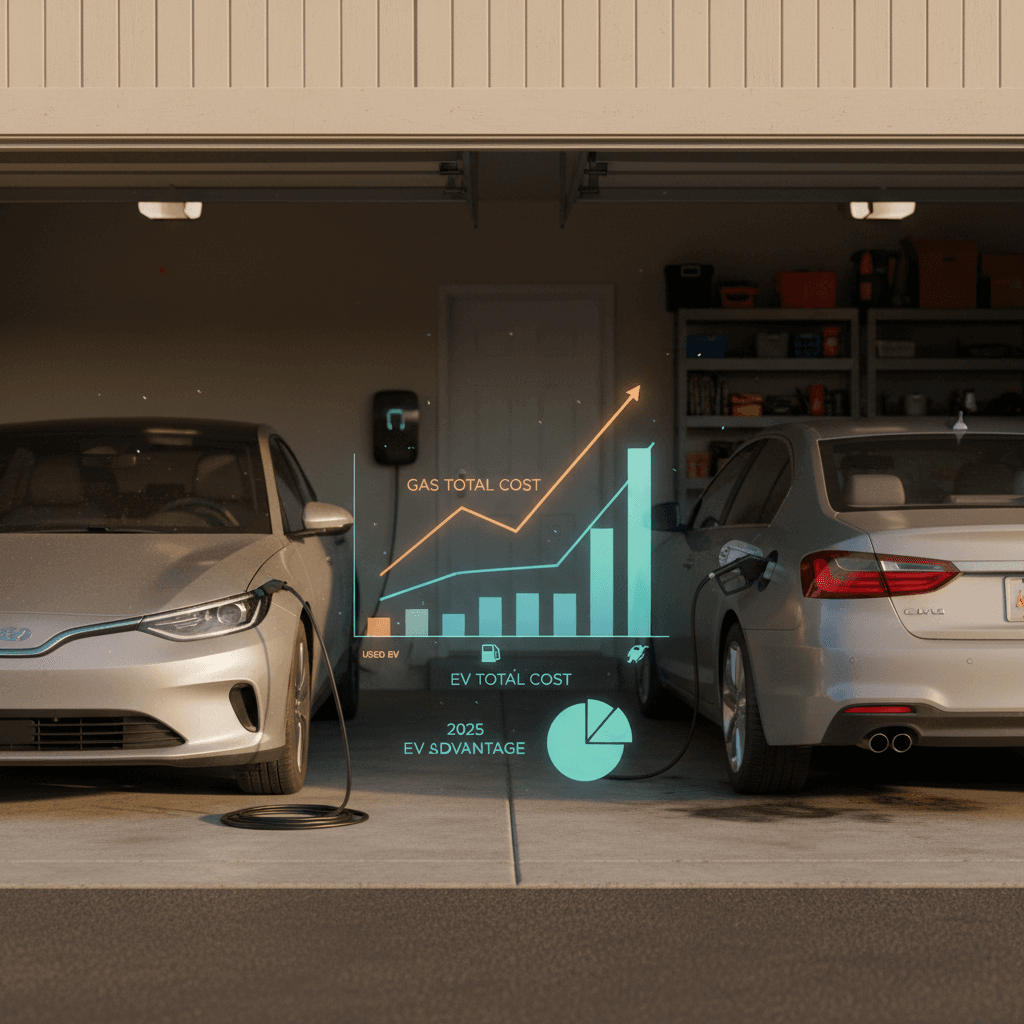
When people talk about EV costs, they usually mean one of two things: the sticker price or how cheap it is to “fuel up” with electricity. But what really matters is total cost of ownership, what you actually spend over several years on payments, charging, maintenance, insurance, and resale. In 2025, that picture is more nuanced than simple “EVs are cheaper” or “EVs are too expensive” headlines.
Why EV costs feel confusing
EV costs at a glance in 2025
Key EV cost numbers for 2025 (U.S.)
Those quick numbers explain why so many buyers are considering an EV. But they don’t tell the whole story. To understand EV costs, you need to look at five buckets: upfront price, charging, maintenance, insurance/fees, and depreciation. We’ll tackle each, and then put them together in a 5‑year example.
Upfront EV price, incentives, and why used can be smarter
New EVs still tend to cost more than comparable gas cars. In 2025, mainstream electric crossovers and sedans commonly list in the mid‑$30,000s to mid‑$40,000s before incentives, while many gas equivalents sit a bit lower. Luxury EVs can easily reach $60,000 and up. That higher MSRP is the main reason some ownership-cost studies show EVs with higher 5‑year costs despite cheaper fuel and maintenance.
- Federal tax credits: Many new EVs built in North America can qualify for up to $7,500 in federal tax credits, subject to income limits and battery-sourcing rules.
- State and local incentives: Some states add $1,000–$4,000 rebates, HOV-lane access, or reduced registration fees for EVs.
- Utility rebates: Many utilities offer $300–$1,000 toward a home Level 2 charger or discounted EV-only rates.
Important note on incentives
Why used EVs often make the best financial sense
EVs depreciated quickly in the early years of the market, and that pattern still holds for many models. The upside for you: used EV prices can be thousands below comparable gas cars of the same age, because the original buyer already took the big depreciation hit and early incentives are “baked in.”
How Recharged helps on upfront costs
Ready to find your next EV?
Browse VehiclesCharging costs: home vs public and vs gas
Charging is where electric vehicles usually shine. The cost per mile depends on where you charge (home vs public), your local electricity rate, and how efficient your EV is. But some broad patterns are very consistent across the U.S.
Typical fueling costs in 2025 (per mile & per year)
Approximate average costs for a typical U.S. driver covering about 12,200 miles per year, using current national averages.
| Scenario | Fuel type | Approx. cost per mile | Approx. annual fuel cost* |
|---|---|---|---|
| EV – mostly home charging | Electricity | ≈5–6¢ | ≈$600–$750 |
| EV – mostly public fast charging | Electricity | ≈12–13¢ | ≈$1,400–$1,600 |
| Gas compact/midsize car | Gasoline | ≈11–13¢ | ≈$1,350–$1,600 |
| Gas SUV or truck | Gasoline | ≈15–17¢ | ≈$1,800–$2,100 |
Home charging delivers the biggest savings; heavy use of public fast charging narrows or erases the fuel-cost advantage.
Quick rule of thumb
Home charging setup costs
To get those low home charging costs, many owners install a Level 2 charger that uses a 240‑volt circuit, similar to an electric dryer. Depending on your home’s panel capacity and distance from the service panel, installation typically runs:
- Basic install: $500–$1,200 for a short run and existing capacity.
- More complex: $1,200–$2,500+ if you need panel upgrades, long wire runs, or trenching.
- Charger hardware: $300–$800 for most popular Level 2 units (sometimes offset by utility rebates).
Safety first with home charging
Maintenance and repairs: where EVs really save
On the maintenance side, EVs have a structural advantage: fewer moving parts. There’s no engine oil, no spark plugs, no timing belt, and no multi-speed automatic transmission. Regenerative braking also reduces wear on brake pads. Over time, that translates into meaningfully lower service spend.
Typical maintenance differences: EV vs gas
What you service, and what you don’t, over several years of ownership
Gas vehicle maintenance
- Oil and filter changes every 5,000–10,000 miles
- Spark plugs, coils, timing belts or chains over time
- Transmission fluid and sometimes major transmission work
- More frequent brake jobs (pads and rotors)
EV maintenance
- No engine oil or spark plug changes
- Single‑speed gear reduction, no traditional transmission service
- Brake pads last longer thanks to regenerative braking
- Focus on tires, cabin filters, brake fluid, and coolant for the battery/drive unit
How much can you actually save?
Insurance, registration, and fees
Here’s where some shoppers get surprised. Because EVs are often more expensive to buy and can cost more to repair after a collision, insurance premiums tend to run higher than average gas cars. Recent market data shows many popular EVs, Tesla Model 3, Hyundai Ioniq 5, Ford Mustang Mach‑E, and others, carrying full‑coverage premiums above the national average for all vehicles.
Sample annual full‑coverage insurance premiums (recent averages)
Illustrative averages for popular EVs vs the overall U.S. vehicle average. Your actual rate depends heavily on location, driving record, credit, and coverage choices.
| Vehicle | Type | Approx. annual full‑coverage premium |
|---|---|---|
| National average (all vehicles) | Gas & EV combined | ≈$2,700 |
| Chevrolet Bolt | EV | ≈$2,500–$2,700 |
| Hyundai Ioniq 5 | EV | ≈$3,000 |
| Tesla Model 3 | EV | ≈$3,400 |
| Tesla Model Y | EV | ≈$3,800 |
EVs often cost more to insure today, but the gap is slowly narrowing as repair networks and parts availability improve.
Watch for EV-specific registration fees
Tips to keep EV insurance costs in check
- Compare quotes from multiple insurers; some now specialize in EVs.
- Consider higher deductibles if you have savings set aside.
- Ask about discounts for low annual mileage or telematics/usage‑based policies.
- Look for models with strong safety ratings and widely available parts, which can be cheaper to insure.
Depreciation and resale value (and how used EVs flip the script)
Depreciation, the loss in value as a car ages, is the single largest cost of owning most new vehicles, often bigger than fuel or maintenance. EVs, especially early models, have generally depreciated faster than comparable gas cars because incentives, technology changes, and battery‑life worries all pushed prices down on the used market.
Why EV depreciation has been steeper
The good news is that battery technology is maturing, and more data is available on how packs age. With better information, used buyers can separate healthy EVs from those that have truly lost too much range. That, in turn, should help stabilize resale values over time.
How Recharged addresses depreciation risk
5‑year EV vs gas cost comparison
Let’s put these pieces together with a simple 5‑year comparison. We’ll look at a mainstream compact SUV, one gas and one electric, each driven about 12,000–15,000 miles per year. Numbers are rounded and generalized, but they show how the tradeoffs work.
Illustrative 5‑year cost of ownership: EV vs gas compact SUV
Rounded example for a typical buyer in 2025. Actual costs will vary by model, state, and your driving/charging habits.
| Cost category (5 years) | Electric compact SUV | Gas compact SUV |
|---|---|---|
| Purchase price (after incentives) | $40,000 | $34,000 |
| Depreciation (estimated) | −$18,000 | −$14,000 |
| Fuel/energy | ≈$3,500 (mostly home charging) | ≈$7,000 |
| Maintenance & repairs | ≈$3,000 | ≈$4,500 |
| Insurance | ≈$16,000 | ≈$14,000 |
| Registration & fees | Slightly higher in some states | Standard |
| Estimated 5‑year total spent | ≈$64,500 | ≈$63,500 |
| Residual value after 5 years | ≈$22,000 | ≈$20,000 |
In many realistic scenarios, an EV’s higher purchase price is largely offset, or sometimes beaten, by lower fuel and maintenance costs, especially if you charge at home.
What this example shows
- The EV still costs more up front and depreciates a bit faster.
- Fuel and maintenance savings are significant, about $4,000–$5,000 over five years in this scenario.
- Higher insurance and some extra fees narrow the gap, but the EV’s higher resale value claws some of that back.
When the EV wins clearly
- You drive more than average miles each year.
- You can charge at home most nights at reasonable electricity rates.
- You buy used instead of new, letting someone else absorb the steepest depreciation.
How buying a used EV changes your cost picture
Buying used is often the most powerful way to make EV costs pencil out. When you buy a 2‑ to 5‑year‑old electric vehicle:
- The original owner has already absorbed the biggest hit of depreciation.
- You can often buy for a price similar to, or lower than, a comparable used gas car, despite the EV having lower running costs.
- You may still qualify for used EV incentives in some regions, which can further reduce your net cost.
Where Recharged fits into used EV costs
Battery health: the single biggest wild card in used EV costs
Battery condition is to a used EV what engine and transmission condition are to a used gas car, but the signs are harder to see without the right tools. A healthy pack means predictable range for years; a weak one can shorten your usable life with the car or eventually require a very expensive replacement. That’s why objective diagnostics, not just a dashboard range estimate, should be part of any used EV purchase.
Checklist: 8 ways to lower your EV costs
Practical steps to keep EV ownership costs down
1. Decide where you’ll charge most
If you can reliably charge at home or work, the economics of an EV improve dramatically. If you’ll rely on public fast charging, don’t count on big fuel savings.
2. Get real numbers on electricity rates
Check your utility bill for your actual cents‑per‑kWh rate and whether they offer EV time‑of‑use plans with cheaper overnight energy.
3. Right-size the vehicle and battery
Bigger batteries and vehicles cost more to buy and insure. If your daily driving is modest, you may not need the longest‑range model.
4. Consider used instead of new
A well‑chosen used EV can give you most of the benefits of electric driving at a monthly cost similar to, or even below, a comparable used gas car.
5. Run a realistic 5‑year budget
Add payments, expected fuel/charging, insurance, routine maintenance, and registration. Compare that total against a similar gas model instead of fixating on MSRP.
6. Shop insurance before you buy
Get insurance quotes for specific EV models you’re considering. Sometimes a different trim or wheel size can noticeably change your premium.
7. Maintain tires and alignment
EVs are heavier and can go through tires faster if you’re not careful. Proper inflation and alignment protect both safety and your maintenance budget.
8. Use verified battery diagnostics for used EVs
When buying used, insist on a battery health report. Tools like the <strong>Recharged Score</strong> can prevent surprise range loss and protect your resale value later.
FAQ: Common questions about EV costs
Frequently asked questions about EV costs
Conclusion: Are EVs worth the cost in 2025?
When you add everything up, EV costs in 2025 come down to a few simple questions: Can you charge at home? How much do you drive? Are you willing to consider a used EV with verified battery health? If you answer yes to those, an electric vehicle is very likely to match or beat a comparable gas car on total cost, while giving you a quieter, smoother drive and insulation from gas-price spikes.
If, on the other hand, you can’t install home charging, rely on road‑trip fast chargers for daily use, or simply don’t rack up many miles, the financial case is more mixed. In that situation, running the numbers model by model, and including insurance and registration differences, is essential.
Either way, the days of EVs being a clear niche splurge are ending. With maturing technology, growing used inventory, and better data on battery life, you have more tools than ever to decide whether an EV fits your budget. And if you’re exploring used options, Recharged was built to make that decision more transparent, from Recharged Score battery diagnostics to expert EV‑specialist support, financing, and delivery. The right numbers, and the right partner, turn EV ownership from a question mark into a clear, confident choice.