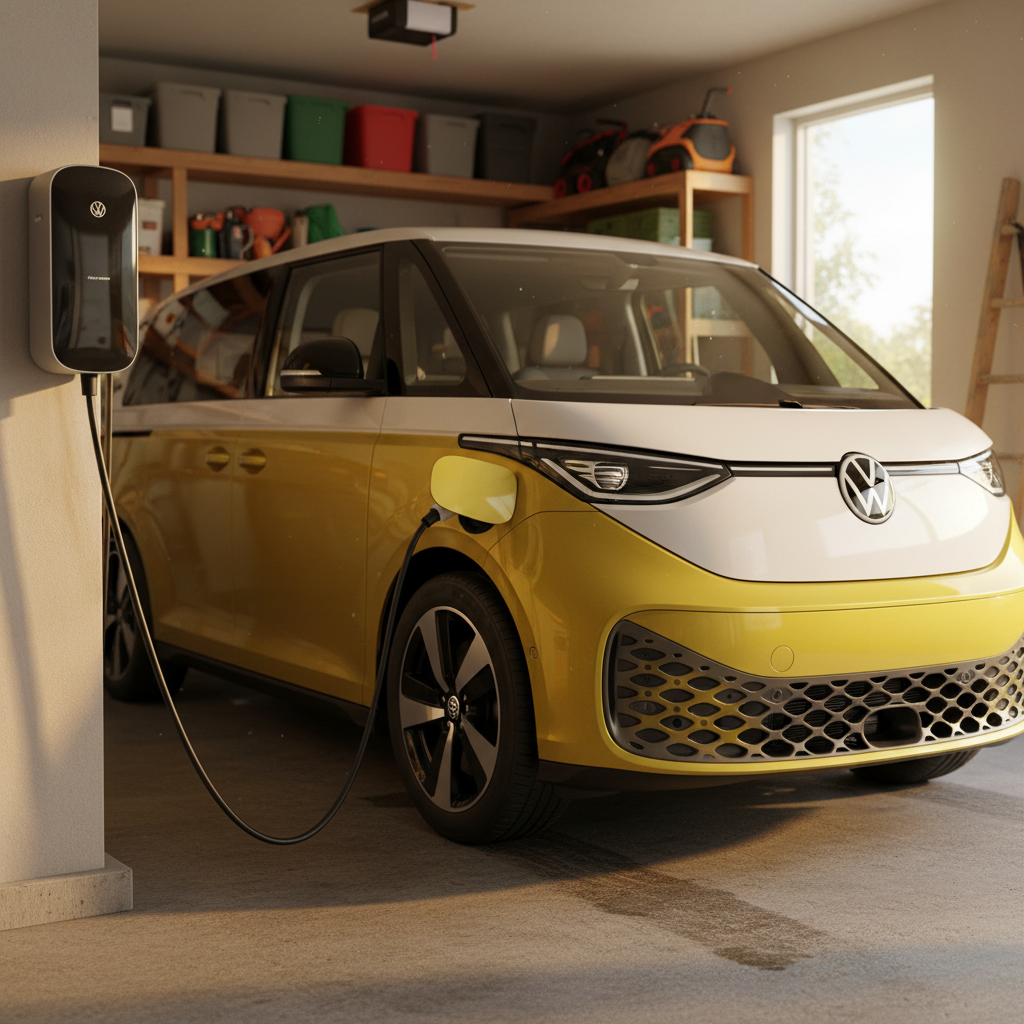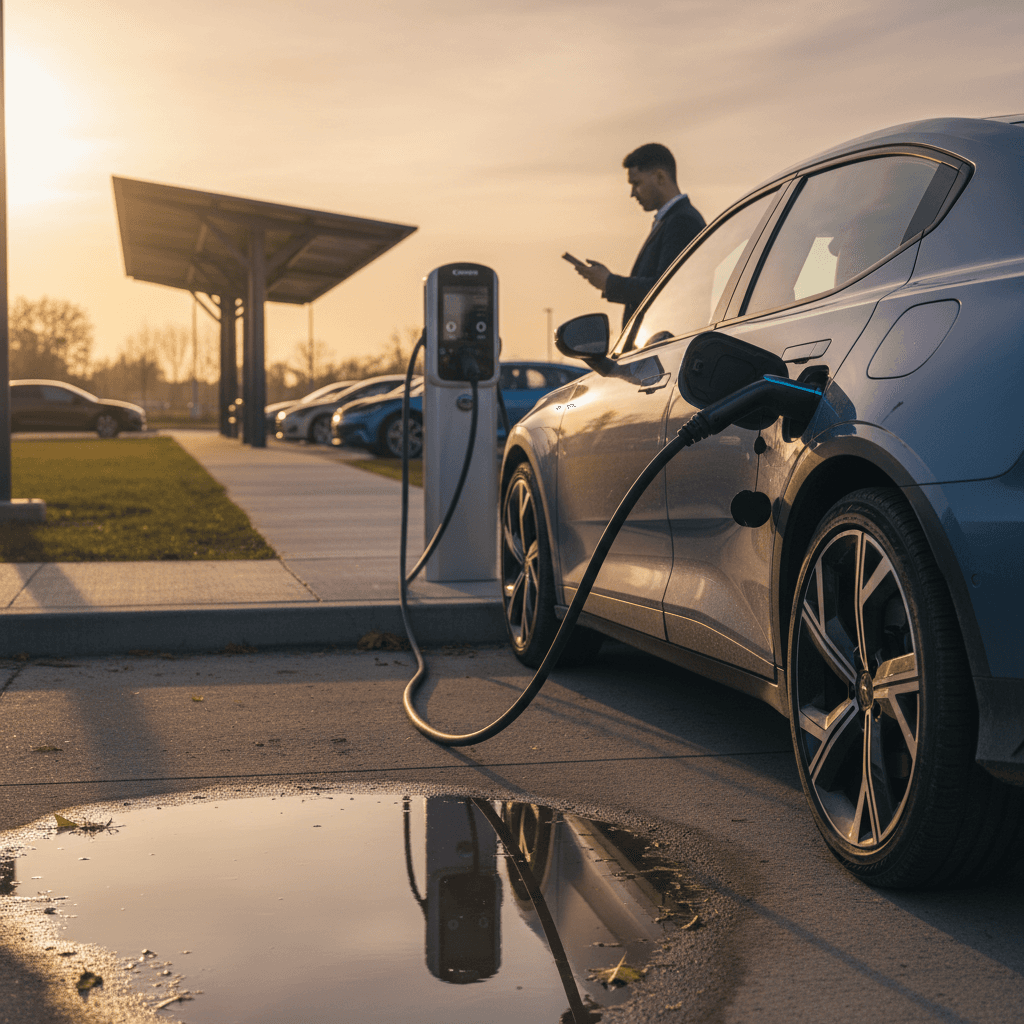
When you’re shopping for an EV, or a used EV on Recharged, one of your first questions is simple: how long will it take to charge? This EV charging time chart breaks down typical times for Level 1, Level 2, and DC fast charging so you can quickly see what to expect at home, at work, and on the road.
Charging times are approximations
EV charging time basics
- Battery size (kWh): Think of this as your tank size. A compact EV might have a 50 kWh battery, while a large SUV can be 90 kWh or more.
- Charger power (kW): This is the flow rate. A 7.2 kW home Level 2 charger “pours in” energy much faster than a 1.4 kW Level 1 cord.
Charging levels at a glance
Three main ways to charge in North America
Level 1 (120V)
• ~1.4 kW from a standard outlet
• Adds about 3–5 miles of range/hour
• Full charge can take 20–40+ hours
Level 2 (240V)
• Typically 7–11 kW at home, up to ~19 kW public
• Adds about 15–40 miles/hour
• Full charge in about 4–10 hours
DC Fast (Level 3)
• 50–350+ kW at public sites
• Adds roughly 100–300+ miles in 20–45 minutes
• Commonly charge 10–80% in 20–60 minutes
A quick rule of thumb
EV charging time chart by level
Here’s a high-level EV charging time chart that compares Level 1, typical home Level 2, strong public Level 2, and DC fast charging for three common battery sizes. These are approximate empty to 80% times, stopping at 80% reflects real-world fast charging behavior and avoids the slower top end of the charging curve.
EV charging time chart by charger level (to ~80%)
Approximate times in hours to charge from near-empty to 80% in mild weather with a typical 2025 EV.
| Battery Size | Level 1 (1.4 kW) | Home Level 2 (7.2 kW) | Public Level 2 (11 kW) | DC Fast 100 kW | DC Fast 150 kW |
|---|---|---|---|---|---|
| 50 kWh (compact EV) | ~23 hours | ~5.5 hours | ~3.5 hours | ~0.4 hours (~25 min) | ~0.25 hours (~15 min) |
| 75 kWh (typical crossover) | ~34 hours | ~8 hours | ~5.5 hours | ~0.6 hours (~35 min) | ~0.4 hours (~25 min) |
| 90 kWh (larger SUV) | ~41 hours | ~9.5 hours | ~6.5 hours | ~0.7 hours (~40 min) | ~0.5 hours (~30 min) |
Use this chart as a planning guide, not an exact prediction. Your specific vehicle, temperature, and charger can shift times up or down.
Your EV may limit max power
Charging time by battery size
If you already know your battery size, or you’re comparing used EVs on Recharged, this breakdown shows how larger packs scale charging time at a typical home Level 2 setup (~7.2 kW).
Home Level 2 charging time by battery size (to ~100%)
Approximate empty-to-full times on a 7.2 kW home Level 2 charger. Many drivers don’t charge from 0–100% in practice; this is a worst‑case planning tool.
| Battery Size | Estimated Time 0–100% on 7.2 kW | Typical Daily 20–80% Top-Up |
|---|---|---|
| 40 kWh (smaller pack) | ~6 hours | ~3 hours |
| 60 kWh (mainstream EV) | ~8.5 hours | ~4–4.5 hours |
| 75 kWh (popular crossovers) | ~10.5 hours | ~5–5.5 hours |
| 90 kWh (larger SUV) | ~12.5 hours | ~6–6.5 hours |
Most daily charging is from 20–80%. For that window, you can roughly cut these times in half.
Why 0–100% is rarely needed
Miles of range added per hour
Many drivers think in miles, not kilowatt‑hours. This chart shows typical miles of range added per hour for different charger types, assuming an average efficiency of about 3.0–3.5 miles per kWh. Your real number may be higher (efficient sedan) or lower (big, heavy SUV).
EV charging time chart: miles of range per hour
Approximate additional highway range per hour of charging on common charger types.
| Charger Type | Power (kW) | Approx. Miles of Range/Hour |
|---|---|---|
| Level 1 (120V wall outlet) | 1.4 kW | ~3–5 miles/hour |
| Home Level 2 – lower power | 3.8 kW | ~12–15 miles/hour |
| Home Level 2 – typical | 7.2 kW | ~20–30 miles/hour |
| Strong Level 2 – public | 11 kW | ~30–40 miles/hour |
| High-end Level 2 – public | 19 kW | ~50–60 miles/hour |
| DC fast – conservative | 50 kW | ~150–180 miles in 30–40 min |
| DC fast – common highway sites | 150 kW | ~200–250 miles in 20–30 min |
| Ultra-fast – latest 800V systems | 250–350+ kW | Often 200+ miles in ~10–15 min (vehicle-dependent) |
Real-world range per hour depends on your driving speed, terrain, temperature, and tire choice.
What this means for your routine
What really affects your charging time
Key factors that speed up, or slow down, charging
Why two identical chargers can give different results
1. Your EV’s max charge rate
Every EV has a maximum AC and DC charging rate. If your car tops out at 7.4 kW AC, plugging into an 11 kW station won’t make it faster. The same idea applies at DC fast chargers, some cars accept 120 kW, others 250+ kW.
2. Battery temperature
Cold packs charge more slowly, and very hot packs may be throttled to protect longevity. Many EVs precondition the battery before fast charging if you set the DC charger as your navigation destination.
3. State of charge (SOC)
Charging is fastest at low to mid SOC, say 10–50%. Above 80%, almost every EV tapers to protect the battery. That’s why fast charging is typically quoted as 10–80%, not 10–100%.
4. Power sharing at public sites
Some DC fast sites split power between two stalls. If another driver plugs in next to you, your charger may drop from, for example, 150 kW to 75 kW depending on demand and hardware design.
5. Actual outlet or circuit capacity
In a home, your Level 2 charger is only as strong as the circuit it’s wired to and the breaker it’s on. A 50‑amp circuit typically supports around 40 amps continuous, or about 9.6 kW; a 30‑amp circuit will be lower.
6. Driving efficiency and conditions
Charging time charts usually assume typical highway efficiency. High speeds, heavy loads, strong headwinds, big wheels, or roof racks all eat into real‑world miles per kWh, effectively stretching out how long it feels like it takes to “refuel.”
Don’t fight the taper
Using these charts for home charging plans
Home charging is where you’ll use these EV charging time charts most. The goal isn’t to fill from empty every night, it’s to match your daily miles to the miles per hour your home setup can add.
Home charging planning checklist
1. Confirm your battery size and efficiency
Look up your EV’s battery capacity and typical miles per kWh. If you’re shopping used on Recharged, specs are listed alongside each vehicle and interpreted in the Recharged Score Report.
2. Decide on Level 1 vs Level 2
If you drive 20–30 miles per day and can plug in 10–12 hours, Level 1 might be enough. Anything more demanding usually benefits from a dedicated Level 2 charger.
3. Check your home electrical panel
A licensed electrician can tell you whether you have spare capacity for a 240V circuit and what amperage is realistic. That determines the kW your future charger can deliver.
4. Use the chart to size your charger
Match your daily driving needs to the “miles per hour” chart. For most owners, a 32–40 amp Level 2 unit (about 7–9.6 kW) strikes a balance between cost and speed.
5. Consider time-of-use rates
Many utilities offer cheaper overnight electricity. If you schedule charging for those hours, you can afford to charge a bit slower as long as you have enough time to refill overnight.
6. Build in some cushion
If you occasionally take longer trips or expect your mileage to increase, choose a charger and circuit that give you at least 25–50% more charging capability than your typical daily needs.
Buying used? Think about your driveway, too.
Planning road trips with DC fast charging
On highway trips, your EV charging time chart becomes a route planning tool. Instead of thinking in full charges, think in segments: drive, charge from roughly 10–70% or 10–80%, repeat.
Example: 75 kWh crossover on 150 kW DC fast
- Highway efficiency: ~3.0 mi/kWh → ~225 miles from 10–80%.
- Charging: 10–80% in about 30–35 minutes at healthy speeds.
- Practical segment: 2.5–3 hours of driving, 30 minutes of charging.
That pattern, 2–3 hours on the road, 30 minutes parked, lines up naturally with bathroom, snack, and stretch breaks.
How to minimize total trip time
- Arrive with the battery warm and relatively low (10–20%) for fastest charging.
- Use the car’s built-in trip planner or third‑party apps to see realistic charge times, not just best‑case numbers.
- Stop a bit more often and unplug around 60–70% rather than waiting to 100%. The taper can cost more time than it saves.
Cold weather adds time
Charging time considerations for used EVs
With a used EV, you’re not just buying a sticker range, you’re buying a specific car with a specific charging history. Two vehicles with the same original battery size can behave differently at a fast charger or a home Level 2 unit.
How used EVs can differ on charging time
What smart shoppers pay attention to
Battery health
Degradation reduces usable capacity, which can slightly shorten charging times but also cuts range. More importantly, poor health can make charging behavior less predictable over time.
Charging history
Heavy, frequent DC fast charging at high states of charge can accelerate wear. A vehicle that mostly charged at home on Level 2 often has a gentler battery history.
Transparent diagnostics
This is where the Recharged Score Report matters. It includes verified battery health and charging data, so you’re not guessing how the previous owner treated the pack.
How Recharged helps
Ready to find your next EV?
Browse VehiclesEV charging time FAQ
Frequently asked questions about EV charging time charts
Key takeaways
EV charging time charts aren’t about memorizing numbers, they’re about seeing quickly whether a given setup fits your life. Level 1 works as a backup, Level 2 is the workhorse for daily charging, and DC fast is the road‑trip tool. Once you know your battery size, your typical miles per day, and what kind of power you can get at home, you can use these charts to dial in a charging plan that feels as simple as filling a gas tank used to.
If you’re comparing used EVs, that same framework helps you decide which models match your driveway and your driving habits. Recharged layers in verified battery health and transparent pricing so you’re not guessing how those charts apply to the specific car in front of you, you’re making a confident, data‑backed decision.