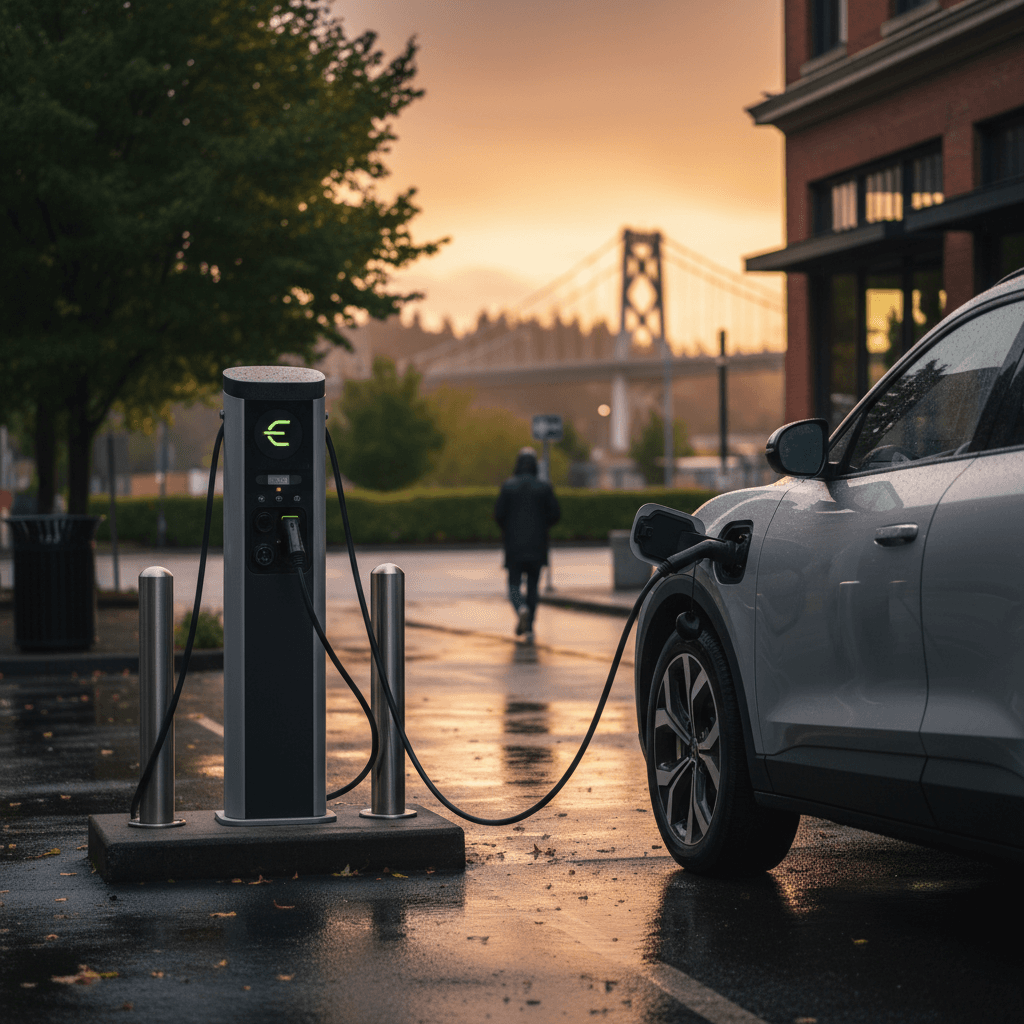
Searching for EV charging stations in Portland, OR can feel overwhelming at first. The city has everything from curbside Level 2 chargers to DC fast charging hubs like Electric Avenue downtown, and the options keep growing thanks to state and utility investments. This guide walks you through how Portland’s charging network actually works, where to plug in, how much you’ll pay, and how to make charging feel as routine as grabbing coffee on Hawthorne.
Portland is an early EV city
Why Portland is Ahead on EV Charging
Electric Vehicles and Charging Momentum in Oregon
Portland’s advantage isn’t just that it has chargers; it’s that the city, state, and local utilities have been coordinating for more than a decade. Portland General Electric’s Electric Avenue fast‑charging sites, Oregon’s multi‑year Community Charging Rebates, and federal reliability grants aimed at fixing broken ports all add up to a network that’s denser and more dependable than what you’ll find in many similarly sized cities.
Think “network,” not single stations
Types of EV Charging Stations in Portland, OR
Before you hunt for specific EV charging stations in Portland, OR, it helps to understand the basic types of charging you’ll see on maps and in parking lots. They’re not all equal in speed or price.
Portland’s Three Main Charger Types
Know what you’re looking at on PlugShare or Google Maps
Level 1 (120V)
Where you’ll see it: Standard household outlets, sometimes in garages or at workplaces.
- Adds ~3–5 miles of range per hour.
- Good for overnight topping up if you don’t drive much.
- Often free, but very slow & rarely signed as "stations."
Level 2 (240V)
Where you’ll see it: Curbside Portland chargers, public garages, grocery stores, workplaces, apartments.
- Typical public speeds: 6–11 kW.
- Adds ~20–35 miles of range per hour depending on your car.
- Best balance of cost and convenience for daily use.
DC Fast Charging (50–350 kW)
Where you’ll see it: Electric Avenue sites, highway travel plazas, big box and grocery parking lots.
- Can add 150–200 miles of range in 30–45 minutes on many EVs.
- Priced per kWh or per minute, usually more expensive.
- Best for road trips or when you’re low and in a hurry.
Watch connector types
Where to Find EV Charging Stations in Portland
Portland’s chargers cluster where people actually spend time: downtown, close‑in neighborhoods, major retail centers, and along the freeways. Here are the main patterns you’ll notice once you start looking at the map.
Central City & Close‑In Eastside
Downtown and the central eastside have a dense mix of Level 2 and DC fast charging, including Portland General Electric’s flagship Electric Avenue by the World Trade Center and additional fast chargers in nearby garages. You’ll also find Level 2 options near hotels, offices, and cultural venues, which are ideal if you’re parking for a few hours.
Across the river in the inner eastside, look around the Lloyd District, Central Eastside Industrial District, and popular retail corridors for more Level 2 stations attached to garages, grocery stores, and mixed‑use developments.
Neighborhoods, Malls, and Suburbs
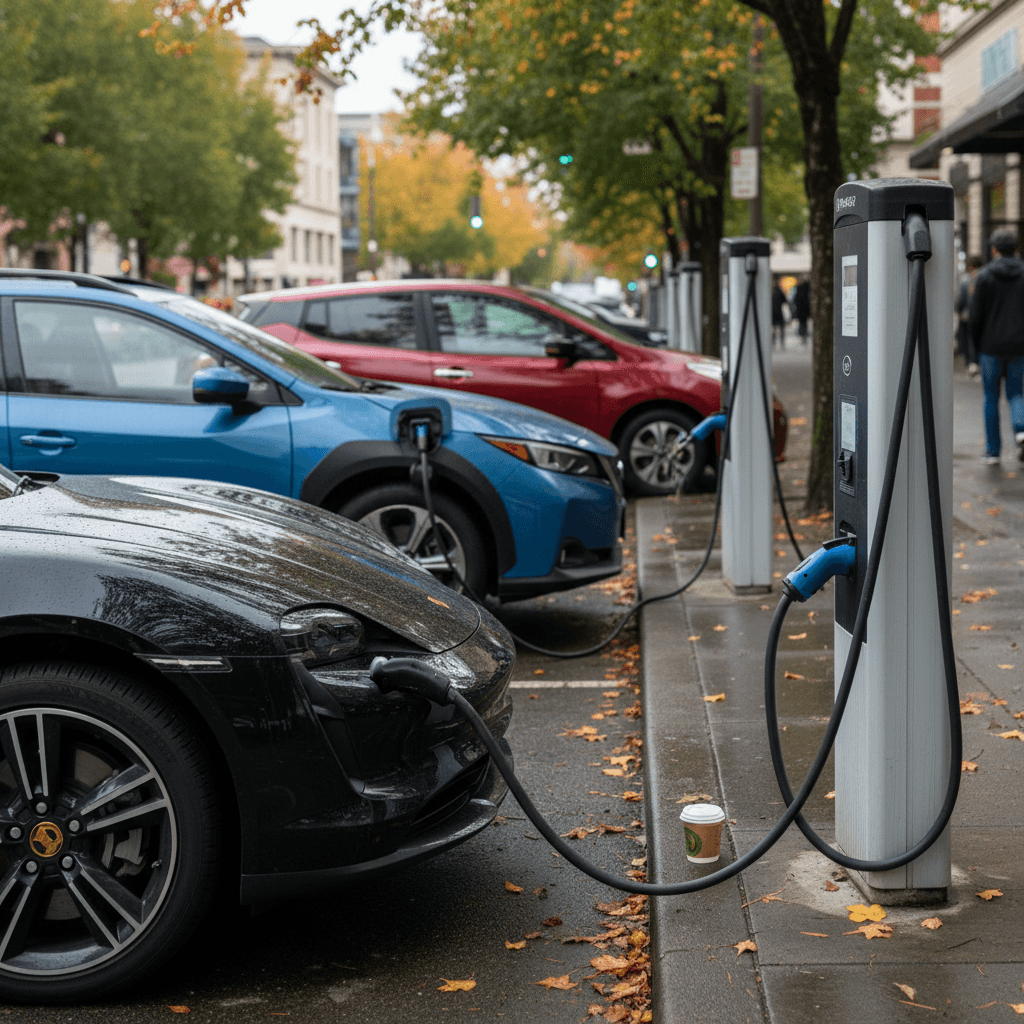
Head out to areas like Hollywood, Sellwood, or Multnomah Village and you’ll see more curbside Level 2 chargers mixed into residential and commercial streets. These are meant for a "park for a while" pattern, think dinner out or errands, not quick fills.
Major retail hubs, Lloyd Center, Cascade Station near the airport, big box strips along 82nd, and suburban shopping areas in Beaverton, Tigard, and Gresham, often feature DC fast chargers from networks like Electrify America, EVgo, and others, positioned for quick top‑ups while you shop.
Common Places to Find EV Charging Around Portland
Use this cheat sheet when you’re scanning maps for chargers near your daily routes.
| Location Type | Typical Charger Type | Use Case | What to Expect |
|---|---|---|---|
| Downtown Portland / Central City | Mix of Level 2 & DC fast | Commuting, events, visitors | Higher parking costs, strong charger density |
| Neighborhood Main Streets | Mostly Level 2 | Meals, shopping, errands | 2–4 hour parking, slower but cheaper |
| Grocery Stores (Fred Meyer, New Seasons, etc.) | Level 2 & some DC fast | Weekly shopping | Charge while shopping; time‑limited parking |
| Big Box / Malls | DC fast + Level 2 | Faster top‑ups, weekend errands | Good fast‑charging clusters, especially near I‑205/I‑5 |
| Hotels & Downtown Garages | Level 2 | Overnight stays, work trips | Great for overnight charging, sometimes for guests only |
| Park & Ride / Transit Hubs | Level 2 | All‑day parking, commuters | Cheaper daily parking, bring charging cable just in case |
Actual station counts change frequently, but these patterns hold across the Portland metro.
Look for signage, not just plugs
Best Apps and Tools to Locate Portland Chargers
You don’t have to memorize every EV charging station in Portland, OR. A few apps and in‑car tools will do most of the work for you, as long as you know how to use them together.
Four Reliable Ways to Find EV Charging in Portland
Use at least two sources so a bad station doesn’t ruin your day
PlugShare & A Better Routeplanner
PlugShare is the go‑to community map for public chargers. In Portland it’s especially useful for:
- User reviews that flag broken or blocked stations.
- Photos that show exactly where chargers sit in big parking lots.
- Filters for plug type, network, and charging speed.
A Better Routeplanner (ABRP) is excellent for route planning from Portland to the coast, Bend, Seattle, and beyond, taking your EV’s range and charging curve into account.
Network Apps (EA, EVgo, ChargePoint, etc.)
Each major network around Portland, Electrify America, EVgo, ChargePoint, FLO, and others, has its own app. They’re useful for:
- Starting and stopping sessions without RFID cards.
- Getting member discounts or bundled pricing.
- Seeing which ports at a site are in use in real time.
Once you know which networks you like near home and work, keep those apps installed and logged in.
Your Car’s Native Navigation
Most modern EVs will show nearby public chargers directly in the built‑in navigation. In Portland this tends to include major DC fast sites along I‑5, I‑84, and I‑205 as well as some Level 2 options.
Use this when you’re already driving and want a "good enough" option nearby instead of optimizing for price.
Google Maps & Apple Maps
Both mapping apps now list many Level 2 and DC fast chargers as points of interest. In Portland they’re good for:
- Seeing chargers in the context of restaurants, parks, and shops.
- Checking live traffic and routing around congestion.
- Finding chargers near a specific destination address.
Double‑check before long drives
How Much Does EV Charging Cost in Portland?
Charging costs in Portland depend on three things: where you charge (home vs public), how fast the station is, and which network runs it. Home charging is usually cheapest per mile; DC fast charging is most expensive but saves time.
Home Charging Costs
Most Portland‑area EV owners do the bulk of their charging at home. If you can plug into a dedicated 240V circuit (Level 2), your cost per mile is typically well below what you’d pay for gasoline, even before incentives.
- Electric rates vary by utility and rate plan, but overnight charging is usually the best deal.
- If you’re in a house with off‑street parking, a wall‑mounted Level 2 charger paired with a time‑of‑use rate can make fueling surprisingly cheap.
Portland General Electric and Pacific Power have both offered rebates for residential chargers in recent years, which can offset equipment and installation costs when available.
Public Level 2 & DC Fast Costs
Public Level 2 stations in Portland are often priced per kWh or per hour, with some workplace and retail chargers offered free or discounted to customers. Expect to pay more than at home but still less per mile than gas in most cases.
DC fast charging, at Electric Avenue sites downtown and other hubs around the metro, commands a premium. Networks may bill per kWh, per minute, or a mix, and prices can change as utility and wholesale costs move.
Membership with a network app often provides a modest discount, so it’s worth joining if you’ll use the same fast‑charging provider regularly.
Beware idle fees
Home vs Public Charging in Portland
If you’re considering an EV in Portland, the biggest strategic question isn’t "Are there enough charging stations?" It’s where your primary fueling pattern will live: at home, at work, or at public stations.
Choose Your Primary Charging Strategy
1. You have off‑street parking at home
If you own or rent a home with a driveway or garage, plan to make Level 2 home charging your default. It’s cheaper and more convenient than public charging. Installing a 240V circuit and wallbox can usually be done in a day by a licensed electrician.
2. You rent in a multifamily building
In Portland’s apartments and condos, on‑site charging is hit or miss. More buildings are adding Level 2 stations, helped by state rebates aimed at multi‑family housing. If your building doesn’t offer charging, you’ll rely more on nearby public Level 2 or workplace chargers.
3. You commute by car to a workplace with charging
If your employer offers Level 2 chargers, that can effectively replace home charging, even if you live in a denser neighborhood with only street parking. Factor workplace charging availability into your EV purchase decision.
4. You can walk or bike for local errands
Portland’s walkable and bikeable neighborhoods reduce how often you need to drive at all. If most trips are short, even a mix of slow Level 1 at home and public Level 2 on weekends can work for many drivers.
5. You’ll road‑trip regularly
If your lifestyle includes frequent trips to the coast, Bend, or Seattle, you’ll use the regional DC fast‑charging corridors. For convenience, favor EVs that charge quickly and are compatible with the dominant fast‑charging standards in the Northwest.
Street‑parking EV owner? It can still work
Oregon EV Charging Rebates and Programs
One reason EV charging stations are becoming more common in Portland, OR is that Oregon is actively subsidizing the build‑out. Knowing the big programs helps you understand why stations are popping up where they are, and how you or your building might tap into support.
Key Oregon Programs Behind Portland’s Charging Network
These incentives mostly target site hosts, but they benefit everyday drivers indirectly
ODOT Community Charging Rebates
Oregon’s Community Charging Rebates program offers thousands of dollars per Level 2 port to help fund new chargers at multifamily housing, workplaces, and public venues.
Recent rounds have steered a majority of funds toward multifamily projects, which should gradually improve charging access for renters in Portland.
Utility‑Run Rebates
Portland General Electric and Pacific Power have both offered rebates for home and business charging equipment, funded in part through clean fuels and other programs.
These incentives help reduce the upfront cost of installing Level 2 chargers in homes, apartments, and commercial sites across the metro.
Reliability & Repair Funding
Federal reliability grants have given Oregon dedicated money to fix or upgrade existing public charging sites, especially those with broken Level 2 or DC fast ports.
The result should be fewer "dead" chargers showing up in Portland over time, especially on key corridors and at older installations.
Ask your landlord or HOA
Planning Road Trips From Portland With an EV
Within city limits, Portland’s mix of Level 2 and DC fast charging makes daily driving straightforward. The real test of your charging setup comes when you point the car toward the coast, Bend, or Seattle for a weekend.
Popular Road Trips From Portland and Charging Considerations
These are high‑level planning notes; always confirm specific stations in apps before you leave.
| Destination | Approx. One‑Way Distance | Typical Strategy | What to Watch For |
|---|---|---|---|
| Oregon Coast (Cannon Beach / Seaside) | 80–90 miles | Top up at Portland fast chargers before leaving; optional mid‑trip fast charge if you have a shorter‑range EV. | Coastal stations can be busy on summer weekends; have a backup stop inland. |
| Central Oregon (Bend) | 160–170 miles | Use DC fast chargers along US‑26 or OR‑22/I‑5 depending on route and weather. | Elevation and winter conditions can cut range; plan extra margin in cold months. |
| Seattle Metro | 175–180 miles | Use I‑5 corridor DC fast hubs; consider a mid‑point fast charge around Centralia. | Traffic can add time; favor bigger sites with multiple fast plugs. |
| Columbia River Gorge (Hood River / The Dalles) | 60–90 miles | Charge fully in Portland, then grab a top‑up at Gorge towns if staying overnight. | Wind and grades in the Gorge can boost consumption; check public stations before festival weekends. |
| Willamette Valley Wine Country | 40–70 miles | Often doable on a single charge with an overnight Level 2 at a hotel or B&B. | Rural stations are sparser; confirm with hosts whether you can plug in overnight. |
Route details and charger availability can change, treat this as a planning starting point, not a guarantee.
Weather matters east of the Cascades
Buying a Used EV for Life in Portland
If you’re still shopping for an EV, the way Portland’s charging network is built should influence what you buy, especially on the used market, where range and charging speed vary widely between models and model years.
What Matters Most for Portland Driving
- Reliable fast‑charging capability: If you plan any regular road trips, favor cars with strong DC fast‑charging speeds and robust support on Northwest corridors.
- Battery health: A degraded pack can turn a 250‑mile car into a 180‑mile car. In Portland’s relatively mild climate that’s less dire than in Phoenix, but it still matters, especially if you’ll be driving out of town.
- Connector and adapter support: As more networks adopt Tesla’s NACS standard, check what adapters your prospective EV comes with and what’s available.
How Recharged Can Help
When you shop for a used EV through Recharged, every vehicle comes with a Recharged Score Report that includes verified battery health and charging performance diagnostics. That means you’re not guessing about degradation or charging speed, critical factors in a region where weekend getaways often involve elevation and weather swings.
Recharged can also help you explore charging basics, compare models, and arrange financing, trade‑ins, and nationwide delivery, all with EV‑savvy support instead of traditional dealership pressure.
Match car to charging reality, not just EPA range
Portland EV Charging FAQ
Frequently Asked Questions About EV Charging in Portland, OR
Key Takeaways for Portland EV Drivers
Living with an EV in Portland, OR is already easier than in much of the country, and the experience keeps improving as the state repairs older stations and funds new Level 2 ports in apartments, workplaces, and public spaces. If you build your routine around a primary charging base, home, work, or a cluster of Level 2 stations near your neighborhood, and lean on DC fast hubs for road trips and emergencies, you’ll find charging quickly fades into the background of daily life.
If you’re still in the market for a car that fits Portland’s charging landscape, shopping used through Recharged lets you see verified battery health, fair pricing, and how well each EV will play with the region’s mix of Level 2 and fast chargers. That way, when you pull up to Electric Avenue or your favorite neighborhood charger, you can trust that your car, and the network, will do what you expect.