If you drive an electric car in Hampton Roads, you’re in better shape than you might think. Public EV charging stations in Hampton Roads are popping up across Norfolk, Virginia Beach, Hampton, Newport News, Chesapeake and beyond, and with the right apps and strategy, charging becomes just another errand, not a daily headache.
Quick snapshot
Why Hampton Roads EV charging matters
Hampton Roads is a mix of dense city streets, military bases, tourism, and long bridge‑tunnel commutes. That’s a unique combination for EVs. You might spend Monday crawling through the HRBT and Saturday cruising to the Oceanfront. Reliable charging options, near work, in public garages, and along I‑64 and Route 58, turn that mix into a strength rather than a source of range anxiety.
Local driving realities
- Frequent tunnel backups can eat into range faster than you’d expect.
- Summer tourism spikes mean more demand for chargers near beaches and attractions.
- Many households have older homes or apartments without easy driveway access.
Why public charging fills the gap
- Gives apartment dwellers an alternative to fighting for the one outlet by the dumpster.
- Keeps regional road trips to Richmond, the Outer Banks, or DC simple.
- Makes used EVs with smaller batteries far more practical in the region.
The EV charging landscape in Hampton Roads today
Virginia and Hampton Roads EV charging at a glance
Build‑out is active, but uneven
Major EV charging networks in Hampton Roads
Key public charging players in Hampton Roads
Know which logos to look for when you pull into a lot
Tesla Supercharger
Tesla has Supercharger sites in and around Hampton Roads, including a high‑power site at a Wawa on Virginia Beach Boulevard that delivers up to 250 kW.
Many stations now support non‑Tesla EVs with a NACS adapter or built‑in compatibility.
DC fast: EVgo, Electrify America & more
Networks like EVgo and Electrify America operate 50–350 kW DC fast chargers at shopping centers and near major roads. EVgo’s 50 kW site at Coliseum Crossing in Hampton is a good example of a typical setup.
Level 2: city garages & workplaces
Norfolk, Virginia Beach and other localities host Level 2 charging in municipal garages and at private businesses. These 240‑volt chargers add roughly 20–40 miles of range per hour, perfect while you work, shop, or grab dinner.
On top of the national networks, local utilities and governments are pushing infrastructure. Dominion Energy runs a Level 2 Charging Program that helps businesses and multifamily communities install and maintain chargers, while cities like Norfolk are studying where future demand will be highest and how to serve apartment dwellers fairly.
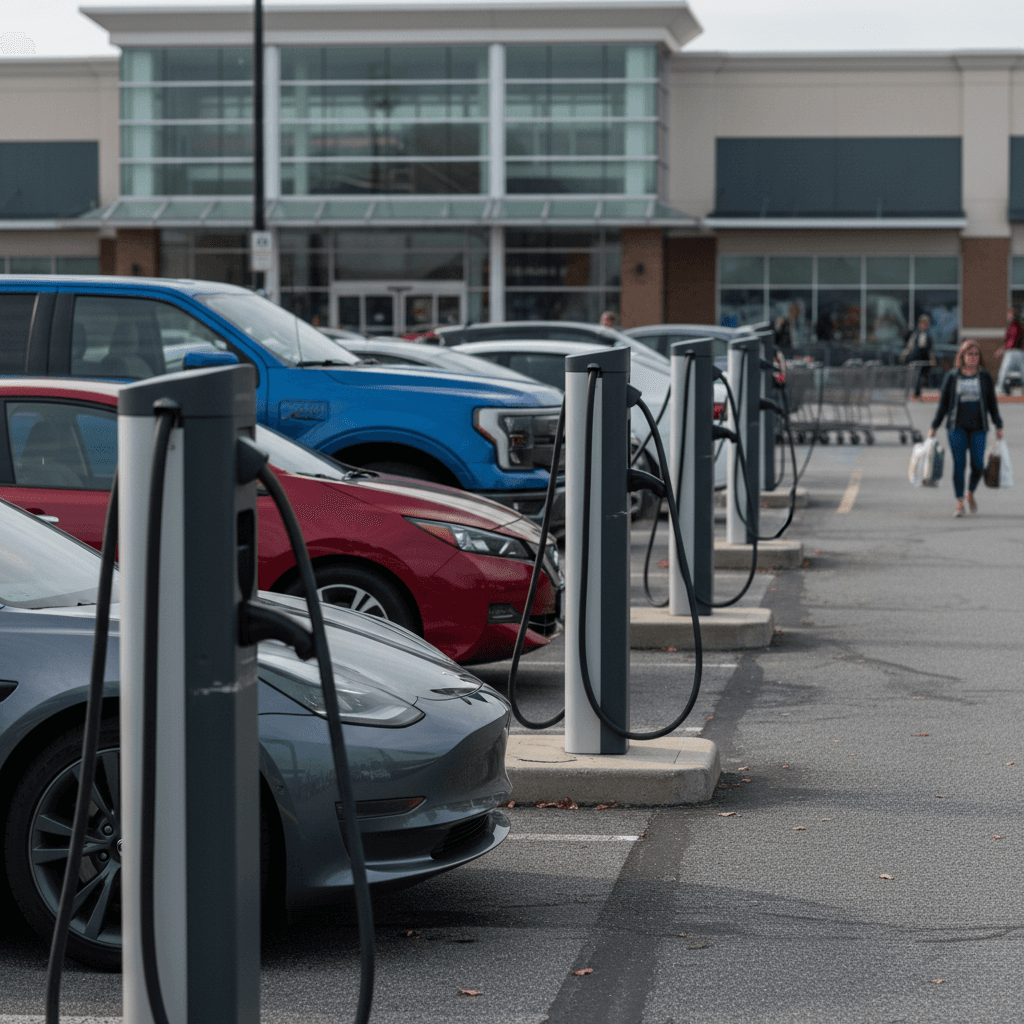
How to find EV charging stations in Hampton Roads
Finding chargers shouldn’t require detective work. Between your car’s built‑in navigation, third‑party apps, and utility tools, you can usually see station locations, real‑time availability, and pricing before you leave your driveway.
Best tools for locating chargers
Combine a few of these for the most accurate picture
In‑car navigation
Most modern EVs, Tesla, Hyundai, Ford, GM and others, surface nearby chargers right in the navigation system. Many will pre‑condition your battery for optimal fast‑charging if you select a DC site as your destination.
Apps: PlugShare, EVgo, Electrify America
Apps like PlugShare crowd‑source station status and reviews, while network apps (EVgo, Electrify America, ChargePoint, Shell Recharge) show live availability and pricing.
Local & utility tools
Dominion Energy’s online maps and tools highlight fast‑charging locations and where grid capacity is best for future installs. City websites also list chargers in municipal garages and public lots.
Step‑by‑step: finding the right charger for your stop
1. Decide how long you’ll be parked
If you’re grabbing a 15‑minute coffee, a DC fast charger makes sense. If you’re at work for eight hours, a cheaper Level 2 charger is usually the better play.
2. Filter by connector and speed
Make sure you pick a charger your EV can actually use (CCS, NACS, J1772, CHAdeMO) and match the station’s power to your needs. Your car’s max DC rating matters as much as the charger’s headline number.
3. Check recent user check‑ins
On apps like PlugShare, scroll through recent comments. They’ll quickly reveal stations that are frequently broken, blocked, or painfully slow.
4. Look at pricing structure
Some networks bill by kWh, others by the minute, sometimes with idle fees once you’re full. Price differences between sites a mile apart can be meaningful on a road trip.
5. Confirm parking rules
Municipal garages, college campuses, and hospitals may have separate parking fees or time limits layered on top of charging fees. Avoid tickets (and towing) by reading the fine print in the app and on‑site signs.
Local insider tip
Tesla Superchargers around Hampton Roads (and using them with non‑Teslas)
Tesla’s Supercharger network has long been the gold standard for road‑trip reliability. Hampton Roads benefits from this, with Superchargers at high‑traffic sites like Wawa on Virginia Beach Boulevard and other strategic stops along I‑64 and nearby corridors.
Example Tesla Supercharger access points near Hampton Roads
Exact sites change over time, but this gives you a sense of how Superchargers are sited around the region.
| Area | Typical host | Approx. power | Notes |
|---|---|---|---|
| Virginia Beach | Wawa or travel plaza | Up to 250 kW | 24/7 access; some stalls may support non‑Tesla EVs with NACS support or an adapter. |
| I‑64 corridor | Travel centers & gas stations | 150–250 kW | Designed for quick highway stops every ~50 miles as new sites open. |
| Wider region | Shopping centers, hotels | 72–250 kW | Slower "urban" Superchargers appear in dense areas where dwell times are longer. |
Always confirm locations and compatibility in the Tesla app or your car’s navigation before you drive.
Non‑Tesla access keeps improving
What you’ll pay: typical charging costs and speeds
Charging prices in Hampton Roads can vary more than gasoline, especially between slow Level 2 and high‑power DC fast charging. But a few local benchmarks help set expectations.
Typical EV charging options around Hampton Roads
Costs are ballpark estimates as of early 2026; always confirm in your charging app or at the station.
| Charging type | Where you’ll see it | Speed (approx.) | Typical cost range | Best use case |
|---|---|---|---|---|
| Home Level 1 (120V) | Standard wall outlet | 3–5 mi/hr | Included in utility bill | Overnight top‑ups for low‑mileage drivers. |
| Home Level 2 (240V) | Garage / driveway | 20–35 mi/hr | Lower per‑kWh than public DC | Daily charging if you own a home or have dedicated parking. |
| Public Level 2 | City garages, workplaces, hotels | 15–30 mi/hr | Often free–moderate, sometimes time‑based | While you work, shop, or stay overnight. |
| DC fast (50–150 kW) | EVgo, Electrify America, travel centers | 100–200+ mi/hr | Higher per‑kWh or per‑minute | Quick top‑ups on the go or on trips. |
| High‑power DC (200–350 kW) | Major highway sites, some Superchargers | 200–1,000+ mi/hr (vehicle‑limited) | Usually premium pricing | Fastest option for long‑distance travel. |
Think of Level 2 as your everyday option and DC fast charging as your road‑trip or last‑minute solution.
Fast charging sticker shock
Charging if you live in an apartment or condo
Hampton Roads has a high share of renters and multifamily housing. If you don’t have a driveway or garage, you’ll need to be more strategic, but that doesn’t mean an EV is off the table.
Realistic charging strategies for renters
Mix a couple of these and most commutes become easy to cover
Leverage workplace charging
If your employer offers Level 2 charging, that alone can cover the needs of many commuters. Even 2–3 days a week at work keeps most batteries happy.
Use city garages as your “virtual driveway”
Norfolk, Virginia Beach, Hampton and other cities host Level 2 chargers in public garages. If you live nearby, topping up a couple of evenings a week can replace home charging.
Talk to your landlord or HOA
Dominion Energy’s Level 2 programs make it easier and cheaper for property owners to install shared chargers. Come prepared with program details, not just a complaint about lack of plugs.
How to make the case for chargers at your building
1. Document demand
You’ll be more persuasive if you can show that multiple residents already own, or are considering, EVs. A quick survey or group email thread helps.
2. Bring incentive info
Point owners or HOAs to state tax credits and Dominion Energy programs that offset costs and simplify installation and maintenance.
3. Propose a simple pilot
Suggest starting with one or two shared Level 2 chargers in the most accessible parking area rather than a full complex‑wide build‑out.
4. Address operational worries
Be ready to discuss billing (networked chargers handle this), parking enforcement, and access rules. The more problems you solve up front, the easier the approval.
Why used EVs still work for renters
Planning road trips from Hampton Roads
Weekend runs to Richmond, Raleigh, the Outer Banks or even DC are firmly in reach for most modern EVs, if you let the charging network work for you rather than against you.
Example routes from Hampton Roads
- To Richmond: Roughly 90–100 miles via I‑64. Many EVs can make this without stopping if you leave with a full battery, though fast chargers along the way give you a margin of safety.
- To DC: Around 180–200 miles depending on route and starting point. Plan a stop at a fast charger along I‑64 or I‑95, especially in winter.
- To the Outer Banks: Mixed highway and local roads; check apps for DC fast options near Elizabeth City and gateway towns, plus destination Level 2 near rentals.
Simple road‑trip planning checklist
- Start with at least 80–90% charge at home or a local fast charger.
- Use your car’s route planner or a tool like A Better Routeplanner (ABRP) to map charging stops.
- Favor sites near food and clean restrooms so charging feels like a normal break.
- In cold or very hot weather, budget extra time, HVAC use reduces effective range.
- Have at least one backup station in mind in case your first choice is down or busy.
Avoid peak traffic + peak charging
Incentives, programs, and the policy backdrop in Virginia
Policy in Virginia has been a bit of a roller coaster, federal tax credits evolving, HOV incentives changing, and charging grants briefly getting caught in political crossfire. But the long‑term direction for EV infrastructure in the Commonwealth still points toward more chargers, not fewer.
What Virginia EV drivers should know in 2026
High‑level context without the legislative maze
Federal NEVI funding
Virginia was awarded over $100 million over five years to build highway fast‑charging under the NEVI program. Even after temporary funding pauses, planners are still targeting chargers roughly every 50 miles along key corridors.
State & utility incentives
Businesses can tap state‑level credits toward charger installation, and Dominion Energy’s Level 2 program reduces upfront cost and handles ongoing maintenance, especially relevant for workplaces and multifamily properties.
Perks are changing, not disappearing
Perks like solo‑driver HOV access have been scaled back, but broader infrastructure investment is rising. For most drivers, more chargers on the ground are worth more than a special license plate.
Check current incentives before you buy
Choosing the right charging strategy for your lifestyle
Match your Hampton Roads charging plan to how you drive
Daily commuter (20–60 miles/day)
Install or use Level 2 charging where you park most, home, work, or a nearby garage.
Use DC fast charging sparingly, mainly for out‑of‑pattern days or road trips.
Consider a used EV with solid battery health; you don’t need a 300‑mile pack for this pattern.
Apartment dweller with mixed driving
Anchor your routine around 1–3 public Level 2 sessions per week, ideally near home or work.
Stack errands around Level 2 chargers at grocery stores, malls, or gyms.
Use fast chargers for weekends away or unexpected longer trips.
Frequent regional traveler
Prioritize vehicles with strong DC fast‑charging curves and good highway efficiency.
Plan trips around reliable fast‑charging hubs along I‑64, I‑95 and key state routes.
Keep a Level 2 option at home or work so you start long drives with a full battery.
Two‑car household testing EV waters
Use the EV for commuting and local trips while the gas car covers edge‑case journeys initially.
Lean on public Level 2 and occasional DC fast charging instead of rushing into a major electrical upgrade.
If the EV fits 80–90% of your use, you’ll know your next car can confidently be electric.
Where Recharged fits in
Ready to find your next EV?
Browse VehiclesFAQ: EV charging stations in Hampton Roads
Frequently asked questions about Hampton Roads EV charging
Wrapping up: how Recharged can help your Hampton Roads EV journey
Hampton Roads isn’t yet a charging utopia, but it’s far ahead of where it was even a couple of years ago, and the trajectory is clear. Between expanding fast‑charging along I‑64, growing clusters of Level 2 stations in city garages and retail hubs, and utility‑backed programs for workplaces and apartments, EV ownership in the region keeps getting easier.
The key is matching the right car and charging strategy to your real life. That’s exactly where Recharged comes in. Every used EV on our platform includes a Recharged Score battery health report, transparent pricing, and expert EV‑specialist support so you understand how that car will behave on your Norfolk commute or your weekend runs to the Outer Banks. With digital buying, financing options, trade‑ins and nationwide delivery, or an in‑person visit to our Experience Center in Richmond, you can focus less on decoding charging maps and more on finding the EV that truly fits Hampton Roads life.