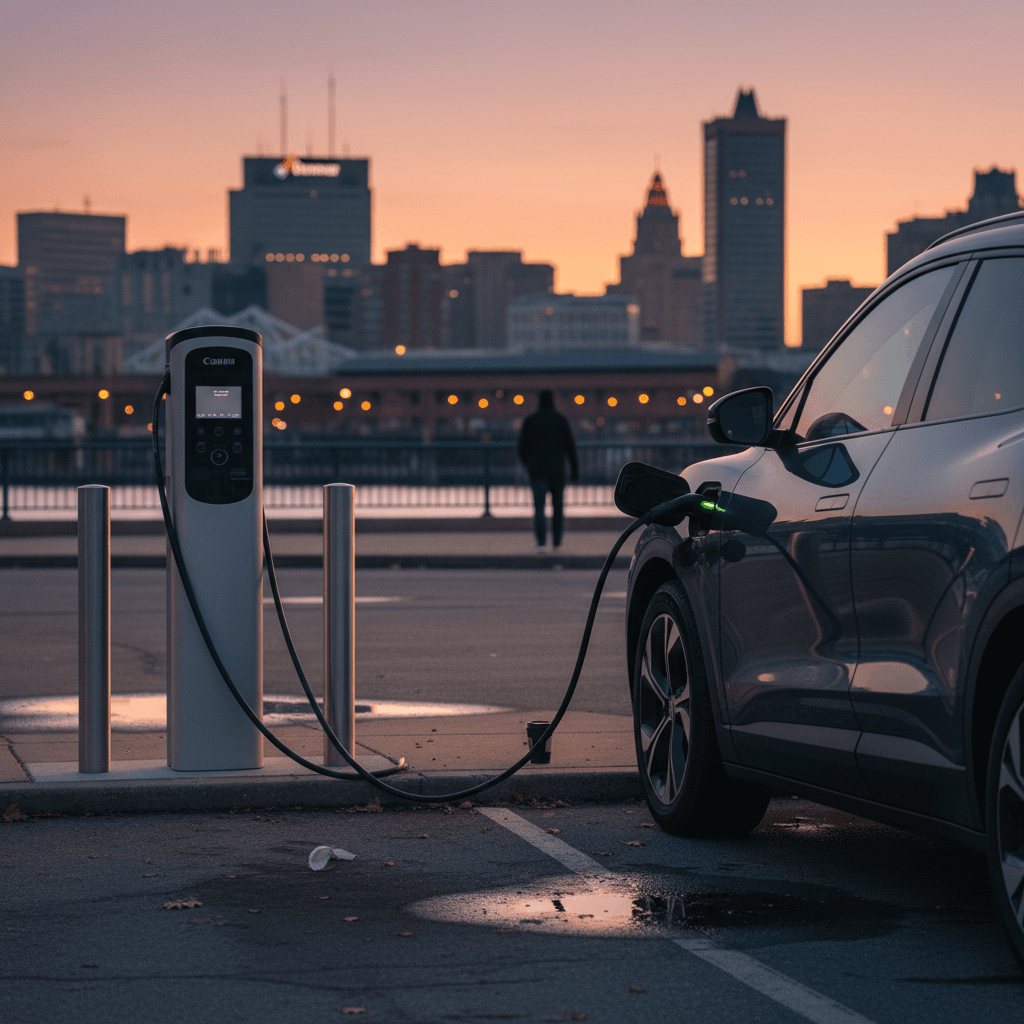
If you drive an electric car in Baltimore, your daily routine probably revolves around **where you can plug in**, at home, on the street, or in one of the city’s garages. The good news: the **EV charging station network in Baltimore, MD** is growing fast, from Inner Harbor garages to I‑95 and tunnel plazas. This guide walks you through the types of chargers you’ll see, how to find reliable stations, what they cost, and how charging fits into owning (or shopping for) a used EV in Charm City.
Baltimore is quietly building a real EV network
Overview: EV charging in Baltimore, MD
Baltimore sits in the middle of one of the most EV‑friendly states in the country. Maryland has a long‑running **Electric Vehicle Supply Equipment (EVSE) Rebate Program** that helps residents and businesses pay for chargers, plus separate community charging grants aimed at underserved neighborhoods. On top of that, the Maryland Transportation Authority (MDTA) now hosts public chargers at key tunnel and bridge facilities including the **Baltimore Harbor Tunnel** and **Fort McHenry Tunnel**, which matter if you commute via I‑95 or I‑895.
Maryland and Baltimore EV charging snapshot
Those high‑level numbers don’t tell you whether you can plug in near your rowhouse or office, though. For that, you need to understand **charger types**, where stations actually sit around the city, and how to navigate pricing and parking rules.
Level 1, Level 2 and DC fast charging in Baltimore
Every charger you’ll see in Baltimore falls into one of three buckets. Knowing the difference helps you match **charging speed** to your schedule and budget:
Three types of EV charging you’ll use around Baltimore
Match the speed to your commute and living situation
Level 1 (120V)
Think of Level 1 as a trickle charge from a regular household outlet.
- Adds roughly 3–5 miles of range per hour.
- Best for overnight charging if you drive very little or park 12+ hours.
- Most useful for single‑family homes with dedicated parking.
Level 2 (240V)
Level 2 is the workhorse for both home and public EV charging stations in Baltimore, MD.
- Adds ~20–40 miles of range per hour depending on your car.
- Common in city garages, workplaces and multifamily lots.
- Sweet spot for topping up during work or errands.
DC fast charging (DCFC)
DC fast chargers dump energy into your battery much more quickly.
- Typical public units: 50–350 kW power output.
- Can add 150+ miles of range in 30–45 minutes on many EVs.
- Best for road trips, rideshare drivers, or emergency top‑ups.
Watch your battery on frequent fast charging
Where to find EV charging stations in Baltimore
Baltimore’s EV charging map looks very different depending on whether you’re downtown, in a neighborhood like Hampden or Federal Hill, or commuting from county suburbs. You’ll find clusters of chargers in three broad categories: **city and MDTA facilities, private garages and lots, and retail or highway sites**.
City garages and public facilities
- Downtown & Inner Harbor garages managed by the Parking Authority increasingly include Level 2 stations. These are ideal if you leave your car for a workday or an Orioles game.
- Municipal buildings & parks sometimes host chargers as pilots, especially where the city has pursued state EVSE grants.
- MDTA toll facilities at the Baltimore Harbor Tunnel and Fort McHenry Tunnel offer public charging that’s convenient if you commute along I‑95 or I‑895.
Private garages, retail and corridors
- Apartment & office garages often install Level 2 chargers for tenants and employees. Access may be restricted, but some are open to public use via network apps.
- Grocery, big‑box and shopping centers host a mix of Level 2 and DC fast chargers, common spots for 30–60 minute top‑ups while you shop.
- Highway and corridor sites along I‑95, I‑83 and I‑70 increasingly feature multi‑stall DC fast charging plazas, useful if you’re coming in from suburbs or heading to D.C., Philly or New York.
Use apps, not just your car’s map
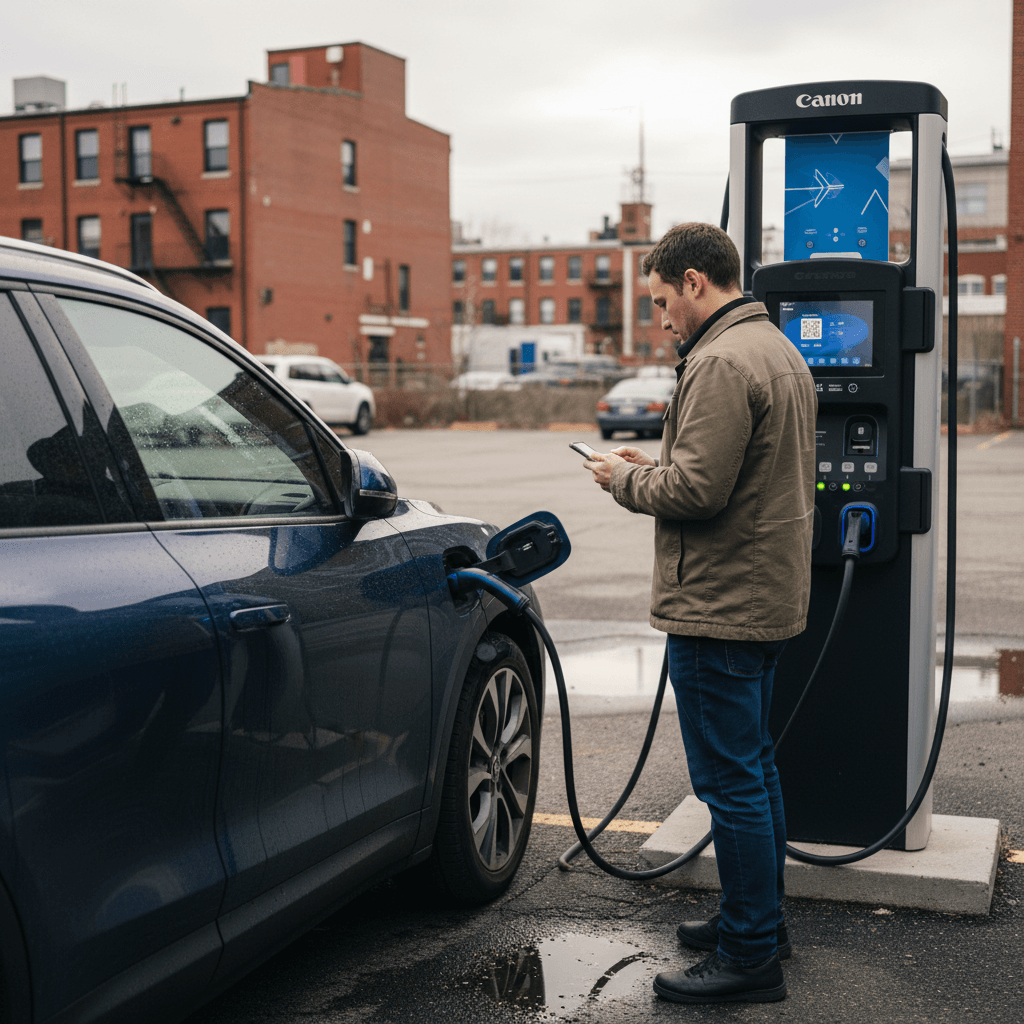
Major public charging networks in Baltimore
Most **EV charging stations in Baltimore, MD** are operated by a handful of national or regional networks plus some utility‑run infrastructure. You’ll see these names on the hardware, the app, or both.
Key charging networks serving Baltimore drivers
You’ll encounter a mix of Level 2 and DC fast options. Here’s how they generally stack up.
| Network | Typical sites | Common speeds | Access model |
|---|---|---|---|
| BGE EVsmart | Baltimore Gas & Electric territory: workplace, retail, public lots | Level 2 and some DC fast | RFID card or app; often kWh‑based pricing with off‑peak discounts |
| Blink / SemaConnect | City garages, commercial properties, universities | Level 2, some DC fast | Blink app, RFID, or credit card where enabled |
| Electrify America | Highway‑adjacent shopping centers and big‑box stores | 150–350 kW DC fast plus some Level 2 | App or card; many stations support tap‑to‑pay |
| EVgo | Urban parking lots, retail centers | 50–350 kW DC fast, some Level 2 | App, RFID, or credit card at many locations |
| Tesla Supercharger (with adapters) | Interstate corridors and some urban sites | Up to 250 kW DC fast | Tesla app; many newer non‑Tesla EVs can use these with built‑in NACS ports or adapters |
| Property‑specific networks | Apartments, offices, hospitals | Mostly Level 2 | Access often controlled by building management or a private app |
Exact locations and prices change frequently, so always confirm details in the network’s app before you plug in.
Baltimore is home turf for one big player
What it costs to charge in Baltimore, and parking rules to know
Public charging prices in Baltimore vary by network, site host and charger speed. You’ll typically see pricing in one of three formats: **per kilowatt‑hour (kWh), per minute, or session plus time‑based fees**. Maryland regulators have pushed operators toward **energy‑based billing**, especially as shared‑power sites can make per‑minute pricing unfair if your car is charging slowly.
Typical public charging costs
- Level 2 in garages: Often priced per kWh, sometimes with a small connection fee. Expect total session costs similar to or slightly higher than home electricity for the same energy.
- DC fast charging: Priced higher per kWh or per minute to reflect the infrastructure cost. Think of it as paying a premium for speed and convenience.
- Idle or overstay fees: Many networks now add a per‑minute fee once your battery is full or after a grace period to keep stalls turning over.
Parking rules that can surprise you
- “EV charging only” is not just a suggestion. In city garages and some lots, you can be ticketed or towed if you park an EV in a charging bay without plugging in, or if you leave it there long after charging completes.
- Time‑limited charging: Some Baltimore garages email or post rules like a 15‑minute grace window after your charge finishes before fines or extra fees kick in.
- Garage fees are separate: Don’t forget that garage parking charges typically apply in addition to whatever the charging network bills you.
Don’t be that driver blocking the charger
Home vs. public charging for Baltimore drivers
How heavily you rely on **public EV charging stations in Baltimore, MD** will depend on where you live and park. A rowhouse with a private driveway in Lauraville is a very different situation from a walk‑up in Canton with only street parking. Maryland’s own EV guidance stresses that most charging is still done at home when possible, with public charging filling in gaps for renters, condo owners and road‑trippers.
Deciding whether you can mostly charge at home
1. Do you have dedicated off‑street parking?
If you have a garage, driveway or deeded space near your home, installing Level 2 charging is usually the cheapest and most convenient long‑term option.
2. Can your electrical panel handle a 240V circuit?
Older Baltimore homes sometimes need panel upgrades before adding a 40–60 amp circuit for an EV charger. Maryland and federal incentives can offset some of that cost if the work supports EV charging.
3. Does your building or HOA allow chargers?
In condos and townhome communities, you’ll likely need HOA approval and a contractor who understands both code and property rules. Many boards are more receptive now that state incentives reduce their costs.
4. How many public stations are within a short walk?
If you rent without off‑street parking, check a charging map for nearby Level 2 options you’re comfortable using late at night or early in the morning when demand is lower.
5. What does your weekly driving actually look like?
Plenty of urban drivers average under 150 miles a week. In that case, a mix of Level 1 at home (if available) and an occasional long Level 2 session downtown might cover your needs.
The sweet spot: home Level 2 plus occasional public fast charging
Maryland incentives and utility programs for EV charging
Maryland doesn’t just build public EV infrastructure, it also helps residents and businesses pay for charging. That matters in Baltimore, where panel upgrades and structured parking can otherwise make home or workplace installations expensive.
- Maryland EVSE Rebate Program (MEA): For eligible Level 2 and DC fast chargers, the state offers a rebate worth up to 50% of hardware and installation costs, subject to caps and annual funding. Funding windows and maximums change by fiscal year, so always confirm current details before you start a project.
- Community EVSE grants: Maryland’s Community EVSE Program funds chargers in low‑ and moderate‑income and overburdened communities, many of which are in or around Baltimore City. This is why you’re starting to see more chargers at community centers, libraries and small business districts.
- Utility programs (BGE EVsmart): BGE’s EVsmart program has combined rebates for eligible home chargers with **time‑of‑use (TOU) rates or bill credits** for off‑peak charging. That makes it cheaper to top up overnight compared with daytime home charging.
- Federal tax incentives: Through 2025, federal credits can help with certain panel upgrades and commercial charging infrastructure, especially in designated census tracts. The details are complex, so it’s smart to confirm with a tax professional before counting on the credit.
Stack incentives when you can
Choosing the right EV for Baltimore based on charging access
If you’re shopping for a used EV in Baltimore, your charging options should shape what you buy just as much as color or trim. That’s especially true if you’ll depend heavily on **public EV charging stations in Baltimore, MD** rather than a home charger.
If you mostly charge at home
- Range can be modest. A smaller‑battery EV with 200 miles of EPA range may be plenty if you plug in every night.
- Charging speed matters less. A car limited to 7.2 kW on AC charging is fine when it sits on Level 2 for 8–10 hours.
- Road‑trip fast charging still counts. If you take frequent long drives on I‑95 or I‑70, look for an EV with reliable DC fast‑charging performance and good compatibility with major networks and, increasingly, Tesla Superchargers.
If you rely on public charging
- Prioritize fast‑charge capability. A car that can accept 100–150 kW or more on DC fast chargers will spend less time parked at paid stations.
- Look for strong Level 2 speeds. An onboard charger that supports 11 kW AC can turn a 3–4 hour garage stay into a meaningful recharge.
- Check connector support. In 2026, more used EVs will include or support NACS adapters, opening up Tesla Superchargers along with CCS networks, helpful for Baltimore‑to‑Philly or Baltimore‑to‑NY runs.
How Recharged fits into the picture
FAQ: EV charging stations in Baltimore, MD
Frequently asked questions about EV charging in Baltimore
Bottom line for Baltimore EV drivers
Baltimore isn’t California yet, but the city and state have put real money and planning behind **EV charging stations in Baltimore, MD**, from MDTA tunnel plazas to city garages, retail sites and neighborhood‑level projects supported by state grants. If you already drive electric, now is the time to learn which networks you like, when idle fees kick in, and how to combine home, workplace and public charging so you’re rarely forced into an expensive last‑minute fast charge.
If you’re still shopping, start with your charging reality: do you have a driveway in the city, or will you live on public chargers and garage infrastructure? Then choose a used EV and a charging plan that fit that reality. Recharged can help you do both, pairing **battery‑verified used EVs** with clear upfront pricing and guidance on how that specific car will fit into Baltimore’s fast‑evolving charging network, so you spend less time worrying about plugs and more time just driving.