EV charging cost in 2026 is having a moment. Home electricity prices are at record highs, public fast charging can flirt with gas-car money, and every EV ad still promises “cheap to run.” If you’re trying to make sense of what charging will actually cost you this year, you’re not wrong to be skeptical.
A quick 2026 snapshot
Why EV charging costs matter in 2026
Electricity prices have climbed noticeably in 2024–2025, driven by grid upgrades, fuel costs, and the AI data‑center boom. By mid‑2025, average U.S. residential rates were hovering in the **mid‑ to high‑teens cents per kWh**, and many forecasts point to **around 17–18¢/kWh** on average in 2026. That changes the EV value story: home charging is still usually cheaper than gas, but it’s no longer a rounding error on your budget, and public DC fast charging can be downright pricey.
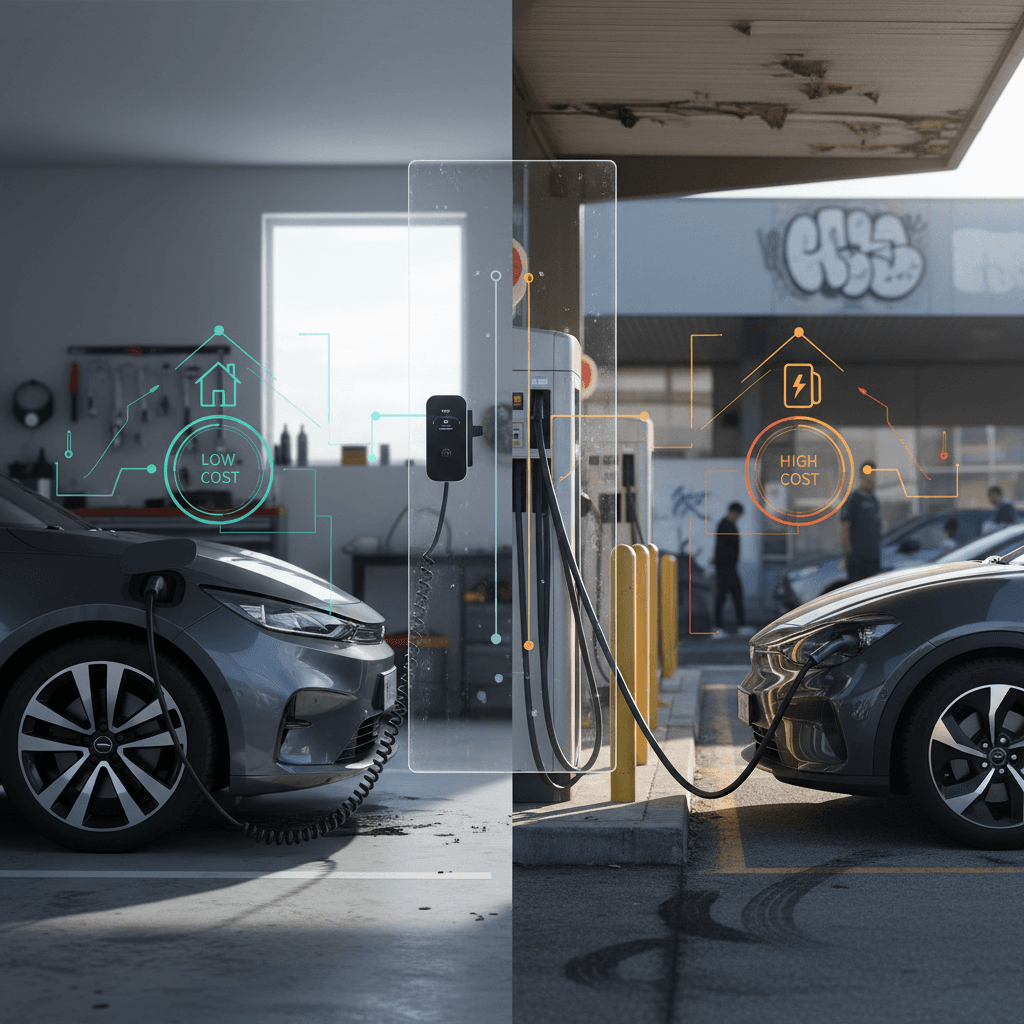
At the same time, public fast‑charging networks have nudged prices upward. Industry trackers put the **national average DC fast‑charging price around $0.45–$0.50/kWh in late 2025**, and there’s no sign of that easing in early 2026. That’s roughly **three to five times** what many homeowners pay for off‑peak electricity.
EV charging cost benchmarks for 2026 (United States)
How EV charging cost is actually calculated
Underneath the billing schemes and loyalty programs, **EV charging cost is three simple numbers multiplied together**:
- Your **electricity price** (¢/kWh or $/kWh).
- Your car’s **energy use**: kWh per 100 miles (often shown as kWh/100 mi or MPGe).
- How many **miles you drive**.
The core formula looks like this: Cost per 100 miles = (Electricity price per kWh) × (kWh used per 100 miles). So if your EV averages 28 kWh/100 mi and you pay $0.17/kWh at home, your energy cost is about **$4.76 per 100 miles**, or **4.8¢/mi**. Same car on a $0.49/kWh fast charger? Now it’s roughly **$13.72 per 100 miles**, or **13.7¢/mi**, suspiciously close to a thrifty gas sedan.
Know your own numbers
Home EV charging cost in 2026
In 2026, most U.S. households can assume **$0.15–$0.20 per kWh** for residential electricity, with some states well below and some painful outliers above $0.30. Using a middle‑of‑the‑road **$0.17/kWh** and a reasonably efficient EV that uses **28 kWh/100 mi**, here’s the math:
Typical 2026 home charging costs (U.S. averages)
Estimates use 17¢/kWh electricity and 28 kWh/100 mi unless noted.
| Scenario | Assumptions | Estimated Cost |
|---|---|---|
| Daily commuter | 35 miles/day, 5 days/week | ≈$12–$15/month in electricity |
| Average driver | 1,000 miles/month | ≈$45–$50/month |
| Heavy driver | 1,500 miles/month | ≈$70–$80/month |
| Inefficient EV or winter driving | 34 kWh/100 mi, 1,000 miles/month | ≈$55–$60/month |
| High‑cost electricity state (28¢/kWh) | 28 kWh/100 mi, 1,000 miles/month | ≈$75–$80/month |
Your results will vary by state and by vehicle efficiency, but the pattern, home far cheaper than fast charging, holds almost everywhere.
Watch the fixed fees
Level 1 (120V) at home
- Uses a standard household outlet.
- Slow but simple: often 3–5 miles of range per hour.
- Cost per kWh is the same as any other electricity you use.
- Best for low‑mileage drivers and renters who can’t install a charger.
Level 2 (240V) at home
- Dedicated 240V circuit, often 32–48 amps.
- Typical **25–40 miles of range per hour** of charging.
- Same ¢/kWh rate as Level 1, but much more convenient.
- Upfront hardware + install, but usually the **lowest lifetime cost per mile** for EV driving.
Off‑peak charging can be a game‑changer
What public Level 2 charging costs in 2026
Public Level 2, those 6–11 kW AC chargers outside grocery stores, parking garages, and offices, sits in an awkward middle ground. It’s **slower than DC fast charging**, but the operator has to recover equipment, network, and parking costs, so prices are often much higher than your home rate.
Typical 2026 public Level 2 pricing models
You’ll usually see one of these four approaches on the screen or in the app.
Per‑kWh pricing
Most common where regulations allow utilities to bill by energy:
- $0.25–$0.40/kWh is typical.
- Same formula as home, just a higher price.
- 100 miles in an efficient EV: roughly $7–$11.
Per‑minute pricing
Common in states that historically restricted per‑kWh billing:
- Rates like **$0.03–$0.10 per minute**.
- Effective $/kWh depends on your car’s onboard charger speed.
- Slow‑charging cars get a worse deal.
Session or parking fee
Flat fee for a plug‑in session or bundled parking:
- Examples: **$2–$5 to start** or added to garage fee.
- Can be cheap for a quick top‑up, expensive for long sessions.
Workplace / destination perks
Office, hotel, or retail chargers:
- Sometimes free as an employee or guest amenity.
- Other times priced slightly below nearby public chargers.
- Convenience and parking often matter as much as pure ¢/kWh.
Check the fine print before you plug in
DC fast charging prices in 2026
Fast charging is where the EV cost story gets complicated. You’re paying for speed, infrastructure, and grid demand. As of late 2025, multiple analyses put the **average U.S. DC fast‑charging price near $0.49/kWh**, and many urban or high‑demand sites push into the low‑50‑cent range. Membership plans and off‑peak discounts can shave that down, but nobody is giving electrons away at 350 kW.
What DC fast charging really costs in 2026
Assumes an EV that averages 28 kWh/100 mi in mild weather.
| Pricing example | Electricity price | Approx. cost per 100 mi | Approx. cost per 1,000 mi |
|---|---|---|---|
| Budget DCFC (membership, off‑peak) | $0.35/kWh | ≈$9.80 | ≈$98 |
| Typical highway station | $0.45/kWh | ≈$12.60 | ≈$126 |
| High‑cost urban site | $0.55/kWh | ≈$15.40 | ≈$154 |
| Premium network, demand spike | $0.60/kWh | ≈$16.80 | ≈$168 |
If you road‑trip a lot and rely heavily on DCFC, your EV can cost nearly as much per mile as an efficient gas car.
The expensive half‑charged battery
Tesla Supercharger pricing
- Most U.S. sites charge by kWh; some legacy sites still use per‑minute tiers.
- Prices vary widely by region and time of day: think **$0.30–$0.55/kWh** as a broad range.
- Dynamic congestion pricing at busy stations is becoming more common.
Other fast‑charging networks
- Electrify America, EVgo, and others often land in the **$0.40–$0.55/kWh** band.
- Memberships can knock **15–25%** off the headline rate.
- Some networks are adding idle fees and peak pricing to manage demand.
Road‑trip reality check
EV charging cost vs gas in 2026
To compare fairly, you have to talk in **cost per mile**. Let’s assume a typical compact crossover EV that averages **28 kWh/100 mi**, and a comparable gas crossover that averages **30 mpg**. Assume gas at **$3.75/gal**, a perfectly boring 2026 national average.
Cost per mile: EV vs gasoline in 2026
Same size vehicle, different fuel. Numbers rounded for clarity.
| Fuel scenario | Assumptions | Approx. cost per 100 mi | Approx. cost per mile |
|---|---|---|---|
| EV, mostly home charging | $0.17/kWh, 28 kWh/100 mi | ≈$4.76 | ≈$0.048 |
| EV, mix of home + public L2 | Blend to ~$0.25/kWh | ≈$7.00 | ≈$0.070 |
| EV, mostly DC fast charging | $0.49/kWh average | ≈$13.72 | ≈$0.137 |
| Gas vehicle | 30 mpg, $3.75/gal | ≈$12.50 | ≈$0.125 |
Home‑first charging keeps EVs clearly cheaper to operate; public fast charging narrows or erases the gap.
The sweet spot: charge like a commuter, not a taxi
Seven ways to lower your EV charging cost in 2026
Practical tactics you can use this month
1. Enroll in a time‑of‑use (TOU) rate
Call your utility or check its website for EV or TOU plans. Shifting charging to late night hours can cut your ¢/kWh by 20–40% in many markets, especially if daytime prices have spiked.
2. Schedule charging in your car or app
Almost every modern EV lets you set start/stop times. Align those with your utility’s cheap hours so you don’t have to think about it, and you’re not accidentally charging at peak rates.
3. Right‑size your home charger
A 48‑amp beast is nice, but a 32‑ or 40‑amp Level 2 charger is plenty for many commuters and usually cheaper to install. You’re paying for **amperage, wiring, and breaker size**, not better electrons.
4. Treat DC fast charging as a luxury
On road trips, charge just enough to reach the next efficient stop, often **10–80%**, then get back on the road. In daily life, reserve DCFC for genuine time emergencies, not habit.
5. Improve your driving efficiency
Gentler acceleration, lower highway speeds, and using Eco modes can cut your kWh/100 mi by 10–20%. In winter, pre‑heat the car while plugged in so the pack doesn’t have to climb out of a cold‑soak on its own dime.
6. Hunt for workplace and retail deals
Ask your employer about EV charging policies. Some offices quietly subsidize Level 2. Apps like PlugShare and Chargeway can help you find lower‑cost or free destination chargers.
7. Keep your charging hardware healthy
Loose connections and damaged cables are not just a safety issue, they can reduce charging efficiency. If you buy a used EV, consider an electrical checkup and a modern Level 2 charger that plays nicely with TOU rates.
Real‑world 2026 cost scenarios
Three charging profiles, and what they really pay
Use these as rough yardsticks to sanity‑check your own situation.
Urban renter, no home charging
Profile: Apartment dweller using public L2 and some DCFC.
- 800 miles/month.
- 70% public L2 at $0.30/kWh, 30% DCFC at $0.49/kWh.
- Blended energy price ≈ $0.36/kWh.
Result: About $100–$110/month in electricity, closer to gas‑car money, but still stable versus volatile gasoline spikes.
Suburban commuter with garage
Profile: Detached home, 240V outlet, rare fast charging.
- 1,000 miles/month.
- 90% home at $0.16/kWh, 10% DCFC for trips.
- Blended price ≈ $0.18/kWh.
Result: Around $50–$60/month, like driving a 60–70 mpg gas car, without hunting for cheap stations.
Road‑trip heavy driver
Profile: Frequent long‑distance travel, lots of DCFC.
- 1,200 miles/month, half done on road trips.
- 50% home at $0.17/kWh, 50% DCFC at $0.49/kWh.
- Blended price ≈ $0.33/kWh.
Result: Around $110–$125/month. Still competitive with gas, but nowhere near the “pennies to run” mythology.
If you can’t charge at home, do the math first
Used EVs: charging costs and battery health
On a used EV, charging cost is a two‑part story: the cost of electricity, and how much of it the battery wastes. A healthy pack and efficient thermal management system mean more of each kWh turns into miles. A tired pack or a car that’s been DC‑fast‑charged to death will **use more kWh per 100 miles** and spend longer, and more money, on fast‑charging pedestals.
Why battery health affects your bill
This is where buying from a specialist EV marketplace like Recharged really matters. Every vehicle on Recharged comes with a **Recharged Score Report**, including verified battery health and charging behavior insights. That helps you understand not just how far the car will go, but how much it will cost to feed over the next several years.
How Recharged helps you avoid a kilowatt‑hour money pit
Ready to find your next EV?
Browse VehiclesEV charging cost 2026: FAQ
Frequently asked questions about EV charging cost in 2026
The bottom line on EV charging cost in 2026
In 2026, EVs are no longer powered by magic; they’re powered by the same stressed‑out grid that’s lighting your kitchen and feeding the cloud. That means **charging costs are real money**, especially if you lean hard on public fast charging. But if you can plug in at home or at work, keep an eye on time‑of‑use rates, and treat DCFC as an occasional tool, an EV still looks like a **60‑mpg‑equivalent** car that just happens to be silent and quick.
If you’re shopping for your first, or next, EV, price out **your personal mix**: home, work, public. Then look at models not just by range and 0–60 times, but by efficiency and battery health. That’s exactly the gap Recharged tries to close: verified battery diagnostics, transparent pricing, and EV‑savvy guidance so you understand both the **up‑front cost** and the **ongoing cost per mile** before you click “buy.”