If you’re shopping for an electric car, you keep seeing numbers like 60 kWh, 77 kWh, or 100 kWh for EV car battery capacity, but what do they actually mean for range, performance, and long‑term value? And how worried should you be about capacity loss on a used EV?
Quick definition
What EV car battery capacity actually means
Think of EV car battery capacity like the size of a fuel tank, but measured in energy instead of gallons. The unit is the kilowatt-hour (kWh). One kWh is the amount of energy needed to run a 1 kW device for one hour. If an EV has a 60 kWh battery, in theory it can deliver 60 kW of power for one hour, or 6 kW for ten hours, and so on.
- Battery capacity (kWh) = how much energy the pack can store
- Motor power (kW) = how quickly the car can use that energy
- Consumption (kWh/100 miles or mi/kWh) = how efficiently the car uses capacity to move you
New EV spec sheets usually list both gross capacity (total pack size) and usable capacity (what the car lets you access). Automakers reserve a buffer at the top and bottom of the pack to extend life, so a car advertised with a 77 kWh battery might give you ~73 kWh usable in day‑to‑day driving.
Tip: focus on usable kWh
How kWh translates into real-world EV range
To turn EV car battery capacity into an estimated range, you need one more number: efficiency. In the U.S., the EPA labels and many automakers express this as kWh per 100 miles or miles per kWh (mi/kWh).
- Find usable battery capacity in kWh
- Estimate efficiency in mi/kWh (or convert from kWh/100 miles)
- Range ≈ usable kWh × mi/kWh
For example, suppose an EV has a usable 77 kWh pack and averages 3.5 mi/kWh in mixed driving. Rough range is about 270 miles (77 × 3.5). A more efficient sedan with 4.0 mi/kWh and the same capacity would be closer to 308 miles. Same capacity, very different result.
Typical real-world EV efficiency today
Highway vs city reality
Typical EV battery capacity sizes in 2025
Battery capacity has become one of the big levers automakers use to position price and range. In 2025, most new EVs cluster into a few rough brackets:
Common EV battery capacity brackets in 2025
Approximate ranges for modern EV battery packs and what they typically deliver.
| Usable capacity (kWh) | Typical vehicle type | Approx. EPA range | Good fit for |
|---|---|---|---|
| 40–55 kWh | Smaller crossovers, compact hatchbacks | 150–230 miles | Short commutes, city driving, second cars |
| 60–77 kWh | Mainstream sedans and crossovers | 230–320 miles | Most U.S. drivers, mixed city/highway use |
| 80–100 kWh | Larger SUVs, performance sedans | 280–380 miles | Frequent road trips, heavier vehicles |
| >100 kWh | Premium long-range and performance EVs | 350+ miles | High-performance or luxury buyers prioritizing range |
Real‑world range depends heavily on efficiency, climate, and driving style, these are directional, not promises.
Trend: smarter, not just bigger
Battery capacity vs efficiency: why kWh isn’t everything
Big battery, mediocre efficiency
Imagine a 100 kWh SUV that averages just 2.3 mi/kWh at highway speeds because it’s heavy and as aerodynamic as a brick.
- Estimated range: ~230 miles
- Long charging sessions, especially on Level 2
- Expensive pack, more raw materials
Smaller battery, great efficiency
Now picture a 70 kWh mid‑size sedan that achieves 3.8 mi/kWh thanks to slippery aerodynamics and an efficient powertrain.
- Estimated range: ~266 miles
- Faster to recharge to full
- Cheaper to build, potentially cheaper to buy
Both cars above deliver comparable usable range, even though one has 30 kWh less capacity. When you’re cross‑shopping EVs, it’s worth looking beyond the headline battery size and paying attention to efficiency ratings and real‑world owner reports.
How to compare two EVs quickly
How EV battery capacity degrades over time
All lithium‑ion packs lose some capacity as they age. The good news is that large datasets of real‑world EVs show modern batteries holding up far better than early skeptics predicted. Many studies now peg average long‑term degradation around 1.5–2% of capacity per year, with a slightly steeper drop in the first couple of years and a slower slope after that.
- After 1–2 years: a few percentage points of capacity loss is common
- After ~5 years: many EVs still retain around 90–95% of original capacity
- After 8–10 years: 80–90% of capacity is typical in real‑world fleet data, depending on climate and usage
- Manufacturers often warrant at least 70% remaining capacity at 8 years or ~100,000–150,000 miles
Degradation isn’t linear
What accelerates EV battery capacity loss?
Four habits and conditions that matter far more than the odometer alone.
High heat
Living at 100%
Constant DC fast charging
Aggressive driving & towing
The encouraging reality
Battery capacity warranties and when to worry
Because capacity is so central to EV value, automakers back it with separate battery warranties, usually distinct from the basic bumper‑to‑bumper coverage. In the U.S., most brands guarantee that your pack will retain around 70% of its original capacity for 8 years or 100,000–150,000 miles, whichever comes first.
When should falling capacity be a red flag?
Capacity well below peers of same age
If the EV shows significantly less remaining capacity than typical cars of the same model year and mileage, something may be off.
Range below your daily needs
Even if the pack is technically “within spec,” it’s a practical problem if real‑world range no longer covers your commute and routine trips without stress.
Out of warranty and rapid decline
If you’re outside the 8‑year battery warranty and capacity starts dropping quickly, replacement or major repair may be on the horizon.
Fast‑charging throttled aggressively
Some cars limit DC fast‑charge speeds when the pack loses health. That’s an indirect but important sign of battery aging.
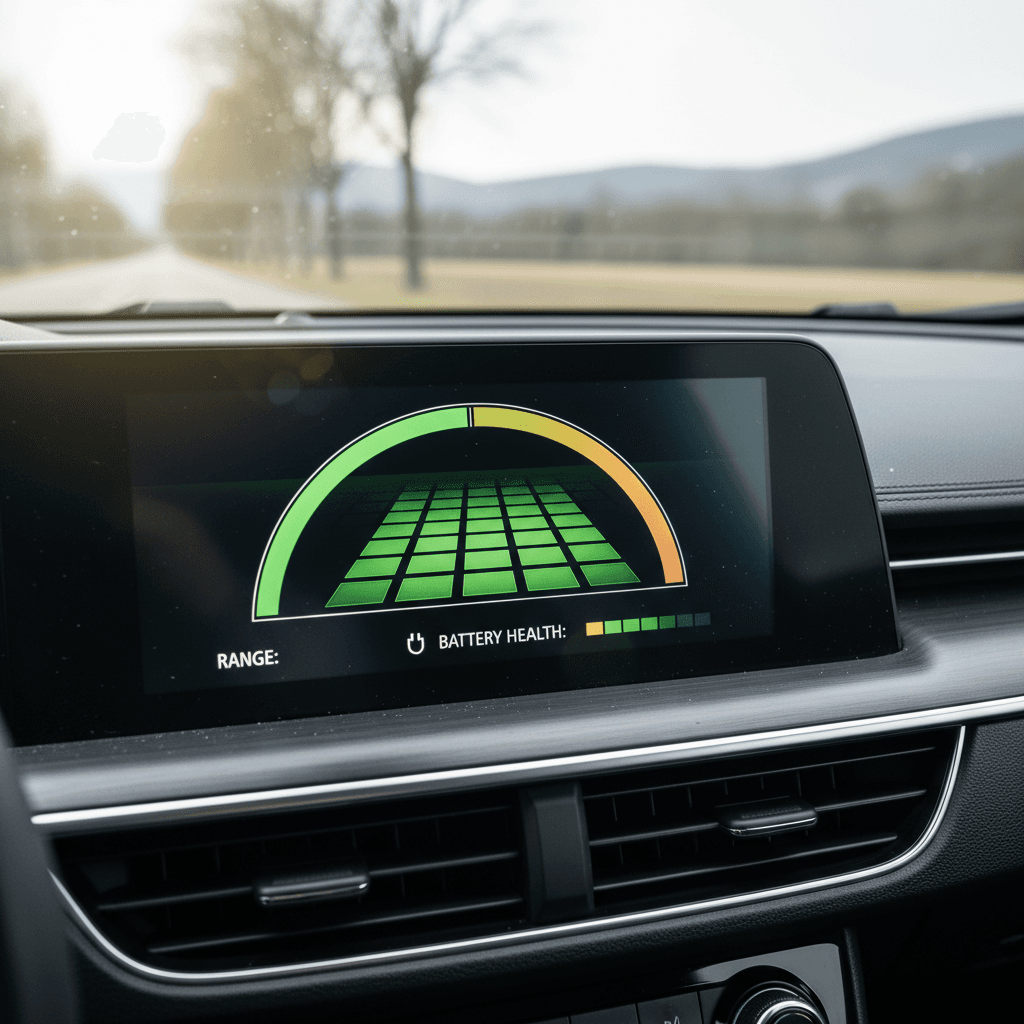
Don’t rely on the dash bar alone
How much EV battery capacity do you really need?
It’s tempting to chase the biggest battery you can afford, but that’s often the wrong move economically. A larger pack adds cost, weight, and charging time. The right EV car battery capacity is the smallest pack that comfortably covers your real life with a healthy margin.
4 steps to choose the right battery capacity
1. Map your real daily miles
Look at a typical week: commute, errands, kids’ activities. Many U.S. drivers average 30–40 miles per day, which even smaller packs handle easily.
2. Consider winter and highway use
If you regularly drive in cold climates or at 75–80 mph, assume 20–30% less range than the EPA sticker in those conditions.
3. Decide your comfort buffer
Some drivers are fine arriving home at 10–15% state of charge; others want 30% in reserve. Your buffer effectively shrinks usable capacity.
4. Think about where you’ll charge
Home overnight Level 2 charging makes a smaller battery feel bigger. Relying on public fast charging may justify a larger pack for flexibility.
Home charging changes the math
Battery capacity and used EV shopping with Recharged
When you’re buying a used EV, battery capacity isn’t an abstract spec, it’s the core of the car’s value. Two cars with the same odometer reading can have very different remaining capacity and real‑world range. That’s exactly the uncertainty Recharged is designed to remove.
How Recharged makes EV battery capacity transparent
Every EV comes with a Recharged Score Report focused on the pack, the most expensive component in the car.
Verified battery health
Degradation in context
Pricing that reflects capacity
Ready to find your next EV?
Browse VehiclesOn top of that, Recharged offers financing, trade‑in support, instant offers or consignment, nationwide delivery, and EV‑specialist guidance. If you’re capacity‑conscious, and you should be, having a clear, third‑party view of the battery is the single best way to shop used EVs with confidence.
Frequently asked questions about EV battery capacity
EV car battery capacity FAQs
Key takeaways: making sense of EV battery capacity
- EV car battery capacity (kWh) is your energy tank size, but efficiency decides how far that tank takes you.
- Most new EVs fall between 50 and 100 kWh, with 60–80 kWh covering the sweet spot for many U.S. drivers.
- Real‑world range depends on efficiency, speed, climate, and how high you charge the battery, not just the published EPA number.
- Modern EV batteries usually retain 80–90% of their capacity after many years, especially when not abused by heat or constant fast charging.
- When buying used, verified usable capacity in kWh is far more important than odometer alone, this is where the Recharged Score Report earns its keep.
- The “right” battery capacity is the smallest pack that comfortably fits your driving patterns, charging access, and road‑trip expectations.
If you treat battery capacity as the foundation of an EV’s value, the market suddenly becomes much easier to navigate. Instead of chasing the biggest number on the window sticker, you can focus on what matters: how many miles you need, how often you can charge, and how healthy the pack really is. And if you’d rather not decode all of that on your own, Recharged’s combination of verified battery diagnostics, transparent pricing, financing, and nationwide delivery takes the guesswork out of choosing the right EV for the long haul.