Under everything you love about an electric car, instant torque, quiet cruising, dirt‑cheap “fuel”, there’s one fragile hero: the battery. And that battery only lives its best life if it stays in the right temperature window. That’s where EV battery cooling, the car’s thermal management system, goes to work.
The short version
Why EV battery cooling matters for real drivers
Why temperature control isn’t nerd trivia
You feel temperature in obvious ways: winter range drops, summer fast‑charging slows, fans whirring in the background. Underneath, your EV’s battery management system is doing a constant juggling act, drawing energy to cool or heat the pack so the chemistry stays stable, safe, and efficient.
Think of it like a nervous system
How EV battery cooling systems actually work
1. Sensors: feeling the heat
Inside the pack, dozens of temperature sensors monitor individual modules or zones. The Battery Management System (BMS) watches these readings in real time, looking for hot spots and big temperature differences that can damage cells.
2. Control unit: making the calls
Based on those readings, the car’s thermal controller decides when to spin fans, run coolant pumps, open valves, or call in the air‑conditioning system. Its job is to keep the pack inside a narrow target band, often around 68–86°F (20–30°C), while using as little energy as possible.
3. Heat transfer hardware
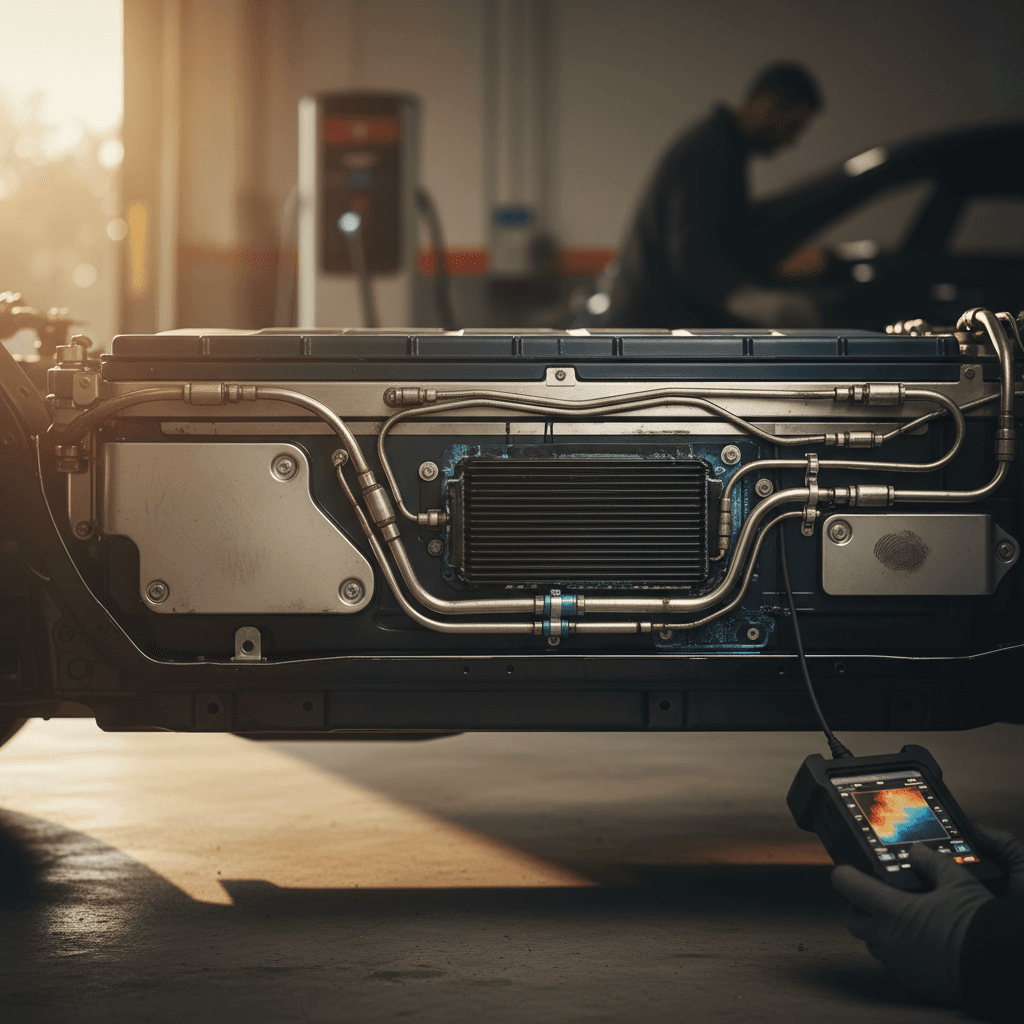
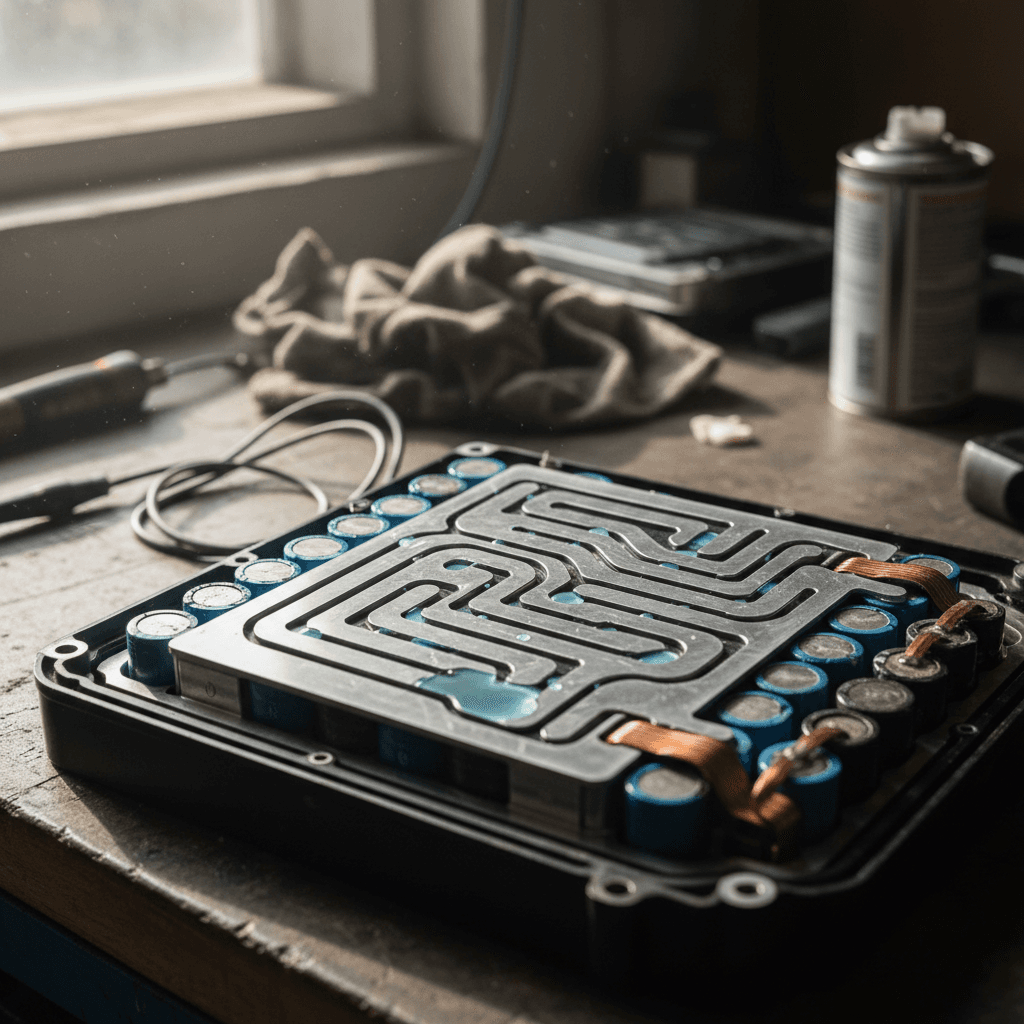
This is the plumbing: cold plates running under or between cells, coolant channels molded into pack structures, or air ducts and fans that blow across modules. Heat flows from the cells into coolant or air, then out to a radiator or condenser.
4. Integration with the rest of the car
Most modern EVs tie battery cooling into the same loop that cools the motor, inverter, or even the cabin. That lets the system share heat, say, using waste heat from the motor to warm the battery on a cold morning, or using the A/C refrigerant loop to yank heat out of a battery being fast‑charged in August.
The main types of EV battery cooling systems
Three main approaches to EV battery cooling
Most modern EVs use some form of liquid or refrigerant cooling; basic air cooling is fading out except in smaller packs.
Air cooling
How it works: Fans blow ambient or conditioned air across the battery pack.
- Simpler and cheaper
- Works for small batteries or mild climates
- Struggles in heat, high loads, and fast charging
Common in early EVs and some hybrids; increasingly rare in long‑range EVs.
Liquid cooling
How it works: Coolant circulates through channels or plates touching the cells, then passes through a radiator or chiller.
- Much higher heat capacity than air
- Good temperature uniformity across the pack
- Essential for repeated DC fast charging
This is the default solution in most current long‑range EVs.
Refrigerant direct cooling
How it works: The A/C refrigerant loop directly cools the battery (or the coolant) via a chiller.
- Very fast, aggressive cooling
- Strong performance during hot‑weather fast charging
- More complex controls and plumbing
Often paired with heat pumps for efficient heating in cold climates.
Don’t just read the window sticker
Temperature, range, and why your EV feels different in July vs January
Every EV owner has the same moment the first winter: you leave the house at 100% charge and the range estimate drops like a stock chart in a recession. It’s not your car being dramatic. It’s physics, and the battery cooling and heating system is right in the middle of it.
- In cold weather, the battery’s internal resistance rises, so it can’t efficiently accept or deliver energy. The car spends extra energy heating the pack and the cabin.
- In hot weather, chemical reactions speed up. That helps performance in the short term but accelerates long‑term degradation, so the cooling system works harder to pull heat away.
- At moderate temperatures (roughly 60–75°F / 15–24°C), you often see your best real‑world range, because the cooling system is barely needed.
What the data shows
How cooling affects battery life and degradation
Lithium‑ion cells are long‑term relationships, not flings. They prefer stability: stable temperatures, stable charge levels, and stable usage patterns. Battery cooling is less about keeping the pack “cold” and more about keeping it consistent.
Three big ways temperature shapes battery life
The cooling system is the referee between chemistry and climate.
Chronic heat
Prolonged exposure to high temperatures (think hot parking lots, frequent DC fast‑charging in summer) accelerates chemical breakdown inside the cells.
Good liquid cooling and smart charge limits help keep pack temperatures from sitting in the danger zone for hours.
Deep cold
Charging a cold battery too fast can lead to lithium plating, where metallic lithium deposits on the anode instead of integrating into it.
Modern cars preheat the pack before fast charging, but that only works if you let the system do its thing.
Temperature gradients
When part of the pack runs hotter than the rest, those cells age faster. Over time, that imbalance can reduce usable capacity and power.
Uniform cooling plates and smart coolant routing are designed to keep temperatures even from module to module.
Why this matters for a used EV
Cooling, safety, and thermal runaway
Any time you mention EV batteries and heat, someone will bring up fires. The phrase you’ll hear is thermal runaway: a chain reaction where a battery cell overheats, damages its neighbors, and the process snowballs. It’s rare, and cooling is part of why it stays rare.
- The cooling system helps keep cells in their safe operating window, even when you’re charging hard or towing.
- If a module starts to misbehave, the BMS can reduce power, slow charging, or in extreme cases shut things down.
- Pack design adds physical firebreaks and venting paths so, if the worst happens, damage is contained as much as possible.
Cooling is not a fire extinguisher
Buying a used EV: what to look for in the cooling system
When you’re shopping new, the factory has already made the thermal choices for you. In the used market, you’re evaluating not just the design, but how that design has been treated by real life, traffic jams, road trips, DC fast chargers, and heat waves.
Cooling‑savvy checklist for used EV shoppers
1. Confirm the cooling type
Look up whether the model uses air, liquid, or refrigerant‑based cooling. For long‑range packs and frequent fast charging, <strong>liquid or refrigerant cooling</strong> is strongly preferred.
2. Ask about climate and usage history
A car that lived in mild climates and mostly AC‑charged overnight will typically show gentler battery aging than one that lived on DC fast chargers in desert heat.
3. Review battery health data
Look for an independent battery health report, not just the dash’s rough percentage. At Recharged, every vehicle comes with a <strong>Recharged Score</strong> that summarizes pack health, usage patterns, and how the thermal system has likely impacted aging.
4. Listen and look during a test drive
On a longish drive, the cooling system should behave predictably, fans ramping under load, then calming down. No persistent warnings, odd smells, or unexplained power limits.
5. Check service and recall history
Ask for records of any battery or cooling‑system service, software updates that changed thermal strategies, or recalls related to battery packs or high‑voltage coolant leaks.
6. Consider a professional EV inspection
A technician familiar with high‑voltage systems can spot early signs of trouble, coolant residue, corrosion, or fault codes you won’t see from the driver’s seat.
How Recharged fits in
Owner tips to help your EV’s cooling system help you
Your EV is constantly taking care of its battery in the background. A few simple habits make that job easier, especially if you live at the temperature extremes of the map.
Practical habits that support battery cooling and heating
1. Use preconditioning before fast charging
Most modern EVs let you tell the car you’re headed to a fast charger. That gives the thermal system time to warm or cool the pack into its sweet spot before you plug in, better for both speed and longevity.
2. Don’t treat 100% like a daily target
Holding the pack at 100% in hot weather forces the cooling system to work harder. For daily driving, many manufacturers now recommend charging to around 70–90% and saving full charges for road trips.
3. Limit repeated back‑to‑back DC fast charges
Your car can do them, but each session adds heat. If you’re stringing fast‑charging stops together on a road trip, expect the cooling system to run hard and speeds to taper as the car defends the pack.
4. Be kind in extreme heat
If possible, park in the shade or a garage, especially after a fast charge. Baking a hot battery in direct sun just makes the cooling system fight longer to pull temperatures back down.
5. And in extreme cold
Keep the car plugged in overnight so it can use grid power to maintain pack temperature. Precondition before you leave instead of “warming it up” on the road where the pack starts cold and stressed.
6. Stay on top of software updates
Carmakers frequently refine thermal strategies via over‑the‑air updates. Accepting updates is one of the easiest ways to improve cooling performance and battery longevity over time.
EV battery cooling: frequently asked questions
Common questions about EV battery cooling
Key takeaways for shoppers and owners
You don’t need an engineering degree to benefit from EV battery cooling, but you do benefit from understanding that it exists, that it’s busy all the time, and that different cars handle it differently. If you’re shopping, pay attention to the type of cooling system and the climate the car has lived in. If you already own an EV, adopt a few smart charging and parking habits to give the thermal system an easier life.
Done right, EV battery cooling fades into the background, no drama, just stable range, strong performance, and a pack that feels “young” long after the new‑car smell is gone. That’s the kind of invisible engineering that makes owning a used EV from Recharged feel simple: verified battery health, transparent history, and expert guidance so you can enjoy the quiet part of electric driving and forget about the chemistry under your feet.