You hear it all the time: “Electric cars are cheaper in the long run.” But is that actually true in 2025, now that electricity prices are climbing and federal EV tax credits are changing? This electric vehicle cost comparison walks through the math, purchase price, fuel or electricity, maintenance, insurance, battery health and resale, so you can see when an EV really does beat a gas car, and when it doesn’t.
Quick answer
Why electric vehicle cost comparison matters in 2025
Key 2025 cost numbers at a glance
Costs are moving targets. Residential electricity in the U.S. has climbed into the mid‑teens to high‑teens cents per kWh on average, and some coastal states see 30–40+¢/kWh. At the same time, gasoline has eased from 2022 highs but remains volatile. Federal EV tax credits of up to $7,500 for new and $4,000 for used EVs are scheduled to end for many buyers on September 30, 2025, which changes the payback math if you’re shopping after that date.
Important date for incentives
How much do EVs cost to buy, new vs used?
New EV vs new gas car
In 2025, a typical new EV still carries a higher sticker price than a comparable gas car, often by $5,000–$10,000 for mainstream models. Luxury EVs can be much more.
- Average new EV: often in the low–mid $50,000s before incentives.
- Average new gas car: more like high $40,000s, with many solid options in the $30,000s.
- Federal/State incentives: when available, can shave thousands off the EV price, but eligibility is narrower in 2025.
Used EV vs used gas car
The used market is where the EV cost comparison gets interesting. Rapid innovation and early depreciation mean many 3–5‑year‑old EVs are now priced similarly to, or even below, comparable gas models.
- Used EVs: You’ll see plenty of well‑equipped, 200+‑mile‑range EVs in the mid‑$20,000s.
- Used gas cars: Similar‑age compact crossovers and sedans often live in that same $20,000–$28,000 band.
- Battery health is critical: Two identical‑looking EVs can have very different battery condition, which is why independent battery reports, like the Recharged Score, matter so much.
Used EV sweet spot
Fuel vs electricity: cost per mile in 2025
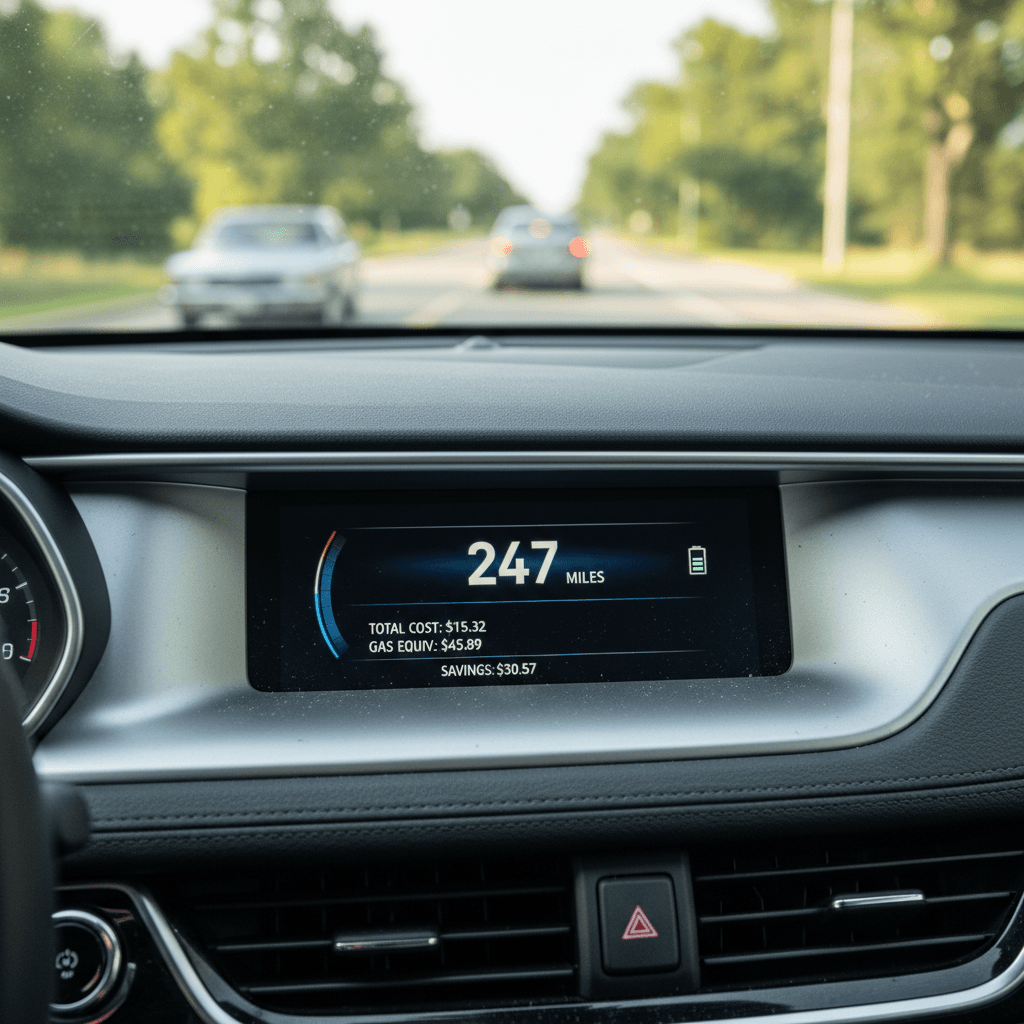
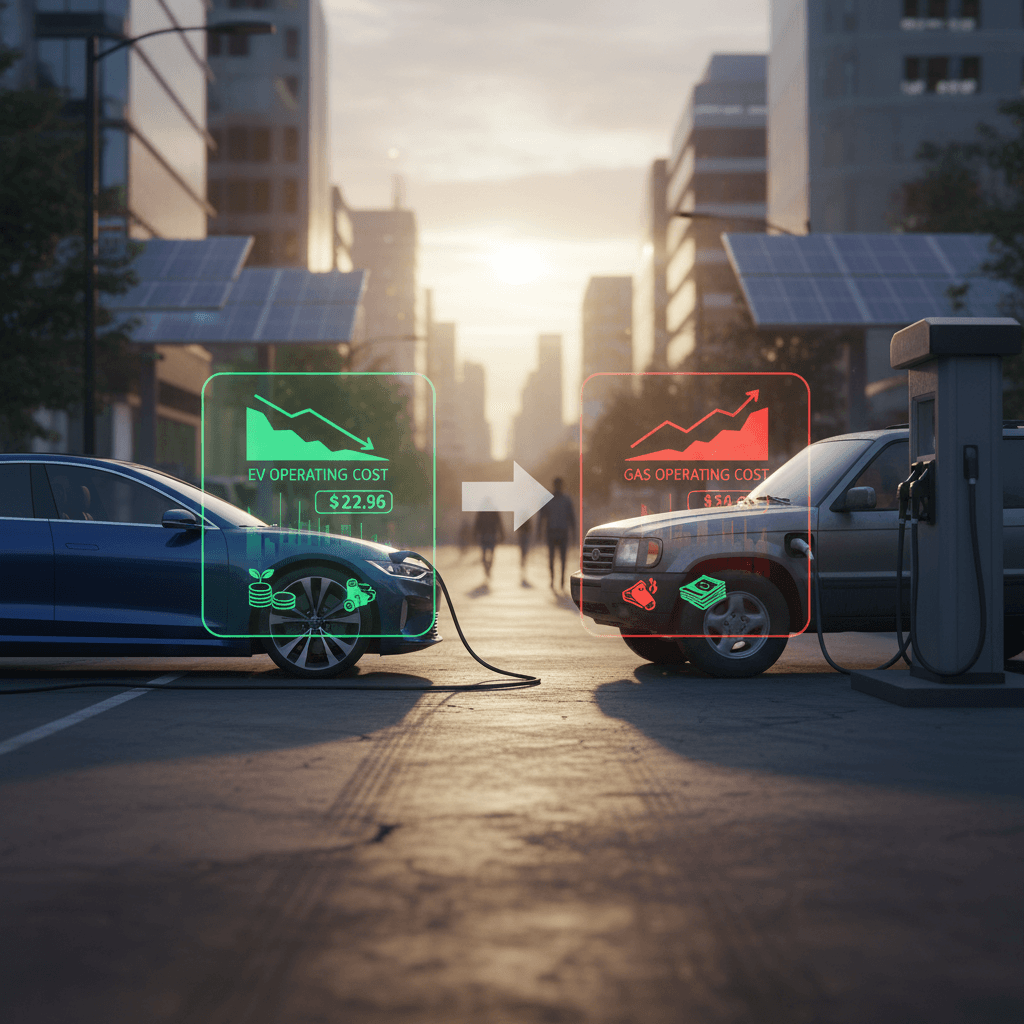
To compare day‑to‑day costs, you want to know how much it costs to move the car one mile. We’ll use round‑number examples based on typical 2025 prices; your local numbers may be a bit higher or lower.
Illustrative 2025 fuel vs electricity cost per mile
Assumes 12,000 miles/year. Adjust the numbers with your local prices for a personalized comparison.
| Vehicle type | Key assumptions | Energy cost per 100 miles | Approximate cost per mile | Annual energy cost (12,000 mi) |
|---|---|---|---|---|
| Efficient EV, home charging | 28 kWh/100 mi, 17¢/kWh | $4.76 | 4.8¢ | $571 |
| EV, expensive electricity | 28 kWh/100 mi, 30¢/kWh | $8.40 | 8.4¢ | $1,008 |
| Gas compact sedan | 32 MPG, $3.15/gal | $9.84 | 9.8¢ | $1,181 |
| Gas SUV | 25 MPG, $3.15/gal | $12.60 | 12.6¢ | $1,512 |
EVs shine when you can charge at home at average U.S. electricity rates. Heavy fast‑charging or very high local power prices can narrow the gap.
What about public fast charging?
How to calculate your own per‑mile fuel vs electricity cost
1. Grab your local energy prices
Check your last utility bill for your <strong>all‑in electricity rate</strong> (including fees). For gas, use the current price at your usual station or state average.
2. Note your vehicle’s efficiency
For EVs, look for kWh/100 mi or MPGe on the window sticker or in the trip computer. For gas cars, use EPA combined MPG or your real‑world average.
3. Do the quick math
For EVs: <strong>(kWh/100 mi × electricity price) ÷ 100</strong>. For gas: <strong>(gas price ÷ MPG)</strong>. That gives you cost per mile. Multiply by your annual miles to get yearly fuel or charging cost.
4. Consider your mix of charging
If you split charging between home and fast chargers, estimate what percent you use of each and do a blended average. Home charging is usually your cheapest source.
Maintenance and repairs: EV vs gas
Why EVs usually win on maintenance
Fewer moving parts, fewer fluid changes, fewer surprise repairs.
Simpler drivetrain
Brakes last longer
Still needs regular care
Study after study finds that EVs typically cost 30–50% less to maintain than gas cars over the first several years, mainly because there’s less to service. For a typical driver, that might mean saving a few hundred dollars per year on oil changes, transmission services, engine repairs, and so on. Over 5–10 years, that becomes real money.
Out‑of‑warranty surprises
Insurance, taxes and fees
Insurance is one place where EVs don’t always come out ahead. Insurers look at vehicle value and repair cost, and many EVs have pricey body panels, sensors, and battery‑adjacent structures. That can mean higher premiums compared with a similarly sized gas car, especially for newer, higher‑value EVs.
- In many states, new EVs can cost more to insure than comparable gas cars, though the gap is shrinking as repair networks improve.
- Some states add extra registration fees for EVs to make up for lost gas‑tax revenue, typically $100–$250 per year.
- Other states still offer rebates or HOV lane access, which can save both money and time if you commute.
How to keep EV insurance reasonable
Battery health and replacement costs
The biggest question in any electric vehicle cost comparison is the battery. You don’t replace an engine in most cars; you do replace a 12‑year‑old EV battery if it’s lost too much usable range for your needs. Modern packs are holding up better than early skeptics expected, but age, mileage, climate and fast‑charging habits all matter.
Battery realities that affect your cost
These are broad ranges; exact numbers vary by model and market conditions.
| Factor | What to expect | How it affects cost |
|---|---|---|
| Degradation over time | Many modern EVs lose roughly 5–10% in the first few years, then a slower drip after that, assuming normal use. | Less range over time may change how you use the car but doesn’t always require a new pack. |
| Replacement cost | Out‑of‑warranty pack replacements often fall in the $8,000–$20,000 range installed, depending on vehicle and parts availability. | A full pack swap can wipe out years of fuel savings if you weren’t planning for it. |
| Warranty coverage | Most OEMs cover the battery for 8 years or 100,000–150,000 miles against excessive capacity loss. | Buying a used EV with plenty of battery warranty left reduces your risk. |
| Verified battery health | Independent diagnostics, like the Recharged Score battery health report, measure real usable capacity instead of guessing. | Knowing true battery health helps you avoid cars that look cheap because their packs are tired. |
Battery replacement is rare in the first 8–10 years for most mainstream EVs, but capacity loss is gradual and you feel it, especially in winter.
How Recharged reduces battery risk
Resale value and depreciation
Depreciation is the silent heavyweight in total cost of ownership. AAA’s 2025 data shows that depreciation alone can account for more than a third of what it really costs to own a new vehicle each year. For EVs, depreciation has historically been steeper and more unpredictable than for mainstream gas cars, thanks to fast‑moving tech and shifting incentives.
How EV depreciation compares to gas
Where electric vehicles lose, or keep, their value.
New EVs: steeper first years
Used EVs: opportunity zone
Gas vs EV: who wins on resale?
Three 5‑year total cost examples
Now let’s put the pieces together. These are simplified, ballpark examples over five years and 60,000 miles (12,000 per year). Your situation will differ, but the patterns are what matter.
Illustrative 5‑year cost comparison scenarios
All numbers are approximate and rounded for clarity; they’re meant to show relationships, not exact quotes.
| Scenario | Vehicle | Upfront price | 5‑yr fuel/energy | 5‑yr maintenance | Insurance & fees | Estimated 5‑yr depreciation | Approx. 5‑yr total |
|---|---|---|---|---|---|---|---|
| 1. New mainstream | New gas crossover | $38,000 | $6,500 | $4,000 | $7,000 | $15,000 | $70,500 |
| New EV crossover (after incentive) | $45,000 | $3,000 | $2,500 | $7,800 | $18,000 | $76,300 | |
| 2. Used commuter | 5‑yr‑old gas sedan | $20,000 | $6,500 | $4,000 | $5,000 | $9,000 | $44,500 |
| 4‑yr‑old used EV (healthy battery) | $24,000 | $2,800 | $2,200 | $5,500 | $8,000 | $42,500 | |
| 3. High‑mileage driver | New gas hybrid | $32,000 | $5,000 | $4,000 | $6,500 | $13,000 | $60,500 |
| New long‑range EV | $45,000 | $2,500 | $2,700 | $7,800 | $18,000 | $76,000 |
The more you drive and the more you can charge at home, the more an EV’s higher purchase price is offset by cheaper running costs.
How to use these numbers
When an EV saves you money, and when it doesn’t
Situations where an EV likely wins
- You drive 12,000–15,000+ miles per year. The more you drive, the more you benefit from lower per‑mile energy and maintenance costs.
- You can charge at home at fair electricity rates. Level 2 charging in your garage or driveway is usually far cheaper than public fast charging.
- You buy a used EV with a healthy battery. Let the first owner take the big depreciation hit while you enjoy low running costs.
- Your state still offers strong incentives or EV‑friendly electricity plans. Time‑of‑use rates can make off‑peak home charging especially cheap.
Situations where a gas car may be cheaper
- You drive relatively little. At 6,000–8,000 miles per year, fuel savings may not offset a big purchase‑price premium.
- You pay very high electricity rates (think 30–40+¢/kWh) and can’t shift charging to off‑peak hours.
- You rely on public fast charging most of the time. High fast‑charge pricing can erase much of the EV’s energy‑cost advantage.
- You’re shopping new with no incentives. In late 2025 and beyond, some buyers may see higher 5‑year costs for new EVs than for equivalent gas models if tax credits disappear and prices don’t adjust.
How buying a used EV with Recharged changes the math
Most cost‑comparison calculators assume a brand‑new EV. But the used market is where many drivers find the sweet spot between purchase price and running costs, and where Recharged is built to help.
Ways Recharged helps you win the EV cost comparison
Lower risk, clearer numbers, simpler ownership.
Verified battery health
Fair market pricing
Financing & nationwide delivery
Ready to find your next EV?
Browse VehiclesFrom spreadsheet to driveway
FAQ: Electric vehicle cost comparison
Frequently asked questions about EV vs gas costs
Bottom line on electric vehicle cost comparison
There isn’t a one‑size‑fits‑all verdict in the electric vehicle cost comparison. In 2025, EVs still tend to cost more up front but can be significantly cheaper to run, especially if you buy used, drive plenty of miles, and can charge at home at reasonable power rates. Gas cars keep winning on predictable resale and, for low‑mileage drivers, simple math.
The smart move is to compare total cost of ownership for the specific vehicles you’re considering, not just sticker prices or someone else’s average chart. And if you decide an EV is the right financial fit, shopping used through Recharged, with verified battery health, fair pricing, financing, and nationwide delivery, can tilt the numbers even further in your favor.