Search for “electric cars mpg” and you’ll quickly run into a different language: MPGe, miles per kWh, range estimates, and efficiency charts that don’t look anything like a standard 30 mpg gas sedan. If you’re trying to compare an EV to the car in your driveway, or you’re shopping for a used electric car, this is exactly the guide you need.
Quick definition
What “electric cars mpg” really means today
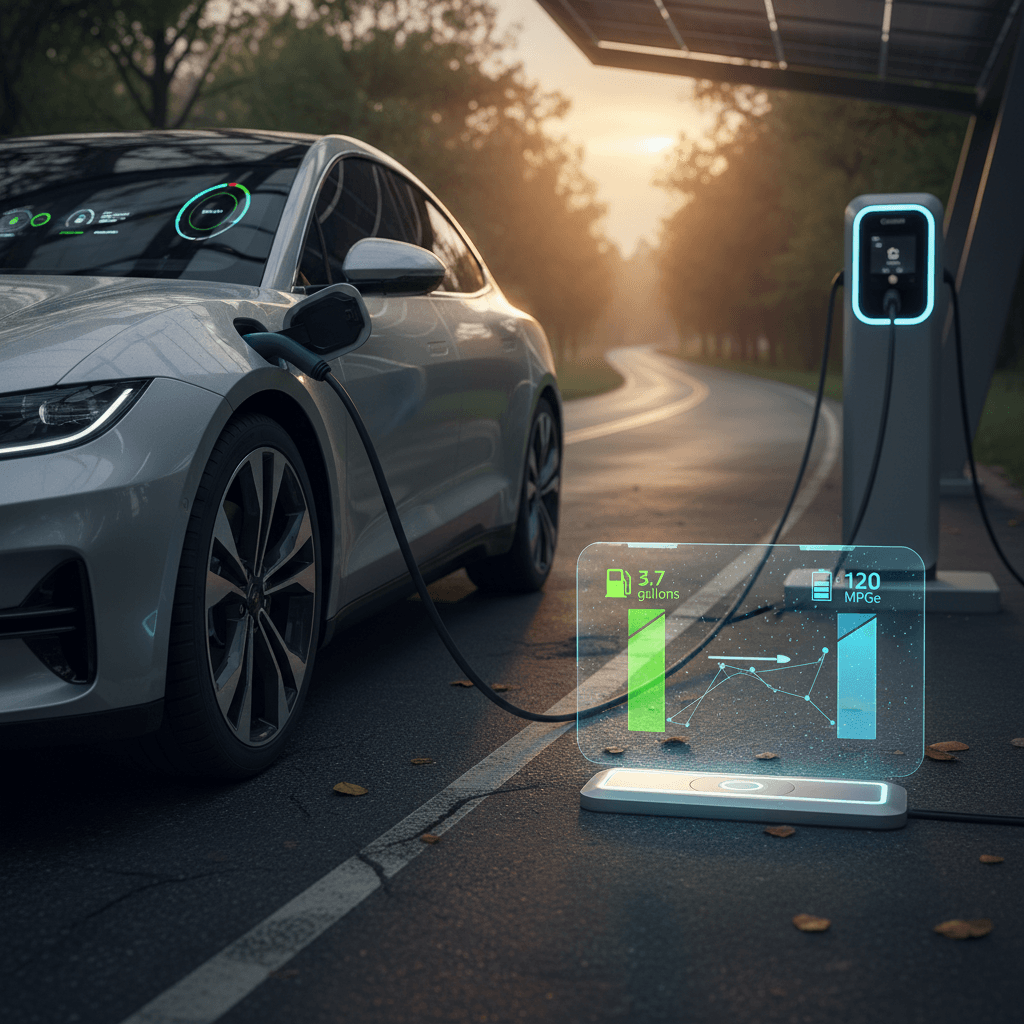
Traditional MPG tells you how many miles a gasoline car can travel on one gallon of fuel. Electric cars don’t burn gallons, they use electricity, so the U.S. Environmental Protection Agency created a new metric called MPGe (miles per gallon equivalent) to make apples-to-apples comparisons between gas and electric vehicles.
The EPA defines one “gallon of gasoline equivalent” as 33.7 kWh of electricity. In plain English: if an EV can drive 120 miles using 33.7 kWh from the battery, it earns a 120 MPGe rating. That number appears on the Fuel Economy and Environment label on new EVs and in listings for many used models.
Think of MPGe as a translation
MPG vs MPGe vs miles per kWh
Three efficiency metrics you’ll see on EV listings
They’re related, but they answer slightly different questions.
MPG
Used for: Gasoline and diesel cars.
- Miles per gallon of fuel.
- Easy to understand, but only for liquid fuels.
- Doesn’t apply directly to EVs.
MPGe
Used for: Electric and plug‑in hybrid vehicles.
- Miles per gallon of gasoline equivalent.
- Based on 33.7 kWh = 1 gallon of gas.
- Good for comparing EVs to gas cars.
Miles per kWh
Used for: EV owners and reviewers.
- Miles you drive per kWh from the battery.
- Great for estimating real‑world range and cost.
- Easy to track from your EV’s trip computer.
If you’re cross-shopping gas and electric, MPGe is the best single comparison tool. Once you own an EV, though, you’ll probably care more about miles per kWh because it connects directly to your utility bill and your actual driving.
Don’t overthink the label math
How MPGe is calculated for electric cars
Behind the scenes, MPGe is just a unit conversion. The EPA runs each vehicle through standard drive cycles, measures how much energy it uses, then converts that into a gasoline-equivalent rating using the 33.7 kWh per gallon benchmark.
Basic MPGe calculation for an EV
A simplified look at how an MPGe rating is derived from an EV’s energy use.
| Step | What it means | Example value |
|---|---|---|
| 1. Measure energy use | Electricity used from the wall or battery during testing | 28 kWh used on a test route |
| 2. Measure distance | Miles driven during the same test | 100 miles driven |
| 3. Find kWh per mile | Energy used per mile | 0.28 kWh per mile |
| 4. Scale to 33.7 kWh | How far the car would go on 33.7 kWh | 33.7 ÷ 0.28 ≈ 120 miles |
| 5. Report MPGe | MPGe equals miles per gallon equivalent | Result: 120 MPGe |
The actual EPA process uses multiple test cycles, but the core math looks like this.
EVs are inherently more efficient
Real-world examples: How efficient are today’s EVs?
To make “electric cars mpg” concrete, here’s how a few popular EVs shake out on efficiency. Exact numbers vary by trim and wheel size, but these examples reflect typical combined city/highway ratings from recent model years:
- A compact crossover EV such as a Hyundai Kona Electric can deliver around 4.5 miles per kWh, which converts to well over 120 MPGe in testing.
- A mid-size electric sedan like a Tesla Model 3 typically lands around 3.5–4.0 miles per kWh, or roughly 115–130 MPGe depending on configuration.
- Larger SUVs and performance EVs often sit closer to 2.5–3.0 miles per kWh (around 85–100 MPGe), trading efficiency for size, weight, and power.
- Electric pickup trucks such as the Ford F‑150 Lightning tend to post some of the lowest MPGe figures among EVs because of their mass and aerodynamics, especially when towing or loaded.
Typical combined MPGe ranges by vehicle type
How this compares to gas cars
Cost per mile: gas vs electric in dollars, not just MPGe
MPGe is helpful, but most shoppers really care about cost per mile. With U.S. averages in late 2024 and 2025 hovering around $3.15 per gallon of gas and roughly $0.17 per kWh of residential electricity, an efficient EV can dramatically cut your fuel bill, especially if you charge at home.
Example: 30‑mpg gasoline car
- Gas price: $3.15 per gallon.
- Efficiency: 30 miles per gallon.
- Fuel cost per mile: $3.15 ÷ 30 ≈ $0.105 per mile.
Drive 12,000 miles per year and you’ll spend roughly $1,260 on gasoline, not counting oil changes and other engine-related maintenance.
Example: Efficient EV at 3.5 mi/kWh
- Electricity price: $0.17 per kWh.
- Efficiency: 3.5 miles per kWh.
- Energy cost per mile: $0.17 ÷ 3.5 ≈ $0.049 per mile.
At 12,000 miles per year, that’s about $590 in electricity for home charging, less than half the fuel cost of the 30‑mpg gas car in this example.
Public fast charging changes the math
Range vs MPGe: which spec should you care about?
Window stickers and online listings usually put driving range front and center, with MPGe and miles per kWh a little further down. Both matter, but in different ways.
Range vs MPGe: how to prioritize them
Think about how and where you actually drive.
When range matters more
- You frequently drive 150–250 miles in a day.
- You live in a region with long distances between chargers.
- You plan regular road trips or tow with an EV.
Here, a larger battery and higher range rating can be worth a slight hit in MPGe.
When MPGe & mi/kWh matter more
- Your commute is under 60 miles per day.
- You’ll mostly charge at home or work.
- You want to minimize monthly operating costs.
For many urban and suburban drivers, an efficient EV with "only" 220–260 miles of range is more than enough.
Watch the combo, not just one number
Used EVs: how efficiency changes over time
If you’re looking at a used EV, MPGe tells you how efficient the model was when it was new. But what really matters now is how much usable energy the battery still has and how the previous owner drove and charged it.
- Battery degradation: Over time, most EVs lose some usable capacity. A pack that started at 75 kWh might effectively behave more like 68–70 kWh after years of use, trimming range and nudging real‑world MPGe down.
- Driving history: Lots of highway miles, frequent fast charging, or heavy towing can age a battery faster than light city use and gentle charging habits.
- Software updates: Automakers routinely tweak efficiency and range estimates via over‑the‑air updates, which can slightly change how range and energy use are displayed versus the original window sticker.
Where Recharged fits in
How to compare “electric cars mpg” when you’re shopping
Step‑by‑step: Comparing EV efficiency like a pro
1. Start with the EPA label or listing
Look for the <strong>combined MPGe</strong> number and the <strong>estimated range</strong>. These give you a standardized baseline for comparison across models.
2. Convert MPGe to miles per kWh
You can estimate miles per kWh by dividing MPGe by about 33.7 and then multiplying by your EV’s kWh‑per‑gallon equivalent. Many shoppers skip this step and instead rely on the <strong>mi/kWh readout</strong> from road tests and reviews.
3. Check real‑world reviews
Owner forums and professional tests often share observed <strong>mi/kWh</strong> numbers at highway speeds, in winter, or in city driving, helpful reality checks against the official rating.
4. Match range to your daily life
Map your actual driving: commute, kids’ activities, weekend trips. If your regular days are under 100 miles, you don’t need a 350‑mile EV, but you might still want it for peace of mind.
5. Estimate your cost per mile
Use your local electricity rate and the EV’s expected mi/kWh. Even a rough calculation will show you whether you’re closer to $0.05 per mile or $0.10+ per mile in your specific area.
6. For used EVs, demand battery data
Ask for <strong>state‑of‑health</strong> information and any available battery reports. At Recharged, the Recharged Score and diagnostics are done for you, so you can compare vehicles on verified battery health, not just sticker ratings.
Red flag on any used EV listing
FAQ: Electric cars MPG, MPGe and real-world efficiency
Frequently asked questions about electric car MPG and MPGe
Key takeaways before you buy
If you’ve been puzzled by “electric cars mpg,” here’s the bottom line: MPGe is simply MPG translated into EV terms, and miles per kWh is the on-the-ground number that will shape your charging bills. Use MPGe and range to compare models, then dig into real-world mi/kWh and battery health, especially in the used market.
Whether you’re shopping your first EV or trading out of a gas car, you don’t have to decode those numbers alone. At Recharged, every used EV comes with a Recharged Score Report, including verified battery diagnostics, fair market pricing, and EV‑specialist guidance. That way, the labels on the window and the numbers on the screen translate into something that actually matters: an electric vehicle that fits your budget, your driving, and your expectations day after day.