If you’re thinking about an electric car, you’re really thinking about the electric car battery, even if you don’t say it out loud. Range, charging speed, resale value, long-term costs… they all start with the pack under the floor. The good news in 2025: modern EV batteries are lasting longer and aging more predictably than most early headlines suggested.
Batteries age, but not like phone batteries
Why electric car batteries deserve their own guide
When people say they’re “nervous about EVs,” they’re usually nervous about batteries: Will it lose range? Will I have to replace the pack? How much does that cost? Can I trust the previous owner? Those are rational questions, especially if you’re comparing a used EV to a used gas car that just needs the occasional oil change and timing belt.
Electric car battery reality check in 2025
This is why Recharged builds every transaction around the Recharged Score battery health report. Instead of guessing how a pack has aged, you see verified diagnostics, fair market pricing that reflects that data, and expert guidance on what it means for your day-to-day use.
How an electric car battery actually works
From electrons to motion
The pack in an electric car is a large collection of individual lithium-ion cells. These cells are grouped into modules and then into a pack, managed by a battery management system (BMS) that monitors voltage, temperature, and state of charge for safety and longevity.
- The pack stores energy in kWh (kilowatt-hours).
- The motor draws power in kW (kilowatts).
- The BMS controls charging and discharging to prevent damage.
Key terms you’ll see on spec sheets
- Battery capacity (kWh): Like the size of your gas tank; a 60 kWh pack holds more energy than a 40 kWh pack.
- Voltage: Most modern EVs run 350–800 volts; higher voltages help with faster DC charging.
- Peak charge rate (kW): For DC fast charging, this tells you the maximum power the car can accept.
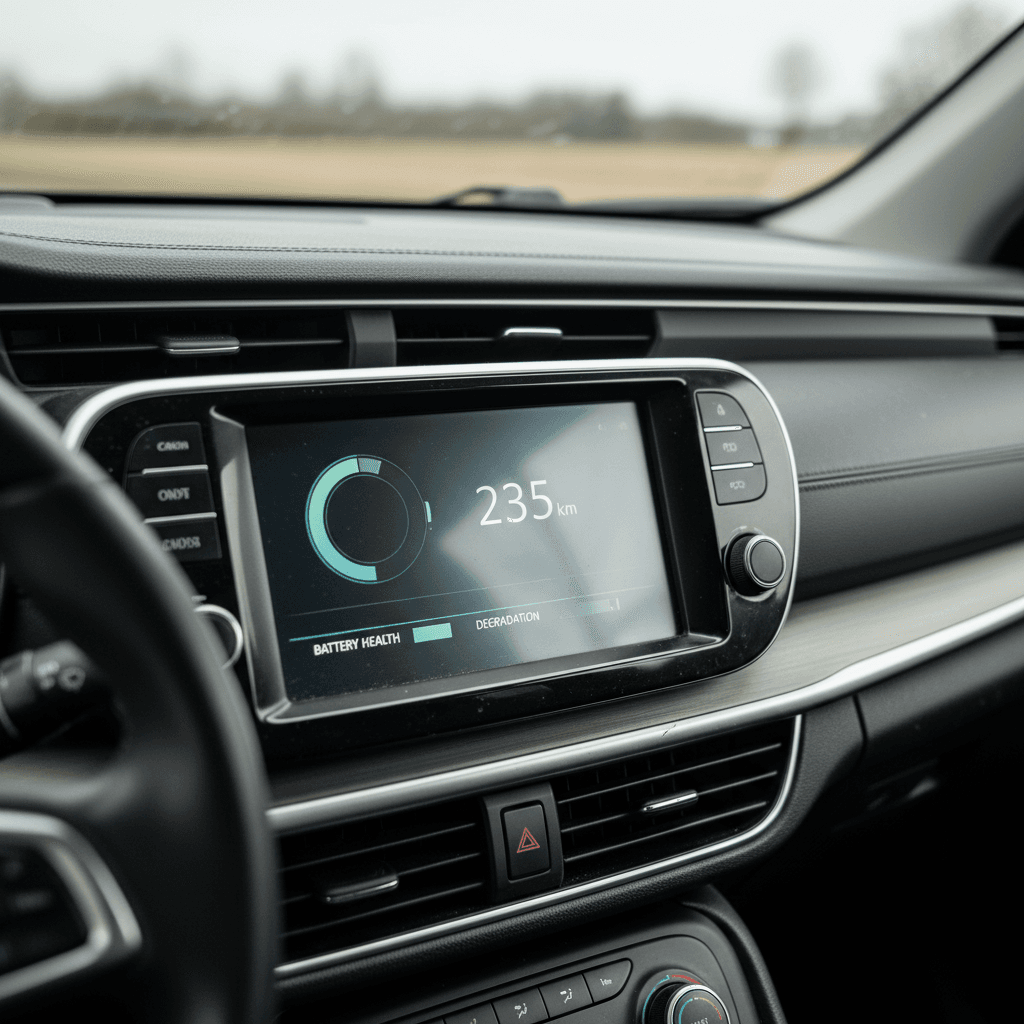
- State of health (SoH): The pack’s usable capacity relative to when it was new, critical for used EVs.
Battery chemistries: LFP vs NMC and others
Not all EV batteries are created equal. Automakers now mix and match chemistries to hit different goals: range, price, longevity, and performance. The big split you’ll hear about in 2025 is LFP vs NMC.
Common electric car battery chemistries
Why some packs last longer, cost less, or charge faster
LFP (Lithium Iron Phosphate)
Pros: Very long cycle life, stable at high state of charge, lower fire risk, uses less nickel and cobalt.
Cons: Lower energy density than NMC, so slightly less range for the same pack size and weight.
Common in affordable EVs and newer Teslas in base trims; also popular in Chinese-market models like the MG4 and BYD’s Blade battery.
NMC/NCA (Nickel-based chemistries)
Pros: Higher energy density, meaning more range in the same physical space; good for long-range and performance EVs.
Cons: More sensitive to being stored full or very hot, can degrade faster if abused, uses more expensive metals.
Used in many long-range variants from Tesla, Hyundai/Kia, Ford, GM and others.
Emerging chemistries
Automakers and suppliers are now piloting semi-solid and solid-state chemistries, and variations like sodium-ion for lower-cost city EVs.
These promise better safety and energy density, but mass-market impact will roll out toward the late 2020s and early 2030s.
How this matters when you buy
Range and degradation: what to expect over time
New EV shoppers often worry they’ll wake up one day and their car will suddenly only go half as far. In reality, battery degradation is usually slow and front-loaded: you might lose a small chunk of capacity in the first few years, then the curve tends to flatten.
Typical electric car battery degradation patterns
These are broad patterns, not guarantees, but they’re a useful sanity check when you look at used EVs.
| Vehicle age | Typical capacity remaining* | What that feels like in range | Notes |
|---|---|---|---|
| Brand-new | 100% | Full advertised EPA range | Real range can still vary with weather and speed. |
| 3–4 years | ~92–97% | Slightly less range than new | Most drivers barely notice day to day. |
| 6–8 years | ~85–92% | Noticeably shorter road-trip legs | Still fine for daily commuting in most cases. |
| 10+ years | ~70–85% | Reduced but usable range | Great for shorter commutes; long trips take more planning. |
Real-world battery life depends on climate, charging habits, mileage, and chemistry.
There’s no single "correct" percentage
Factors that speed up or slow down battery wear
- High average state of charge (parking at 90–100% every night).
- Frequent deep discharges to near 0%.
- Sustained heat (parking outdoors in a hot climate, hard driving and fast charging back-to-back).
- Aggressive DC fast charging on long road trips.
- Poor cell cooling or an outdated thermal management design.
Habits that are tough on a pack
- Daily DC fast charging even when you don’t need it.
- Parking fully charged in the sun during summer.
- Regularly running the pack down to single digits.
- Ignoring software updates that improve battery management.
Habits that help your battery age gracefully
- Using Level 2 home charging for most routine driving.
- Keeping daily charge targets around 70–80% unless you need more.
- Preconditioning the battery before fast charging in winter.
- Letting the BMS “sleep” by avoiding constant app wake-ups when parked.
What Recharged looks for
Ready to find your next EV?
Browse VehiclesBattery warranties and replacement costs
Automakers know the battery is the heart of the car, so they typically give it a longer warranty than almost any other component. In the U.S., 8 years and around 100,000 miles is now common, sometimes with a guarantee that capacity won’t fall below a set threshold during that period.
Typical EV battery warranty terms in the U.S.
Always check the specific language for the model you’re considering.
Time and mileage
Most brands cover the high-voltage battery for 8 years or 100,000 miles, whichever comes first. Some go to 120,000 or even 150,000 miles on specific models.
Capacity guarantees
Many warranties promise the pack will retain at least 70% of its original capacity over the warranty period. If it drops below, you may be entitled to repair or replacement.
What’s actually covered
Coverage usually applies to defects and abnormal degradation, not wear from normal use. Abuse (e.g., ignoring cooling system failures) can void coverage.
Replacement costs
Out-of-warranty pack replacements today often run in the $8,000–$20,000 range at retail, depending on battery size and model. Prices are trending down as pack designs standardize and production scales.
Beware of incomplete service histories
Reading battery health when you buy a used EV
With a gas car you can listen to the engine and glance at the dipstick. With an EV, software and data are your stethoscope. You’re trying to answer three questions: How healthy is this pack today? How has it been treated? And does its remaining life match how long you plan to keep the car?
Used EV battery checklist
1. Look for a clear State of Health (SoH) metric
Some cars display a battery health percentage or “bars” in the instrument cluster or service menus. Others require a diagnostic scan to pull SoH data. Don’t rely purely on what the seller says the range "feels" like.
2. Compare indicated range to original specs
With the pack fully charged, compare the displayed range to the original EPA estimate. A 10–15% drop is normal for many older EVs; much more than that deserves closer investigation.
3. Check for battery-related error messages and recalls
Scan for stored fault codes, warning lights, or open recalls related to the high-voltage system. These can indicate past overheating, voltage imbalances, or software issues that affect longevity.
4. Ask about charging habits and climate
A car that lived its life fast-charging on a hot highway corridor is different from one that slow-charged in a mild climate. You may not get perfect answers, but patterns still matter.
5. Verify remaining warranty coverage
Confirm the in-service date and any transfer conditions so you know if the pack is still under the original manufacturer warranty and for how long.
6. Use a third-party or marketplace battery report
A structured diagnostic like the <strong>Recharged Score battery health report</strong> goes beyond a simple scan. It interprets the data, compares it to similar cars, and builds those findings into transparent pricing.
On Recharged, that last step is built-in: every listed car includes a Recharged Score Report with verified battery diagnostics and a clear explanation of what they mean for range, warranty, and long-term costs. If you’re trading in or consigning, the same data helps defend your asking price.
Future tech: solid-state and beyond
If you Google “electric cars battery,” you’ll quickly fall into a rabbit hole of solid-state batteries promising 10‑minute charges and 600‑mile ranges. The reality in late 2025 is more nuanced: important progress, but a long runway before this tech dominates your used-EV search.
What’s coming next for EV batteries
Exciting advances, on realistic timelines.
Solid-state batteries
Automakers like Toyota, Nissan, and Stellantis are targeting late-2020s demos and early production with solid-state packs that use solid electrolytes for higher energy density and better safety.
Mass-market adoption at scale is more likely around the early 2030s, once cost and manufacturing hurdles are solved.
Semi-solid and structural packs
Some newer models in China and Europe are piloting semi-solid and structural batteries that integrate the pack into the vehicle frame for better packaging and rigidity.
For you as a shopper, this mostly shows up as more range and better crash performance, not a totally different ownership experience.
Sodium-ion and low-cost city EVs
Battery suppliers are also developing sodium-ion packs for shorter-range, lower-cost EVs. Energy density is lower, but materials are cheaper and abundant.
These chemistries could make entry-level EVs and second cars more affordable later in the decade.
The biggest shift over the next decade won’t be that your EV suddenly gets infinite range. It’s that batteries become another boring, predictable component, transparent enough that you can treat them like you treat an engine today, just with better data.
Practical tips to make your EV battery last
Once you own an EV, maximizing battery life becomes less about obsessing over chemistry and more about a few simple habits. You don’t need to baby the car, but you can avoid the situations that accelerate wear without really sacrificing convenience.
Everyday habits that protect your battery
Use Level 2 home charging for routine needs
Set up a Level 2 charger where possible and reserve DC fast charging for road trips and genuine time-pressure situations.
Set a sensible daily charge limit
Many cars let you choose a target state of charge. For daily use, 70–80% is a good balance; charge to 100% shortly before you leave on long trips.
Avoid sitting full or empty for days
Try not to leave the battery parked at 100% or near 0% for extended periods. If you’re storing the car, aim for around 40–60%.
Watch temperature and parking
On very hot days, prefer shaded or indoor parking. In cold climates, precondition the car while plugged in to warm the pack before driving or fast charging.
Stay current on software updates
Battery management strategies improve over time. Keeping your car updated can improve charging behavior, range estimation, and thermal control.
Plan road trips with the battery in mind
On long drives, try to fast charge between roughly 10–70% rather than bouncing between 50–100%. It’s faster, easier on the pack, and usually quicker overall.
Think in miles per day, not miles per tank
Electric car battery FAQ
Common questions about electric car batteries
Key takeaways for EV shopping
If you’re evaluating an electric car in 2025, don’t think of the battery as a mysterious black box. Think of it as a critical asset whose condition you can now measure and price in. The important questions are: How much usable range does this pack give me today? How quickly is it likely to age given its chemistry and history? And does that line up with how long you plan to own the car?
New chemistries, structural packs, and solid-state designs will keep pushing the frontier, but they don’t change the fundamentals: well-managed lithium-ion batteries are proving durable, predictable, and manageable in everyday use. If you’d like help reading the fine print, SoH, charge curves, warranty language, Recharged’s EV specialists and Recharged Score Reports are built precisely for that. They turn battery health from a worry into just another spec you can compare and shop on, so you can focus on finding the right EV and enjoying the drive.