
You tap the start button in your electric car, the cabin stays eerily quiet…and suddenly a symbol you don’t recognize pops up on the screen. With EVs, that silent moment can make any new electric car warning lights feel more unsettling than they did in a gas car. The good news: most EV dashboard symbols are there to inform you, not to scare you, if you know how to read them.
Quick rule of thumb
Why EV warning lights feel different from gas cars
If you grew up with tachometers and rumbling idles, EV dashboards can feel almost alien. Instead of a big rev counter and fuel gauge, you’re staring at power meters, range estimates, and a mix of icons that look familiar, but behave a little differently from the ones in gas cars.
- EVs layer high‑voltage safety and battery‑health alerts on top of traditional automotive warnings.
- Many EVs show more detailed charging and plug status symbols than gas cars ever needed.
- Some lights, like the green “READY” symbol, exist only because EVs are so quiet that you’d otherwise have no idea the car is on.
Under the skin, though, the basic logic is the same: the car is telling you about urgency (color), location (battery, brakes, tires, etc.), and sometimes next steps (“service soon,” “reduced power,” or “not ready to drive”). Once you learn that pattern, EV warning lights become a lot less mysterious.
Color codes: how urgent is that electric car warning light?
Before you worry about specific symbols, get comfortable with color coding. Carmakers have largely standardized this so you can quickly judge how serious an issue is.
What electric car warning light colors usually mean
Use this as your first filter whenever a new light appears on your EV’s dashboard.
| Color | Typical meaning | How fast to act | Example lights |
|---|---|---|---|
| Red or flashing red | Serious fault or safety risk; system may be failing now | Pull over safely and stop driving if it stays on | Brake system, airbag fault, high‑voltage or battery fault, door open, seatbelt |
| Amber / Yellow | System needs attention or has limited function | Service soon; okay to drive gently unless behavior changes | Check EV system, tire pressure, stability control, regen brake warning |
| Green | Feature is active and working as expected | No action needed | READY light, headlights on, lane‑keep assist |
| Blue | Feature is active but may require awareness | No action, just be aware | High beams on, cold battery/temperature indicator in some models |
| White or gray | Informational or upcoming change | No immediate action | Speed limit sign recognition, lane markings, drive mode indicators |
Color tells you urgency; the icon tells you what’s affected.
Don’t ignore a new red icon
Core electric car warning lights you must know
Every manufacturer designs icons a little differently, but most EVs share a core set of dashboard warnings. Here’s what they generally mean and what you should do.
Essential warning lights on most EV dashboards
These are the symbols every EV driver should recognize instantly.
High‑voltage or EV system warning
Often an outline of a car with an exclamation mark, or a battery with an exclamation mark. It signals a fault in the electric drivetrain or high‑voltage system, not just the 12‑volt accessory battery.
What to do: If it’s red or paired with a “Do not drive” message, pull over and call roadside assistance. If it’s amber and the car still drives normally, schedule service soon and avoid long trips until it’s checked.
12‑volt battery/charging system light
Looks like a traditional battery icon. In an EV, it usually refers to the low‑voltage system that powers computers, lights, and safety systems.
What to do: Don’t ignore this. If the 12‑volt system dies, the car may refuse to wake up even if the main pack is full. Drive to a safe place and plan to service the battery or DC‑DC converter soon.
Powertrain / “check engine” equivalent
Many EVs repurpose a generic malfunction indicator light for the electric motor, inverter, or emissions‑related systems in plug‑in hybrids.
What to do: If it’s steady and amber, it usually indicates a non‑urgent fault, book service, but you can drive normally unless the car feels different. If it flashes, reduce power and have it checked immediately.
Temperature warning
May show a thermometer or coolant symbol. In EVs, this can indicate overheating of the battery, inverter, or motor, especially during fast charging or hard driving.
What to do: Reduce speed, turn off DC fast charging if you’re plugged in, and allow the car to cool. If it stays red, stop driving and call for assistance.
Use your owner’s manual app
EV‑specific warning lights explained
Beyond the familiar icons, electric cars add a few symbols that simply didn’t exist in gas vehicles. These are the ones that tend to confuse new EV drivers the most.
Common EV‑only dashboard icons
You’ll rarely see these in a gasoline car.
READY light
Usually a green “READY” text or a small car icon with arrows. It appears after startup to confirm the high‑voltage system is live and the car will move if you select Drive or Reverse.
What to do: Treat it like the sound of an engine idling in a gas car. If READY is off and the car won’t move, you may have a charging connector still latched, a door open, or a fault that needs attention.
Turtle / reduced power mode
A small turtle icon or “Reduced power” message signals that the car has entered a limp‑home mode, usually because the traction battery is very low or the powertrain is protecting itself from overheating.
What to do: Move to the right lane, avoid hard acceleration, and plan to charge or stop soon. If it appears with plenty of range remaining, have the car inspected.
EV system service soon
Often an amber car with an exclamation point. This is a general “service the electric system soon” alert, not an immediate stop sign.
What to do: Note when it appears, any unusual sounds or behavior, and schedule service. It’s safe to continue driving gently unless the light turns red or other warnings appear.
High‑voltage fault is different from low battery
Charging and plug‑related dashboard icons
EVs also use the instrument cluster or central screen to keep you informed about charging status. These icons usually aren’t emergencies, but misreading them can lead to frustrating surprises, like waking up to an uncharged car.
Plug connected / charging status
Most EVs show a plug symbol, charge bars, or a pulsing battery icon when the car is actively charging. A solid plug with no animation can mean the car is plugged in but not actually charging, for example, if a departure timer is set or a fault is detected at the station.
What to do: Before walking away from a public charger, confirm that the screen or app clearly says “Charging” and not just “Connected.” If a warning icon appears alongside the plug, check for an error message at the station or in the car’s app.
Charge port door or latch warnings
Some EVs have a specific icon for an open charge door or a latched connector that prevents you from driving. This can appear as a small car with a highlighted port area or a door‑open symbol near the plug icon.
What to do: If the car won’t go into gear and you see a plug or port warning, make sure the connector is fully removed and the door is closed. In winter, check for ice around the port and latch.
Always check on‑screen text at chargers
Brake and regenerative brake warning lights
Braking is one area where EVs behave differently from traditional cars. You still have hydraulic friction brakes, but regenerative braking does a lot of the work, and can have its own warning light.
Key brake‑related warning lights on EVs
Treat all brake warnings with respect, even if the car still feels normal.
Brake system warning
Usually a red exclamation point inside a circle, sometimes with “BRAKE” text. It can indicate the parking brake is on, low brake fluid, worn pads, or a more serious hydraulic issue.
What to do: First, confirm the parking brake is fully released. If the light remains on, avoid high‑speed driving and have the brakes inspected immediately.
Regenerative brake warning
Some EVs, like Kia and Hyundai models, use a separate regen brake warning icon that can appear in yellow and sometimes trigger the main brake light in red at the same time. It means the car has detected a problem with regenerative braking and possibly with overall brake performance.
What to do: Expect the brake pedal to feel different and stopping distances to increase. Drive cautiously and have the car serviced as soon as possible; if both lights are red, stop driving and call for assistance.
Brake lights vs. regenerative braking behavior
In strong one‑pedal modes, most EVs illuminate the rear brake lights automatically when regen is strong enough, but some older models have been criticized for not always lighting the brake lamps during heavy regen. That’s a design quirk, not a dashboard warning, but it’s worth being aware of.
What to do: Leave extra following distance when using aggressive one‑pedal modes, and remember that drivers behind you may not expect how quickly your car can slow without a visible cue.
Recent brake‑system recalls
When to pull over vs. when you can drive home
The hardest part of dashboard triage is deciding whether to keep driving or to stop immediately. With EVs, erring on the side of caution is wise, but you don’t need a tow truck for every amber light.
5 quick questions to decide how serious a warning is
1. Is the light red or flashing?
If yes, and it isn’t obviously a door, trunk, or seatbelt icon, treat it as urgent. Slow down, move to a safe location, and consider calling roadside assistance.
2. Did the car’s behavior change?
If you feel reduced power, weird noises, harsh shifts, shuddering, or a very different brake pedal feel, you’re not just dealing with a sensor glitch. Stop driving and get it checked.
3. Is there a clear message on the screen?
Many EVs will display text like “Do not drive,” “Service EV system,” or “Reduced power.” Take those literally, especially the first two.
4. Were you charging or driving hard beforehand?
If a warning appears only during DC fast charging or after repeated high‑speed runs, it may be temperature or charging‑related. In that case, stopping to let the car cool or ending the charging session is usually the right move.
5. Has this light appeared more than once?
Intermittent amber lights that return over several days are your car asking for a service visit. Logging when they appear and under what conditions can help your technician diagnose the issue faster.
When it’s usually safe to keep driving
Used EV shopping: what warning lights reveal
Warning lights matter even more if you’re considering a used electric car. They can reveal how the previous owner treated the car, and what you might be walking into if you ignore them.
During a test drive
- Turn the car fully off, then back on and watch which icons stay lit after the startup self‑check.
- Look for persistent amber or red EV system, battery, or brake lights. Those aren’t normal and shouldn’t be hand‑waved away as “just software.”
- Ask the seller to show recent service records or recall work if any lights are on.
Why this matters financially
High‑voltage battery faults, inverter failures, and complex brake issues can be four‑ or five‑figure repairs. On a used EV, those costs can erase any savings you get on the purchase price.
At Recharged, every vehicle comes with a Recharged Score Report that includes verified battery health and a scan for fault codes, so you aren’t guessing what that warning light really means.
Bring data to the negotiation
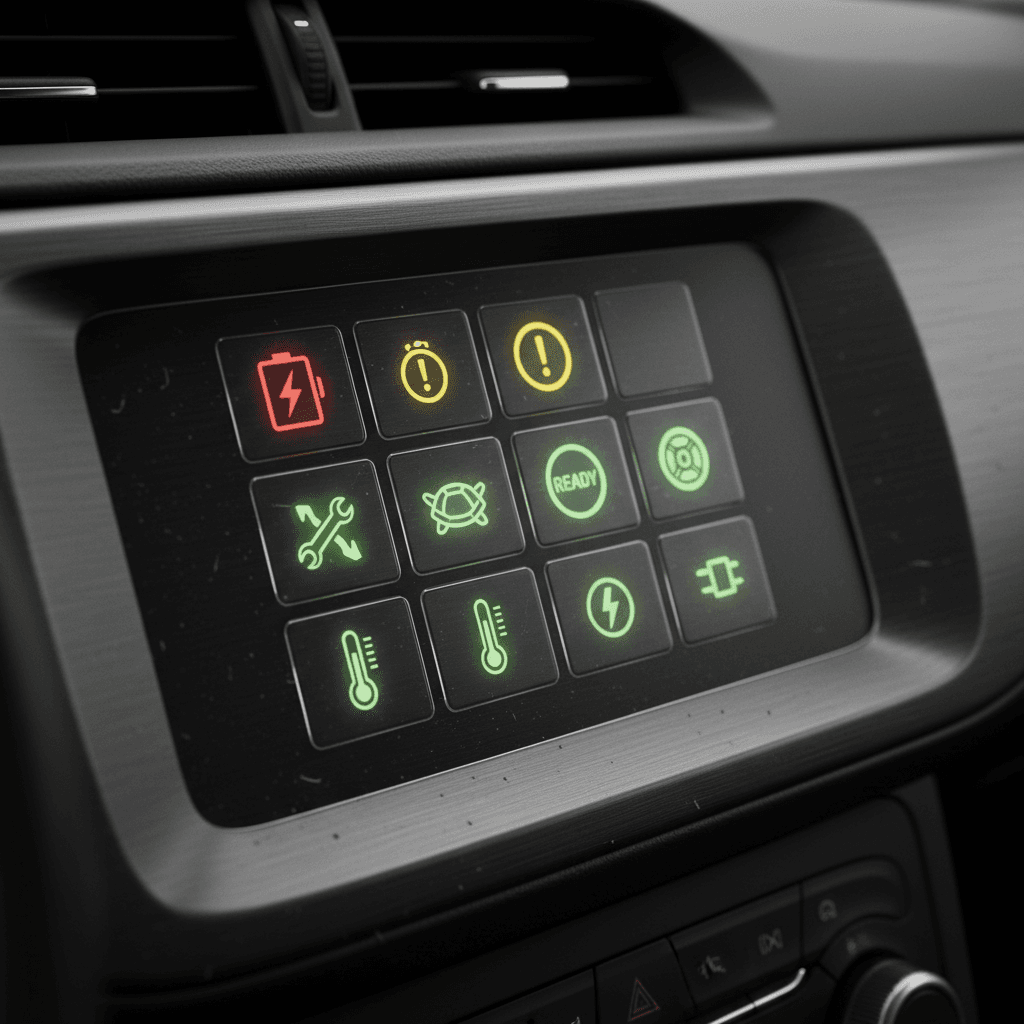
Image dashboard cheat sheet: common EV warning lights
Sometimes a picture really is worth a page of explanations. Use this visual grid as a mental model: your exact icons will vary by brand, but the shapes and colors follow similar rules.
FAQ: electric car warning lights meaning
Frequently asked questions about EV warning lights
Key takeaways for stress‑free EV warning lights
Living with an EV doesn’t have to mean living in fear of mystery icons. Once you understand that color shows urgency, the symbol shows the system, and your car will usually give you plain‑language messages alongside the warning light, the dashboard becomes a helpful conversation rather than a source of anxiety.
If you’re shopping for a used electric car, pay close attention to what the dashboard is telling you during startup and on the test drive. Unresolved warning lights can be expensive, but they’re also opportunities to ask smart questions, or to walk away. At Recharged, every EV we list includes a detailed Recharged Score with verified battery health and fault‑code scans, so you know exactly what those warning lights do and don’t mean before you buy.