You’ve heard it a hundred times: “Electric cars are cheaper to run than gas.” Then you see headlines about rising electricity rates and falling gas prices. So in 2025, what’s the real story with electric car vs gas cost, and how much could you actually save, especially if you’re looking at a used EV?
2025 snapshot
Why electric vs gas costs feel confusing
Car companies, utilities, and politicians all have a dog in this fight, so you see a lot of selective math. One side uses 2022 gas prices; the other uses 2010 electricity rates. Meanwhile, your reality is today’s commute, your utility bill, and the car payment that hits your checking account every month.
1. Prices move in opposite directions
Gasoline has actually gotten cheaper since the 2022 spike, with 2024–2025 averages hovering near $3.10 a gallon. Electricity, on the other hand, has crept up, with U.S. residential rates around 17¢/kWh in 2025.
2. EV savings depend heavily on how you charge
Charging mostly at home on off‑peak rates is a different universe from fast‑charging on the road. The same EV can cost 4¢ per mile in one scenario and over 15¢ per mile in another.
How to think about it
How much does it cost to fuel an EV vs gas car?
Start with the biggest line item: the energy itself. For gas, that’s simple, dollars per gallon. For EVs, you multiply electricity price by how many kWh the car uses to go a certain distance.
2025 U.S. energy price context
Fuel cost per mile: typical EV vs gas car (2025 averages)
Using recent U.S. averages: $3.10/gal for gas and 17¢/kWh for home electricity.
| Scenario | Assumptions | Cost per mile |
|---|---|---|
| Gas car, typical | 25 MPG, $3.10/gal | $0.12/mi |
| Efficient gas hybrid | 50 MPG, $3.10/gal | $0.06/mi |
| EV, home charging | 0.30 kWh/mi, $0.17/kWh | $0.051/mi |
| EV, cheap off‑peak plan | 0.30 kWh/mi, $0.10/kWh | $0.030/mi |
| EV, mostly DC fast charging | 0.30 kWh/mi, $0.35/kWh effective | $0.105/mi |
Your local prices will nudge these numbers up or down, but the relationship usually holds.
Watch that fast‑charging habit

Real-world cost-per-mile examples
Let’s plug in some realistic numbers. We’ll assume 12,000 miles per year, close to the U.S. average. If you drive more, EV economics get even better, because you’re multiplying a lower per‑mile cost by more miles.
Three everyday commuters
Same 12,000 miles a year, very different fuel bills.
Gas compact sedan
25 MPG on $3.10/gal gas:
- Fuel per mile: about 12.4¢
- Annual fuel: ≈ $1,490
Hybrid sedan
50 MPG on $3.10/gal gas:
- Fuel per mile: about 6.2¢
- Annual fuel: ≈ $745
Used EV hatchback
0.28 kWh/mi at $0.17/kWh:
- Energy per mile: about 4.8¢
- Annual “fuel”: ≈ $575
The simple takeaway
Maintenance costs: electric vs gas
Fuel is only half the story. Gas cars hide an entire orchestra pit of moving parts under the hood, valves, belts, pistons, exhaust systems, that EVs simply don’t have. Fewer parts, fewer things banging together, fewer things to service.
Where EVs save you money on upkeep
No oil changes
A modern gas car might see 2–3 oil changes a year at $60–$100 a pop. Over 5 years, that’s easily $800–$1,000 you never spend with an EV.
Fewer brake jobs
Regenerative braking does a lot of the slowing in an EV, so pads and rotors last longer. Many EV owners don’t see a major brake job until well past 60,000 miles.
No exhaust or emissions system
There’s no muffler, catalytic converter, or emissions equipment to fail, and those are some of the most expensive repairs on older gas cars.
Simpler driveline
Most EVs have a single‑speed gearbox. There’s no multi‑gear automatic transmission to flush, service, or replace at eye‑watering prices.
Typical maintenance cost gap
Purchase price, incentives, and financing
For new cars, EVs still tend to cost more up front than comparable gas models, although that gap has narrowed dramatically. In 2025, a compact electric crossover might still run $3,000–$8,000 more than its gas twin before incentives, depending on brand and battery size.
New EVs
- Federal tax credit of up to $7,500 still applies to many models, subject to income and battery sourcing rules.
- Some states and utilities add their own rebates or discounted charging plans.
- Net price can end up similar to or even lower than a gas equivalent once incentives are baked in.
Used EVs
- Federal used EV credit of up to $4,000 (with price and income caps) can make a 3–6‑year‑old EV surprisingly affordable.
- Early depreciation works in your favor, many used EVs sell well below original MSRP.
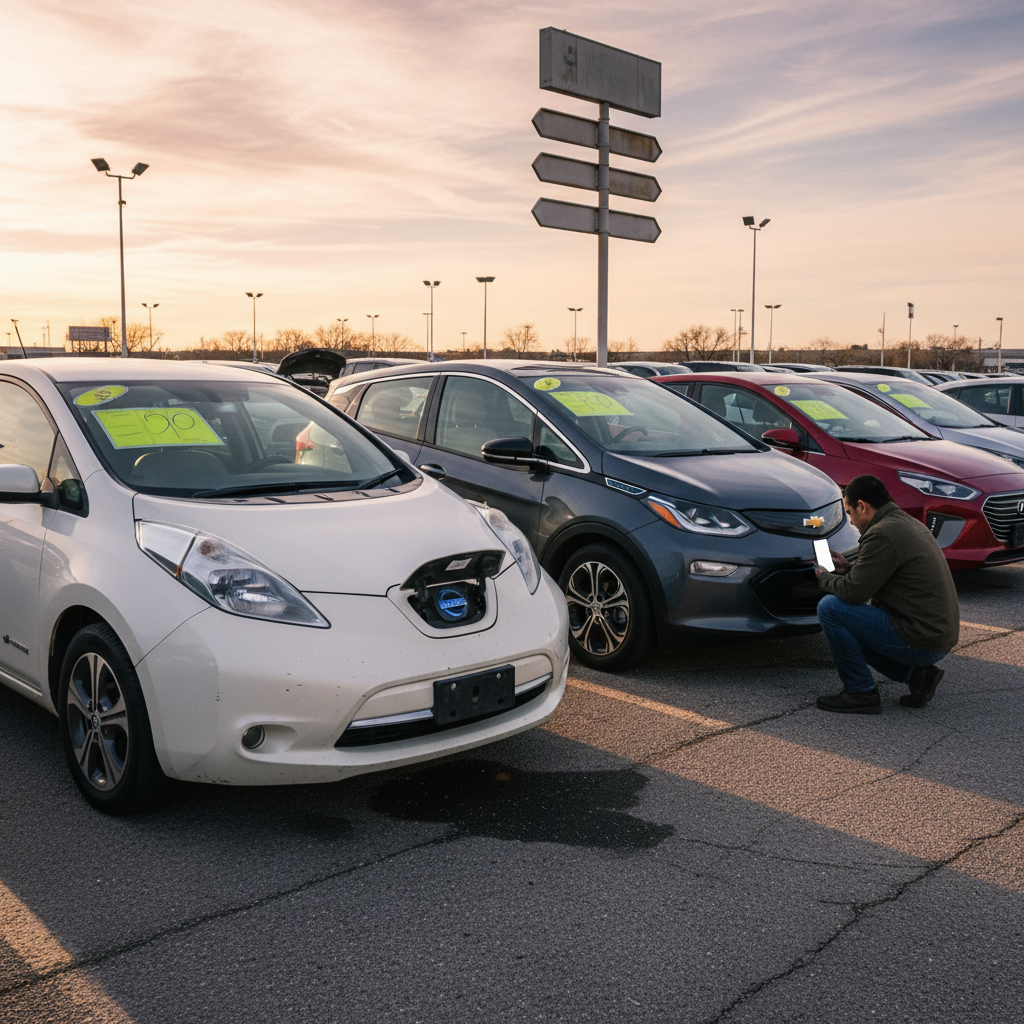
- This is where marketplaces like Recharged shine: you can see battery health and fair‑market pricing up front.
Let the monthly payment tell the truth
Battery health, resale value, and used EVs
The spooky question everyone asks about used EVs: “What happens when the battery dies?” In practice, modern EV packs are lasting longer than early internet fears suggested, but degradation is real and it matters for cost.
How battery health shapes your costs
Range, value, and peace of mind all ride on the pack.
Range and daily usability
Most used EVs lose 10–20% of their original range after 5–8 years, depending on climate and fast‑charging habits. For a 250‑mile car, that still leaves 200+ miles, plenty for commuting.
Resale and trade‑in value
Battery health is the make‑or‑break factor in what your used EV is worth. A pack that still holds 90%+ of its original capacity can keep resale values strong; a weak pack drags them down.
Where Recharged fits in
Total cost of ownership: 5-year scenarios
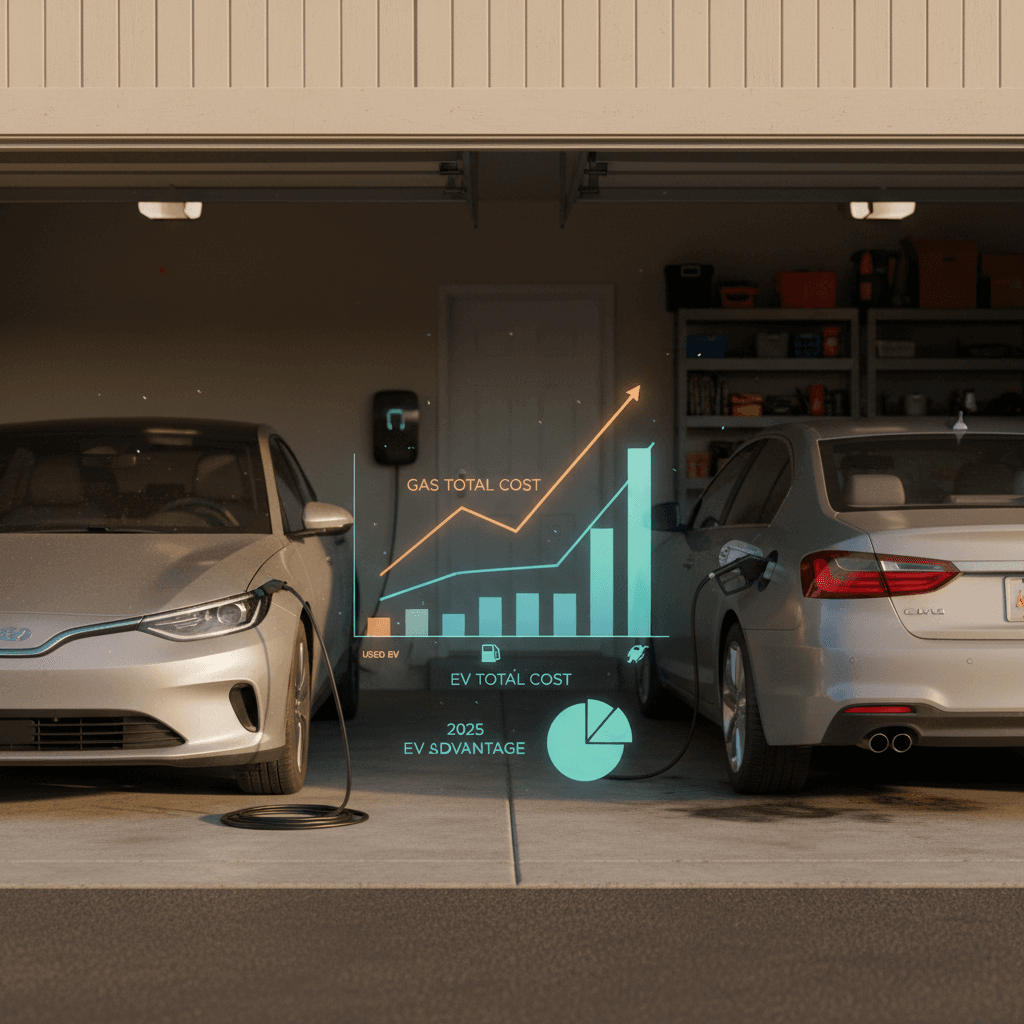
Let’s put all of this together. These aren’t hard predictions; they’re ballpark scenarios using today’s prices and realistic assumptions. The idea is to show how fuel, maintenance, and purchase price interact over a typical 5‑year ownership window.
Sample 5‑year cost of ownership comparison
Assumes 12,000 miles/year (60,000 total), $3.10/gal gas, 17¢/kWh home electricity, and typical maintenance patterns. Purchase prices are illustrative, not quotes.
| Item | Gas compact sedan | Hybrid sedan | Used EV (3‑year‑old) |
|---|---|---|---|
| Purchase price (before tax/fees) | $26,000 | $30,000 | $24,000 |
| Fuel/energy over 5 years | ≈ $7,450 | ≈ $3,725 | ≈ $2,875 |
| Routine maintenance over 5 years | ≈ $3,000 | ≈ $2,500 | ≈ $1,200 |
| Total running costs (fuel + maint.) | ≈ $10,450 | ≈ $6,225 | ≈ $4,075 |
| 5‑year total (purchase + running) | ≈ $36,450 | ≈ $36,225 | ≈ $28,075 |
Actual numbers will vary by model and financing, but the relationships are what matter.
Why used EVs are the current sweet spot
How to calculate your own EV vs gas cost
Your commute, your state’s utility rates, and your driving style will bend these numbers. The good news: you can build a personalized comparison in 10 minutes with a notepad or spreadsheet.
5‑step DIY EV vs gas cost calculator
1. Gather your energy prices
Grab your latest utility bill to find your <strong>price per kWh</strong>, and check a trusted source or your last receipt for your local <strong>gas price per gallon</strong>.
2. Estimate miles per year
Use past odometer readings or app data, or just start with 12,000 miles as a working assumption if you’re not sure.
3. Plug in efficiency numbers
Find the <strong>MPG</strong> rating for your gas candidate and the <strong>kWh/100 miles</strong> rating for your EV candidate (or kWh per mile). These are usually on the window sticker or manufacturer website.
4. Compute cost per mile
For gas: divide gas price by MPG. For EV: multiply kWh per mile by your electricity price. Then multiply each by your annual miles to see your yearly fuel/energy cost.
5. Add maintenance and payments
Estimate annual maintenance (higher for gas, lower for EV) and your actual loan or lease payment. Now you have a clear, apples‑to‑apples picture over 3–5 years.
When a gas car can still make more sense
EVs don’t win every matchup. There are still use cases in 2025 where a gas car, or at least a hybrid, can be the more rational choice.
Situations where gas or hybrid might be better
No ideology, just use‑case reality.
Remote or rural living
If public charging is sparse and home charging isn’t realistic (no reliable power, landlord issues), a gas or hybrid may be less stressful day‑to‑day.
Constant road‑trip duty
If you’re regularly doing 400–600‑mile days in areas with patchy charging, the time and planning overhead of an EV might outweigh its lower per‑mile cost, at least for now.
Ultra‑low mileage drivers
If you only drive a few thousand miles per year, the fuel savings of an EV may not offset a higher purchase price. In that case, a cheap, reliable used gas car can still be the budget king.
But beware the "cheap" old gas car
FAQ: electric car vs gas cost
Frequently asked questions about EV vs gas costs
Bottom line: electric vs gas in 2025
If you strip away the hype and just follow the money, the pattern in 2025 is clear: for most drivers with access to home charging, a reasonably efficient EV is cheaper to run and own than a comparable gas car, often by thousands of dollars over a 5‑year span. A well‑chosen used EV can be cheaper still.
Where EVs don’t yet dominate, rural charging deserts, constant long‑haul driving, ultra‑low annual mileage, hybrids and even traditional gas cars can still make rational sense. The trick is to match the powertrain to your life, not to the loudest headline.
If you’re EV‑curious but nervous about batteries and real‑world costs, start by browsing used EVs with transparent battery health data. That’s exactly what Recharged was built for: a simple, digital way to compare vehicles, understand the true cost of ownership, and get support from EV specialists from the first search all the way to delivery.